 Georgia
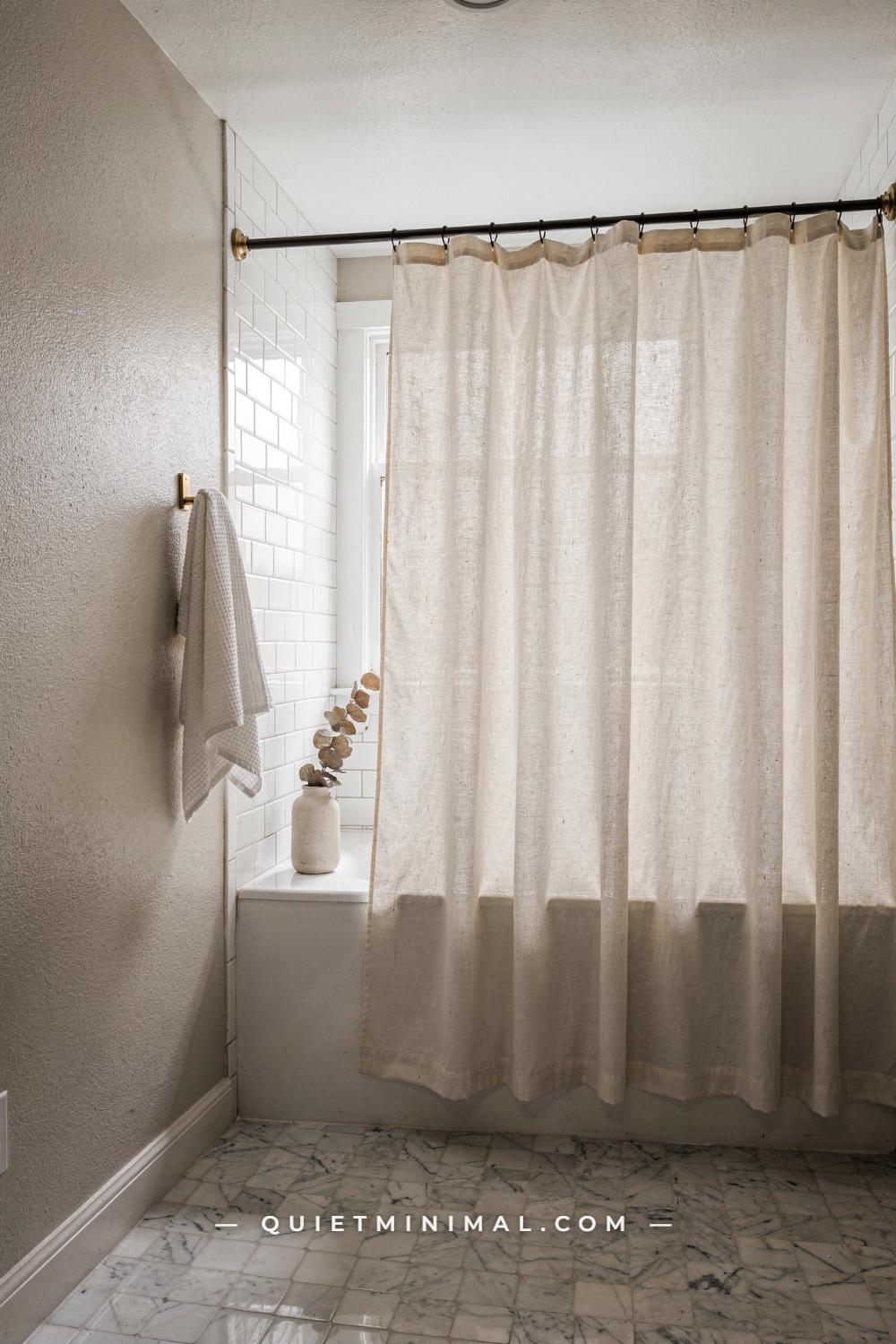
There is a specific reason the bathrooms you have been saving look taller than yours, and it usually is not the tile. It is that the shower curtain starts at the ceiling instead of at 78 inches (198 cm), which is where a tension rod lands by default. Your eye follows an uninterrupted vertical line all the way up, finds no horizontal break, and reads the wall as taller than it is. It is the same trick that makes floor-to-ceiling drapery work in a living room, applied to the one room where nobody thinks to try it.
The move itself is cheap. A length of aluminum curtain track, a handful of screws, and an extra-long liner will do it for less than the cost of a new bath mat set. What is not cheap is getting it wrong, because a bathroom ceiling is drywall over joists that run in one direction only, a 72 inch (183 cm) curtain is two feet short of the job, and a curtain that hangs to the floor outside a tub sends water somewhere you do not want it. What follows works through the decisions in the order you will meet them: the drop from your ceiling to the tub rim, which curtain lengths actually exist, track versus rod, what is above the drywall, how the liner and the curtain divide the work, and the two things this looks makes worse rather than better.
What Actually Changes When the Curtain Starts at the Ceiling
 Save
A standard tension rod sits at about 78 inches (198 cm), because that is where a 72 inch (183 cm) curtain has to hang for its hem to clear a tub rim. In an 8 foot (244 cm) room that leaves 18 inches (46 cm) of bare wall above the rod, and your eye stops there. The horizontal line of the rod becomes the top of the room, visually, and a bathroom that is genuinely 96 inches (244 cm) tall reads as roughly 78.
Move the same curtain to the ceiling and two things happen at once. The vertical folds run the full 96 inches, so the eye travels the whole height before it finds anything to stop on. And the rod, which was a hard dark horizontal bar across the middle of the room, disappears entirely into the ceiling plane. Those two changes together are worth far more than the tile choice or the paint color in a room this small, and they cost about fifty dollars.
There is a second, quieter benefit that matters in tight bathrooms. A ceiling curtain covers a taller opening, which means it can be pulled clear of the tub and stacked against the wall as a soft column rather than bunched around a rod at head height. That is why hotel bathrooms feel less cramped than their square footage suggests, and it is why the technique migrated out of hotels in the first place.
From the guides
You've saved it, wanted it. Here's the how: codes, measurements, order. Your choices make it yours.
 The Japandi Honest PlaybookThe honest version of the style: what to keep, what to skip, and the order to do it in.See inside →
 The Room Refresh PlaybookA repeatable four-step method, room by room, in ten minutes, thirty minutes, or one weekend.See inside →
 Make Any Room Feel Cozy on PurposeWhy some rooms hold people and others empty out, and the moves that change it.See inside →
Be clear about what it does not do. It does not make a small bathroom feel bigger in plan; the floor is still the floor. It does not fix a dark room, and as the later sections cover, it can make a dark room slightly darker. And it does nothing at all if the curtain is the wrong width, because a narrow panel hung high just reads as a tall thin flag. The effect depends on the curtain reading as a full wall of fabric, and that is a width decision more than a height one.
Key Takeaway: Hanging the curtain at the ceiling removes the horizontal rod line and runs the fabric the full wall height, which is what makes a standard 8 foot (244 cm) bathroom read taller than it measures.

Measure the Drop Before You Shop for Anything
 Save
Every failed version of this project fails at the same point, which is that somebody bought the track first and the curtain second. The order is the other way around, because track can be cut to any length in ten minutes and curtains come in three lengths and nothing else.
Take three measurements with a tape held plumb against the wall. First, ceiling to floor, at the wall the curtain will hang on. Second, ceiling to the top of the tub rim, or ceiling to the shower curb if it is a walk-in. Third, the width of the opening the curtain has to cover, wall to wall.
Then do the arithmetic. Your track and rings will eat some height. A ceiling track with rollers plus a hook typically drops the top of the curtain about 1.5 to 2.5 inches (4 to 6 cm) below the ceiling; a ceiling-mounted rod on flanges usually drops it 4 to 8 inches (10 to 20 cm), because the flange has to stand off the ceiling far enough for a ring to pass. Subtract that. At the bottom, a curtain hanging outside a tub wants its hem to finish 1 to 2 inches (2.5 to 5 cm) above the tub rim so it never wicks water down the outside of the tub, while a curtain hanging in front of an open shower or in a wet room wants to finish about 1 inch (2.5 cm) off the floor.
For a typical 96 inch (244 cm) ceiling over a standard tub whose rim sits at about 20 inches (51 cm), the outer curtain drop comes out around 74 to 76 inches (188 to 193 cm) on track, which is awkward: too long for a 72 inch curtain and shorter than an 84 inch one. That gap is the whole reason this project has a reputation for being fiddly, and the next section is about how to close it.
Write all three numbers down and take a photograph of the tape in place. You will need them again when you are standing in a store deciding between an 84 and a 96, and memory is not reliable at that moment.
Key Takeaway: Measure ceiling to floor, ceiling to tub rim, and opening width first, then subtract 1.5 to 2.5 inches (4 to 6 cm) for track and hooks or 4 to 8 inches (10 to 20 cm) for a rod on flanges.

The Curtain Lengths That Actually Exist
 Save
Shower curtains are sold in a very short list of sizes, and knowing it saves an afternoon. The default is 72 by 72 inches (183 by 183 cm), which is the size almost every decorative curtain on a shelf will be. Extra long runs 72 by 84 inches (183 by 213 cm). Extra extra long runs 72 by 96 inches (183 by 244 cm), and that is where the standard range stops. Liners follow the same ladder, with 96 inch options widely available, including PEVA liners sold with weighted stones and rustproof grommets. Beyond that you are into made-to-order, where vinyl liners are cut to any length up to 96 inches in widths of 50, 72, 84 and 100 inches (127, 183, 213 and 254 cm).
Match the length to your ceiling, not to your tub. From a standard 96 inch (244 cm) ceiling, an 84 inch (213 cm) curtain on track lands roughly 10 to 12 inches (25 to 30 cm) above the floor, which is right over a tub rim and slightly short in a walk-in. A 96 inch (244 cm) curtain from the same ceiling essentially reaches the floor, which is what you want in a wet room or in front of a curbless shower, and what you do not want draped over the outside of a tub. From a 9 foot (274 cm) ceiling, 96 inches is the correct choice over a tub. From a 10 foot (305 cm) ceiling you are looking at roughly 118 inches (300 cm) of drop and there is no stock answer; that is custom or hemmed.
Two workarounds cover the awkward middle. Hemming is the cleanest: an extra-long curtain shortened to your exact drop looks intentional and costs very little at an alterations shop, and a plain cotton or linen panel takes a hem beautifully. Or hang the curtain on longer hooks or a slightly dropped rod so the top sits lower, which trades a little of the ceiling effect for a length you can buy off a shelf.
One caution on width. Do not solve a height problem by buying a wider curtain and turning it sideways unless it is a plain unhemmed weave, because most curtains have a finished top and bottom that will not look right on the vertical edges.
Key Takeaway: Stock lengths are 72, 84, and 96 inches (183, 213, and 244 cm) only, so pick to your ceiling height and plan to hem the difference rather than hoping for an in-between size.

Track or Rod: Two Different Projects
 Save
There are two ways to get a curtain onto a bathroom ceiling and they suit different rooms.
Curtain track is an aluminum channel screwed flat to the ceiling with small rollers or gliders running inside it. Designers who use this approach commonly reach for IKEA’s VIDGA single track, an aluminum rail with plastic rollers, noting that a standard 60 inch (152 cm) tub needs two units joined, or for a heavier-duty 6 foot (183 cm) aluminum track. Track cuts to length with a miter saw or a hacksaw, mounts with supports roughly every 12 to 18 inches (30 to 46 cm), and sits so tight to the ceiling that it more or less disappears. That last point is the reason to choose it: the curtain looks like it emerges from the plaster. Track also glides silently, which anyone who has heard metal rings scrape a steel rod at six in the morning will value.
A ceiling-mounted rod is the other route, and it is the better one where the run is not straight or where you want the rod to be visible hardware. Prefabricated ceiling-mount rods exist in shapes track cannot easily do: D-shaped rods that bow out over a tub for elbow room, L-shaped corner rods at sizes like 48 by 48 inches (122 by 122 cm) for a corner shower, and oval rods with three ceiling supports and matching flanges for a freestanding clawfoot tub. Rods are also more forgiving of an uneven ceiling, since the flange takes up a little slop that a rigid track will telegraph.
The practical trade is appearance versus flexibility. Track is nearly invisible and only goes where you can screw a straight channel. A rod is a visible object, drops the curtain 4 to 8 inches (10 to 20 cm) below the ceiling, and handles curves and corners. In a small straight alcove, track wins. Over a freestanding tub or a corner shower, a rod is the only sensible answer.
Key Takeaway: Choose flat aluminum track for a straight alcove where you want the hardware to vanish, and a ceiling-mounted rod for curves, corners, and freestanding tubs.

What Is Above the Drywall Decides the Hardware
 Save
This is the section that decides whether the installation lasts ten years or comes down in a month, and it takes fifteen minutes with a stud finder.
A bathroom ceiling is drywall fixed to joists that run in one direction, typically 16 inches (41 cm) on center, sometimes 24 inches (61 cm) in newer construction. Run a stud finder across the ceiling above your tub and mark every joist you find with a pencil. Then note which way they run. If the joists run perpendicular to your track line, you will cross several of them and you can put a screw into solid wood at every crossing, which is the ideal case. If they run parallel to your track line, you may find yourself with one joist near the track or none at all, and that is the case that needs work.
The reason it matters is the direction of the load. A screw into a wall carries a curtain in shear, which is the strong direction. A screw into a ceiling carries it in straight pull-out, which is the weak one. Toggle bolts advertise ratings well over 100 lbs, but those are wall numbers; an experienced carpenter’s working limit for a toggle in a drywall ceiling is closer to 10 lbs. A soaked cotton curtain plus a liner plus the weight of somebody grabbing it on the way out of the tub goes past that easily.
There are two good fixes. If you can get into the attic or the ceiling above, install blocking: a length of 2 by 4 screwed between two joists directly over your track line gives you continuous solid wood to hit anywhere along it. If you cannot, mount a ledger instead. A 1 by 3 or 1 by 4 painted the ceiling color, screwed up into every joist it crosses, then used as the mounting surface for the track, spreads the load into framing and reads as a slim architectural detail rather than a compromise. In a tiled or plastered ceiling, add the finish thickness to your screw length so you still get a full 1.5 inches (4 cm) of bite into wood.
Key Takeaway: Find the joists and their direction before buying anything, screw into wood wherever possible, and add 2 by 4 blocking or a painted ledger board rather than trusting toggle bolts in a ceiling.

The Liner Does the Waterproofing, the Curtain Does the Looking
 Save
The single most common mistake in a ceiling installation is treating the curtain as one thing. It is two things doing two jobs, and once you separate them the project gets easier.
The liner is the waterproof layer and it belongs inside the tub, hem down against the tub wall, every time. It should be the same length as the outer curtain or an inch shorter so it never peeks. A PEVA or vinyl liner with a weighted hem or magnets is worth seeking out, because at 96 inches (244 cm) of length there is a lot of surface for a draft from the door to billow, and that is what gets water on the floor. Some liners ship with weighted stones sewn into the hem for exactly this reason.
The outer curtain is the decorative layer and it hangs outside the tub. This is where cotton, linen, waffle weave, or a heavier woven fabric belongs, and where a ceiling drop pays off visually, because a natural fiber falls in deeper folds than vinyl and reads as drapery rather than as bathroom equipment. It never needs to be waterproof, which opens the whole category up.
The best hardware answer for the two layers is a double track or double rod. A double aluminum track carries the liner on the inner channel and the curtain on the outer one, so each can be pulled independently, the liner can be left open to dry while the curtain stays closed for privacy, and neither drags on the other. It costs a little more and it is the version that behaves properly six months in.
If you are running a single track, use rings or hooks that carry both layers on one hook, with the liner on the inside of the hook. It works. It just means the two layers always move together, and the liner cannot be spread out to dry independently, which is the thing the next two sections care about.
Key Takeaway: Hang a weighted liner inside the tub and a natural-fiber curtain outside it, and use a double track or double rod so the liner can be spread to dry while the curtain stays closed.
Width and Fullness: Why a Tall Curtain Can Still Look Thin
 Save
Height alone does not produce the look in the photographs. Fullness does, and it is the variable people skip because it costs more.
A standard 72 inch (183 cm) wide curtain across a standard 60 inch (152 cm) tub gives a fullness ratio of about 1.2 to 1. That is barely more fabric than opening, so the curtain hangs nearly flat, and a flat panel at ceiling height reads like a sheet of drywall with a pattern on it. Drapery convention for a curtain that hangs in folds is 1.5 to 2 times the width of the opening, and the difference is immediately visible. Across a 60 inch tub, 1.5 times means about 90 inches (229 cm) of fabric and 2 times means about 120 inches (305 cm).
There are three ways to get there. Buy one wide panel, which exists but is a limited selection. Hang two standard 72 inch panels and let them meet in the middle, which gives you 144 inches (366 cm) of fabric across a 60 inch opening, a center break you can part like drapery, and a genuinely luxurious amount of fold. Or use a plain fabric shower curtain in a 100 inch (254 cm) width, which is one of the custom liner widths and is increasingly available in decorative fabrics too.
The two-panel version is the one worth arguing for. It looks deliberately designed rather than adapted, it lets you open the curtain from the middle so both ends stack against the walls out of the way, and it means each panel is light enough to slide easily on track. Behind them, a single full-width liner does the waterproofing, so you are not doubling the vinyl.
One geometry note: more fabric means more stack when the curtain is open. Two panels stacked at either end of a 60 inch tub will occupy roughly 6 to 8 inches (15 to 20 cm) of the opening each. Extend the track 3 to 4 inches (8 to 10 cm) past the tub at both ends where the ceiling allows, and the stack sits off the opening instead of in it.
Key Takeaway: Plan 1.5 to 2 times the opening width in fabric, which usually means two panels meeting in the middle over one full-width liner, and run the track a few inches past the tub so the stack clears the opening.

The Hem Height That Keeps Water Where It Belongs
 Save
The hem is where a ceiling curtain either behaves or floods the floor, and the correct height is different for the two layers and different again for a tub than for a walk-in.
Over a tub, the outer curtain hem should finish 1 to 2 inches (2.5 to 5 cm) above the tub rim. Not level with it and not below it. A curtain that touches or overlaps the outside of the tub wicks water down the tub’s exterior by capillary action every single shower, and the puddle that appears on the floor is not splash, it is the curtain slowly doing its job in the wrong direction. The liner, meanwhile, goes inside the tub and its hem should sit against the tub wall a few inches above the base so water running down it lands in the tub.
In front of a curbless or walk-in shower, the outer curtain finishes about 1 inch (2.5 cm) off the floor, which is the same rule good drapery follows, and the liner sits inside the wet zone. In a full wet room, a floor-length curtain is fine and a weighted hem is essential, because there is no rim to contain a billow.
From the guides
You've saved it, wanted it. Here's the how: codes, measurements, order. Your choices make it yours.
The Japandi Honest PlaybookThe honest version of the style: what to keep, what to skip, and the order to do it in.See inside →The Room Refresh PlaybookA repeatable four-step method, room by room, in ten minutes, thirty minutes, or one weekend.See inside →Make Any Room Feel Cozy on PurposeWhy some rooms hold people and others empty out, and the moves that change it.See inside →The practical way to get an exact hem without a sewing machine is iron-on hem tape, which is genuinely durable on cotton and linen if the fabric is washed and pressed first. Hang the curtain, mark the fold line with pins while it is hanging, take it down, press and tape. Doing it on the rod rather than on a table is what keeps the line straight, because fabric hangs differently under its own weight than it lies flat.
One thing to check before you cut anything: whether the curtain is going to shrink. Cotton and linen shower curtains commonly lose 2 to 4 percent in the first hot wash, which across 84 inches (213 cm) is 2 to 3 inches (5 to 8 cm). Wash and dry it once, then hem.
Key Takeaway: Finish the outer hem 1 to 2 inches (2.5 to 5 cm) above the tub rim so it never wicks water down the outside, and wash the curtain once before hemming so shrinkage happens first.

The Daylight a Full Wall of Fabric Costs You
 Save
This is the honest cost of the look, and the people who have installed it are the ones who report it. A curtain that runs from ceiling to tub is a solid wall of fabric where there used to be an 18 inch (46 cm) gap of open air at the top, and when it is drawn, whatever daylight used to spill over that gap into the tub no longer does. In a windowless bathroom with a single central ceiling light, it can leave you showering in your own shadow.
There are three fixes, in ascending order of effort. The cheapest is to choose the fabric with light transmission in mind: a clear or frosted liner rather than an opaque one, and a light-colored loose weave for the outer curtain rather than a heavy blackout-weight cloth. The difference between a clear liner and a white opaque one inside a shower is genuinely large.
The second is to put light inside the enclosure. An exhaust fan with an integrated LED, mounted over the tub, is the standard solution and the one designers reach for after living with the change; it solves ventilation and lighting in one fixture and one hole in the ceiling. A damp-rated recessed can over the shower does the same job if the fan is elsewhere. Both need to be rated for wet or damp locations, which is a label on the box, not a judgment call.
The third is to stop treating the curtain as something that stays closed. A ceiling curtain is easier to leave fully open than a rod curtain, because it stacks into a tall narrow column against the wall rather than bunching at head height. Left open, it costs you nothing in daylight at all and it dries faster, which is the subject of the next section.
Key Takeaway: Expect a drawn floor-to-ceiling curtain to cut daylight in the tub, and solve it with a clear liner, a light loose-weave outer panel, and a damp-rated light or a fan with an integrated LED over the enclosure.

Airflow, Drying, and the Mildew Question
 Save
The gap above a standard rod was doing something besides looking unfinished. It was letting warm wet air out of the enclosure. Close it and the air above the tub moves more slowly, which means the enclosure stays humid longer and the liner takes longer to dry. That is the mechanism behind the mildew concern people raise about this look, and it is real but entirely manageable.
Three habits handle it, and none of them are new. Leave the curtain fully open between showers rather than pulling it across to dry, which is the opposite of the advice you get for a rod curtain and is correct here because a ceiling curtain stacks tightly and the enclosure needs the airflow more than the fabric needs the spread. Run the exhaust fan for 10 to 15 minutes after the water goes off, which is the interval the people who installed these systems recommend. And crack the bathroom door if the room has no window, because a fan with no makeup air moves much less than its rating.
On the fan itself, size matters and most bathrooms are under-fanned. The common rule of thumb is 1 CFM per square foot of floor area for bathrooms up to 100 square feet, with a practical floor of 50 CFM, and more if the ceiling is above 8 feet (244 cm). If your existing fan is original to the house and rattles, it is almost certainly under-performing its label, and replacing it is a better investment than any anti-mildew spray.
Fabric choice helps too. Linen and cotton in a loose weave dry markedly faster than heavy canvas or anything with a coated backing, and both wash hot without complaint. Choose an outer curtain you are willing to put through a wash every few weeks and the whole issue stays hypothetical.
Key Takeaway: Leave the curtain fully open between showers, run the fan 10 to 15 minutes after the water goes off, and size the fan at roughly 1 CFM per square foot with a 50 CFM minimum.

Corner Showers, Freestanding Tubs, and Wet Rooms
 Save
Straight alcoves are the easy case. Everything else needs a shape, and the shapes are all available off the shelf if you know what to search for.
A corner shower, where two sides are open, wants an L-shaped ceiling-mounted rod. These are sold in fixed sizes, commonly around 48 by 48 inches (122 by 122 cm), with ceiling flanges at the ends and usually a support at the corner. Measure both legs from the wall face, not from the tile edge, and check whether the model is cuttable, because many are and it makes an imperfect fit fine.
A freestanding or clawfoot tub, which sits away from all walls, wants an oval or rectangular surround rod suspended on ceiling supports. Three ceiling supports with matching flanges is the common configuration, and the flanges are the part that has to land on joists or blocking, since the whole assembly is hanging in mid-air with nothing to lean on. This is the one installation in this article where you should not improvise the fixing. If the joists do not line up with the flange positions, put blocking in.
A wet room or curbless shower is where flexible track earns its keep, because track can be bent or joined into a curve that follows the tile edge exactly, and the curtain can run floor to ceiling with nothing to clear. Weighted hems matter more here than anywhere else, and a double track for liner and curtain is close to essential, since there is no tub rim to catch a billow.
For a shower over a tub with a sloping or vaulted ceiling, a straight track will not sit flat. The answer is a wall-mounted rod set as high as the low side allows, or a ceiling ledger scribed to the slope with the track mounted to it, which is a carpentry job rather than an afternoon.
Key Takeaway: Use an L-shaped ceiling rod for a corner shower, an oval rod on three ceiling supports for a freestanding tub, and flexible track for a curbless or wet-room layout, with blocking behind every flange.

Weight, Fabric, and What the Track Can Carry
 Save
Nobody weighs a shower curtain before buying track, and it is the reason some installations sag in the middle within a season.
Run the numbers roughly. A vinyl liner at 72 by 96 inches (183 by 244 cm) is about 1.5 to 2.5 lbs (0.7 to 1.1 kg) dry. A cotton or linen curtain of the same size is 2 to 4 lbs (0.9 to 1.8 kg) dry, and a heavy cotton canvas can reach 5 lbs (2.3 kg). Wet fabric can hold a substantial fraction of its own weight in water. Then add the real load case, which is a person steadying themselves on the curtain while stepping out of a slippery tub, and you are asking the ceiling for a short sharp pull of tens of pounds, not a gentle two.
That is why support spacing matters more than track brand. Fixing a track every 12 to 18 inches (30 to 46 cm) is the spacing installers use, and it is not overkill. On a 60 inch (152 cm) run that is four or five fixings, and every one of them ideally into a joist or blocking. Where two track sections join, put a fixing within a couple of inches of the joint on both sides, because a joint is the weakest point in the channel.
Fabric weight also changes how the curtain moves. Heavy canvas on plastic rollers drags; the same canvas on ball-bearing or nylon gliders slides easily. If you have chosen a heavy natural-fiber curtain, spend the extra on better gliders rather than on a thicker track, because friction is what makes people yank, and yanking is what pulls fixings out.
Finally, resist the temptation to hang anything else from the track. It is a curtain rail, not a towel bar, and a wet bath sheet over the top of it is a load the fixings were never sized for.
Key Takeaway: Fix the track every 12 to 18 inches (30 to 46 cm) into joists or blocking, add a fixing either side of any joint, and match glider quality to fabric weight so the curtain slides instead of dragging.
The Details That Make It Look Built In
 Save
The gap between a ceiling curtain that reads as a design decision and one that reads as a workaround comes down to four small things, and all four are finishing rather than construction.
Paint the hardware into the ceiling. Aluminum track takes a coat of the ceiling paint readily once it is scuffed and primed, and a track painted the exact ceiling color effectively disappears. If you have used a ledger board, paint it the ceiling color too, not the wall color, so it reads as part of the plane rather than as a shelf.
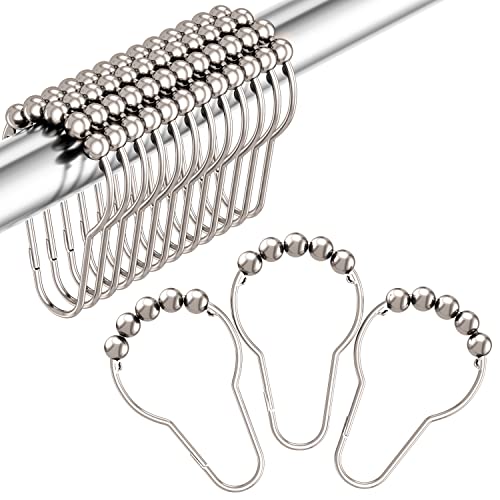
Match the metals to the room rather than to the curtain. Rings and hooks in the same finish as the shower valve, the towel bar, and the faucet make the curtain look specified. Mixed finishes in a small bathroom are the fastest way to make new hardware look temporary. If your fixtures are brushed nickel, buy nickel rings even though white plastic ones cost a third as much.
Run the track wall to wall where you can, not just tub to tub. A track that stops exactly at the tub ends draws attention to the tub. A track that runs the full width of the room, with the curtain stacking beyond the tub at one or both ends, reads as an intentional wall of drapery and gives the stack somewhere to go.
And keep the top of the curtain tight to the ceiling. The whole effect depends on there being no visible gap between the ceiling and the top of the fabric. If your rings drop the curtain more than about 2 inches (5 cm), switch to a track with clip gliders, or use rings with the shortest possible eye. Two inches of daylight above a curtain is the detail that tells the eye it is hung, not built.
Key Takeaway: Paint the track the ceiling color, match rings to the room’s other metals, run the track wall to wall, and keep the gap between ceiling and fabric under about 2 inches (5 cm).

The whole project comes down to three numbers and one check. Measure ceiling to tub rim and subtract for the hardware, so you know whether you are buying an 84 or a 96 and how much you will hem. Plan 1.5 to 2 times the opening in fabric width, because fullness is what sells the height. And find the joists before the drill comes out, because a ceiling carries a curtain in the weak direction and a toggle bolt is not a plan. The trade you are making is a little daylight and a little airflow for a room that reads a foot and a half taller, which in a small bathroom is a very good trade as long as the fan is working and the curtain gets left open between showers. Take the tape measure in there tonight, write the three numbers on your phone, and the shopping becomes a five-minute decision instead of a returns pile.
From the guides
You've saved it, wanted it. Here's the how: codes, measurements, order. Your choices make it yours.
The Japandi Honest PlaybookThe honest version of the style: what to keep, what to skip, and the order to do it in.See inside →The Room Refresh PlaybookA repeatable four-step method, room by room, in ten minutes, thirty minutes, or one weekend.See inside →Make Any Room Feel Cozy on PurposeWhy some rooms hold people and others empty out, and the moves that change it.See inside → Save


