 Georgia
The question underneath every ceiling shower curtain idea is a plain one, and it deserves a plain answer: does moving the rod from its usual spot around 76 in. (193 cm) up to the ceiling actually make a small bathroom feel bigger, or does it just make the curtain longer? The answer is yes, it genuinely works, and it works for one specific reason that has almost nothing to do with the curtain fabric you choose. It also carries real costs, in light at the showerhead, in how steam clears the room, and in the fact that the curtain you already own will not fit.
Both halves of that answer matter before you drill a single hole in a ceiling. What follows takes the whole thing apart: the visual mechanism, the length math, the hardware that holds it up, the fabrics that hold their shape at full height, and the failure modes that turn a good idea into a wet floor. Every section is one facet of the same answer, with the measurements you need to check your own room against.
Yes, It Works, and the Unbroken Vertical Line Is Why
 Save
Your eye measures a room’s height by the tallest uninterrupted line it can find. A shower rod hung at standard height puts a hard horizontal across the wall at roughly 76 in. (193 cm), which splits the wall into a lower band and an upper band. The brain reads the lower band as the room. Everything above the rod becomes leftover space, and a small bathroom with a ceiling at 96 in. (244 cm) suddenly reads as a room that is barely six and a half feet tall.
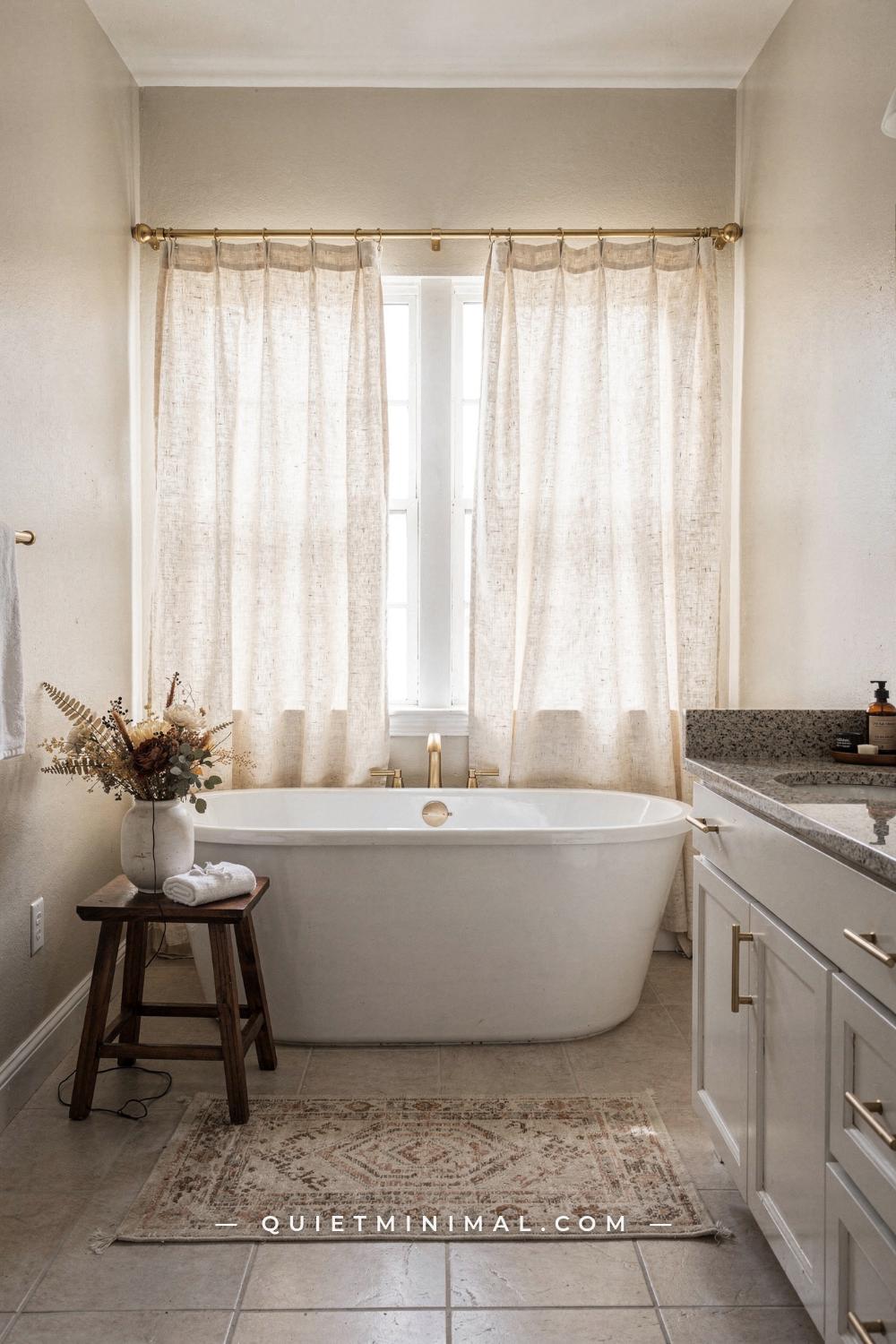
Move the rod to the ceiling and that horizontal disappears. In a bathroom like this one, twin cream linen panels at 60×108 in. (152×274 cm) each drop in one continuous line from the ceiling to just above the tile, and the wall behind them stops being measured at all. Design writers have been calling this out recently as one of the more consequential shifts in bathroom styling, precisely because it costs so little relative to what it changes: it reads as permanence rather than an afterthought, and it softens a room full of hard glazed surfaces.
The fullness is the part most people skip. Two 60 in. (152 cm) panels over a slender brass ceiling-to-wall rod spanning 54 in. (137 cm) puts 120 in. of fabric on 54 in. of rod, a ratio above 2 to 1. That ratio is what makes the folds stack deep enough to throw shadow, which is the difference between drapery and a flat shower curtain hanging in a taller position. At 1.2 to 1, a full-height panel looks like a bedsheet on a wire.
From the guides
You've saved it, wanted it. Here's the how: codes, measurements, order. Your choices make it yours.
 The Japandi Honest PlaybookThe honest version of the style: what to keep, what to skip, and the order to do it in.See inside →
 The Room Refresh PlaybookA repeatable four-step method, room by room, in ten minutes, thirty minutes, or one weekend.See inside →
 Make Any Room Feel Cozy on PurposeWhy some rooms hold people and others empty out, and the moves that change it.See inside →
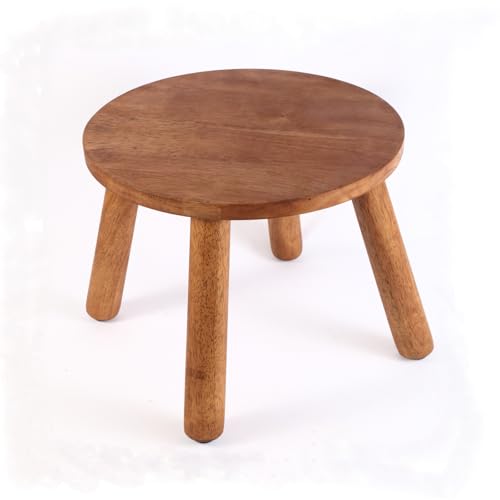
Give the tall line something low to be measured against. A dark walnut three-legged stool at 18 in. (46 cm) high and a soft printed cotton rug at 24×36 in. (61×91 cm) sit near the floor and hold the bottom of the frame, so the vertical has a starting point. The warm cream of the linen against warm white walls keeps the whole thing quiet, and the speckled grey of the granite vanity top gives the palette one cool note so it does not read as a wash of beige.
The failure mode here is simple and common: hanging a standard 72 in. (183 cm) curtain from the ceiling and calling it done. You do not get the tall line. You get a horizontal at the hem instead of at the rod, which is worse, because now the gap is at eye level and there is visible bare wall under the fabric.
Key Takeaway: The height effect comes from one uninterrupted vertical line, so the rod must reach the ceiling and the fabric must reach the floor, with at least two times the rod span in total panel width.

Where the Curtain Gathers Decides How Tall the Wall Reads
 Save
A full-height panel does not have to hang straight. Gathering it to one side with a tieback partway down turns a flat plane into a diagonal, and a diagonal makes fabric look like it has weight. In this bathroom an oatmeal linen panel with a 108 in. (274 cm) drop hangs from a ceiling track and is caught by a small brass tieback rod with ball finials, and the effect is closer to a drawing room window than to a shower.
Height of the holdback is the decision that matters. On a 108 in. (274 cm) drop, mounting the tieback at roughly half the drop, around 54 in. (137 cm) off the floor, produces a curve that starts high and lands low, which keeps the tallest fold intact. Mount it lower, around 36 in. (91 cm), and you pull the fabric into a tight cinch at hip height that reintroduces exactly the horizontal break you just removed by going to the ceiling.
Reach is the second number. This tieback rod projects about 4 in. (10 cm) from the tile, which is deliberately short. In a bathroom this narrow, a 6 in. (15 cm) holdback pushes a bundle of fabric into the walkway and you brush it every time you pass. Short reach keeps the gather flat against the wall and still gives the panel a visible curve.
The mechanical rule underneath all of this: never tie back the layer that keeps water in. A ceiling-hung setup is a two-layer system. The decorative outer panel hangs on the outside of the tub and gets the tieback. A separate waterproof liner hangs inside the tub on its own hooks or its own inner track and stays closed while the water runs. Tying back a single-layer curtain that is also doing liner duty is the surest route to a soaked floor and a warped baseboard.
The room around it supports the read. Bright white stacked subway tile runs the shower wall, and because the tile is stacked rather than offset, its grout lines already run vertically, which reinforces the curtain’s line instead of arguing with it. A gilt-framed landscape print at 16×20 in. (40×50 cm) sits on warm cream plaster at upper right, comfortably outside the spray zone, which is where framed paper belongs in a bathroom unless it is sealed behind glass with a gasket. A white terry robe on a gold double hook keeps the antique brass reading as a family rather than a one-off.
Warm sconce light from the right is doing quiet work too. Side lighting rakes across the folds and makes them legible. Overhead-only light flattens gathered fabric into a smear, which is why a beautifully gathered panel can look inert in a room lit by a single ceiling fixture.
Key Takeaway: Set the holdback near the midpoint of the drop and only ever gather the decorative outer panel, keeping a separate liner closed inside the tub.

When the Ceiling Panel Is a Light Screen and Not a Water Barrier
 Save
Some of the most striking ceiling-hung panels are not curtains in any functional sense. A brass chain-mail mesh panel with an 84 in. (213 cm) drop, suspended full width from a flush ceiling rod on round disc flanges spanning 60 in. (152 cm), does nothing to contain water. It filters light. Woven metal breaks a light source into hundreds of small points, which is why the amber-gold glints scatter across the large-format beige travertine behind it instead of casting one flat shadow.
Decide what job you are asking the panel to do before you buy hardware. If the answer is privacy, division, or light quality, mesh and other rigid or semi-rigid media are legitimate. If the answer is keeping water off the floor, you need a waterproof liner on a second track inside the mesh, and you need to plan the two tracks at the same time. Retrofitting an inner liner track after a heavy decorative panel is already mounted usually means opening the ceiling again.
Weight is the real constraint, and it is where this idea goes wrong. Chain-mail mesh at full width is dramatically heavier than linen. A 60 in. (152 cm) panel of woven metal can run into the tens of pounds, and every bit of that load is carried by two ceiling flanges. Half-inch drywall with plastic anchors will not hold it, and it will not fail immediately, which is the dangerous part. It will sag for a month and then pull through. Flush disc flanges need to land in ceiling framing or in blocking installed between joists. If you cannot find framing where the rod needs to go, add blocking before you close the ceiling, or move the rod.
Material choice matters in a wet room. Specify a non-ferrous alloy or a properly plated finish for anything metal that lives in a shower’s humidity. Untreated steel mesh will bloom rust at the links within a season, and rust stains on travertine are difficult to remove without etching the stone. Hard water is the other maintenance reality: mineral spotting shows on metal weave far more than on textile, so a quick rinse and a dry cloth after showers is the price of the look.
Light the panel from the side. Here a single globe-bulb sconce at the right edge does the work, and it is a better choice than a downlight because a mesh panel lit from directly above just goes dark. The ivory ceiling keeps the top of the room bright so the brass reads warm rather than muddy.
Key Takeaway: Treat a metal mesh panel as a light screen that requires its own waterproof liner behind it, and mount its flanges into framing or blocking, never into drywall alone.

Two Panels or One: What the Parted Formula Buys You
 Save
Twin panels parted symmetrically over a tub is the formula that shows up most often in the ceiling-hung bathrooms people save, and it is worth understanding why it outperforms a single panel pushed aside. A single panel shoved to one end reads as a curtain that was in the way. Two panels of 60×108 in. (152×274 cm) each, held open on a slender brass ceiling-to-wall rod spanning 54 in. (137 cm), read as a framed opening. Same fabric, same rod, completely different message.
The part only works if the gap reveals something. In this bathroom a small gold-framed figurative print at 8×10 in. (20×25 cm) sits centered on the tub surround back wall, and that is the entire reason the composition holds. Your eye travels down the fabric, hits the opening, and finds a destination. Part two panels onto a blank tiled wall and the gap reads as an absence. If you have nothing to reveal, either close the panels or hang something small and water-tolerant on the back wall: a ceramic piece, a simple framed print on the dry end, a narrow shelf.
Run the fullness numbers before ordering. 120 in. of total panel width on a 54 in. (137 cm) rod gives you generous stacking when closed and a deep, sculptural fold on each side when parted. If you buy two 40 in. panels instead, you have 80 in. on a 54 in. rod, which is under 1.5 to 1, and parted panels at that ratio look like two flat rectangles taped to the wall. Fullness is the single most reliable predictor of whether a ceiling-hung curtain photographs well.
The composition here is deliberately off center, weighted toward the right where a granite-topped vanity carries visual mass. That is a useful principle in a small bathroom: perfect bilateral symmetry in a room this size can read stiff, so let one side carry more. A dark walnut three-legged stool at 18 in. (46 cm) high with a white ribbed ceramic vase of dried baby’s breath anchors the left at floor level, and a faded floral cotton rug at 24×36 in. (61×91 cm) bridges the two sides across the tile.
Palette discipline is doing a lot of quiet work. Cream linen, antique brass, warm white walls, speckled granite grey: four notes, no more. Once a curtain runs floor to ceiling it becomes the largest soft surface in the room, so it sets the temperature of everything else. Cream against warm white is a small value step, which is what keeps the wall reading as one continuous plane rather than as fabric stuck onto paint.
The failure mode is parting for the sake of the photograph and then living with panels that are never actually closed, so the liner inside is permanently visible. Choose a liner you are content to see.
Key Takeaway: Part two panels only when the opening reveals something worth seeing, and buy at least twice the rod span in total panel width or the parted look falls flat.
A Contrasting Border Is What Makes a Tall Curtain Read Tailored
 Save
At 96 in. (244 cm) of drop, a plain white panel is a very large blank rectangle. That is the quiet problem with going full height in a minimal palette: you gain the vertical line and lose all the detail. A contrasting border solves it without adding pattern. Here a white linen curtain edged in matte-black trim hangs from a matte-black ceiling-mount rod spanning 60 in. (152 cm), and the trim draws the outline of the panel so the eye can read its shape from the doorway.
Border width is the whole decision. Anything under about 1 in. (2.5 cm) disappears at conversational distance and just looks like a seam. A band of roughly 2 to 3 in. (5 to 8 cm) reads clearly across a small bathroom without becoming the subject. Placement matters as much as width: run the border down the leading edge and along the hem and the panel looks tailored. Run it around all four sides and it starts to look like a picture frame hanging in the shower.
The trim also does structural work in the palette. Matte black appears three times in this room, on the rod, on the border, and on the two black glass pump bottles at roughly 8 in. (20 cm) tall in the inset tile niche. Three placements is usually the threshold at which an accent color stops looking accidental. Below three it reads as one dark object that wandered in.
The slatted dark walnut ceiling panel above the tub is the reason this room feels like a resort rather than a bathroom, and it comes with a maintenance requirement. Wood on a bathroom ceiling directly over a wet zone needs real air movement to survive. The residential ventilation standard most builders design to calls for 50 cfm of local exhaust for a bathroom, with the common sizing shortcut of about 1 cfm per square foot and 50 cfm as the floor. Run the fan through the shower and for a stretch afterward, because slatted wood traps humid air in the gaps between slats where you cannot wipe it.
Two small things ground the scene at the tub. A teak bath tray at about 30 in. (76 cm) wide spans a standard tub deck, which is why teak trays are sold at that length; measure your own tub’s outside width before ordering, because a tray 2 in. short slides in and a tray 2 in. long will not seat. A cylindrical glass candle holder gives the room its warm light from the right, and candlelight is genuinely flattering on white linen because it rakes across the weave.
White geometric hexagon floor tile gives the floor enough small-scale movement to balance the strong ceiling, without introducing another color.
Key Takeaway: Give a full-height plain panel a 2 to 3 in. contrast border on the leading edge and hem, and repeat that accent color at least twice more in the room.

One Panel Swept to the Side, and When That Is the Right Call
 Save
The single gathered panel is not a lesser version of the twin-panel formula. It is the correct answer in two specific situations, and the wrong answer everywhere else. Situation one: the opening is narrow, roughly 48 in. (122 cm) or less, where two panels would each be too skinny to gather well. Situation two: there is something on the shower wall you want to keep visible.
This bathroom is the second case. An exposed brass rain showerhead with a handheld on a slide rail is mounted on vertical white glazed subway tile, and it is the most interesting object in the room. Two panels meeting in the middle would bury it. A single warm taupe linen panel at 54×108 in. (137×274 cm), gathered to one side with a tassel-and-cord tieback and hung from a brass rod at ceiling height, frames the fixture instead of competing with it.
Be honest about the fullness you get. A 54 in. (137 cm) panel across a narrow opening lands somewhere near 1.5 to 1, which is modest. That is exactly why it must be gathered rather than hung flat: gathering concentrates the fabric so the folds stack visibly on one side, and the eye reads richness there rather than thinness across the whole span. A 54 in. panel hung flat across a 48 in. opening looks like a hospital screen.
The tassel-and-cord tieback with roughly a 6 in. (15 cm) cord wrap loop is a period detail, and it needs a wall anchor at the right height. Set the cleat or hook at about half the drop for the same reason as any holdback: keep the diagonal long. Cord tiebacks also collect moisture where they wrap, so choose one you can take down and wash, and give it a shake after showers.
Aged brass in a wet room behaves differently from lacquered brass. Unlacquered or aged finishes will keep patinating, going deeper and more mottled with humidity and hand contact, which is the appeal. Hard water is the complication: mineral deposits dry white on a warm brass surface and are visible. If your water is hard, plan on wiping the exposed shower system after use, or specify a lacquered finish and accept that it will look the same in five years as it does now.
The room reinforces the vertical everywhere. The subway tile is set vertically rather than in a running bond, so the tile itself is running the same direction as the curtain. The blush-tinted wood vanity at about 30 in. (76 cm) wide with brass cup pulls sits low and wide as a counterweight, and the cream and blush painted diamond floor keeps the eye moving underfoot. Painted floor tile is a real option, and a real commitment: it needs a proper floor-rated primer, a hard-wearing enamel, and at least two clear coats, and it will still show wear at the doorway first.
The failure mode is a single 54 in. panel on a full 60 in. (152 cm) tub, where the gathered side leaves an uncovered gap and the liner shows all day.
Key Takeaway: Choose a single swept panel when the opening is under about 48 in. or when a wall fixture deserves to stay visible, and always gather it rather than hanging it flat.

Can You Do This Without Drilling? The Tension Rod Answer
 Save
Renters ask this first, and the honest answer is a qualified yes. A brass tension rod mounted near the ceiling gives you most of the height with no holes at all, but it works under conditions that are worth checking before you order anything. The rod needs two solid, opposing walls to press against, which means it only works across an alcove tub or a three-wall stall. A corner shower with one open side gives a tension rod nothing to push on.
Span is the first limit. A tension rod spanning 60 in. (152 cm) is at the upper end of what most residential rods hold reliably, and the load is not just the rod. A natural linen panel at 54×96 in. (137×244 cm) plus a waterproof liner is heavier than people expect, and wet fabric is heavier still. Tension rods hold by friction alone, so every pound of added weight is working against you. If your span is over 60 in., or if you are hanging a heavy woven fabric, buy a rod rated well above what you think you need or accept that you are drilling.
Surface is the second limit. Tension rods grip best on painted drywall. Glossy tile like this bright white vertical subway is slick, and the rubber end caps will creep down over weeks unless the pressure is high and the caps are clean. Wipe both contact points with rubbing alcohol before setting the rod, let them dry, and check the rod again after a week. If it has moved at all, it will move again.
Height is the third decision, and here you should not go tight to the ceiling. Keep the rod 6 to 10 in. (15 to 25 cm) below the ceiling. That gap is the standard recommendation because it lets hot steam rise past the curtain and reach the fan, and it also gives you room to get a hand around the rod to twist and tension it, which is genuinely impossible when the rod is 1 in. from the ceiling.
The rest of the room here is doing the quiet legwork that makes a renter-friendly setup read as considered rather than temporary. Unbleached natural linen against bright white tile is a small, warm value step. A waffle-weave taupe hand towel at 16×28 in. (41×71 cm) hangs on a brass double hook with about a 5 in. (13 cm) projection, which is deep enough to hold a folded towel without it pressing against the wall and staying damp. Matte brass on the rain showerhead and the tub filler keeps the metal story consistent, which matters more than the finish itself.
Light oak plank flooring is the one thing to watch. Wood floors and shower splash are a slow-motion problem, not a dramatic one: the plank ends nearest the tub cup and darken over a year or two. If your floor is wood, prioritize a liner that reaches inside the tub and a bath mat that actually absorbs, and dry the transition strip.
Key Takeaway: A tension rod can give you near-ceiling height with no holes, but only across two opposing solid walls, at a span of 60 in. or less, hung 6 to 10 in. below the ceiling.

Corner and Walk-In Showers: The L-Rod Geometry
 Save
A corner shower has only two tiled walls, so a straight rod has nowhere to land. The rod itself has to turn the corner, which is what an L-shaped ceiling rod does: two legs meeting at a right angle, suspended from the ceiling at three points, with two cream linen panels framing the open corner. Here the legs run roughly 36×36 in. (91×91 cm), and understanding that geometry is what keeps the installation from sagging.
Support the elbow. Two legs of 36 in. each give you 72 in. of total rod, and the corner joint is the weakest point because that is where the two moment arms meet. Any decent L-rod kit includes a ceiling support at or near the elbow in addition to the two wall ends. If your kit does not, add one. A corner rod supported only at its two ends will visibly droop within a few months, and once matte black powder coat creases at a bend it does not come back.
Run the fullness math and be prepared for the answer. Two panels at 52×96 in. (132×244 cm) each give 104 in. of fabric across 72 in. of rod, which is roughly 1.4 to 1. That is why corner installations so often photograph flatter than tub installations: the geometry eats your fullness. Either buy wider panels, add a third panel on the longer leg, or accept a more tailored, less gathered look and choose a fabric with enough body to fall in soft columns anyway. Linen does this better than polyester, which tends to hang in sharp creases.
The ceiling rain showerhead is what makes a curtain-only corner shower workable at all. A 10 in. (25 cm) head mounted overhead sends water straight down instead of at an angle toward the opening, so far less spray reaches the curtain line. Pair it with a handheld, as here, and use the handheld with the curtains closed. A wall-mounted head aimed across the stall at a curtained corner is asking for water on the floor no matter how long the liner is.
Plants belong in this room and they have requirements. Monstera, fiddle-leaf fig, and snake plant in woven baskets all appreciate the humidity, but only the snake plant is genuinely content in low light. If your bathroom has one window on the right and nothing else, put the snake plant furthest from it and rotate the others. Woven baskets need a waterproof cup inside or they wick and rot at the base.
A round jute bath mat at 30 in. (76 cm) diameter is the right scale for a corner opening, and jute holds water. Hang it or stand it on edge to dry after a shower, or it will smell within a week.
Key Takeaway: Corner installations need a ceiling support at the elbow and wider panels than you would use on a tub, because the L geometry cuts your fullness to roughly 1.4 to 1.

The Install Itself: What Is Actually Above Your Drywall
 Save
This is the section people skip and then regret. A ceiling-mounted rod puts its entire load in shear and tension on two small flanges screwed into a horizontal surface, which is a fundamentally different situation from a wall-mounted rod resting in a cup. Before you buy hardware, find out what is above your ceiling.
Ceiling joists in most homes run 16 in. (41 cm) on center, sometimes 24 in. (61 cm). A matte-black rod spanning 54 in. (137 cm) will almost never land both flanges on a joist, because 54 is not a multiple of 16. You have three options and only three. Find one joist and shift the rod so both ends land on framing, which usually means changing the span. Open the ceiling and add blocking between joists, which is the right answer during a renovation. Or use heavy-duty toggle bolts rated far above the working load, understanding that they rely on the drywall’s paper face and will not tolerate someone grabbing the rod for balance.
Run a stud finder across the ceiling and mark the joists with painter’s tape before you commit to a rod length. It is far easier to buy a 48 in. rod that lands on framing than to fight a 54 in. rod that does not. If you are installing a track rather than a rod, the spacing rule is friendlier: track systems take ceiling supports roughly every 12 to 18 in. (30 to 46 cm), so at least one of those supports will find framing, and the intermediate ones can take anchors.
Then there is the second problem this room solves well. Once the curtain runs to the ceiling, the rest of the wall reads empty, because you have just drawn attention to how tall the room is. A dark walnut floating shelf at 36×8 in. (91×20 cm) on the back wall gives the upper half of the room something to hold. Eight inches of depth is the useful number: deep enough for a small object and a folded towel, shallow enough that it does not crowd a narrow bathroom or block the recessed light.
Style the shelf seasonally and lightly. Small figurines and one brass accent piece is the correct density for a bathroom shelf, because everything on it collects dust film from soap and steam, and a crowded shelf becomes a chore. This is a good place for Holiday styling that changes three or four times a year without committing you to anything.
Do not drill the tub surround. A smooth white acrylic surround is a single molded piece with a hollow cavity behind it, and a screw driven through it creates a permanent water path into the wall. Wall hardware goes into tile or drywall above the surround, never through it. A wicker basket at about 14 in. (35 cm) diameter on the floor handles what the shelf cannot.
Key Takeaway: Locate joists before choosing rod length, since a 54 in. span will not land on 16 in. centers, and never drive a screw into an acrylic tub surround.

The Length Math, and Why a Standard Curtain Fails Up High
 Save
Here is the arithmetic that decides whether your ceiling-hung curtain looks intentional or looks like a mistake. A standard shower curtain is 72×72 in. (183×183 cm). Hang that curtain near a ceiling in a room with 96 in. (244 cm) ceilings and you leave a gap of roughly 2 ft. (61 cm) of bare wall under the hem. That gap is the single most common reason a ceiling-hung curtain looks wrong, and no amount of good fabric fixes it.
Work backward from the ceiling instead. The usual guidance is to set the rod 6 to 10 in. (15 to 25 cm) below the ceiling so steam can rise past it, and to leave 2 to 4 in. (5 to 10 cm) of clearance at the bottom so the hem does not sit in standing water. On a 96 in. ceiling that leaves you needing about 84 in. (213 cm) of curtain: an 8 in. rod drop with 4 in. of floor clearance, or a 10 in. drop with 2 in. of clearance. If the ventilation fan sits directly over the shower, you can pull the rod up to within 1 to 4 in. of the ceiling and go to a 96 in. curtain, because the steam has a shorter path out.
Then measure to the right floor. This shower sits on a pale stone mosaic platform with a raised curb of about 4 in. (10 cm), and the liner has to fall inside that curb, not to the room floor. So the liner is measured from the rod to the shower pan, which is 4 in. shorter than the outer curtain’s measurement to the bathroom floor. Buy them the same length and the liner will pool inside the pan and stay wet.
Extra-long liners are widely stocked and this is where you spend, not on the pretty panel. Both 84 in. and 96 in. (213 and 244 cm) liners are common in clear or white PEVA and in polyester fabric. PEVA is fully waterproof, odorless and mildew-resistant, and it clings to a wet surface, which is why it stays put against a splashy shower. Fabric polyester liners are treated to resist mildew and can go in the washing machine, which is the real advantage over the long run, but they wet through more readily and need a curtain that hangs inside the pan properly.
The failure mode here is buying a 96 in. decorative panel and reusing the 72 in. liner already in the closet. It looks fine from the doorway and floods the floor at the corners, because the water leaves at the bottom where nobody is looking.
From the guides
You've saved it, wanted it. Here's the how: codes, measurements, order. Your choices make it yours.
The Japandi Honest PlaybookThe honest version of the style: what to keep, what to skip, and the order to do it in.See inside →The Room Refresh PlaybookA repeatable four-step method, room by room, in ten minutes, thirty minutes, or one weekend.See inside →Make Any Room Feel Cozy on PurposeWhy some rooms hold people and others empty out, and the moves that change it.See inside →An oil-rubbed bronze L-rod at 48×36 in. (122×91 cm) with a white curtain pushed to one side is exactly the practical, real-home version of this. The bronze gooseneck head, the decorative herringbone tile inset on the back wall, and the white tile all stay legible because the curtain is the right length.
Key Takeaway: On a 96 in. ceiling, drop the rod 8 to 10 in. and buy an 84 in. curtain, then buy a liner measured to the shower pan, which is shorter by the height of the curb.

No Walls at All: The Oval Track Canopy Around a Freestanding Tub
 Save
A freestanding tub in the middle of a large bathroom has no wall to hang anything from, and that is where a ceiling track earns its keep. An oval track in dark bronze at roughly 72×48 in. (183×122 cm), mounted flat to the ceiling and carrying four to six cream muslin panels at 84 in. (213 cm) drop, encircles the tub and makes a soft room within a room. It is a privacy and warmth device before it is anything else.
Size the oval to the tub, not to the room. A 72×48 in. oval around a 60 to 67 in. (152 to 170 cm) tub gives roughly 6 in. (15 cm) of clearance at the ends and a few inches at the sides, which is enough that the fabric does not rest against the rim and wick. Less clearance and the panels touch the tub every time they move. Considerably more and the enclosure stops reading as a canopy and starts reading as a laundry line.
Be clear about what muslin can and cannot do. Loose-weave unbleached muslin is not waterproof and is not meant to be. It softens light, provides visual privacy, and holds a little heat around the tub, and it will let water straight through. If you shower over this tub rather than soaking in it, you need a separate waterproof liner ring inside the muslin, running on a second channel or on the same track with dedicated hooks. Plan that at the outset, because retrofitting an inner ring into an oval track is fiddly work.
The drop is a deliberate choice, not an accident. At 84 in. (213 cm) in a room with tall ceilings and crown molding, the panels stop well above the floor. That reads as a canopy rather than a curtain, and it also keeps loose-weave cotton off a dark-stained wide-plank hardwood floor, which is the genuine risk in a bathroom like this one. Water sitting on a plank seam swells the wood and lifts the finish, and the failure shows up at the seams months later.
The chandelier is a matter for a licensed electrician, not a styling decision. Building codes restrict what kind of fixture may hang in the zone directly above and around a tub, and they set minimum clearances. A crystal-and-iron fixture at about 18 in. (46 cm) diameter over an oval track is beautiful and it needs to be a damp-rated or wet-rated fixture installed at a compliant height. Ask, do not assume, and have it checked if it came with the house.
The rest of the room stays deliberately plain so the canopy carries the drama. White painted walls with crown molding, a slipcovered white ottoman in the background, and one large clear glass carboy at around 20 in. (51 cm) tall on the dark vanity. That is enough. A canopy this large does not need company.
Key Takeaway: Size an oval ceiling track about 6 in. larger than the tub at each end, treat muslin as a privacy layer only, and have any fixture over a tub confirmed as code-compliant by a licensed electrician.

Does a Dark Bathroom Lose the Height You Just Gained?
 Save
Short answer: no, provided the curtain and the wall behind it stay close in value. The height effect never came from brightness. It came from one uninterrupted vertical line, and a line survives in a dark room as long as nothing cuts across it. What kills it is a sharp value break at mid-wall, which is exactly what a pale curtain against a dark lower wall produces.
This bathroom handles it well. A natural grey linen curtain at 54×108 in. (137×274 cm) hangs from a brass ceiling-mount rod and runs past a forest-green painted wainscot cap without changing much in value. Grey linen and deep green are close enough in weight that your eye keeps traveling upward rather than stopping at the cap rail. Hang a bright white curtain in the same room and the wainscot line becomes the loudest horizontal in the space, and the ceiling drops.
The rod span is the constraint to notice. At 48 in. (122 cm) the brass rod is narrow, and a single 54 in. (137 cm) panel across it gives barely more than 1.1 to 1 fullness, which is flat. In a room this rich, flat fabric looks like a drop cloth. Two 54 in. panels on a 48 in. rod gets you to well over 2 to 1 and gives the linen the deep folds that make it read as intentional against handmade tile.
The olive zellige surround is the reason this room looks the way it does, and it carries obligations. Zellige is handmade, irregular in shape and glaze, and it is genuinely at home in a shower, but only over a fully waterproofed substrate. Tile setters use a waterproof membrane system behind it on walls and pan, and they use adhesive and grout rated for wet areas. Grout sealer goes on 48 to 72 hours after grouting and gets renewed annually in a wet zone. Grout color is a design decision as much as a technical one, since a grout too pale or too dark will overwhelm the tile’s variation instead of letting it read.
Hire a tile setter who has laid zellige before. Standard porcelain technique does not translate: the tiles need careful back-buttering, more attention to leveling, and a lighter hand with grout, because the irregular edges and glaze pooling are the point and can be ruined by an aggressive float.
Two smaller pieces hold the palette together. A worn Turkish wool kilim at roughly 24×48 in. (61×122 cm) in ochre and deep red gives the floor a warm note against white hexagon mosaic, and wool tolerates damp better than cotton as long as air can get under it, so lift it or shake it out regularly. A dark walnut turned stool at 18 in. (46 cm) high sits beside the tub and repeats the dark wood note without adding another color.
Key Takeaway: Dark rooms keep the height gain as long as the curtain stays close in value to the wall behind it, and a narrow 48 in. rod needs two panels, not one, to look full.

Pattern at Ceiling Height: How Loud Is Too Loud
 Save
A full-height curtain is the biggest single surface in a small bathroom, so putting pattern on it is a real decision. The rule that holds up is about scale, not about restraint. A narrow rust-and-cream ticking stripe reads as texture from across the room and only resolves into pattern when you are standing next to it. That double life is why a stripe survives in a bathroom that already has powder-pink plaster walls and a bold yellow-ochre and cream checkerboard floor, where a large floral would be shouting over both.
There is a second, quieter benefit. A vertical stripe runs the same direction as the effect you are trying to create, so the pattern reinforces the height instead of fighting it. If you want pattern and you also want the room to read taller, a vertical stripe is close to the safest choice you can make. A horizontal stripe on a full-height panel does the opposite and does it emphatically.
The knot at the top is a styling move with a caveat. Bunching and knotting a 54×108 in. (137×274 cm) panel at ceiling height gathers mass up where the eye lands, and it looks deliberate and slightly theatrical, which suits a room this eclectic. Where it goes wrong is when a knot is used as a permanent fix for a curtain that is too long. Knotted cotton holds moisture in its folds, creases set hard, and in a bathroom the knot becomes the one spot that never fully dries. Knot it if you like the look and untie it regularly, or hem the panel and knot a decorative length instead.
Rough pink plaster walls are the other thing to think about here. Lime and clay plaster finishes are breathable and handle humidity better than most people assume, but they are not waterproof and they mark. Keep plaster out of the direct spray zone, run the fan, and accept that the finish will develop a patina, which is the point of choosing it. A painted checkerboard floor in ochre and cream has a similar bargain attached: it needs a floor-rated primer, an enamel made for foot traffic, and clear topcoats, and it will show wear at the door first.
Two objects hold the room’s height in balance. A bentwood cafe side stool at about 26 in. (66 cm) high is taller than a typical bath stool, closer to counter height, and here it works as a perch beside the pedestal sink rather than as a seat. A rattan-framed mirror at roughly 20×24 in. (51×61 cm) keeps the wall opposite the curtain from reading blank, and its woven frame ties to the seagrass baskets stored on a utility rod overhead. Raw wood on the exposed beam and the warm light coming through the curtain from upper right do the rest.
Key Takeaway: Choose a narrow vertical stripe when you want pattern at full height, because it reads as texture from a distance and reinforces the vertical line instead of interrupting it.

Non-Fabric Panels: Bamboo Slats, Screens, and What They Cannot Do
 Save
Not every ceiling-hung panel is textile. A vertical bamboo-slat panel at roughly 48×96 in. (122×244 cm), suspended from an oval matte-black ceiling rod spanning 60 in. (152 cm), belongs to a different category: it is a screen. Screens divide space and filter light. They do not contain water, and the moment you ask one to, you have a problem.
Read the geometry of this room and the logic becomes obvious. The white oval freestanding soaking tub is about 67 in. (170 cm) long and sits near tall floor-to-ceiling windows on the left. The bamboo panel is not over the tub. It is beside it, screening the window side, which is exactly the job a slatted panel does well: privacy that is partial by design, with daylight still coming through in bands. Slats filter light, they do not block it, so understand that at night with an interior light on, a bamboo screen gives you shape and not much more.
Natural material choices are having a real moment in bathrooms right now, with bamboo, hemp, and organic cotton all named in current trend coverage alongside recycled polyester as the synthetic option. Bamboo is the one with the maintenance conversation attached. Bamboo slats tolerate humidity but not standing water and not repeated soaking. Keep the panel out of the splash zone, seal it if the maker has not, and wipe it down rather than letting it stay damp. A bamboo panel hung where a liner belongs will swell, warp, and stain along the lower slats within a season.
The oval rod is doing something subtle. A 60 in. (152 cm) oval carries a rigid panel around a curve without a hard corner, and rigid slats need that gentleness because they cannot fold. If you are hanging a slatted or rigid panel, a curved or oval rod also gives you a place to park it out of the way, since it cannot bunch the way fabric does.
Everything else in the room is holding the same natural palette without repeating the same texture. Two large tropical plants in round jute-woven baskets flank the tub, a round jute bath mat at 30 in. (76 cm) diameter centers the floor, and a small wooden side table at about 20 in. (51 cm) high sits within arm’s reach of the tub rim, which is the right height: level with or just below the tub edge so you are not reaching up for anything. Honed marble floor tile keeps the floor cool and quiet under all that warm amber.
Key Takeaway: Bamboo and other rigid slat panels are light screens and dividers, so hang them beside the wet zone rather than across it, and pair them with a real liner if water is involved.

The Wire-Drop Rod: Ceiling Height Without a Ceiling-Length Curtain
 Save
This is the detail that solves the problem most people run into, and it is worth reading twice. You do not have to mount the rod itself at the ceiling. You mount the hardware at the ceiling and suspend the rod below it on thin wire drops. The eye reads the fixture as ceiling-mounted, the vertical line runs all the way up, and the rod ends up 6 to 12 in. (15 to 30 cm) down, which is precisely where a 96 in. (244 cm) panel needs it to clear the floor.
Recent design coverage has credited this technique to designers looking to extend standard curtain height without custom fabrication, and the appeal is straightforward. It solves three problems at once. You get the tall line. You keep the steam gap the ventilation actually needs. And you can use curtain lengths that are widely stocked rather than commissioning something at 108 in.
Spacing the drops is the whole craft of it. Set them evenly, roughly every 12 to 18 in. (30 to 46 cm), the same interval track systems use for their ceiling supports. A 60 in. (152 cm) span therefore takes four or five drops. Even spacing is not a stylistic preference here: uneven drops let the rod tilt, and a rod that is off level by even a small amount is instantly visible against horizontal grout lines. Use the grout as your reference and measure from the ceiling to each drop, not from the rod up.
Chrome wire is close to invisible against bright white subway tile, which is the second reason this works so well in a minimal room. If your walls are dark, use a dark wire and dark hardware, because a bright wire against a dark ground draws a set of hard little lines exactly where you want the eye to see nothing. Match the wire to the wall, not to the rod.
Load matters less here than with a flush-mount rod, but it does not vanish. The wire drops still terminate in ceiling anchors, so the same joist and blocking rules apply. The advantage is that with four or five drops instead of two flanges, at least one and usually two will land on framing, and the load per anchor is much lower.
The rest of this bathroom is deliberately spare. A cream linen panel at 54×96 in. (137×244 cm) hangs straight, white rectangular subway tile covers all walls with clean grout lines, and a polished chrome wall-mount showerhead with a 6 in. (15 cm) head sits at upper left. Nothing else. In a room this pared back, the wire drops become a legitimate design element rather than a workaround, which is the nicest thing you can say about a piece of hardware.
Key Takeaway: Suspend the rod from evenly spaced ceiling wire drops every 12 to 18 in. to get full ceiling height while still using a standard 96 in. panel and keeping the steam gap open.

What Happens to the Rest of the Room When the Curtain Goes Tall
 Save
Raising the curtain changes the hierarchy of the whole bathroom, and this is the part that catches people out. You have just created the tallest, softest, most prominent element in the room. Everything else now has to answer it, and if the rest of the room stays at its old scale, the bathroom reads lopsided rather than taller.
The alcove at the end of the tub is the answer this room found. An open tile niche holding three folded white towels, a small terracotta pot with green foliage, and a white flower arrangement gives the eye a horizontal pause partway up the wall. That pause is useful. Without it the tall curtain has no counterweight and the room looks like a curtain with a bathroom attached. A recessed niche also costs no floor area, which matters in a small room.
Fold, do not roll, in a niche this size. Rolled towels are a hospitality look that needs depth to work; in a shallow alcove, three flat folds stacked with their folded edges facing out read cleaner and stay tidier. Three is the right number. Two looks sparse and four starts to look like storage.
Terracotta is the one warm note in an otherwise all-white and chrome room, and it is doing more work than its size suggests. A single small terracotta pot against bright white tile and cabinetry keeps the palette from going clinical, and it pairs naturally with the pale green foliage and the white cut flowers. If you want one rule for an all-white bathroom, it is this: introduce exactly one earth tone and repeat it once, rather than adding three accent colors.
Scale the floor down as the curtain goes up. Round penny-tile mosaic underfoot is small, repetitive, and quiet, and small floor tile is a genuinely useful counterweight to a large vertical element. A big-format floor in this room would compete. This is also why the wicker laundry basket at about 18 in. (46 cm) high works where a tall hamper would not: it sits below the sightline and keeps the lower third of the room calm.
Keep the metals consistent. Polished chrome on the wire-drop rod, on the wall-mount fixtures, and on the visible hardware means the eye never has to reconcile two metal temperatures in a room this small. Mixed metals are a legitimate choice in a large bathroom with room for each finish to establish itself. In a small one, pick a finish and hold the line.
Key Takeaway: After the curtain goes to the ceiling, add a horizontal pause such as a niche with three folded towels and scale the floor tile down, or the room reads lopsided rather than taller.

DIY Extensions: Tab Ties, Cord Loops, and Sheer Fabric
 Save
If the curtain you love is 12 in. too short, you do not have to replace it. You can add the height at the top, where nobody reads it as a shortfall. Braided fabric tab ties looping over a polished brass ceiling-height rod at a 60 in. (152 cm) span add roughly 8 in. (20 cm) of height each, and because they are visible and deliberate and dark navy against brass, they read as a design detail rather than a workaround.
Count your ties correctly. A standard 72 in. (183 cm) wide curtain carries twelve grommets spaced about every 6 in., though some makers space them so that thirteen hooks are needed. Make one tie per grommet and make them all the same length, which means cutting them from a single measured template rather than eyeballing each one. Ties that vary by even half an inch produce a wavy top edge, and a wavy top edge is the one thing that gives away a homemade extension.
The material of the tie matters more than it looks like it should. Braided cotton cord holds a loop shape and does not slip through a grommet, and it takes dye well, which is how you get a saturated navy. Ribbon flattens and slides. Leather looks good and stains from water. If you want the tie to be the detail, braid it thick enough to read from the doorway, around finger width, not shoelace width.
Sheer fabric raises a separate question. A sheer white diamond-lattice panel at 72×96 in. (183×244 cm) gives you a soft, light-filled enclosure, and it gives you almost no privacy and no water containment at all. It has to run with an opaque waterproof liner inside it, on the same rod or on a second one, and you should assume the liner will be visible through the sheer. Choose a liner in a color you are willing to see: white behind white, or a deliberate contrast, never a mismatched off-white.
A clawfoot tub adds its own complication. At about 60 in. (152 cm) long with open ends and open sides, water leaves in every direction, which is why clawfoot enclosures use an oval or a wraparound rod rather than a straight one. A single flat panel on a straight rod beside a clawfoot tub is decorative only.
The floor tells you how well it is working. Matte black hexagon tile shows every drop of water while it is there and dries clean, which is honest feedback. A large silvery-variegated foliage plant in a terracotta pot on a wooden plant stand at about 28 in. (71 cm) high sits well outside the splash path, which is where a plant stand belongs.
Key Takeaway: Add height with uniform braided tab ties cut from one template, one per grommet, and always back a sheer panel with an opaque liner you are content to see through it.

The Budget Version That Still Reads Deliberate
 Save
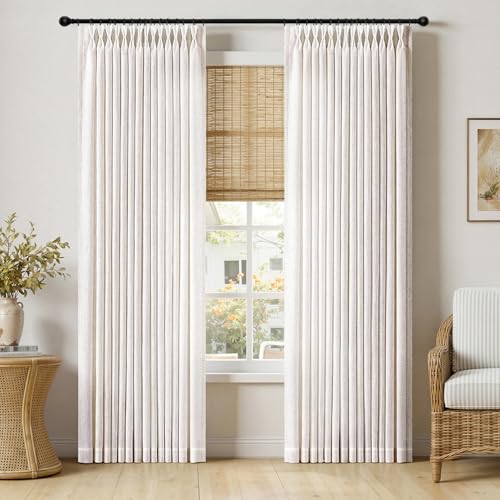
The least expensive part of this whole idea is the part that reads most, and it is the heading style at the top of the curtain. Grommets, rod pockets, and pinch pleats cost roughly the same and behave completely differently at full height. On a 54×96 in. (137×244 cm) drop, grommets slump between the rings and the panel goes wavy at the top. A rod pocket bunches unevenly and cannot be drawn. A pinch pleat holds an engineered fold from the header all the way to the hem, which is why the panel in this bathroom looks tailored despite everything in the room being ordinary.
You can retrofit pleats. Four-inch pleat tape sewn or fused across the top of a flat panel plus pin-on drapery hooks turns an off-the-shelf curtain into a pleated one, and this is standard workroom practice rather than a trick. Budget the width, though: pleating consumes fabric. A 54 in. (137 cm) flat panel typically finishes around 24 to 28 in. (61 to 71 cm) wide once pleated, so a 60 in. (152 cm) rod needs two panels, not one. That single fact is the most common reason a pleated curtain looks skimpy.
Brushed nickel is the value finish that does not look like a compromise. On a near-ceiling rod spanning 60 in. (152 cm) it is widely stocked in every length, it costs less than brass or matte black in most lines, and it hides water spotting far better than polished chrome, which shows every mineral mark. In a bathroom with hard water, that is a maintenance decision as much as a style one.
The wallpaper is the other budget lever and it needs one rule. Soft cream damask on the dry walls of a bathroom is entirely workable, provided the room has working ventilation and the paper never meets the wet wall. Keep it off the shower surround, keep it back from the tub deck, seam it away from corners that collect condensation, and run the fan. Damask in a cream-on-cream colorway gives you pattern without color, which is why it sits quietly behind a cream linen curtain rather than competing with it.
Small dark accents are what stop a cream room from reading washed out. A dark walnut toilet seat lid is an unglamorous, inexpensive swap that puts a warm dark note at low level. Grey and white marble-look diamond-check floor tile carries a second dark note underfoot. A small neutral ceramic vase at about 5 in. (13 cm) tall with a dried botanical arrangement on the tub ledge finishes it, and dried stems are the sensible choice on a tub ledge because they do not object to humidity or to being knocked over.
Key Takeaway: Spend on the heading style rather than the fabric, since a pinch-pleated panel holds its folds at 96 in. where grommets sag, and buy two panels because pleating cuts a 54 in. panel to roughly 26 in. of coverage.
So here is the answer, stated plainly: hanging your shower curtain from the ceiling does make a small bathroom read taller, and it does so because it removes the horizontal break at 76 in. and replaces it with one uninterrupted vertical line, not because the fabric is longer.
Everything else follows from that. The line only survives if the panel reaches the floor, which means an 84 in. curtain with the rod dropped 8 to 10 in. below a 96 in. ceiling, or a 96 in. panel hung from wire drops. The gap you leave at the top is not a compromise, it is how steam gets to the fan. And the fullness, at least twice your rod span in total panel width, is what separates drapery from a shower curtain hung high. Measure your ceiling height and your rod span this week, find your joists with a stud finder before you buy hardware, and choose the liner length before you choose the pretty panel. Get those three numbers right and the rest of it is just deciding which fabric you want to look at every morning.
From the guides
You've saved it, wanted it. Here's the how: codes, measurements, order. Your choices make it yours.
The Japandi Honest PlaybookThe honest version of the style: what to keep, what to skip, and the order to do it in.See inside →The Room Refresh PlaybookA repeatable four-step method, room by room, in ten minutes, thirty minutes, or one weekend.See inside →Make Any Room Feel Cozy on PurposeWhy some rooms hold people and others empty out, and the moves that change it.See inside → Save


