 Georgia
Most coastal bedroom accessories end up in a donation pile within two years. Not because the style is wrong — it’s because the layering sequence is wrong. Driftwood mirrors, shell accents, and linen throws each do a specific job in the room. Drop them in randomly and the result reads like a gift shop near a pier. Follow the right order and the same three elements produce a bedroom that looks genuinely curated, organic, and expensive. This guide walks through 29 specific accessories — with the exact reasoning behind each choice — so Maya can build her coastal bedroom one intentional layer at a time.
1. The Driftwood Leaner Mirror as Your Anchor Piece
 Save
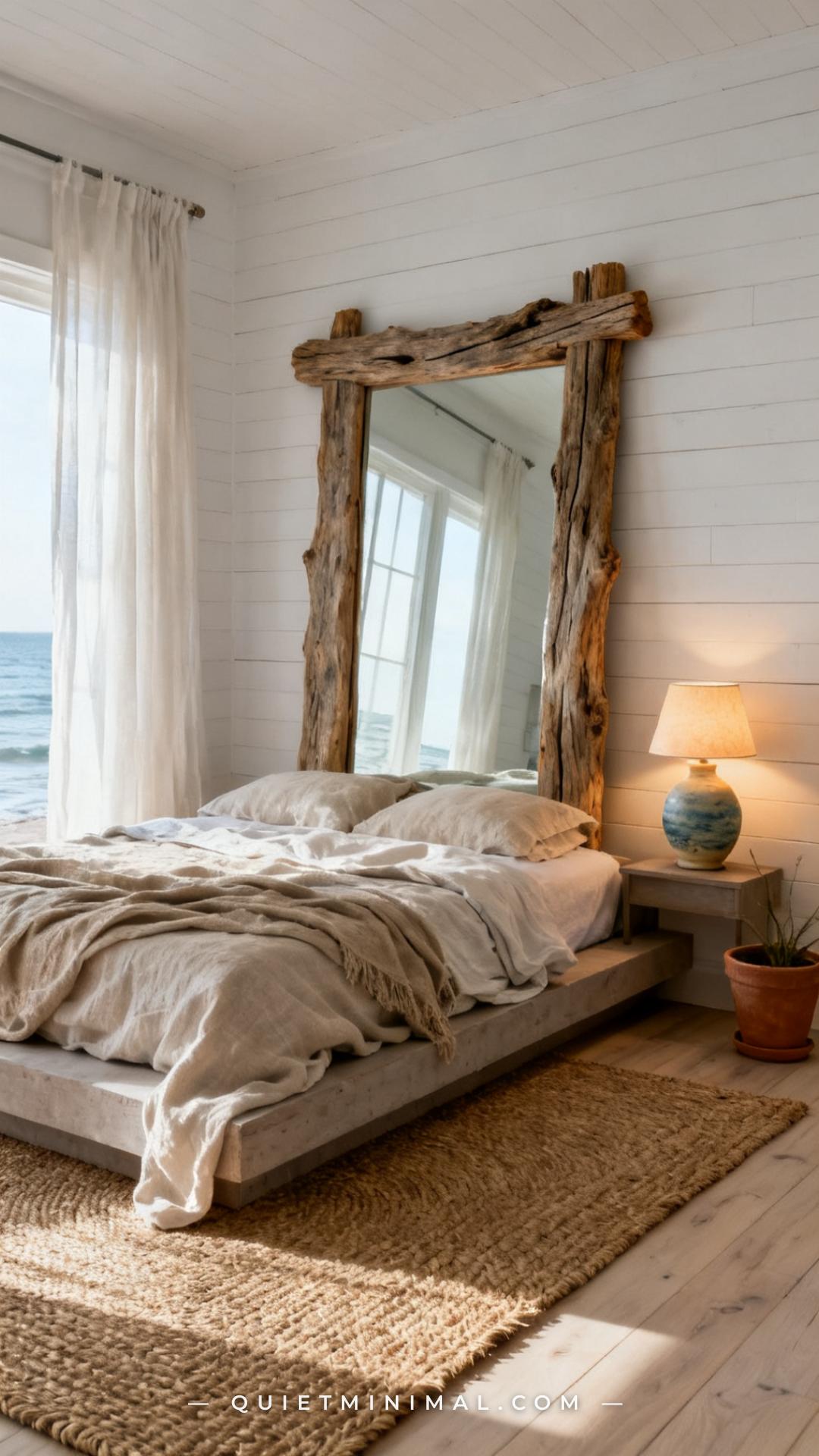
A leaner mirror with a driftwood frame is the single most effective statement piece you can add to a coastal bedroom because it does three jobs at once: it adds height, reflects natural light, and introduces organic texture without any effort. The frame itself — grey-bleached wood with visible grain and irregular edges — is the texture layer that shells and linen can then respond to.
Position it against your largest blank wall or leaning beside the bed rather than hanging it. The leaning posture keeps the room feeling relaxed rather than formal, which is exactly the energy a well-done coastal bedroom needs. Size matters: go at least 60 inches tall so it reads as furniture, not as a decorative accessory.
From the guides
You've saved it, wanted it. Here's the how: codes, measurements, order. Your choices make it yours.
 The Japandi Honest PlaybookThe honest version of the style: what to keep, what to skip, and the order to do it in.See inside →
 The Room Refresh PlaybookA repeatable four-step method, room by room, in ten minutes, thirty minutes, or one weekend.See inside →
 Make Any Room Feel Cozy on PurposeWhy some rooms hold people and others empty out, and the moves that change it.See inside →
Key Takeaway: The driftwood leaner mirror is the first layer you place — it sets the organic texture tone that every subsequent accessory should echo.

2. A Round Driftwood Mirror Above the Dresser
Save
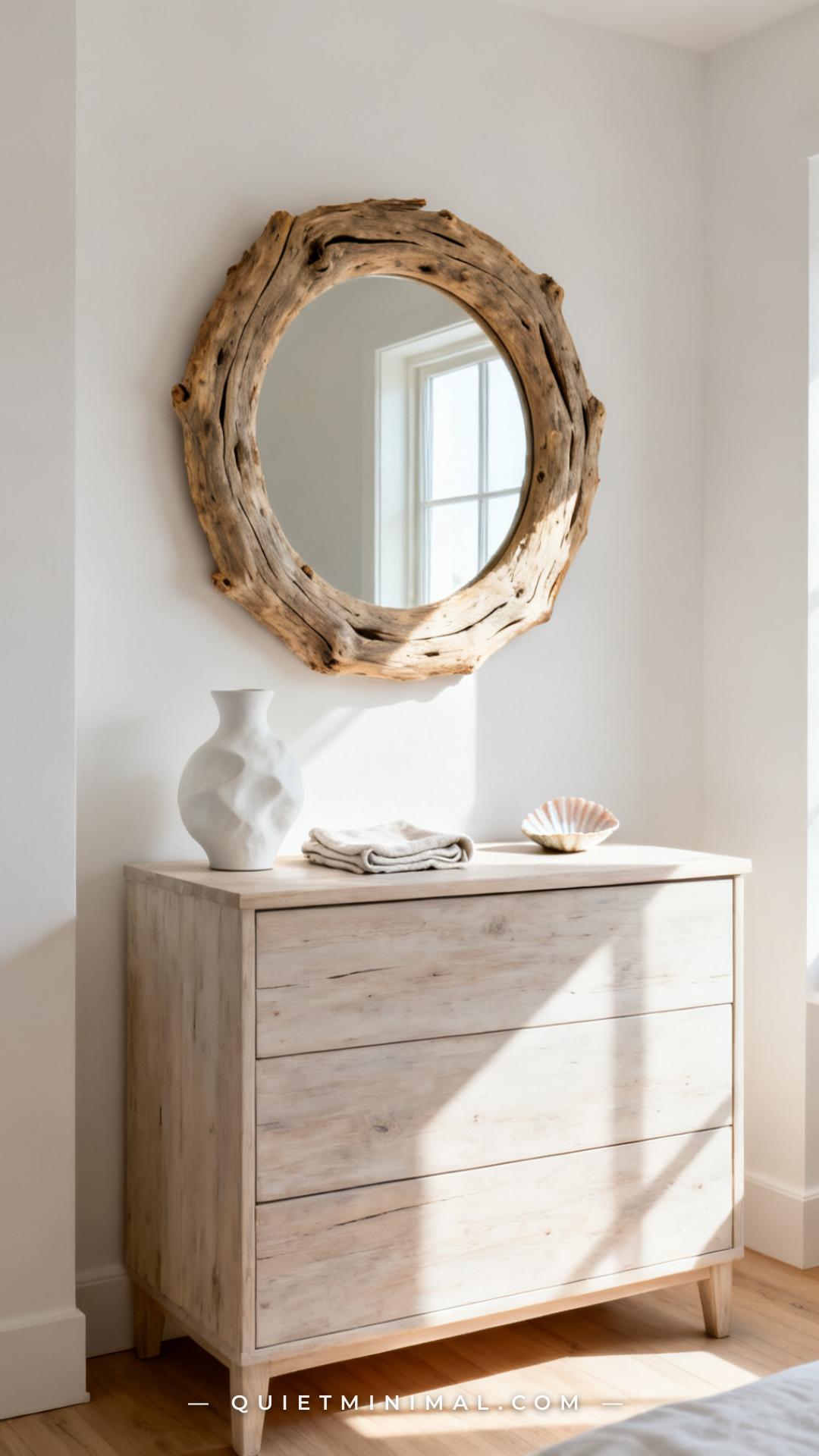
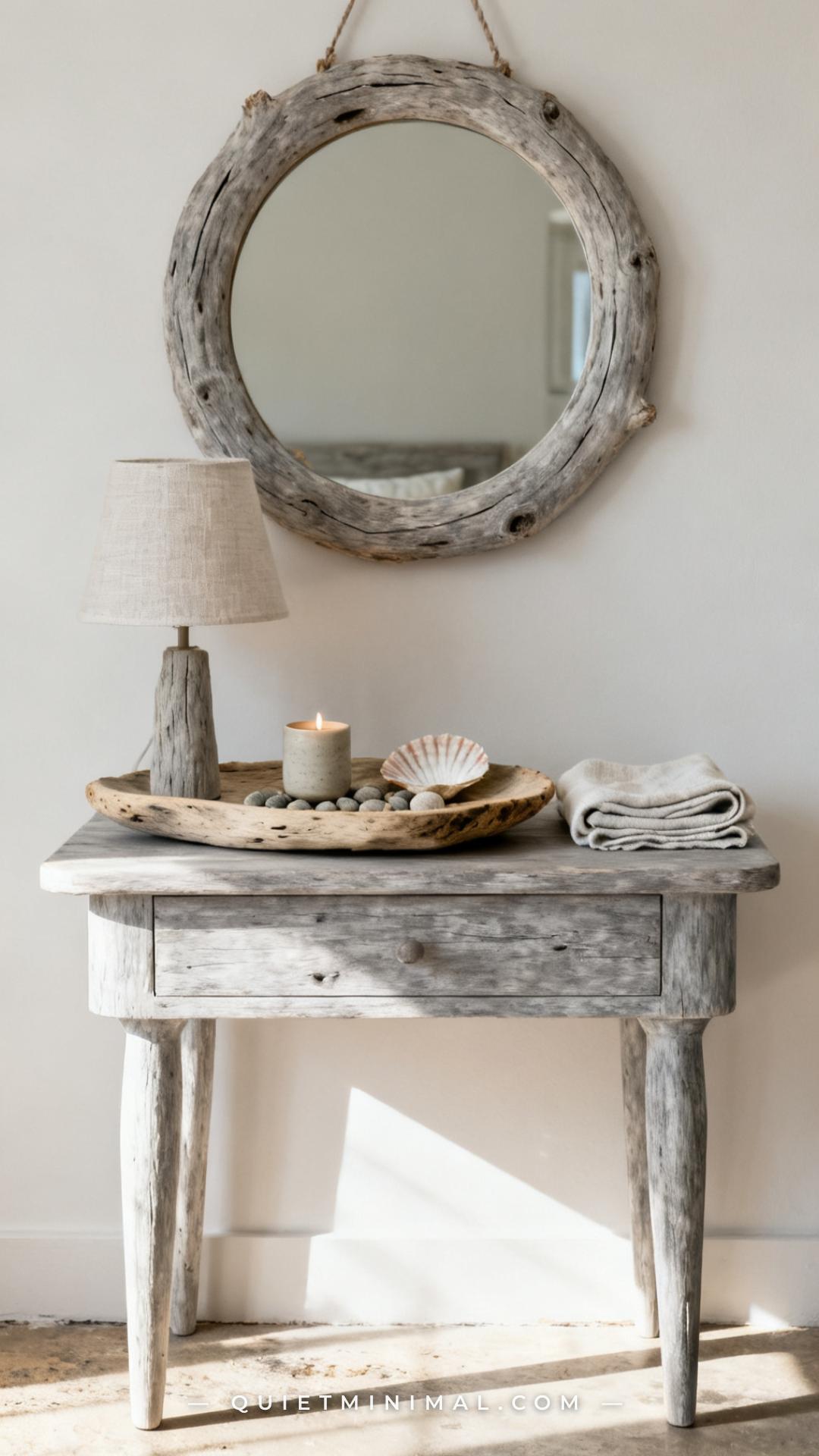
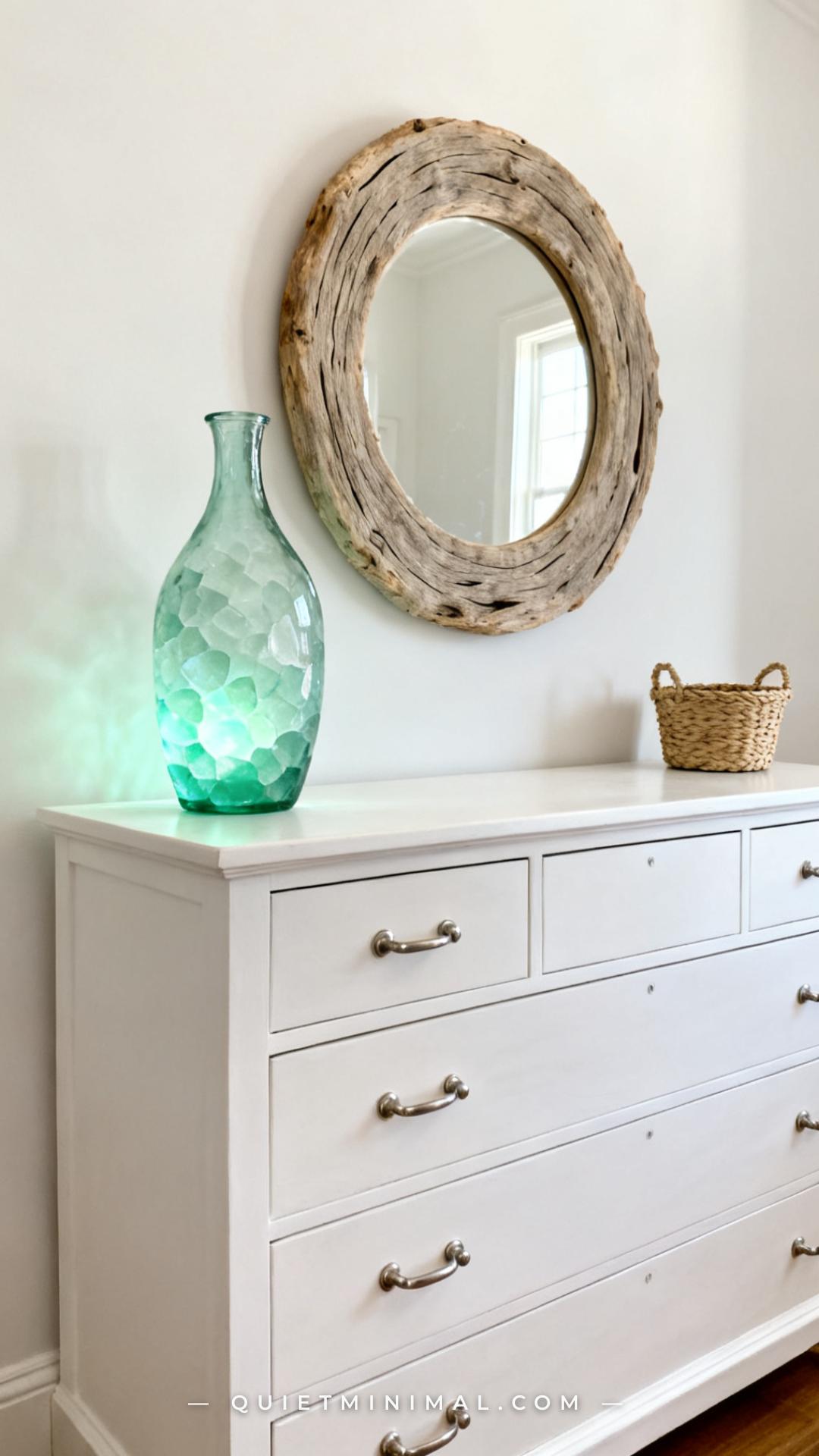
Round mirrors with driftwood or natural wood frames have a specific advantage over rectangular ones in a coastal bedroom: their circular shape mirrors the organic, non-linear quality of natural materials. Above a dresser, a 24–30 inch round driftwood mirror creates a focal point that feels artful without being precious.
The trick is leaving breathing room on the dresser surface below it. Resist the urge to crowd the top with accessories — two or three intentional pieces (a ceramic bowl, a small plant, a folded linen cloth) read far better than a collection of twelve small objects.
Key Takeaway: A round driftwood mirror above the dresser works best when the surface beneath it is deliberately edited down to two or three pieces.

3. Shell-Inlay Mirror for a Subtle Texture Layer
 Save
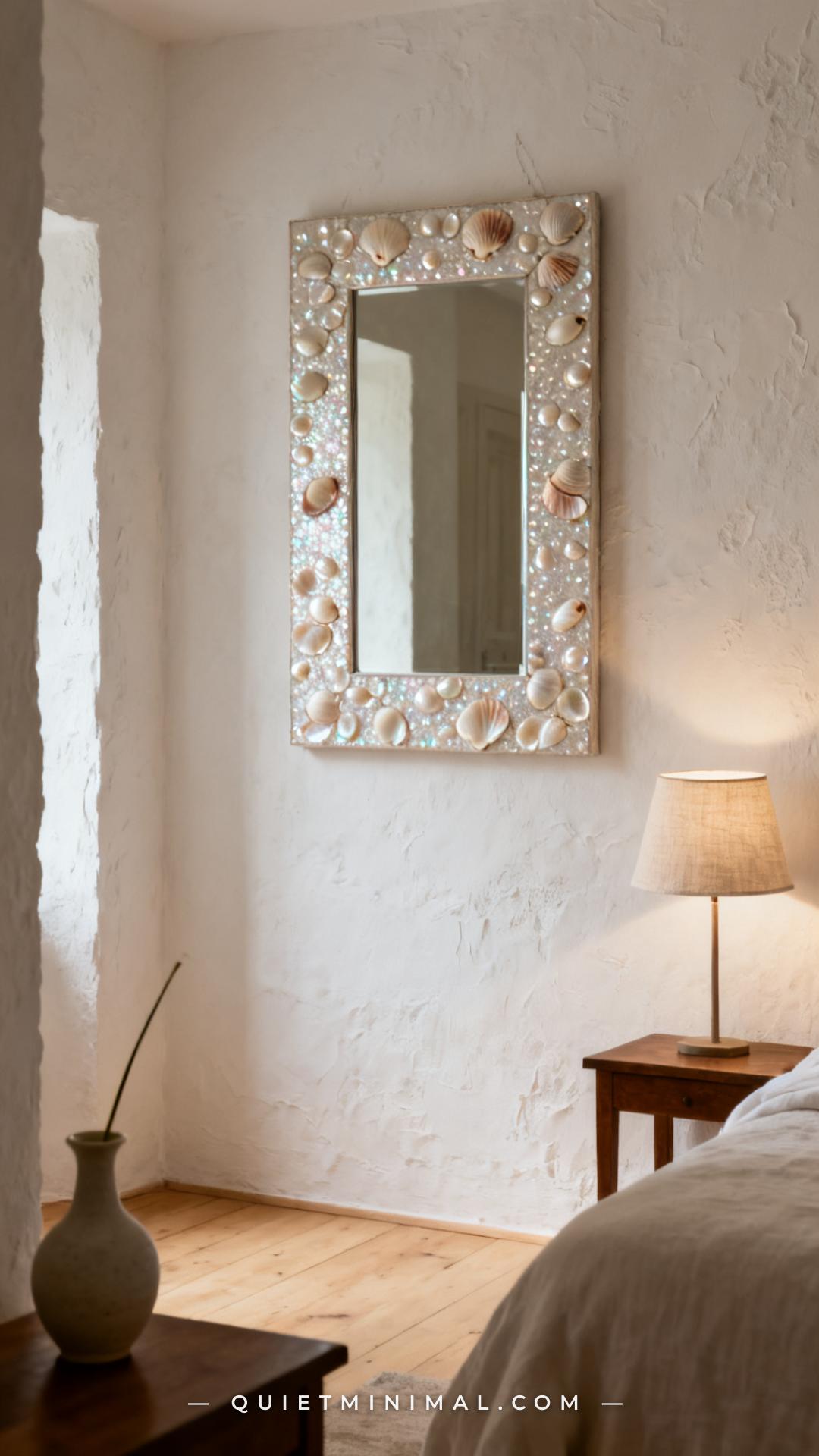
A shell-inlay mirror is a more refined alternative to a full driftwood frame — the shells are worked into a lacquered or resin base, creating a smooth, pearlescent texture that reads upscale rather than crafty. This is the mirror you choose when you want coastal character without anything that could read as themed.
Look for versions with mother-of-pearl or capiz shell inlay rather than large whole shells glued to a surface — the former looks intentional, the latter looks like a beach souvenir. A 24-inch round or an arched rectangular shape both work well in a coastal bedroom, and either hangs cleanly on a plank wall or smooth plaster.
Key Takeaway: Shell-inlay mirrors add coastal texture at a subtler register than driftwood — choose them when you want refinement over rusticity.

4. Natural Linen Throw in Oatmeal or Warm Sand
 Save
The linen throw is the first textile layer that signals “coastal” without using any coastal imagery. Natural linen in oatmeal, warm sand, or undyed ecru reads as the interior equivalent of beach grass — organic, slightly irregular, and utterly at home near anything driftwood or shell.
The key is choosing linen with visible texture: a loosely woven waffle or slub linen reads far more intentionally than a tight, flat weave. Drape it casually across the foot of the bed rather than folding it precisely — precision kills the relaxed coastal feeling you’re building.
Key Takeaway: A loosely woven linen throw in a sandy neutral is the textile anchor for the coastal palette; how you drape it matters as much as which one you choose.

5. Ocean Blue or Sea Glass Linen Throw for a Color Note
 Save
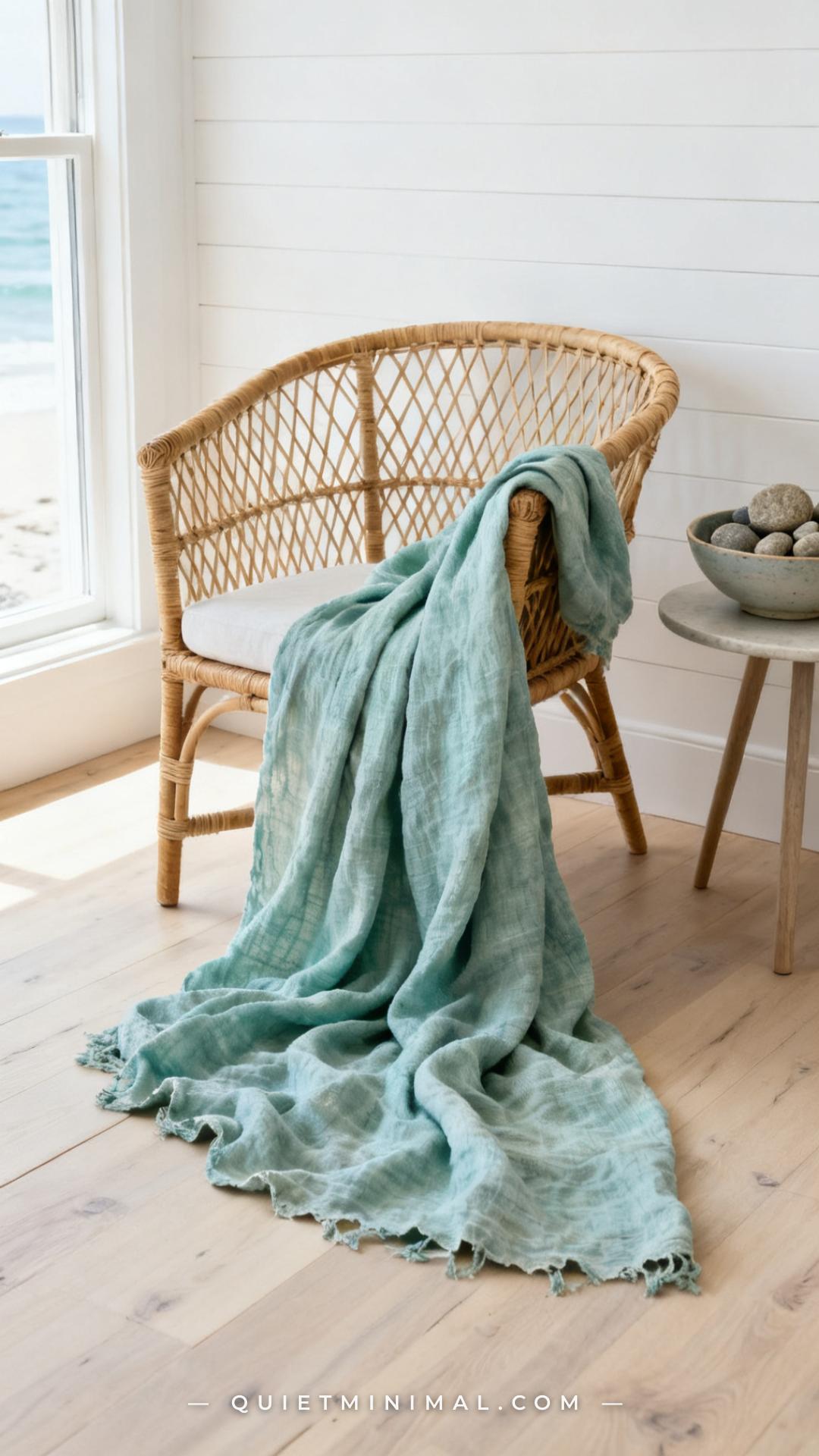
A second linen throw in a muted coastal color — faded ocean blue, sea glass green, or dusty sage — adds the color layer that keeps the room from feeling entirely neutral. The operative word is muted: a saturated cobalt reads as a generic nautical accent; a weathered, dusty sea glass tone reads as genuinely coastal.
Drape this one over the armchair or bench at the end of the bed, not on the bed itself. Two linen throws on the bed becomes a pile; one on the bed and one on a chair creates a layered, lived-in look that’s harder to achieve intentionally than it appears.
Key Takeaway: A muted coastal-toned linen throw works as a color note when placed off the bed — on the chair or bench — rather than competing with the primary throw.

6. Shell Garland Draped Over a Mirror or Headboard
 Save
A shell garland is one of the most effective small accessories in a coastal bedroom because it bridges two layers — it adds shell texture while also dressing a larger piece of furniture like a mirror or headboard. The key is placement: draped casually over the top of a leaner mirror or along the top rail of an upholstered headboard, it reads as an intentional styling choice rather than a decoration hung on a wall.
Choose garlands made from real shell pieces (auger shells, puka shells, or small clam shells) rather than resin replicas — real shells have variation in tone and surface that resin cannot replicate. A 6-foot length gives you enough drape to look natural without overwhelming the piece it’s decorating.
Key Takeaway: A shell garland draped over a mirror or headboard bridges the natural textures in the room — it’s a connector piece, not a standalone decoration.

7. Woven Seagrass Rug Under the Bed
 Save
A seagrass or sisal rug is the floor-level texture layer that ties driftwood, shell, and linen together. Its woven, organic surface introduces a material that directly references coastal environments — seagrass, sea rushes, woven marsh plants — without any figurative imagery.
For a bedroom, size generously: the rug should extend at least 18 inches beyond the sides and foot of the bed. Undersized rugs are one of the most common mistakes in bedroom styling, and a too-small rug makes even excellent accessories feel disconnected. An 8×10 or 9×12 is appropriate for a standard queen or king bedroom.
Key Takeaway: A correctly sized seagrass rug unifies the floor plane and gives the organic textures above it a visual foundation to anchor to.

8. Linen Pillow Covers in Coastal Neutrals
 Save
Linen pillow covers are the fastest way to shift a bedroom’s textile quality without replacing your pillows. For a coastal bedroom, work with a narrow palette: warm white, natural oatmeal, pale driftwood grey, and soft sand. Four to six covers in these tones, mixed in two or three sizes, creates a layered effect that looks intentionally styled.
Avoid printed coastal patterns on pillows — anchors, seahorses, rope knots. They instantly flatten the aesthetic from curated to themed. Plain linen in coastal neutrals does more visual work because it contributes texture without a narrative.
Key Takeaway: Plain linen pillow covers in coastal neutrals build layered texture without the themed-décor problem that printed coastal pillows create.

9. Rattan or Seagrass Pendant Light
Save
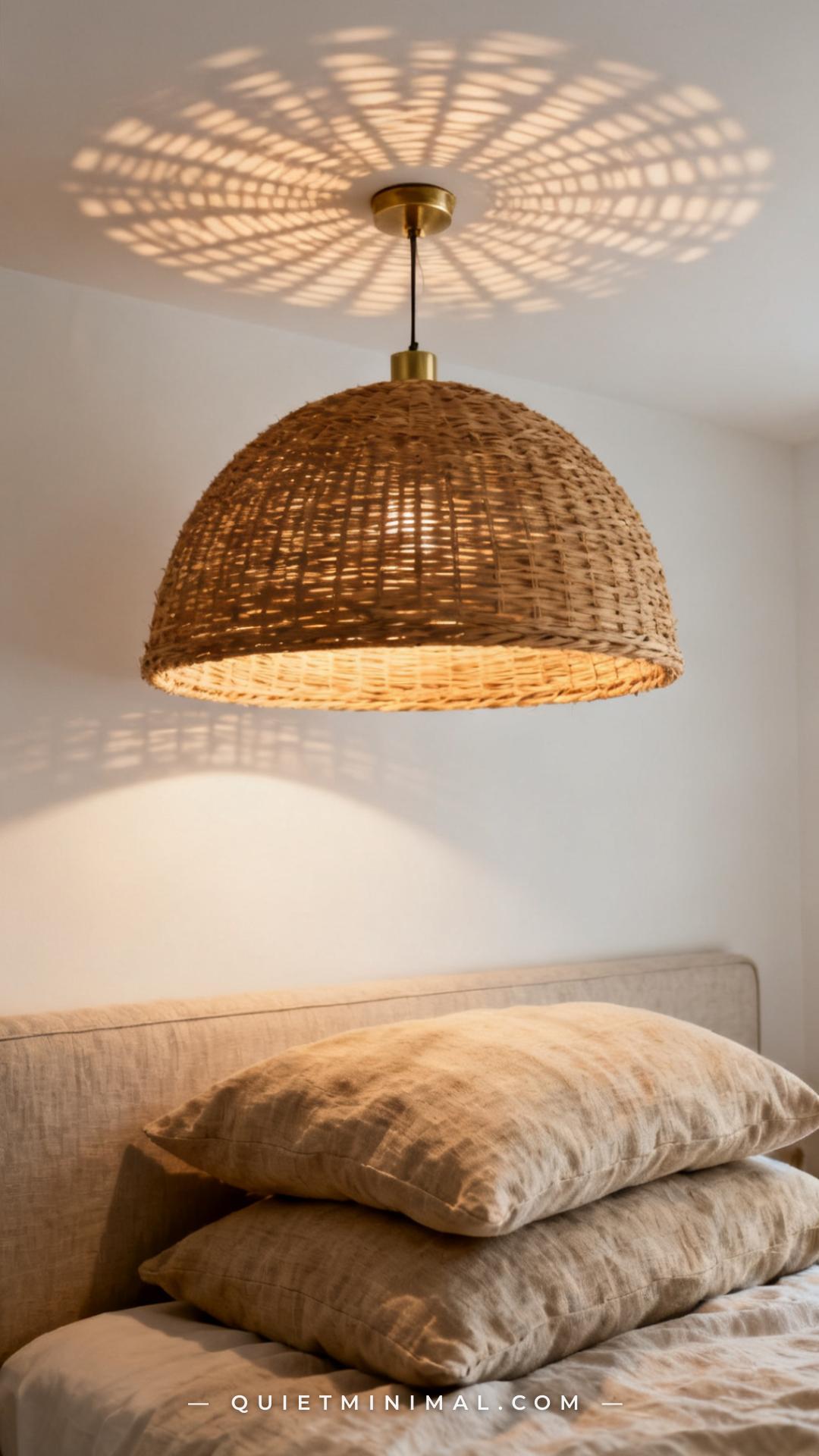
A rattan or seagrass pendant light introduces coastal material vocabulary at the ceiling level, which most coastal bedroom accessories fail to reach. The woven fiber shade casts a warm, dappled light pattern on the ceiling that mimics the filtered-light-through-sea-grass quality that makes coastal interiors feel so atmospheric.
Hang it as a bedside pendant rather than a central overhead fixture — drop it 12–18 inches above nightstand height, on one or both sides of the bed. This positioning keeps the pendant reading as a functional light source while giving it visual prominence at eye level.
Key Takeaway: A rattan pendant at bedside height brings coastal texture to the ceiling plane and creates the warm, dappled-light atmosphere that floor-level accessories cannot achieve alone.

10. Shell and Coral Branch Bud Vase Grouping
 Save
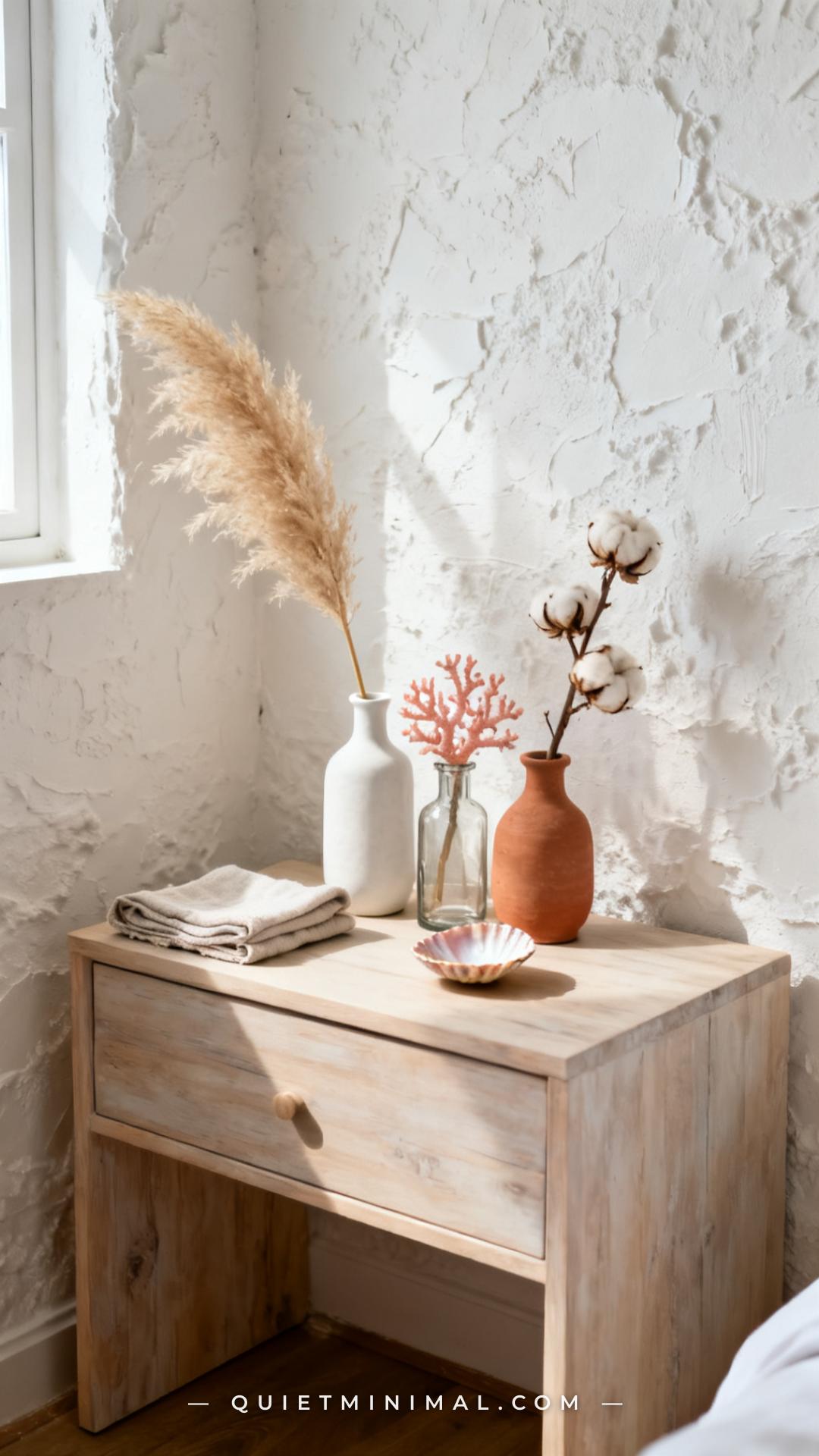
A grouping of bud vases styled with coral branches, dried sea botanicals, and a single shell is the accessory arrangement that consistently separates curated coastal rooms from generic ones in design photographs. The key is odd numbers — three or five pieces — and variation in height and material.
Use one taller vessel (a ceramic or glass vase at 10–12 inches), one mid-height vessel (6–8 inches), and one low dish or shell as the base. This height variation creates a small still-life composition that has a clear foreground, middle, and background even within a nightstand footprint.
Key Takeaway: A three-piece bud vase grouping with varying heights creates a proper still-life composition on the nightstand — the most photographed and most-saved surface in coastal bedroom content.

11. Driftwood Decorative Tray for Nightstand Organization
Save
From the guides
You've saved it, wanted it. Here's the how: codes, measurements, order. Your choices make it yours.
The Japandi Honest PlaybookThe honest version of the style: what to keep, what to skip, and the order to do it in.See inside →The Room Refresh PlaybookA repeatable four-step method, room by room, in ten minutes, thirty minutes, or one weekend.See inside →Make Any Room Feel Cozy on PurposeWhy some rooms hold people and others empty out, and the moves that change it.See inside →A flat driftwood tray on the nightstand solves one of the most common problems in coastal bedroom styling: loose accessories that feel uncontained and random. When objects sit inside a defined tray — a candle, a small shell dish, a crystal — they immediately read as an intentional grouping rather than a collection of clutter.
Choose a tray with the same bleached driftwood finish as your mirror, not a stained or painted alternative. Matching the material vocabulary across pieces is what creates the sense that a room was designed rather than assembled.
Key Takeaway: A driftwood tray on the nightstand contains and elevates loose accessories — and matching its finish to the mirror frame creates material continuity across the room.

12. Sea Glass or Aqua Glass Accent Vase
Save
A sea glass or aqua-toned glass vase introduces the one color that is unmistakably coastal without being nautical — the particular green-blue of genuine sea glass, worn smooth by waves. Unlike a blue ceramic or a painted vase, a glass vessel in this tone also interacts with light, shifting from pale green in shadow to vivid aqua in direct daylight.
Use it as a statement piece on the dresser rather than filling it with flowers — a single dried pampas stem or a few branches of eucalyptus is enough. The vase shape and color carry the moment on their own.
Key Takeaway: A sea glass aqua vase brings coastal color to the room through light-interactive material rather than paint or print, keeping the palette feeling organic rather than themed.

13. Whitewashed Wood Nightstand
A whitewashed wood nightstand is the furniture piece that makes all the organic accessories you’re adding feel intentional rather than placed on whatever was already in the room. The whitewash technique — thin white paint worn back to show the wood grain — visually echoes the bleached driftwood tone of the mirrors and trays without being identical.
Look for versions with a lower open shelf rather than a drawer — the open shelf gives you space to tuck a woven basket or a stack of linen-covered books, adding a secondary vignette at floor level that strengthens the coastal narrative.
Key Takeaway: A whitewashed nightstand bridges the raw driftwood tones of your accessories and the white of your walls, giving the room’s organic pieces a furniture-level foundation.

14. Coastal Table Lamp with Linen Shade
A bedside lamp with a natural linen shade introduces both light quality and textile texture at eye level — the warm amber glow through a linen shade is the exact warmth that makes a coastal bedroom feel like a retreat rather than a staging. Lamp base options that work: bleached ceramic, natural cord-wrapped, white gesso wood, or pale stone.
Avoid nautical lamp bases (rope-wrapped, anchor-shaped, lighthouse forms). The goal is a lamp that reads as a quality bedside lamp in a well-decorated room — coastal in material, not in motif.
Key Takeaway: Choose a coastal lamp base by material (bleached ceramic, natural cord, stone) rather than motif — the linen shade does the coastal work while the base reads as refined furniture.

15. Woven Wall Basket or Seagrass Wall Art
Save
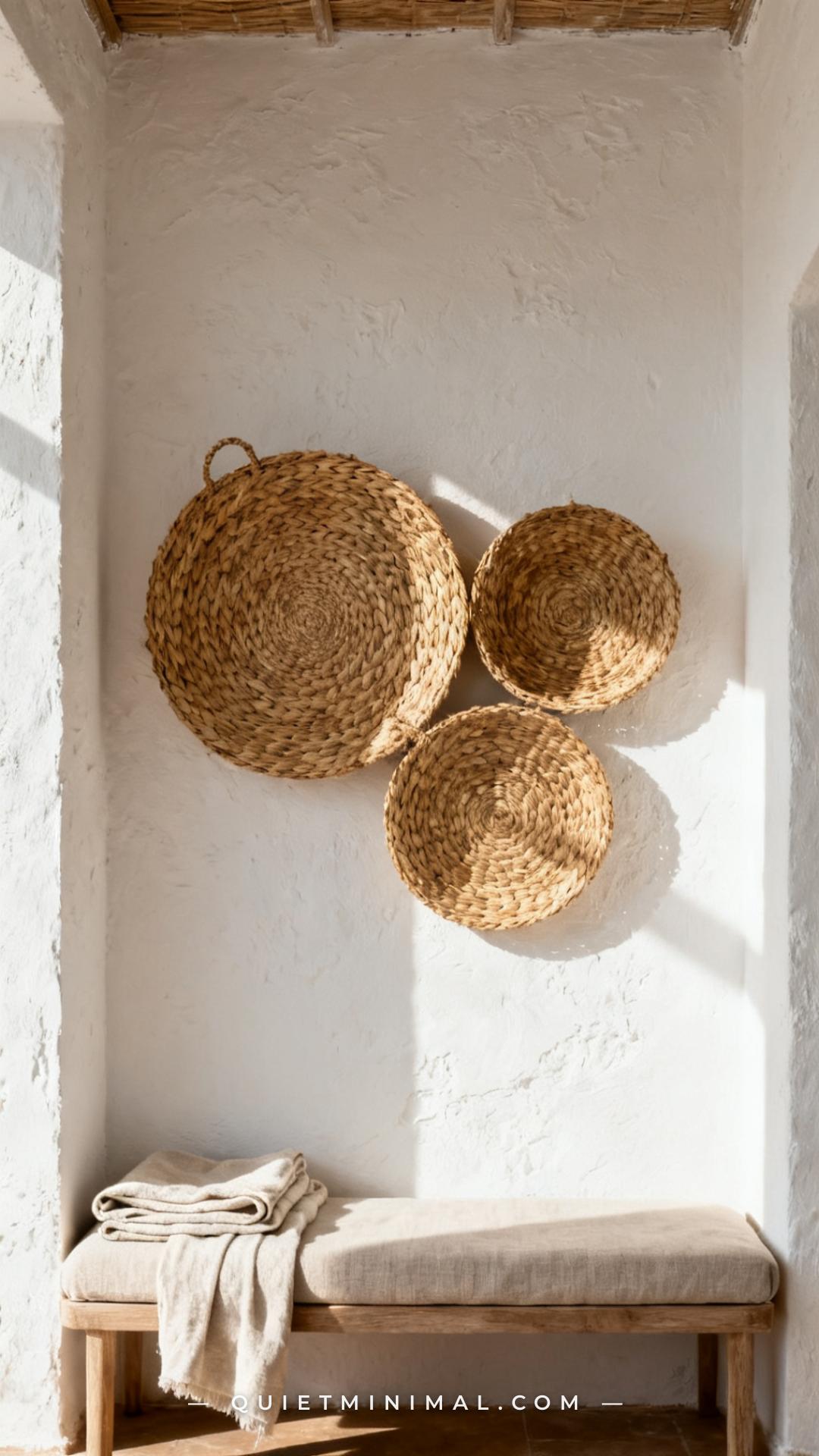
Woven wall baskets — seagrass, water hyacinth, or wicker — are among the most effective large-scale accessories in a coastal bedroom because they add three-dimensional texture at wall height where most rooms rely entirely on flat art. A grouping of three baskets in varying diameters (10 inches, 16 inches, and 22 inches) creates an arrangement that reads like gallery wall art but with material depth.
Arrange them in an asymmetric cluster rather than a grid — coastal rooms are not symmetrical by nature. The largest basket sits slightly off-center, the mid-size and small pieces orbit around it with 3–4 inches of breathing room between each.
Key Takeaway: A three-basket woven wall grouping delivers gallery-wall scale with three-dimensional coastal texture — arrange asymmetrically, not in a grid.

16. Shell Dish or Trinket Tray for the Dresser
A shell dish — either a ceramic piece cast in a shell form or a literal large shell — on the dresser solves the same problem the nightstand tray solves: it gives loose small objects a defined home. Jewelry, a folded hair tie, a lip balm. When these functional objects live in a shell dish rather than sitting loose on the dresser surface, the dresser top reads as styled even when it’s serving a daily function.
Choose a white or off-white ceramic shell dish over a natural shell if durability is a concern — ceramic holds its finish and is easier to clean. A natural large clam or conch shell works beautifully if you’re comfortable with the material.
Key Takeaway: A shell dish on the dresser bridges function and styling — it contains everyday clutter while adding an organic coastal material to the surface.

17. Macramé Wall Hanging with Shell Details
A macramé wall hanging with shell accents woven into the fringe gives a coastal bedroom its largest single texture statement at wall height — and unlike a print or a painting, it introduces actual three-dimensional depth to the wall surface. The shells in the fringe connect the textile layer to the shell accent layer without needing to add more shell pieces elsewhere.
Size for the wall: in a bedroom, a macramé piece that spans 24–36 inches wide and drops 36–48 inches long is the right proportion for a standard wall. Too small and it reads as a craft project; at this scale it reads as art.
Key Takeaway: A macramé with shell fringe detail unifies the textile and shell layers of the room in a single wall piece — size it large enough (24 inches wide minimum) to read as art.

18. Coastal Scented Candle in a Sea Glass Vessel
A scented candle in a sea glass or frosted aqua vessel serves double duty: it contributes to the color palette when unlit and to the atmosphere when burning. Coastal candle scents — sea salt, driftwood, white tea, sandalwood — deepen the environmental feeling of the room through a sensory layer that decor objects alone cannot reach.
Place it on the nightstand tray rather than loose on the surface — a candle with a purpose-built tray looks intentionally placed, and the tray protects the surface from wax and heat.
Key Takeaway: A sea glass vessel candle adds both color and atmosphere to the nightstand vignette — the vessel stays decorative even after the candle is burned through.
From the guides
You've saved it, wanted it. Here's the how: codes, measurements, order. Your choices make it yours.
The Japandi Honest PlaybookThe honest version of the style: what to keep, what to skip, and the order to do it in.See inside →The Room Refresh PlaybookA repeatable four-step method, room by room, in ten minutes, thirty minutes, or one weekend.See inside →Make Any Room Feel Cozy on PurposeWhy some rooms hold people and others empty out, and the moves that change it.See inside → Save


