 Georgia
Ask anyone how to decorate the wall above the stairs and you will hear the same four rules. Commit to a plan and hit the nails once. Hang a gallery of frames until the wall is full. Keep the staircase itself spare so nothing gets in the way. Add an inspiring line of words if the wall still looks empty. The rules are repeated because they are easy to say, not because they hold up on a wall that slopes.
The wall above a staircase is the longest, most visible stretch of wall in many homes, and you see it moving, from below, at an angle, in changing light. It has to work as a place to look and as a path to walk past. Decorating the wall above the stairs well means measuring from the stair line, choosing things that stay shallow, and lighting them so they look right at 7 a.m. and at 9 p.m.
Each section below overturns one rule with the reason it misleads and the version that holds up.
“Commit to the Nails” Misses the Case for a Picture Ledge
 Save
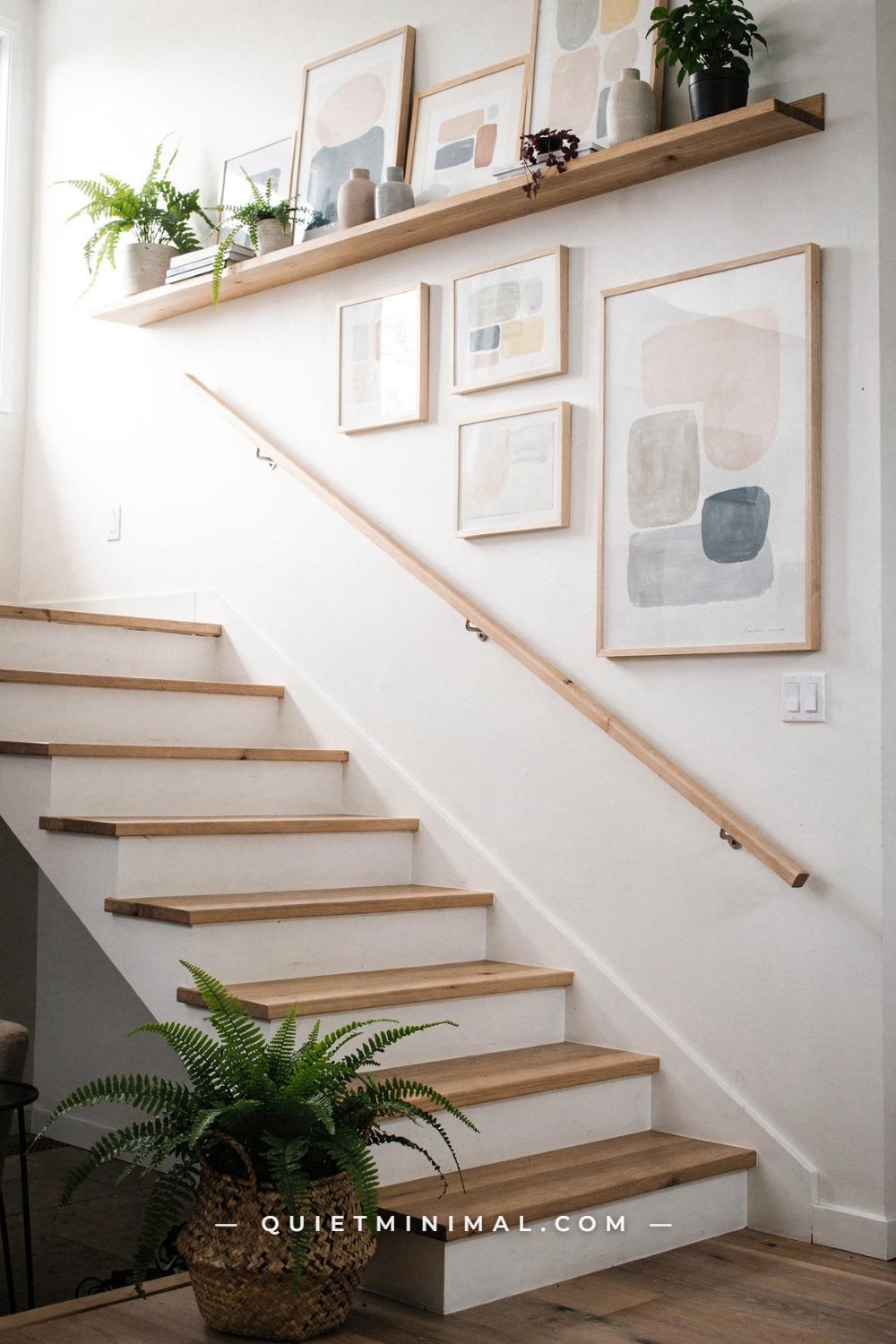
The conventional plan is to decide the layout, mark it, and drill. On a stair wall that is a risky commitment, because you cannot judge the slope, the eye line and the light until you have lived with it. The more forgiving answer is a picture ledge: a shallow shelf, here angled to follow the stair, holding framed prints, potted plants and ceramic vases.
A ledge turns the wall into something you can restyle without making new holes. Choose one 4 to 5 in (10 to 13 cm) deep, which is deep enough to hold a frame leaning at an angle and shallow enough that a shoulder will never meet it. Mount it into studs along the line of the stairs and use two or three brackets, since a loaded ledge on a stair wall carries real weight.
Below it, framed botanical prints in light wood frames climb the white wall beside the floating oak treads, with a large fern print as the anchor. That is the hybrid worth copying: a few fixed frames for the backbone and a ledge for everything that will change. Keep the fixed frames matching and let the ledge hold the variety.
Style the ledge with the rule of three. Lean one large frame at the back, set a ceramic vase in front, and add one small plant. Overlap them so they look layered, and leave 6 to 8 in (15 to 20 cm) of ledge empty at the lower end so the whole thing does not look finished. Swap one object a month and the wall will keep feeling fresh.
A potted fern in a basket at the stair foot repeats the green of the prints and keeps the eye anchored low.
A ledge is also the kindest option for a wall you plan to live with for years. A shallow shelf with a lip, 3 to 4 in (8 to 10 cm) deep, is fixed once into studs and never touched again, while the frames on it move whenever you like. Lean the largest piece at the back, overlap a smaller one in front, and leave a few inches of bare shelf at the end so the display has room to grow.
Key Takeaway: Pair a few fixed frames with a 4 to 5 inch picture ledge along the stair line, so most of the styling can change without new holes.

“Plan It on the Wall” Is the Wrong Place to Plan It
 Save
People tend to hold a frame to the wall, step back, and adjust. On a stair wall you cannot step back far enough, and every nail hole is permanent. The reliable method is planning on the floor, then transferring with paper.
Trace each frame on kraft paper and cut it out. Tape the templates to the wall with painter’s tape, and rearrange them until the group looks right from the foot of the stairs, from the landing and from the fourth step. Keep the template for each frame’s hanger position marked with an X so the nail lands in the right place when you remove the paper.
This collected stairwell shows what the method buys. A dense gallery of gilt and wood frames climbs beside dark wood treads and white balusters, mixed with small wood shelves, a brass lantern, a round mirror and a macrame hanging. It could so easily look chaotic. It works because the mass is planned: a loose triangle with the heaviest frames low and the lightest high, and consistent gaps of about 2 in (5 cm) between frames.
Set the bottom edge of the lowest frame no closer than 6 in (15 cm) above the stair nosing line at its position, and keep the center of the group near 57 in (145 cm) above that line. A console with a lamp and plants below, and tall windows at the landing, give the wall a context and a light source.
The patterned vintage runner is the one busy element on the stairs. Because the wall is already layered, a runner with a restrained pattern in the same warm cream and green family keeps the whole stairwell feeling like one room.
Use the stair itself as the ruler. Hold a long level against the nosing line, find the angle of the stair, and mark a line on the wall parallel to it at the height where the group should sit. Everything you hang can then be measured up from that line, so the whole display climbs at the same angle as the steps. Tape a paper stand-in for every piece along it, and leave it up for a few days.
Key Takeaway: Plan a stair gallery with paper templates taped to the wall and view it from three positions on the stairs before drilling.

“A Basement Stair Is Just a Passage” Wastes the Best Blank Wall
 Save
Basement stairs are usually treated as a way to get somewhere, with a bare wall and one bulb. They are also one of the longest uninterrupted walls in the house, and they set the first impression of a space you want people to use. This cozy basement stairwell shows how to treat the wall as an entrance: a plant-topped ledge running above the wall, trailing pothos spilling down beside black-framed botanical prints and a small arched mirror.
Light is the first issue, because a basement stair rarely has a window. Add a candle-style sconce and up-down wall lights, aim for a warm 2700K bulb, and put them on a dimmer. Warm light at several heights stops the stair from feeling like a tunnel. If you want a flame look, use LED candles.
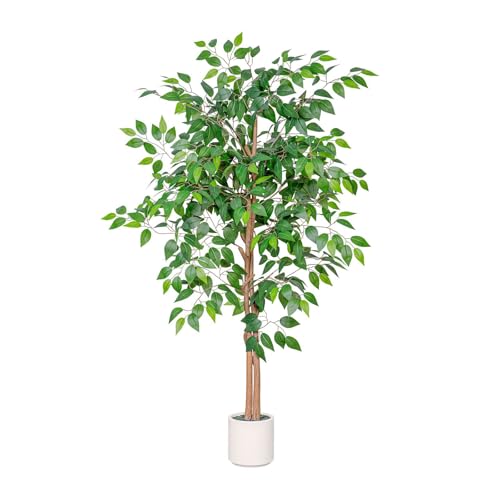
Then choose plants that can live there. Pothos tolerates low, artificial light, and a ledge at the top of the wall lets the vines trail down in a gentle line. Water from a small watering can with a long spout, and place a drip tray under each pot. A potted tree at the stair foot, near a white paneled door, signals arrival at the bottom, and a faux tree is a sensible choice where light is limited.
A thick wool runner on the treads does something practical as well: it absorbs sound, which matters when a stairwell carries footsteps into the rooms above.
Hang the black-framed prints at the usual 57 in (145 cm) above the nosing line, and let the small arched mirror pick up the sconce light. The mirror need not be big; at 14 to 18 in (36 to 46 cm) tall it still doubles the glow.
Basement stairs often sit against a masonry or unfinished wall, so check for damp before you hang anything. Press a hand against the wall on a humid day, and look for flaking paint, white mineral deposits or a musty smell. If you find them, solve the moisture first, since art on a damp wall suffers and so does the paint. Choose frames with sealed backs, and use mildew-resistant paint where the wall is cool.
Key Takeaway: Treat a basement stair wall as an entrance, with warm layered light, low-light plants and a runner that quiets the steps.
“Art Must Match the Furniture” Misses an Easier Source of Color
 Save
A familiar rule says to pull art colors from the furniture. A stairwell often has no furniture to pull from, so the rule leaves people stuck. What works is pulling from the materials of the stair itself: the treads, the railing and the wall color.
This earthy stairwell does exactly that. Warm taupe walls, wood treads and a black rod railing set the palette, and the art follows with muted landscape paintings in sepia and sage in thin frames. Nothing in the art is brighter than the wall, so the whole stairwell reads as one tone. Thin frames, about 0.75 in (2 cm) wide, keep the pieces from competing with the railing.
Two floating wood shelves carry ceramic vases and trailing plants between the paintings. At the base, a snake plant in a concrete planter and a tall vase of pampas grass anchor the stair foot. A snake plant is a good stairwell choice since it tolerates dim light and irregular watering, and a concrete planter gives it weight so it will not tip.
Space the paintings with a consistent 2 to 3 in (5 to 8 cm) gap, and let the shelves interrupt the rhythm every second or third piece. A large potted olive tree nearby adds a vertical and a softer green than the sage in the art, which stops the palette feeling flat.
Hang the center of the group at about 57 in (145 cm) above the stair line, and check from the landing that the lowest piece is not blocked by the railing’s balusters. A railing can hide the bottom row of a gallery, so view it from where people will stand.
Take your color from things you already own rather than from a catalog. A throw, a rug and a ceramic bowl in the nearby room contain a palette, and a piece of art that repeats one of those shades will feel connected without matching. Hold a paint chip or a fabric swatch against the art in daylight to check, and be willing to leave one accent that does not appear anywhere else.
Key Takeaway: On a stair wall, take the palette from the treads, railing and wall color, and keep every piece quieter than the wall behind it.

“Every Collection Needs a Hero” Is the Rule That Makes Vintage Walls Work
 Save
A vintage wall of mismatched pieces is the easiest gallery to get wrong, since nothing ties it together. The old advice is to make everything match. The better advice is to pick a hero and let the rest orbit it. This charming stairwell has a large gilt-framed painting that anchors a cluster of small landscapes, a small portrait and tiny bird prints.
The hero should be at least three times the area of the largest of the small pieces. Hang it first, slightly off-center in the group, and build outward so the small frames sit around it at 2 in (5 cm) intervals. The eye lands on the big frame and then wanders, which is the pleasure of a collected wall.
What ties the rest together is a repeated finish. Gilt on the hero, a few gilt or warm wood frames in the cluster, and nothing in a stark white or black frame. Cream textured walls and dark wood treads give a warm ground, and white railings keep the stairs crisp.
Objects add the softness. A hanging wicker basket, a small green wreath and a few vintage keys on a hook relieve the frames and add a three-dimensional layer. Keep these light, under 3 lb (1.4 kg) each, and set them at the edge of the group rather than the middle.
A glimpse of the living room beyond is a gift: the colors on the stair wall should echo it. If the room beyond is cream and wood, the gallery will feel like a continuation instead of a separate theme.
Give the hero real scale. A single piece should be roughly twice the size of the others in the group, so the eye has a clear place to start, and the supporting pieces should echo its shape or color. Keep the supporting pieces in one family of frame, and arrange them in a loose cluster around the hero, not in a straight row.
Key Takeaway: Give a vintage stair collection one large hero piece and a single repeated frame finish, and the small pieces will organize themselves around it.

“Keep the Stairs Spare” Forgets How Shelves Can Climb
 Save
The usual instruction is to keep stairs and the wall above them spare. It is true that a stair wall is no place for a busy mix of objects at hip height. But three floating shelves set in ascending steps, above the line of the shoulder, add the layered look of a styled bookcase without any safety cost.
Here three dark wood floating shelves ascend the wall above the staircase, styled with framed botanical prints, stacked books, candles and small potted plants, and a large monstera print hangs above the top shelf. The shelves climb with the stair, so each one sits at the same height above its tread. Space them about 18 to 24 in (46 to 61 cm) apart measured along the stair line, and make each 4 to 5 in (10 to 13 cm) deep.
Dark wood against warm white walls is a high-contrast choice, so the shelves read as lines on the wall, and the items on them need to be light in color. Frame prints in white or pale mats, books with calm spines, and plants in pale pots will stand out against the dark wood.
Candles on stair shelves should be LED. A real flame on a shelf above a stair is a hazard, and the LED version gives the same glow.
At the foot, a sculptural wood side table with a lamp and a striped basket makes the base feel furnished, and a tall vase of branches on a landing tread adds height. Keep the vase against the wall at the outer edge and heavy enough not to tip.
Step the shelves with the stair. Each shelf can sit one riser height higher than the last, about 7 in (18 cm) up for each tread of run, so the display rises at the same pitch as the steps. Keep each shelf shallow and short, so the whole thing reads as a slim staircase of its own, and leave the lowest shelf clear of the walking line at the foot.
Key Takeaway: Ascending floating shelves, 4 to 5 inches deep and above shoulder height, give a stair wall layers without crowding the steps.

“Add Words to Fill It” Works Only When the Words Stay Small
 Save
When a stair wall feels empty, many people reach for words. A wall quote decal fills a big space cheaply and can be removed, which is its charm. It is also the easiest element to overdo, because words pull the eye harder than any image.
The version that holds up keeps the text short and low in contrast. In this warm stairwell a quote decal sits beside four framed botanical and abstract prints in wood frames that ascend the wall. The decal is one line, set in a color just a shade darker than the warm beige wall, so it reads as texture first and message second. Aim for a line about 24 to 36 in (61 to 91 cm) long and keep it beside the frames rather than above them.
The frames do most of the work. Small spotlights above each frame wash the wall, and the warm beige picks up the glow. Place each spotlight 6 to 8 in (15 to 20 cm) above the frame and aim it so it is not visible from the stairs.
Tiny stair lights on the white risers and dark wood handrail give the climb a low glow at night. They are a safety feature first, so keep them at the outer edge of the tread, and use warm white, not cool white, to match the spotlights.
At the base, a potted olive tree in a stone planter finishes the corner. If you have limited light, choose a faux tree with a slim crown. The planter should be heavy enough to sit securely, and set about 4 in (10 cm) from the wall.
Keep the lettering small and quiet. Words on a stair wall are read while moving, so one short phrase in modest letters, set at eye level on the landing, works better than a large slogan. Choose a hand or a typeface that is plain and legible, in a tone only a little darker than the wall, and place it where it will be seen as you climb, not as you descend.
Key Takeaway: If you add words to a stair wall, keep them to one short line in a tone close to the wall color, and let the lit frames carry the design.

“The Space Under the Stairs Is Separate” Ignores the Wall Above It
 Save
The wall above the stairs and the space beneath them are usually treated as two projects. Treating them as one is what makes an elegant stairwell. This one has a botanical gallery wall of wood-framed leaf prints and architectural sketches climbing beside white balusters and wood treads, with a round wicker mirror at its center, and arched niches under the stairs glowing with candles and vases.
The mirror is the link. A round wicker mirror, about 24 to 30 in (61 to 76 cm) across, at the center of the gallery picks up the wicker of the basket holding a large palm at the base, so the top and bottom of the stairwell share a material. Keep the prints in wood frames and the sketches in a lighter wood, with a consistent 2 in (5 cm) between frames.
The far wall carries floating shelves with trailing plants and lanterns, ascending above the arched niches. Because the niches are recessed into the wall under the stair, they add depth without any projection. Line each niche with a warm LED strip, add a vase or LED candle, and they glow all evening.
Warm sconces add height to the lighting, with the marble floor reflecting it so the whole space feels brighter. Keep sconces at 60 to 66 in (152 to 168 cm) above the floor and under 4 in (10 cm) of projection.
The palette is warm cream, wood brown, wicker and soft green, and it is deliberately close, so the eye reads a single idea. Repeat the wicker at least three times, in the mirror, the basket and one lantern, and the stairwell will look planned rather than assembled.
Connect the lower and upper walls with something they share. A single paint color that runs from the space under the stairs up along the wall above, a shelf at the same height on both, or a repeated material such as oak ties the two into one composition. A line of picture lights along both makes the connection visible at night.
Key Takeaway: Link the wall above the stairs to the space under them with one repeated material, a mirror at the gallery center and lit niches below.

“Paint the Stair Wall White” Misses What a Deep Color Does on a Slope
 Save
White is the default for a stair wall, and the reason is simple: the wall is tall, the light is poor, and white seems to promise brightness. But a long wall painted white can look flat and slightly institutional, and the slope of the stair ceiling can make the white look gray in the evening. A deeper, muted color often does more with the same light.
Choose by the light, not by the swatch. Tape or prop up a large sample, about 24 by 24 in (61 by 61 cm), on the stair wall and look at it at several times of day. A color that looks soft at noon can look heavy at 6 p.m., and the sloping ceiling above a stair gives it a cast you will not see on a bedroom wall. Look at the sample from the foot of the stairs and from the top.
Keep to muted tones. A gray-green, a soft clay, a warm taupe or a deep blue-gray holds its depth without turning stark. Avoid very saturated colors on a long wall, which can feel overwhelming from below, and avoid very dark colors if the stair has no window at all, unless you are prepared to add light.
Think about the finish. A matte or an eggshell finish hides flaws in an older plaster wall, and a washable formula handles the scuffs a stair wall collects. Use the same color and a satin finish on the baseboard and the stair stringer, so the wall reads as one volume.
Paint safely. A tall wall means a tall ladder, and the stair makes it unstable. Use an extension pole with a roller and an angled brush for the top, hire a professional for the highest section if there is any doubt, and never set a ladder on the stair treads without a purpose-built stair ladder or a stable platform. A fall from a ladder on a stair is a serious risk.
Light it. A deep color absorbs light, so add a warm picture light or a sconce, and keep bulbs at about 2700K. A single abstract canvas in cream and clay gives the wall a pale focus, and the white ceiling above reflects some light back down.
Finally, commit to the whole wall. Painting only half a stair wall in a deep color, with a line halfway up, can look arbitrary. Run the color to the ceiling, or stop at a rail or molding that makes a clear boundary.
Key Takeaway: Test a large sample at several hours, choose a muted deep color, run it to the ceiling, add warm light, and take ladder safety seriously.

“Textiles Belong on Beds” Forgets How a Woven Piece Warms a Hard Stair
 Save
A staircase is a hard place. Wood treads, plaster walls and a rail echo every footstep, and a stair wall can feel cold even in a warm house. Hanging a textile on that wall is one of the simplest ways to soften both the look and the sound.
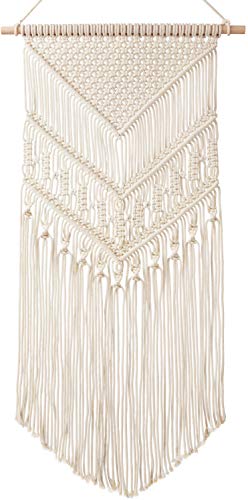
Choose a piece that suits the scale. A tall wall can take a large woven hanging, 30 to 48 in (76 to 122 cm) wide and as tall as 60 in (152 cm), and a piece that large reads as a statement without the cost of a big canvas. Look for hand-woven or well-made wool, linen or cotton in a flat pattern of broad bands and soft shapes, since a fine, busy pattern is lost on a distant wall.
Keep the palette quiet. Oatmeal, rust and cream sit well against warm oak and pale plaster, and the bands of color give the wall movement without noise. If the wall is a deeper color, choose a lighter piece, and if the wall is pale, a darker one will stand out.
Hang it correctly. A woven piece with a wooden rod is hung from two hooks or brackets screwed into studs, spaced a few inches in from each end of the rod. Weight depends on size and fiber, so check the figure and choose hooks rated for twice that. Keep the bottom edge at least 8 in (20 cm) above the nosing line at the point where it hangs, so a passing shoulder or a bag does not catch it.
Think about the sound. A large textile on a stair wall absorbs a measure of the echo, and the effect is noticeable in an open stairwell. Layer it with a runner on the treads and a rug at the foot, and the whole space sounds warmer.
Mind the dust and the light. Textiles gather dust, so vacuum them gently with a brush attachment every few weeks, and keep them out of direct sun, which can fade natural dyes. Wool is naturally flame-resistant to a degree, but keep any textile away from heaters and open flames.
Rotate the piece with the seasons. A heavier wool in the cold months and a lighter cotton in summer keeps the wall feeling fresh, and the rod makes swapping simple.
Key Takeaway: Hang a large woven textile on a rod from two stud-fixed hooks, keep it 8 inches above the nosing line, and vacuum it regularly.
“Light the Stairs From the Ceiling” Leaves the Wall in Shadow
 Save
A single bulb at the top of the stairs is the standard stair light, and it lights the steps while leaving the wall in a dull shade. A stair wall that is decorated and then left in the dark is a wasted effort. A plan with three types of light makes the wall look as good at night as it does at noon.
The first layer is ambient light, the overall glow that lets you see the stairs. A ceiling fixture at the top or a pendant in a stairwell does this, and it should be controlled from both the top and the bottom of the stair. Choose a warm bulb of about 2700K, and put the fixture on a dimmer if the wiring allows.
The second layer is accent light, aimed at the things on the wall. A slim picture light mounted above a frame, with an arm that projects about 6 to 8 in (15 to 20 cm), puts light directly on the art. On a stair wall, keep the projection short, so it does not catch a shoulder, and choose a plug-in model with a cord cover if hardwiring is not an option.
The third layer is low light, which guides the foot. A thin LED strip tucked under the handrail, or small lights near the baseboard, casts a soft glow on the treads and makes night trips safe. Pick a warm color and a strip rated for indoor use, and have any permanent wiring done by a licensed electrician.
Balance the three. The wall should be the brightest thing in the stairwell, the treads second and the ceiling the least. If the ceiling is the brightest, the effect feels flat, so aim the light downward and keep the fixtures shaded.
Mind glare. A picture light aimed at framed glass can create a bright reflection from the foot of the stairs, so test the angle by standing where people will stand. Matte or non-glare glazing helps. Aim a picture light slightly downward and check at dusk.
Think about the cost. A set of plug-in picture lights and a strip is a modest investment that makes a bigger difference than a new frame. Add the lighting first, and the art will feel more deliberate.
Key Takeaway: Layer ceiling, picture-light and low handrail lighting in one warm tone, test for glare from below, and keep fixtures shallow.

“Anchors Are Optional for Light Frames” Fails on a Stair Wall
 Save
A frame that weighs 5 lb (2.3 kg) can sit on a nail in a living room and nobody worries. On a stair wall, the same frame hangs above a drop, in a space where people lean on the wall, brush it with a bag, and slam doors that shake the plaster. The hardware matters more here than the art.
Begin by finding the studs. A stud finder run along the wall shows where the framing sits, and on a stair wall studs usually fall at 16 in (41 cm) intervals along the slope, or at 24 in (61 cm). Mark each stud with a pencil and a small piece of tape, and check by tapping or by probing with a thin nail in an area that will be hidden.
You've saved it, wanted it. Here's the how: codes, measurements, order. Your choices make it yours.

Match the fixing to the weight. A frame under 10 lb (4.5 kg) hangs from two picture hooks nailed at an angle into the wall. Heavier pieces need a screw into a stud, or a toggle or similar anchor rated for the load if no stud is available. Check the rating on the packet, and choose a fixing rated for at least double the weight of the piece.
Use two points for anything wide. A single hook lets a frame tilt, and on a stair wall a tilting frame looks wrong from every angle. Two hooks, spaced about a third in from each side, hold the frame level. A small piece of removable putty or a rubber bumper on the lower corners stops it from swinging.
Check the wall type. Plaster over lath, drywall and masonry each need different fixings. A masonry wall needs a masonry bit and plugs, and a plaster wall can crack if drilled with too much force. Drill pilot holes slowly and use a bit sized to the anchor.
Keep the heavy pieces low. The heavier the object, the lower it should hang, so if it falls it does less damage and cannot reach anyone on the stairs. Do not hang a heavy mirror or shelf directly above a step that people stop on.
Test it. Once a piece is up, press on it gently in several places, and check it again after a month. Wall fixings can loosen with vibration, and a stair wall vibrates every time someone climbs.
Key Takeaway: Find the studs, rate fixings at twice the load, use two points on wide frames, drill carefully, and hang heavy pieces low.

“Art Should Be Permanent” Overlooks the Rotating Stair Wall
 Save
A permanent gallery has a lot to recommend it, and a stair wall seems to ask for one. But the wall above a staircase is seen every day, and the same pieces in the same place for years can fade into the background. A wall that changes, even a little, keeps being seen.
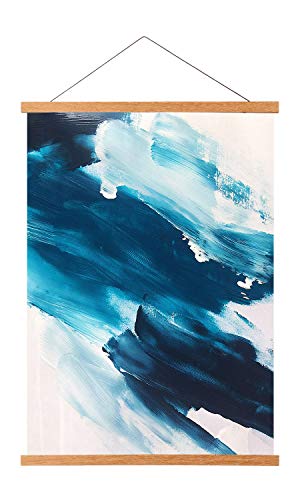
Build the structure once. A row of lightweight magnetic wood poster hangers, a picture rail or a set of clip frames fixed to the wall at the right height gives you a system that can take new pieces without new holes. A ledge shelf or a slim rail along the slope can hold prints, boards or small canvases that lean or hang.
Choose art that suits swapping. Abstract prints in a family of colors, such as sage, clay, cream and blue, are easy to rotate, since each piece sits well beside any other. Prints on paper in standard sizes are inexpensive and fit standard frames and hangers. Rotate three or four times a year with the seasons.
Keep a storage system. A flat portfolio or a basket at the foot of the stairs holds the pieces that are not on display. Label each with the date it went up and a short note on where it hung, and you will know what to bring back. A storage box in a closet keeps prints flat and free of damp.
Keep the structure consistent. Choose the hangers or frames in one material, such as pale oak, and the same hanging height for each. Leave 2 to 3 in (5 to 8 cm) between them, and keep the center of the group at about 57 in (145 cm) above the nosing line, so that rotating the art does not change the shape of the display.
Include a place for the household’s own work. A child’s painting, a drawing or a framed textile can go into a clip frame and be swapped when it is time for a new one. This keeps the wall personal and avoids a set-piece look.
Protect the work. Prints on paper fade in direct sun and curl in damp, so keep them out of strong light, use acid-free materials for anything you want to keep, and use glazing or a sleeve for valuable pieces. A sheet of acrylic is lighter and safer than glass on a stair wall.
Key Takeaway: Install a flexible hanging system once, choose prints that suit each other, store the spares flat, and rotate with the seasons.
“One Big Piece Looks Lonely” Forgets the Power of Scale on a Tall Wall
 Save
A tall stair wall invites a gallery, and a single piece seems timid by comparison. But one large piece, hung with confidence, often looks better than twelve small ones. It reads as a decision, it takes one hole to hang and it never needs dusting.
Think about scale first. On a wall that rises 9 to 12 ft (2.7 to 3.7 m), a piece 24 in (61 cm) wide looks like a postage stamp. A piece 36 to 48 in (91 to 122 cm) wide, or a pair side by side, has the weight to hold the wall. As a rule of thumb, the art should fill about two thirds of the width of the furniture or space below it.
Choose the position with the eye in mind. On a stair, the best spot is the wall you see as you climb or at the turn. Use painter’s tape to mark the outline on the wall, then stand at the foot, in the middle and at the top. The piece should be visible from each, and not hidden by the rail.
Hang it at a sensible height. The center of the piece should sit at about 57 in (145 cm) from the floor of the landing or half landing, or about 57 in above the nosing line on the slope. A piece that floats too high looks lost, and one that is too low blocks the path.
Anchor the piece well. A large canvas can weigh 10 to 20 lb (4.5 to 9 kg), so use two stud-fixed screws or a French cleat, a two-part bracket that spreads the weight along the wall. Check the rating and avoid sawtooth hangers for anything heavy.
Support it with a quiet vignette. A slim console, a lamp and a trailing plant beneath the canvas make the single piece feel placed. Keep the objects small, and no taller than a third of the height of the piece.
Use color to carry it. A soft abstract in sage, cream and clay works on warm white and with oak, and repeats on a nearby runner or cushion. Pick up one of its colors, no more, so the piece connects without being matched.
Finally, trust the empty wall around it. Space around a large piece is part of the effect, so resist the urge to add more.
Key Takeaway: Hang one large abstract piece 36 to 48 inches wide at about 57 inches to center, fix it with a cleat or two stud screws, and leave the wall around it empty.

“Smooth Paint Is the Only Finish” Overlooks Limewash, Paneling and Plaster
 Save
When the wall above a staircase feels blank, the instinct is to add things to it. But the quietest, most lasting way to decorate a stair wall is to give the wall itself some character. A texture or a surface can do what a dozen frames cannot, and it never needs rearranging.
Consider limewash. A limewash or a mineral paint gives a soft, cloudy, slightly uneven finish that catches light and shifts in tone through the day. It suits an older or plastered wall, and a warm white or soft gray limewash glows in a stairwell. Prepare the wall carefully, follow the maker’s instructions on priming, and test on a small area first, since the look depends on the base.
Consider paneling. Vertical wood slats, flat-panel wainscoting or a simple board and batten treatment on the lower two thirds of the wall adds depth and protects the wall from scuffs, which is useful on a stair. A picture rail or a thin horizontal trim at about 54 to 60 in (137 to 152 cm) finishes the top, and the wall above can be painted or limewashed.
Follow the slope. Paneling on a stair wall must follow the angle of the stair, which means each panel is cut at an angle, or the trim line steps up in parallel with the nosing line. A carpenter’s help for the first runs saves a lot of trouble, and the bottom edge of the paneling should follow the stringer, not a floor line.
Think about the budget. Slat paneling in solid wood is costly, but a version made from thin plywood or MDF strips painted or stained is less so. Choose a moisture-resistant material for a basement stair, and check that the paneling does not alter the clear width of the stair below the code minimum of 36 in (91 cm).
Add light to make the texture show. A sconce near the paneling throws a grazing light across the surface and emphasizes every slat, and the effect is stronger than any frame. Keep the bulb warm, and mount the sconce at about 60 in (152 cm) above the stair.
Leave the decor simple. With a textured wall, one or two pieces are enough, because the surface carries the interest.
Key Takeaway: Give a stair wall character with limewash or slat paneling that follows the slope, light it from the side, and then add very little.

“The Ceiling Is Not Part of the Wall” Ignores the Slope Above the Stair
 Save
The wall above the stairs usually stops at a line where it meets the ceiling, and many people stop decorating there too. But on a stair the ceiling slopes with the flight, and from below it is as visible as the wall. The most polished stairs treat the two as one surface.
Start with paint. Painting the ceiling the same color as the wall, in a matte finish, removes the hard line between them and makes the stairwell feel enveloping, not boxed. In a tall stair, this can make the space feel cozier, and in a low one it can make the ceiling appear to rise because the eye no longer sees the edge. A lighter tint of the wall color on the ceiling is a gentler version.
Add a line. A thin picture rail or a molding along the wall about 12 to 18 in (30 to 46 cm) below the ceiling gives frames something to hang from and gives the wall a defined top. Paint it in the wall color for a quiet look, or in black for a graphic line. It runs parallel to the stair, which strengthens the slope.
Use a pendant at the turn. A woven or paper pendant hung in the stairwell, at a half landing or above the turn, adds a soft light and a sculptural note. Check the clearance, since a pendant must be at least 6 ft 8 in (203 cm) above any tread below it, and a lower position is a head hazard. Choose a light, shaded fixture.
Think about the junction. Where the stair wall meets the ceiling along a slope, the line is rarely straight, and a bead of paintable caulk makes it neat. Paint the ceiling before the wall, cut in carefully with an angled brush and keep a steady hand. Use a stable platform and not a ladder on the stairs.
Look up. From the foot of the stair, the ceiling is what you see at the top of your view. A small detail, such as a skylight, a paneled section or a row of simple beams, can turn that surface into a feature. Add one only if the structure allows, and consult a builder before changing any ceiling.
Keep the decor calm. A single shelf with a ceramic jar below the pendant is enough, since the paint and the light do the work.
Key Takeaway: Paint the sloped ceiling to match the wall, add a picture rail parallel to the stair, hang a light pendant above 6 feet 8 inches, and keep the objects few.

“Hang Everything Level and in Rows” Is the Rule a Sloped Wall Breaks First
 Save
On a flat wall, frames hang level and in rows, and the rule is so familiar that it is carried up the stairs without question. On a slope, a perfectly level row of frames looks like a staircase has been drawn the wrong way. Each frame appears to tilt against the line of the steps, and the eye sees a mistake.
The better approach is to follow the stair. Establish the angle by laying a long level or a straight board along the nosing line, and use it to draw a parallel line on the wall at the height where the bottom of the frames should sit. Then hang each frame so that its bottom edge sits a consistent distance above that line, and each frame is itself level.
That is the crucial distinction. Each frame hangs level, because a tilted frame looks careless. But the group steps up the wall along the slope, so each frame sits a step higher than the last. The effect is a staircase of frames that climbs with the real one.
Measure the step. Choose a vertical offset between frames that matches the rise of a few treads, for example one frame for every two steps, so the spacing is about 14 to 15 in (36 to 38 cm) of vertical change per frame. Use a tape to mark the center of each frame, then adjust until the group looks even when seen from the bottom and from the top.
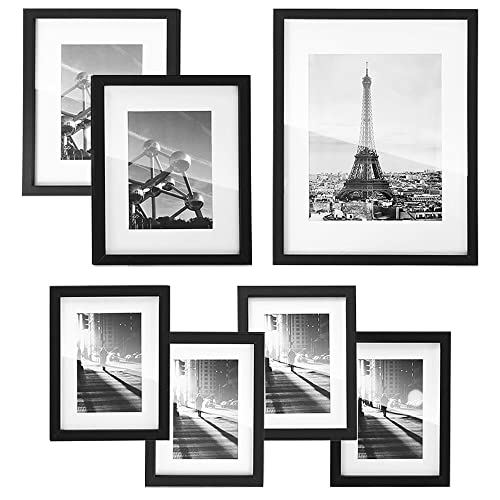
Keep the frames identical. Nine thin black frames of the same size, with the same white mat, make the stepping rhythm easy to read. If you want variety, vary the prints and not the frames. Abstract prints in sage, clay and blue color fields differ enough to be interesting but are united by the shared palette.
Plan with paper. Cut paper to the frame size, tape the shapes along the guide line, and walk the stair up and down. Check that every frame is clear of the handrail, since a rail that cuts across a frame looks clumsy, and make sure the lowest frame sits at least 4 in (10 cm) above the nosing line.
Use the rule of one level. Level the frames individually, and trust the slope to do the rest.
Key Takeaway: Hang each frame level but step the group up the wall parallel to the nosing line, in identical frames, with a paper plan first.
“A Mirror Doubles the Light” Needs a Window or a Lamp to Double
 Save
Every guide to dim stairs recommends a mirror. It is true that a mirror can lift a stairwell, but only when it reflects something worth reflecting. A mirror placed opposite a blank wall doubles the blank wall, and a mirror opposite a closed door doubles the door.
Find the light first. Stand where the mirror would hang and look straight into it in your mind. If the mirror would face a window, a lamp or a bright doorway, it will bounce that light into the stair. If it faces a dark corner, move it. A mirror placed at a right angle to a window, on the wall beside it, picks up the light too and avoids glare in your eyes.
Choose a tall, slim shape. Stairs reward a mirror that echoes the vertical, such as a rectangle 18 to 24 in (46 to 61 cm) wide and 48 to 60 in (122 to 152 cm) tall. A slim brass frame keeps it light. A very large or round mirror can look overbearing in a narrow space, and an ornate frame competes with the wall.
Think about safety. A glass mirror is heavy, a 20 to 40 lb (9 to 18 kg) piece is common, and it hangs above a stair. Fix it into studs with two rated anchors, use a safety backing film if available, and hang it at a height where it cannot be reached by a falling person. A large mirror leaning on a shelf or a floor looks relaxed but can slip, so secure it with a wall bracket or a safety strap.
Mind the reflection. At night, a mirror shows the stairwell lights, so a bare bulb behind you becomes a glaring spot in the glass. Use shaded sources and keep bulbs low and warm. Also, avoid hanging a mirror where it shows the top of the stairs from the bottom in a way that could confuse depth, particularly on a stair with dark treads.
Give it a companion. A narrow shelf beside the mirror with a vase of branches gives the reflection something living to repeat. The doubled branches look like a second vase, and a simple arrangement looks twice as full.
Test with a cheap mirror or a sheet of foil. A sheet of reflective material taped to the wall for a day shows you what will be reflected before you commit.
Key Takeaway: Place a tall slim mirror where it reflects a window or a lamp, fix it to studs, shade the lights it reflects, and pair it with a shelf.

“Hooks Mean Clutter” Overlooks the Peg Rail at the Foot of the Stair
 Save
The wall above the stairs is not only for art. At the foot of the flight, it is also the first wall a household meets as it comes in or goes up, and a few well-placed hooks can make it useful. The worry is clutter, and the fix is a rail with a limit.
Use a peg rail. A long board in pale oak, about 4 in (10 cm) tall and 36 to 48 in (91 to 122 cm) long, with five or six turned pegs, gives you a place to hang a bag, a scarf or a tote. The pegs should project 3 to 4 in (8 to 10 cm), and the rail should be fixed into studs, since coats are heavier than they look.
Set the height with care. For adults, 60 to 66 in (152 to 168 cm) from the floor works, and for children a second, lower rail at about 40 to 44 in (102 to 112 cm) is useful. On a stair wall, check that nothing hung on the rail projects into the stair’s clear width, which must stay at 36 in (91 cm) or more.
Limit what hangs. One peg per item and a rule of one bag per peg stops the pile-up. Keep the pegs for things you use daily, such as a bag, a scarf and an apron, and put seasonal things away. A rail with every peg full is a signal to edit.
Add a place for shoes. A narrow bench below the rail, 12 to 14 in (30 to 36 cm) deep, holds shoes underneath and a basket of mail on top. A round jute rug in front gives wet shoes a place to stand.
Make the rail part of the decor. Choose materials that suit the stair, such as oak pegs in the same tone as the treads, and let the items that hang on it be pleasant to look at, such as woven straw, linen and wool. The collection becomes a still life, and it changes as you use it.
Mind the stair. A rail near the stair foot should never be near the line of travel, since a dangling strap could catch on a passing hand. Keep it on the wall that faces the hall, not the wall beside the steps, and keep straps short.
Key Takeaway: Fix an oak peg rail into studs at 60 to 66 inches, limit one item per peg, add a narrow bench, and keep the stair’s clear width.

“A Stair Wall Stays Clean on Its Own” Forgets the Hands, Bags and Pets That Brush It
 Save
A stair wall is the most touched wall in the house. A hand slides along it for balance, a backpack scrapes it, a dog’s shoulder rubs a gray line along the bottom and a vacuum cleaner knocks the corners. Decorating it without planning for that wear leaves you touching up paint every season.
Start by finding where the damage happens. On most stairs it falls in a band between about 30 and 48 in (76 to 122 cm) above the nosing line, where hands, bags and shoulders meet the wall, and along the bottom edge where shoes and vacuum heads strike. Protect that band and the rest of the wall can stay delicate.
Wainscoting is the traditional answer. A flat-panel or board and batten treatment up to a cap rail at about 36 in (91 cm) takes the knocks, wipes clean and gives the wall a finished look. Paint it in a satin or semi-gloss enamel, which stands up to a damp cloth far better than wall paint. The cap rail also acts as a small ledge for a lamp or a frame.
If paneling is too much, choose the paint with care. A washable, scrubbable matte or an eggshell finish in a mid-tone hides marks better than white or a very dark color. Keep a labeled jar of the wall color for touch-ups, and wash the wall gently with a soft cloth and mild soap, testing a hidden patch first.
Protect the corners. Where the wall turns, outside corners take the worst of it, and a clear corner guard or a slim wooden bead protects the edge. Choose a style that matches the trim, and fix it with a small amount of adhesive or fine nails, following the maker’s instructions.
Think about pets and children. A low runner of washable wallpaper or a painted band at the height of a dog’s shoulder or a child’s reach can hide the line of grime. Keep leashes, bags and scooters on a hook or in a basket at the foot of the stairs, so they do not travel upstairs and rub the wall.
Be careful with frames. Anything on a stair wall below shoulder height will be knocked, so hang art above the damage band, at about 54 in (137 cm) or higher at its lowest edge, and use putty or bumpers to keep frames from swinging. A battery lamp on the cap rail should have a heavy base.
Finally, plan to maintain it. A five-minute wipe each month and a fresh coat of paint every few years keeps the wall in good order, and good paint protects better than bad paint under good art.
Key Takeaway: Protect the band between 30 and 48 inches with wainscoting or washable paint, guard the corners, and hang art above the damage zone.

Before you buy a single frame, tape a string along the nosing line of your stairs and hold paper templates against the wall. Decide which three things will be fixed, which one thing will change, and which light will make the wall look good at night. A wall above the stairs is a long, slow composition, and the work that matters is measuring, planning and lighting rather than filling. Place the first piece, live with it for a week, and add the next only when the wall asks for it.
You've saved it, wanted it. Here's the how: codes, measurements, order. Your choices make it yours.
 Save


