 Georgia
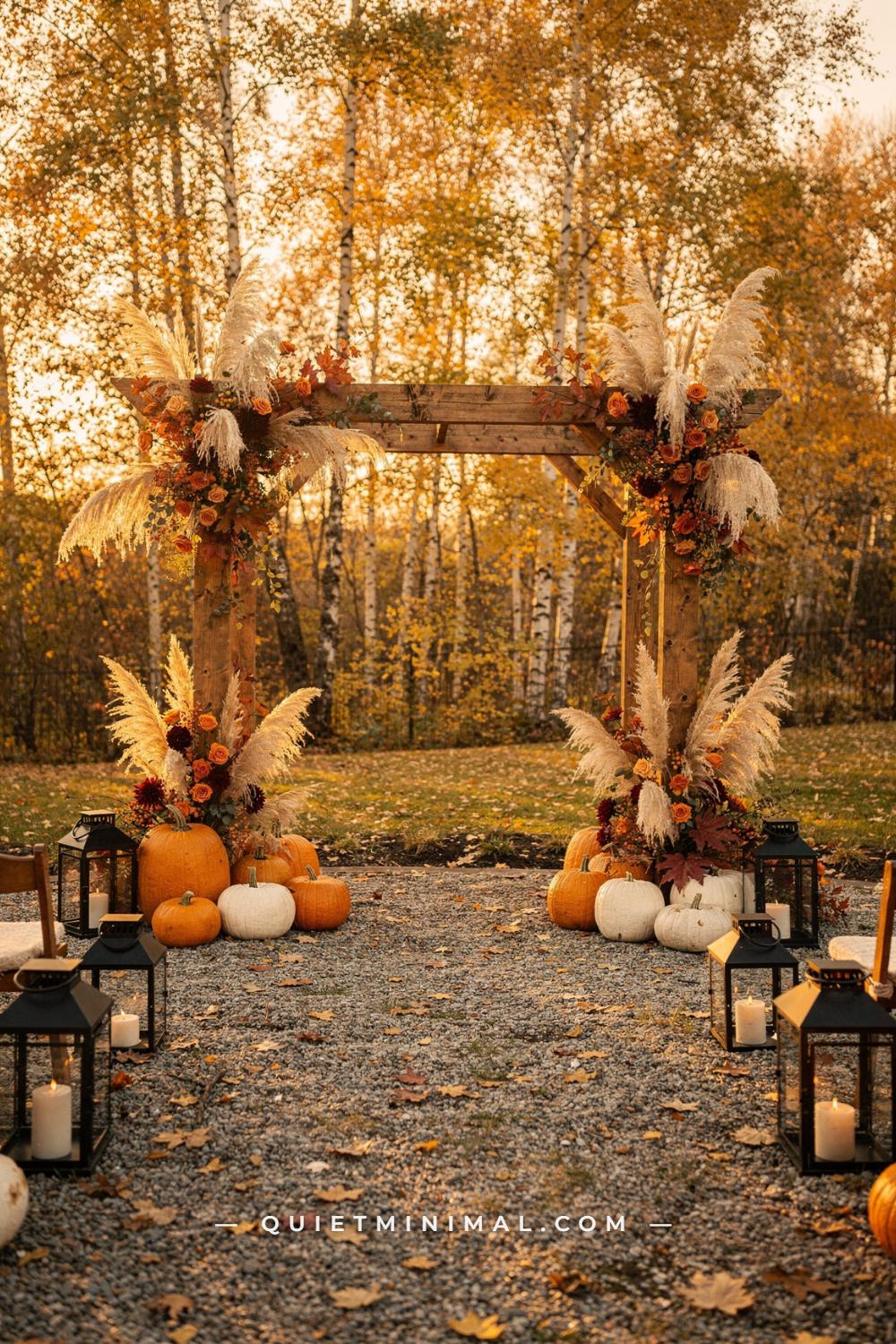
Fall wedding decorations are the easiest to fall for and the hardest to price, because the season hands you the palette for free and then charges for everything that carries it. The five sections further down this page still hold: the color story, the natural centerpieces, the rustic settings, the ceremony backdrops and the favors. What they never gave you is a number. This block sits above the old advice as the decision layer: four palettes written as cards with the split for each, a per-table ladder at $25, $60 and $150 with a centerpiece recipe and a sightline height on every rung, the arch measured at 8 x 8 ft (244 x 244 cm) with its chiffon in yards, the pumpkins and lanterns counted for ten tables, dried against fresh by the stem, the runner sized for a round table and a long one, the candle count where the venue allows flame and the LED count where it does not, string lights by the foot for 100 guests, a rent-or-buy call per item, the short list of things to skip, and the six weeks it takes to do it without a florist’s crew. The photographs are the venues. The charts are the arithmetic.
The Welcome Table Declares the Palette Before Anyone Sits Down
 Save
The first thing a guest sees is the table by the door, and that table is where the palette gets announced or gets muddled. A 5 x 2 ft (152 x 61 cm) raw wood trestle draped in rust gauze is the base color at full strength; the brass urn, the 18 x 24 in (46 x 61 cm) gilt frame and the brass candlesticks are the metal; the navy and terracotta 12 in (30 cm) tapers and the burgundy dahlias are the accents. Everything the reception will repeat is on this one surface, so a guest reads the whole story in three seconds and every table afterward feels intentional rather than assembled.
Build it in three heights. The urn of garden roses and delphiniums stands about 24 in (61 cm), the tapers at 12 in (30 cm), and the two 14 in (36 cm) brass box lanterns sit on the pavers at floor level, so the eye steps down from bouquet to flame to floor. A single height reads as a shop counter; three heights read as a room.
This is also the table that pays for itself twice. The urn moves to the head table after the ceremony, the lanterns go to the aisle mouth, and the gauze becomes the head-table runner. Budget it as the prototype: whatever you cannot afford to repeat ten times over stays here, where one of it is enough.
Key Takeaway: Put the base color, the metal and both accents on the welcome table at three heights, then reuse every piece of it at the reception.

Four Fall Palettes as Cards, With the 60/30/10 Split for Each
 Save
Every fall palette that photographs well is three colors in fixed proportion, never two in equal halves. The base takes 60 percent and it is nearly always a linen: oat, ivory or cream on every tablecloth and chair pad. The second color takes 30 percent and lives in the runner, the drape and the florals. The accent takes 10 percent and belongs to the candles, the ribbon and one metal. Hold that split and any of these four cards works in a barn, a tent or a backyard.
Rust and sage: oat linen base, a rust gauze runner and terracotta chiffon at the arch, toffee roses, orange dahlias and preserved eucalyptus, terracotta tapers, aged brass. Burgundy and navy: ivory linen base, burgundy dahlias, trailing burgundy amaranthus and orange garden roses, navy tapers as the 10 percent, aged brass. Mustard and cream: cream linen base, a mustard velvet runner, solidago, marigolds and wheat, ivory pillars, black iron. Terracotta and blush: oat linen base, terracotta chiffon and dusty rose garden roses with pampas plumes, blush tapers, antique gold.
Two rules ride along. Burgundy carries a whole room only as an accent; as the 60 percent it goes heavy and dark by candlelight. And pick one metal for the entire day; the current reports have gold on 43 percent of October to December weddings, and it is the antique finish that photographs, never the shiny one.
Key Takeaway: Choose one card, keep the linen at 60 percent, the florals and drape at 30, the candles and one antique metal at 10.

A Chiffon-Swagged Arch at the Water, Where the Fabric Does the Work
 Save
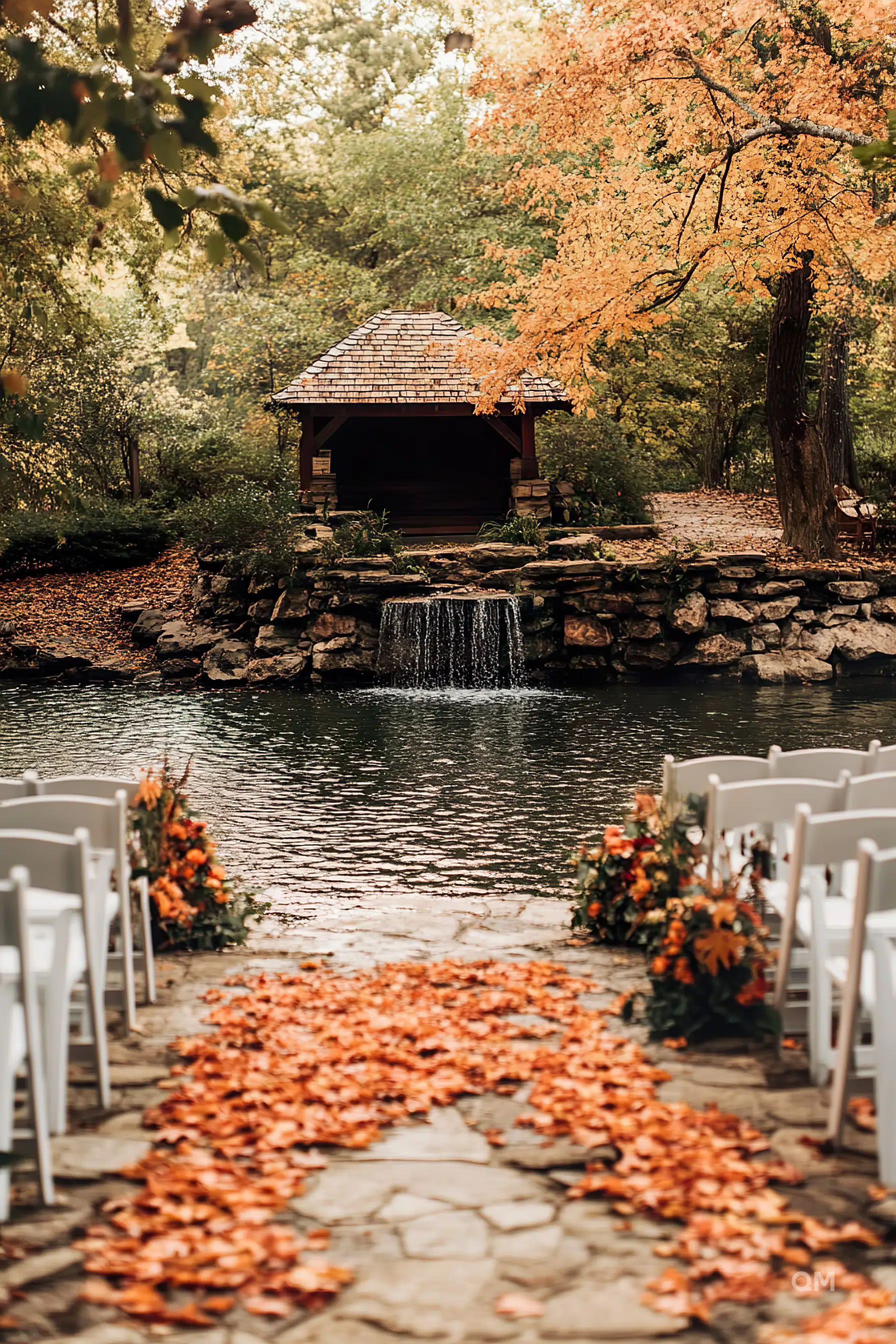
From the last row of chairs, nobody sees a rose. They see color and movement, and on a 9 ft (274 cm) post arch the thing that moves is chiffon. Two 3-yard (2.7 m) panels, burnt orange and burgundy, looped over the beam and gathered at the top corners give the arch its shape from 100 ft (30 m) away; the florals only need to exist where the fabric gathers, at the two upper corners, in clusters of orange and ivory garden roses with copper heuchera for the dark note. That is roughly a third of the stems a fully massed arch takes, for a backdrop that reads bigger.
The base is the part most people forget. Four brass lanterns at 12 in (30 cm), two at each post, stop the arch looking as if it floats, and the maple-leaf carpet on the dock planks carries the palette to the ground without a single extra flower. Overcast light is the friend here: burgundy goes black in direct sun and glows flat gray-red under a cloud, which is the color you saw on the mood board.
By water, weight the chiffon. A dock breeze turns a 3-yard panel into a flag, so tie the tails at 18 in (46 cm) off the deck or drop a drapery weight into each hem, and keep the lantern candles behind glass on every side.
Key Takeaway: Let two panels of chiffon shape the arch and spend the florals only where the fabric gathers.

Backdrop by the Numbers: The 8 x 8 ft Arch, the Drape Yardage and the Floral Coverage
 Save
The standard ceremony arch is 8 ft (244 cm) tall by 8 ft (244 cm) wide: two 4 x 4 posts and one beam, which at current prices is $50 to $70 in lumber and screws to build, $30 to $100 to buy from a big-box retailer, $125 to $350 from a specialty maker, or about $100 to rent as a bare wood frame. Give it a footprint: 24 in (61 cm) base plates on a hard surface, 12 in (30 cm) stakes into lawn, and it will stand in a breeze without a bride’s hand on it.
Chiffon comes 58 in (147 cm) wide at $4.50 to $8 per yard. One full panel runs down a post, across the beam and down the other post, 24 ft (7.3 m) of travel, plus one third for the swag and the puddle: 32 ft (9.8 m), so 11 yards (10 m). Two crossing colors are 22 yards (20 m), $100 to $175 in fabric. A beam-only swag with short tails is 3 yards (2.7 m).
Florals cover corners, never the whole frame. Two upper-corner masses at 24 to 30 in (61 to 76 cm) wide and 18 in (46 cm) deep read as full from the aisle; a single asymmetric column down one post runs 4 to 5 ft (122 to 152 cm). Faux corner swags cost $23 to $125 each; a florist’s half-covered fresh arch runs $850 to $1,500. Finish with a lantern pair at each post, 12 to 18 in (30 to 46 cm) tall.
Key Takeaway: An 8 x 8 ft arch takes 11 yards of chiffon per color, two corner masses of florals, and a lantern pair per post.

Dressing the Aisle: Ribbon Bows on Every Third Chair and Lanterns in Threes
 Save
An aisle is a repeating pattern, and repeats are cheap if you set the interval right. Ten rows of French crossback chairs on each side, the natural wood doing most of the work, need a bow on every third chair: rows one, four, seven and ten, four bows a side, eight in all. A 2 in (5 cm) rust satin ribbon with 24 in (61 cm) tails and a hand-sized bunch of ivory and orange garden roses reads from the back row; a bow on every chair reads as a bridal shop.
Lanterns go in clusters of three, in three places: the aisle mouth, the midpoint and the arch. Brass hexagonals at 18 in (46 cm), 14 in (36 cm) and 10 in (25 cm) with 4 in (10 cm) pillar candles, each cluster ringed with a few roses and eucalyptus at the gravel, give three points of light for nine lanterns rather than a row of twenty that no one notices.
Petals are the one thing to under-order. A light scatter that still shows the gravel between the petals reads as romantic; a solid carpet reads as a florist’s invoice and turns slick under a heel. On a 40 ft (12 m) aisle, two quarts of loose petals is the whole runner.
Key Takeaway: Bow every third chair, cluster lanterns in threes at the mouth, the middle and the arch, and scatter petals lightly enough to see the ground.

Pumpkins, Gourds and Lanterns by Count for Ten Tables, One Aisle and One Arch
 Save
Count before you shop, because pumpkins are the item people overbuy by half and lanterns the item they underbuy by half. For a reception of 100 guests at ten tables, the table count is three mini pumpkins at 2 to 4 in (5 to 10 cm) and two warty gourds at 3 to 5 in (8 to 13 cm) per table: 30 minis and 20 gourds. The welcome table takes six more minis. Order 40 minis, which at farm bulk pricing of $1.00 to $1.50 each at current prices is $40 to $60, and a box of 50 shipped covers it with spares.
Medium pumpkins at 6 to 10 in (15 to 25 cm) belong outside. The aisle takes seven to nine in total, set singly at the mouth and beside each lantern cluster so each one is seen on its own; the arch takes four, two at each post. Twelve mediums for the whole ceremony is the number, and a mix of orange with white Lumina types keeps it from reading as a patch.
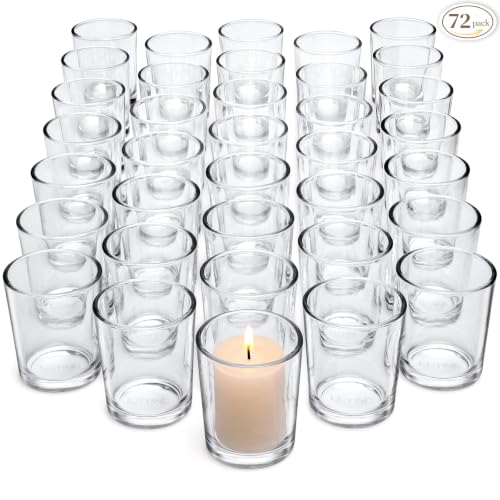
Lanterns: six on the aisle, two to four at the arch, two on the welcome table, and ten on the tables only if the tall lantern is your centerpiece. That is 20 to 22 lanterns, which is why they rent at $6 to $18 each rather than get bought. Votives run four to six per table plus six at the welcome table: 60 glass votives, bought, because they are cheap and reusable.
Key Takeaway: Ten tables need 40 minis, 20 gourds, 12 medium pumpkins, 20 to 22 lanterns and 60 votives; count first, then buy.

The Tall Centerpiece That Keeps Sightlines Open
 Save
The rule that decides whether guests talk across the table is a height, not a flower. Anything between 12 and 24 in (30 and 61 cm) sits at seated eye level, so a centerpiece is either under 12 in (30 cm) and seen over, or over 24 in (61 cm) and seen under. A 24 in (61 cm) black iron lantern with an 8 in (20 cm) square footprint is the tall option done right: the glass column is narrow enough to look past, the 4 in (10 cm) pillar inside puts the light above the plates, and the two 2 in (5 cm) votives at the base bring a little flame back down.
The collar is what makes it a centerpiece instead of a lantern. Peach and deep orange garden roses, eucalyptus rounds, blackberries and burgundy maple leaves wreathed around the base spread to about 18 to 20 in (46 to 51 cm), which is the one-third of a 60 in (152 cm) round that a centerpiece is meant to occupy, and none of it rises above 6 in (15 cm), so the sightline stays clear.
Uplighting does the rest. An amber wash on the draped wall behind turns black iron into a silhouette and deepens every red on the table, which is why the jewel-toned version of this palette needs less flower than the daylight one.
Key Takeaway: Go over 24 in with a slim column and a low collar, or under 12 in; never the 12 to 24 in band where faces are.

The Per-Table Budget Ladder: $25, $60 and $150, With a Recipe and a Height for Each Rung
 Save
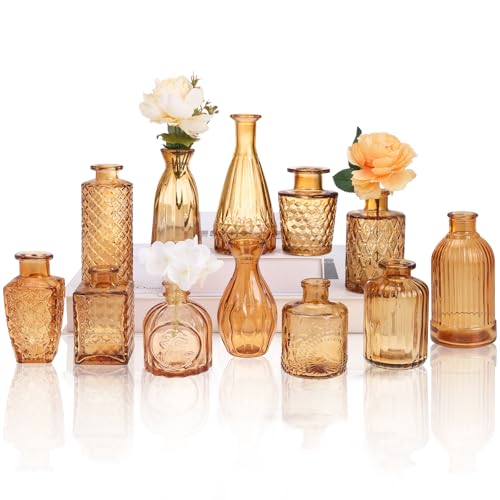
At current wholesale and big-box prices, a table has three honest price points, and the recipe changes at each one rather than the quantity. The $25 table: three amber glass bud vases at 8 to 12 in (20 to 30 cm) for about $9, two fresh garden-rose stems at $2 to $4 each and three dried stems of wheat, solidago and strawflower for about $8 together, three mini pumpkins for $4, four glass votives for $4, all on a 14 to 18 in (36 to 46 cm) wood slice. Finished height 10 to 12 in (25 to 30 cm), seen over.
The $60 table: a 6 in (15 cm) mason jar wrapped in burlap, twelve mixed fresh stems of cream and burgundy roses, blush spray roses and eucalyptus at about $2.50 average, $30; a 10 ft (3 m) gauze runner, $12; four LED tapers, $11; three mini pumpkins, $4; four votives, $4. Finished height 12 in (30 cm), still seen over.
The $150 table: a 24 in (61 cm) black iron lantern, $35 to $40; a fresh wreath collar of twenty stems of garden roses, eucalyptus, blackberries and maple, $60; an 18 in (46 cm) woven linen runner, $20; four tapers, $12; six votives, $6; three minis, $4. Height 24 to 28 in (61 to 71 cm), seen under. For scale, a florist’s fresh centerpiece runs $120 to $600 and a dried one $13 to $300, so every rung here is a DIY price.
Key Takeaway: Pick the rung by the height it buys: $25 and $60 stay under 12 in, $150 clears 24 in, and none of them lands between.
Dried Stems in Amber Glass: The Florals You Buy Once and Move From Ceremony to Reception
 Save
The cheapest fall florals are the ones that were never fresh. Seven amber and dark brown pharmacy bottles at 6 to 14 in (15 to 36 cm), one dried stem in each, wheat, strawflower, solidago, a mini pampas plume, russet oak leaves and a copper heuchera, cost about $20 as a grouping and look like more because the bottles carry the color before the stems do. On a light oak console against a warm off-white wall it is a welcome vignette; on a table it is a $25-rung centerpiece; at the ceremony it lines the signing table. Same seven bottles, three jobs.
That is the real argument for dried: it is portable and it is ordered six weeks out, inspected on arrival and never wilts in a hot barn. One stem per bottle is the discipline. Two stems and the bottle reads as a bouquet in the wrong vase; one stem and the silhouette of each botanical shows, which is the point of choosing wheat and strawflower over a mixed bunch.
Keep three 2 in (5 cm) votives at the base and nothing else. Dried stems and open flame belong 6 in (15 cm) apart, and the glow through amber glass is what makes the grouping read as warm rather than brown.
Key Takeaway: Seven bottles, seven single dried stems, three votives: buy it once and move it from the door to the ceremony to the table.

Dried vs Fresh Florals by Cost, From a Single Stem to the Whole Arch
 Save
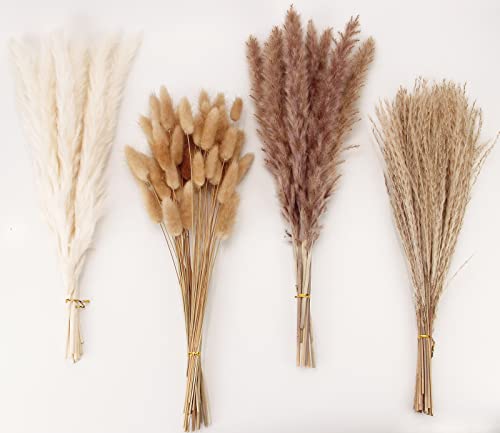
By the stem, dried and fresh are closer than the mood boards suggest. Wholesale standard roses run about $1.50 a stem, garden roses $1.69 to $2.99 and the David Austin types about $4; a florist’s retail stem is $2 to $8. A natural dried pampas bunch is $18, a fresh five-stem pampas bunch $30, and a 250-stem box of dried filler works out near $1.20 a stem. The gap opens at the arrangement, because fresh needs a florist’s hands and a contingency for the day. A finished fresh centerpiece runs $120 to $600 against $13 to $300 dried; a ceremony structure $1,500 to $4,000 fresh against $200 to $1,500 dried; reception decor $600 to $4,000 against $300 to $2,000.
The split that gets both looks is 80/20 by volume. Eighty percent dried and preserved: pampas, wheat, grasses, preserved eucalyptus, strawflower, the stems that hold the shape and the bulk. Twenty percent fresh, all of it at eye level and hand level: the garden roses in the bouquet, the dahlias and amaranthus at the arch corners, the six focal stems in each centerpiece collar.
Timing follows cost. Dried ships six weeks out and sits in a closet; fresh arrives two to three days before and needs a night in buckets. Order the dried now and the fresh last.
Key Takeaway: Buy 80 percent of the volume dried and 20 percent fresh where hands and eyes land, and the arch drops from four figures to three.
Runner, Pillars and Votives Down a Long Farm Table
 Save
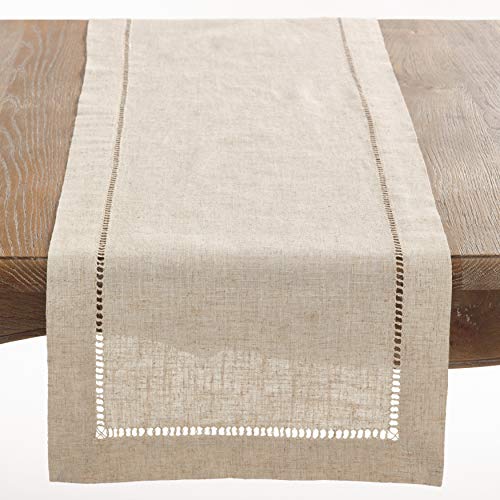
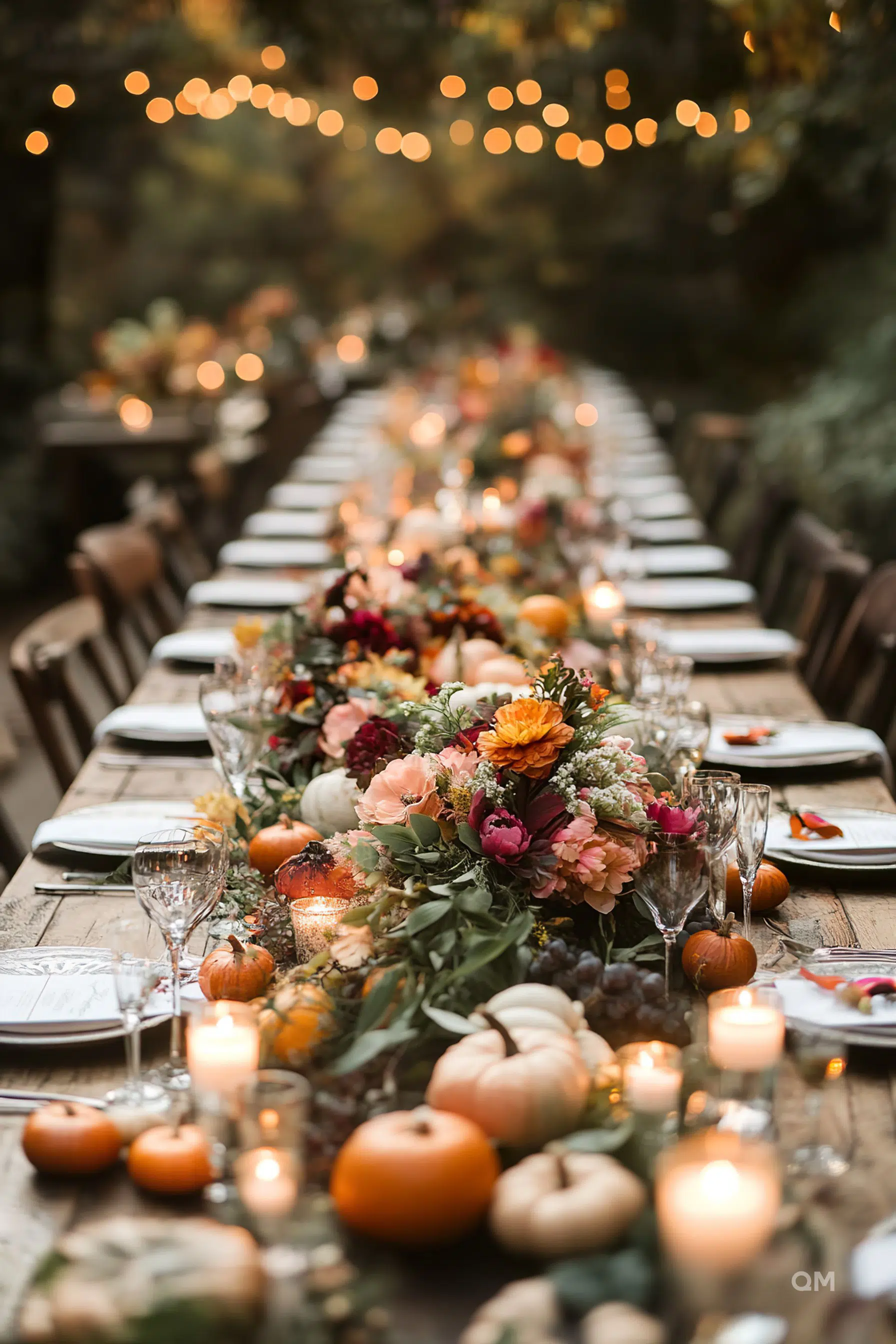
A long table needs no centerpiece at all if the runner is the centerpiece. On an 8 x 3 ft (244 x 91 cm) reclaimed farm table, an 18 in (46 cm) woven linen runner takes the middle third and everything sits on it: a low band of deep orange garden roses, burgundy dahlias and dusty pink mums no taller than 8 in (20 cm), 6 in (15 cm) pillars staggered rather than lined up, votives between them, and orange and green pumpkins at 4 to 8 in (10 to 20 cm) set singly so each one is seen with room around it, seven to nine down the whole length.
The spacing is what keeps it from looking heaped. Place settings sit 24 in (61 cm) apart, and the runner’s contents stay inside a 12 in (30 cm) center lane so the gold charger and the amber goblet at each seat have their own 12 in (30 cm) of bare plank. Fill the goblets with sparkling apple cider before guests sit, so the amber glass glows under the candles from the first photograph.
Dark wood asks for warm light from below. Pillars at table height and votives at plate height put every flame under the eye line, which is what makes dusty pink read as pink and not as gray against reclaimed planks.
Key Takeaway: On a long table let an 18 in runner carry a low 8 in floral band, staggered pillars and single pumpkins, and keep a 12 in bare lane at every seat.
Runner Widths and Lengths for Round vs Long Tables, and the Candle Count per Table
 Save
Runner width is the same everywhere: 14 in (36 cm) as the standard, 16 to 18 in (41 to 46 cm) where the runner carries the whole centerpiece, and never past 18 in on a 30 in (76 cm) banquet table. Length is where rounds and longs part. On a 60 in (152 cm) round the runner goes edge to edge or just short of it: 60 to 72 in (152 to 183 cm), a 6 in (15 cm) drop at most. A 72 in (183 cm) round takes 84 to 90 in (213 to 229 cm). An 8 ft (244 cm) banquet table takes the table plus a 6 to 12 in (15 to 30 cm) drop at each end: 108 to 120 in (274 to 305 cm). Gauze breaks the rule on purpose: 10 ft (3 m) on a round and 10 to 12 ft (3 to 3.7 m) on a long table, puddled at the ends.
Candles by table: a 60 in round takes two tapers and four votives, or one pillar and four votives. A 72 in round takes three tapers and six votives. An 8 ft banquet table takes three staggered pillars, four tapers and six votives.
Where the venue bans open flame, and barns and historic houses often do, get it in writing and swap one for one: 11 in (28 cm) LED tapers run about $2.50 to $3 each at current prices, a six-pack with a remote about $15, switched on from the back of the room as the doors open.
Key Takeaway: Runner 14 in wide, edge to edge on a round and a 6 to 12 in drop on a long table; two to four tapers and four to six votives per table, LED one for one where flame is banned.
You've saved it, wanted it. Here's the how: codes, measurements, order. Your choices make it yours.


String Lights Overhead: The Glow That Makes Every Other Decision Look Right
 Save
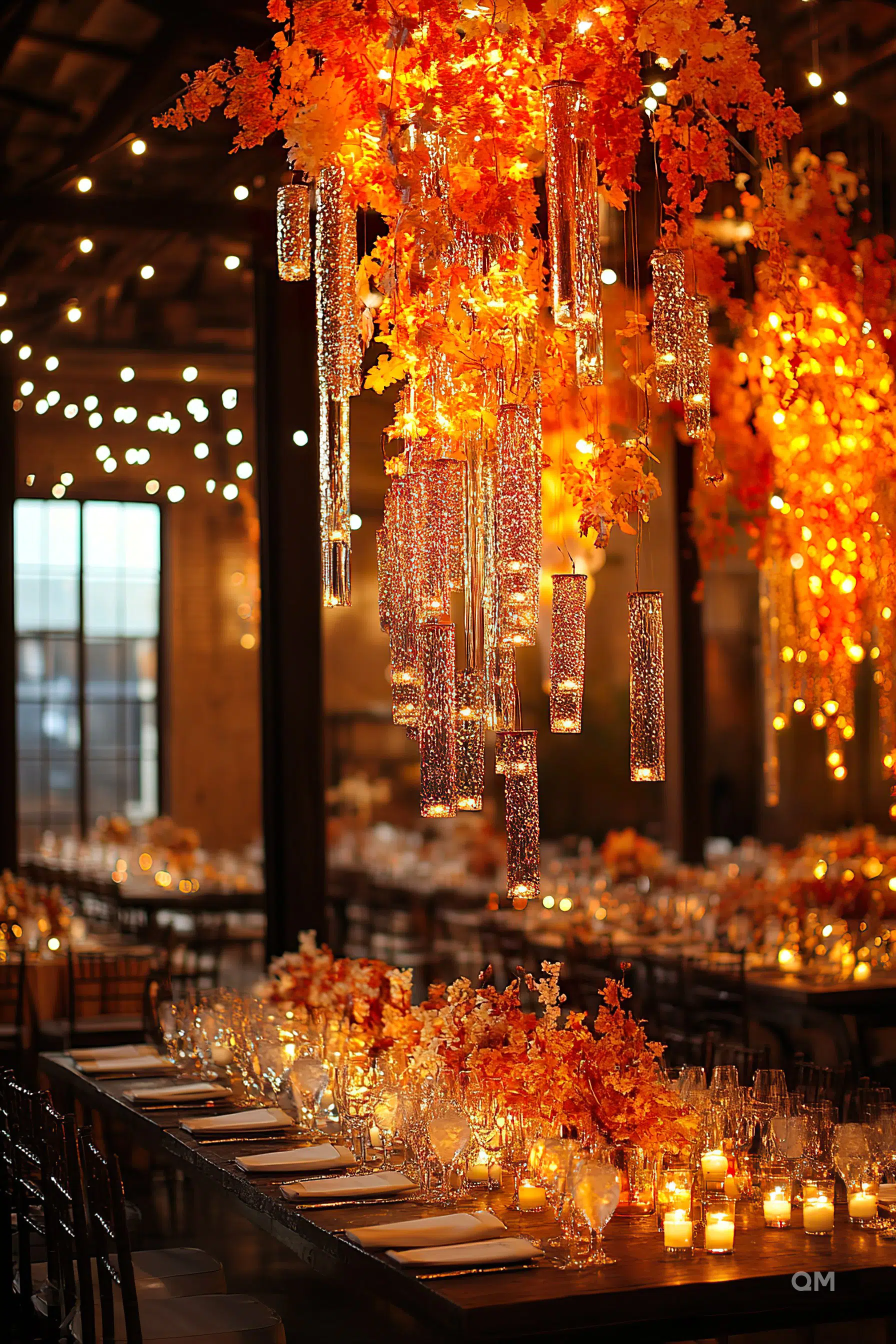
Every palette on this page was chosen by candlelight and most of them get judged under a tent at 7 pm, so the light overhead is the decision that makes the others hold. Cafe string lights at 2200 to 2700 K deepen terracotta, warm cream chiffon to ivory and turn black iron lanterns into silhouettes; the cool white strands sold for patios do the opposite, and one wrong strand undoes a week of palette work.
The number is 400 ft (122 m) for 100 guests. That is the lighting specialist’s figure for a 40 x 60 ft (12 x 18 m) tent, the size tent guides give for 100 seated, and it comes out the same as eight to ten commercial 48 ft (14.6 m) strands of 24 sockets at 24 in (61 cm) spacing. Consumer G40 LED strands run about $16 to $19 per 100 ft (30 m) and about $29 per 200 ft (61 m) at current prices, so 400 ft is $65 to $120 to own.
Hang it at 9 to 10 ft (2.7 to 3 m) so nobody ducks and the glow sits above the arch. A zigzag across the canopy lights the tables; a perimeter run lights the edges and leaves the center dark. For a ceremony in the garden, a single 100 ft (30 m) strand across the aisle canopy, as above, is enough, because the lanterns and the twilight do the rest.
Key Takeaway: 400 ft of 2200 to 2700 K cafe lights, hung at 9 to 10 ft in a zigzag, is the whole lighting plan for 100 guests.

Rent or Buy: The Big Eight Items by Cost per Use
 Save
The verdict changes item by item, so run each one as cost per use for a 100-guest day. The arch: rent a bare wood frame for about $100, or $150 to $500 with setup, against $50 to $70 in lumber or $30 to $100 to buy; build or buy, and sell it after. Lanterns, 20 to 22 of them: rent at $6 to $18 each, $200 to $360 for the set, against $15 to $35 each to buy; rent, and keep four to six you love for the porch.
Tablecloths, ten to twelve: rent at $6 to $18 each; buying at $10 to $20 adds the laundering, so rent. Runners: rent at $8 to $15 each or buy at about the same; buy, because they pack flat and become the next holiday table. Crossback chairs, 100 of them: rent at $6 to $12 each, $600 to $1,200; nobody buys a hundred chairs.
String lights, 400 ft: $65 to $120 to buy against a tent lighting package that costs more and goes back; buy. Chiffon, 22 yards: $100 to $175 to buy against a $25 draping add-on when the arch is rented; rent the add-on if you rent the frame, buy if you built it. Candles are consumable at any price; LED tapers are the one candle you buy and use for years.
Key Takeaway: Rent the chairs, the linens and the lantern set; build or buy the arch, the runners, the string lights and the LED candles.
What to Skip, and the Understated Arch That Proves It
 Save
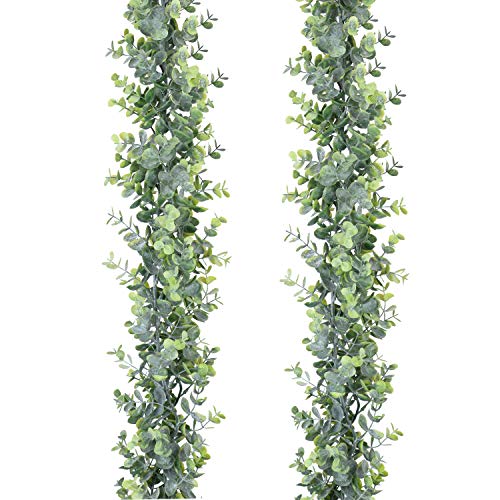
An 8 x 7 ft (244 x 213 cm) wood arch wrapped in one eucalyptus and foliage garland, two 14 in (36 cm) silver lanterns and a 24 x 96 in (61 x 244 cm) kilim runner on the grass is a complete ceremony, and it is complete because of everything it leaves out. When the hills are already gold and rust, the decor’s job is to frame them, which is what the list below protects.
Skip chair covers; a crossback or a folding chair is better bare. Skip a second palette for the reception; one card, all day. Skip mixed metals; the silver lanterns here would fight a brass urn on the welcome table. Skip carved pumpkins, which soften within days, and glittered dried stems, which shed onto every plate. Skip loose leaves on indoor floors and petals on a dock, both of them slick under a heel. Skip floating candles in shallow bowls, which gutter in any draft. Skip a lettered sign at every turn; one at the door is plenty, and the rest is signage. Skip a fully massed arch when a garland and two lanterns will do.
The rug is the one thing not to skip. A kilim runner costs less than a petal aisle from a florist, photographs from every row, and goes home to the hallway.
Key Takeaway: When the setting already carries the season, one garland, one pair of lanterns and one good rug is the whole ceremony.
The DIY Timeline From Six Weeks Out to the Morning Of
 Save
Six weeks out: choose the palette card, count the tables and the chairs, order the dried stems and the chiffon, and book the rentals for the arch frame, lanterns, linens and chairs while the season’s inventory is still there. Five weeks: build or buy the arch, dry-fit the chiffon on it at home and mark the swag points with tape, and run the string lights once across the yard to confirm the 400 ft (122 m) reaches. Four weeks: order candles, LED tapers, votives and runners, and get the venue’s flame policy in writing.
Three weeks: mock up one full table at the venue’s evening light and photograph it; whatever looks wrong in that photo gets changed now, not at the rehearsal. Two weeks: place the fresh floral order for delivery two to three days before, and buy the pumpkins and gourds, which keep for weeks unbruised. One week: pack one labeled bin per table with its exact count of vases, pumpkins, votives and tapers, fit batteries to every LED, and press the runners.
Two days: fresh stems arrive, cut and stand overnight in buckets. The day before: arch up, chiffon on, lanterns placed, string lights hung, about three hours for two people. The morning of: florals onto the arch corners three hours before the ceremony, tables set bin by bin, candles lit thirty minutes before the doors.
Key Takeaway: Dried and rentals at six weeks, one mock table at three, fresh flowers at two days, and a bin per table so the morning is unpacking, not deciding.

 Save
The original ideas from this article continue below.
Plan a fall-themed wedding with decorations that blend rustic charm with elegant touches.
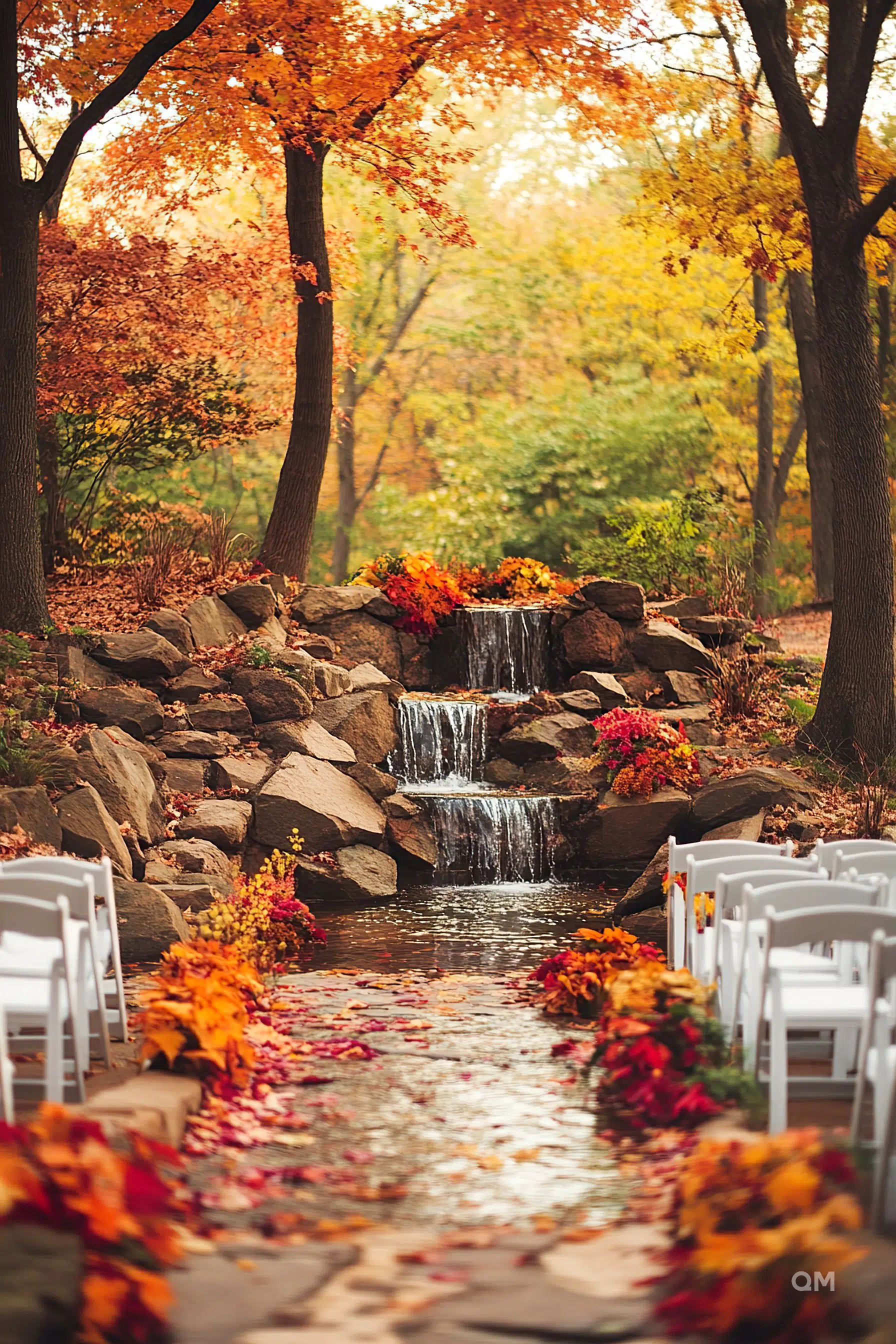
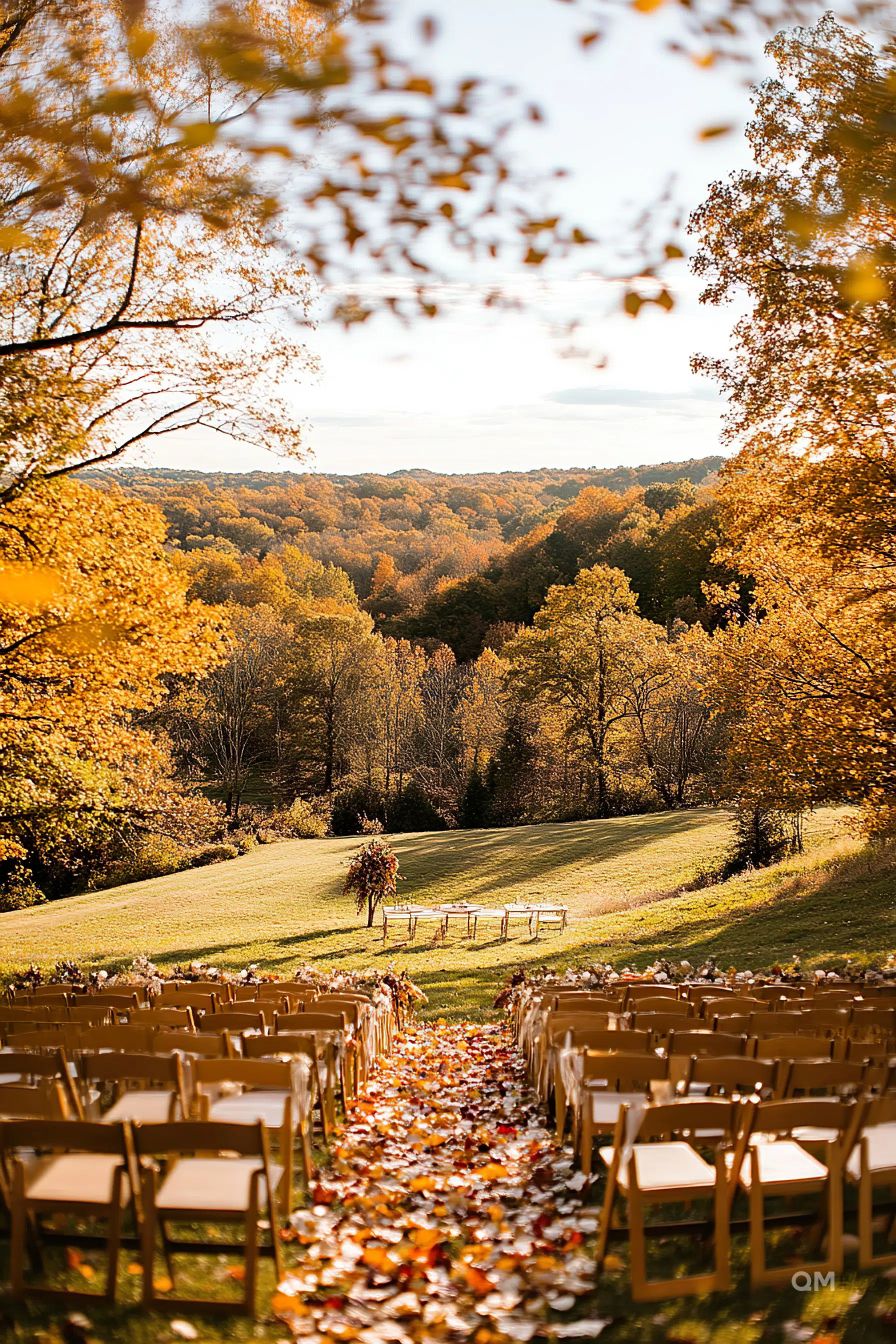
For a fall wedding, embrace rustic elegance by choosing a warm color palette of deep burgundy, burnt orange, and golden yellow. Blend these rich hues with neutrals like cream or taupe for balance. Use natural centerpieces featuring pumpkins, seasonal flowers, and greenery to invite warmth. Consider wooden tables with burlap or lace runners and mismatched vintage tableware for character. A floral arch or a rustic wooden backdrop draped in soft fabric can enhance the charm of the ceremony. Complete the experience with personalized wedding favors that echo the season. There’s much more inspiration waiting for you to explore!
Key Takeaways
- Embrace rich autumn colors like deep burgundy, burnt orange, and golden yellow to create a warm and inviting atmosphere.
- Utilize natural centerpieces featuring seasonal elements like pumpkins, colorful foliage, and fresh flowers to enhance rustic charm.
- Opt for mismatched vintage tableware and wooden tables to add character and warmth to your rustic table settings.
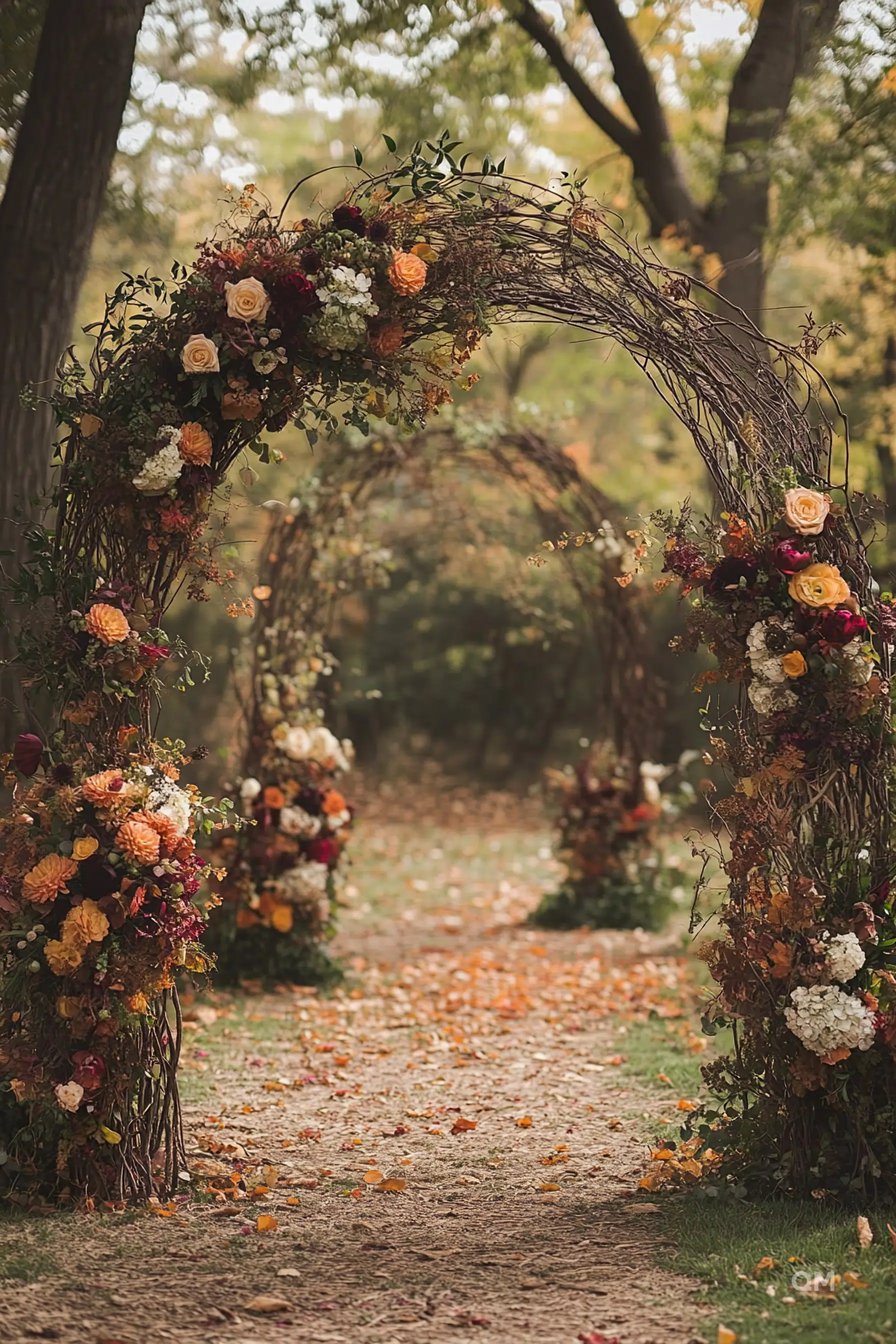
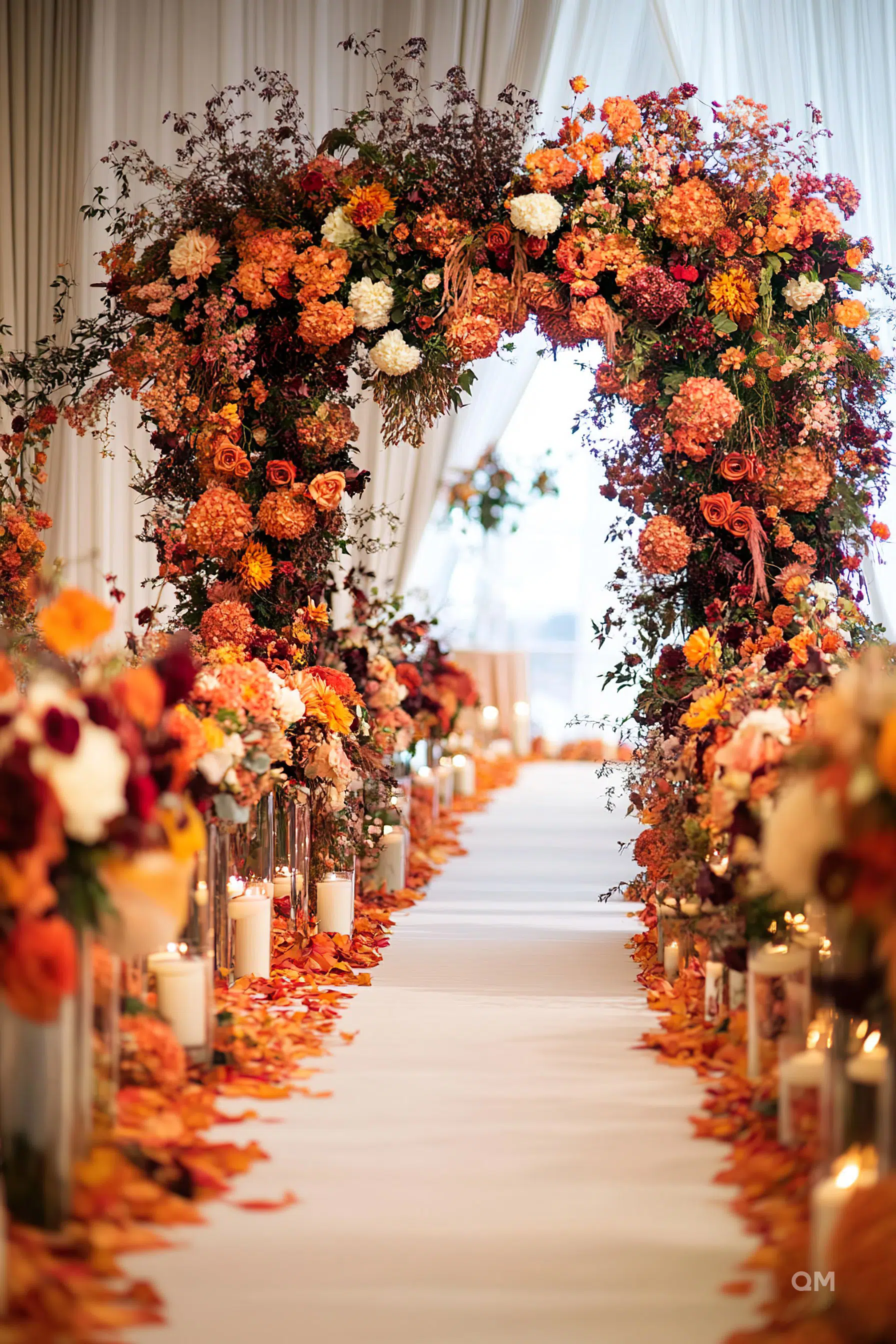
- Create stunning ceremony backdrops with floral arches, rustic wooden frames, or fabric draping in rich fall hues.
- Incorporate unique wedding favors like mini pumpkins or homemade treats, beautifully packaged with natural materials for a rustic touch.
Color Palette Inspiration
 Save
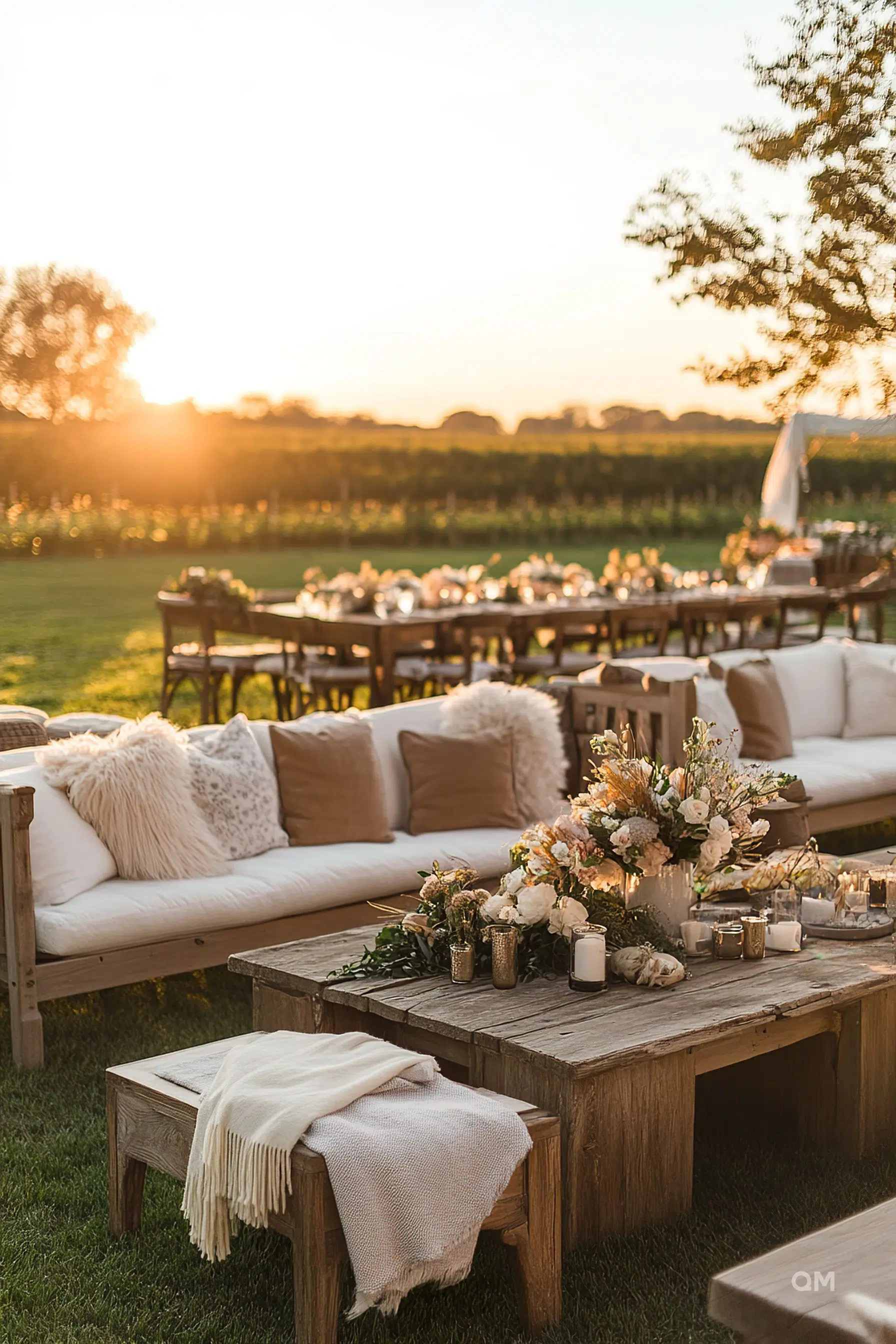
When choosing a color palette for your fall wedding, consider rich hues like deep burgundy, burnt orange, and golden yellow to capture the season’s warmth. These colors evoke the beauty of autumn leaves and create a cozy and inviting atmosphere. You can mix these shades with neutral tones like cream or taupe for balance, ensuring your decor feels elegant without overwhelming your guests.
Remember to incorporate accents of darker colors like navy or charcoal grey. These can add depth and sophistication to your palette, making it perfect for a rustic yet refined setting. You might also consider using metallics like copper or gold to bring a touch of glamour, especially in your table settings or signage.
As you finalize your palette, consider how it will translate across various elements of your wedding, from bridesmaid dresses to floral arrangements. Visual cohesion is key, so gather swatches and samples to see how everything works together.
Natural Centerpieces Ideas
 Save
For a stunning fall wedding, consider using natural centerpieces that showcase seasonal elements like pumpkins, gourds, and colorful foliage. With a variety of textures and colors that reflect the beauty of autumn, you can create a warm, inviting atmosphere. Start with small pumpkins or gourds as the focal point of each table. Opt for different sizes, colors, and shapes to add visual interest.
In rich autumn hues, incorporate fresh flowers like sunflowers, dahlias, or chrysanthemums. Arrange them in mason jars or vintage vases for an added rustic touch. You might also want to include natural elements such as pinecones, acorns, or branches to enhance that organic feel.
Don’t forget about greenery! Eucalyptus or ferns can beautifully complement your centerpieces, adding depth and a hint of softness. For a unique twist, consider using wooden slabs or distressed crates as bases for your arrangements, providing a charming rustic element without overpowering the natural beauty.
Lastly, consider adding candles for a warm glow. Votive candles nestled among the natural elements can create a cozy ambiance perfect for a fall celebration. Your guests will love the inviting and earthy vibe your centerpieces bring.
Rustic Table Settings
 Save
Rustic table settings, building on the natural elements of your centerpieces, enhance the overall charm of your fall wedding.
Think about using wooden farm tables or vintage dining tables to create a warm, inviting atmosphere. Layering burlap or lace runners adds texture and a touch of elegance while also highlighting the rustic theme.
For tableware, consider mismatched vintage plates and glassware. This eclectic mix adds character and can spark conversation among guests. Opt for wooden or ceramic chargers to ground the look. Incorporate natural elements like small pumpkins, pinecones, or seasonal flowers into your table decor.
Don’t forget about lighting! Use mason jars with fairy lights or candles to create a cozy glow. Taper candles in rustic holders can also enhance the ambiance, making the setting feel intimate and romantic.
Creative Ceremony Backdrops
 Save
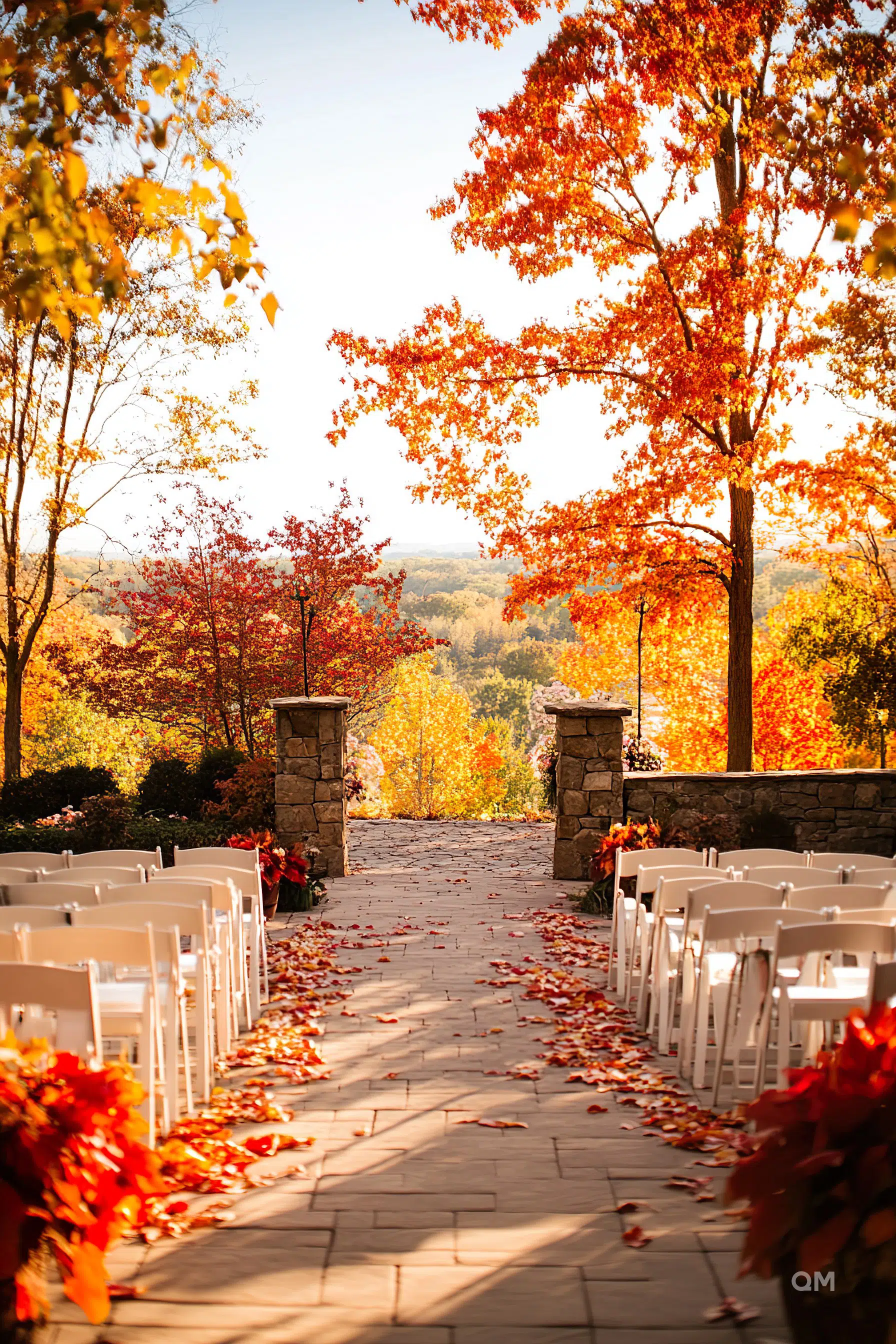
A stunning ceremony backdrop can transform your fall wedding, setting the perfect scene for exchanging vows. You’ll want to choose a design that reflects your style while embracing the cozy aesthetics of the season. Think about natural materials and warm colors that harmonize with the autumn landscape.
Consider these creative backdrop ideas:
| Backdrop Idea | Description |
|---|---|
| Floral Arch | A beautiful arch adorned with seasonal blooms like dahlias and sunflowers. |
| Rustic Wooden Frame | Use reclaimed wood to create a frame, draped with soft fabric or greenery. |
| Hanging Lanterns | Suspend lanterns from tree branches, adding a magical glow as the sun sets. |
| Vintage Door | Repurpose an old door, decorated with foliage and fairy lights for a charming look. |
| Fabric Draping | Soft, flowing fabric in rich fall colors can create a romantic atmosphere. |
These options enhance your ceremony and provide a stunning backdrop for photos. Whichever you choose, make sure it resonates with your vision, creating an unforgettable moment as you say, “I do.”
Unique Wedding Favors
 Save
Choosing unique wedding favors can leave a lasting impression on your guests while perfectly reflecting the charm of your fall celebration. Think about incorporating elements that resonate with the season. For instance, mini pumpkins or gourds can serve as delightful keepsakes, easily personalized with your name and wedding date.
Consider edible favors, like jars of homemade apple butter or spiced nuts. They not only taste great but also evoke the flavors of fall. You might also opt for small potted plants or succulents, symbolizing growth and love—your guests will appreciate the living reminder of your special day.
If you’re looking for something more interactive, create a DIY favor station. Provide supplies for guests to craft their favors, like scented sachets filled with seasonal herbs or dried flowers. This hands-on approach adds a fun element and encourages interaction.
Lastly, don’t forget to package your favors beautifully. Use natural materials like burlap or twine to highlight that rustic elegance. When your guests leave with a thoughtful, unique flavor, they’ll carry a piece of your fall wedding long after the celebration ends.
 Save
 Save
 Save
 Save
 Save
 Save
 Save
 Save
 Save
 Save
 Save
 Save
 Save
 Save
 Save
 Save
 Save
 Save
 Save
 Save
 Save
 Save
 Save
 Save
 Save
 Save
 Save
 Save
 Save
 Save
 Save
 Save
 Save
 Save
 Save
 Save
 Save
 Save
 Save
 Save
 Save
 Save
 Save
 Save
 Save
 Save
 Save
 Save
 Save
 Save
 Save
 Save
 Save
 Save
 Save
 Save
 Save
 Save
 SaveSave
 Save
 Save
 Save
 Save
 Save
 Save
 Save
 SaveSaveSaveSaveSaveSaveSaveSaveSaveSaveSaveSaveSaveSaveSaveSaveSaveSaveSave
Follow Quiet Minimal on Pinterest for more home design tips and inspiration.
You've saved it, wanted it. Here's the how: codes, measurements, order. Your choices make it yours.


