Georgia
If you have looked at a beautifully spare Swedish manor room and wondered exactly how it holds together, the answer is almost never a single statement piece. Gustavian style is a system: a specific palette, a handful of structural objects, a set of textile rules, and a layering sequence. Get the sequence wrong and you end up with something that reads as farmhouse, French country, or just aggressively grey. Get it right, and every room in the house has that quality of calm authority that makes people stop scrolling.
The style grew out of King Gustav III’s 1771 visit to Versailles. He came home determined to remake Stockholm into the Paris of the North, but Sweden’s economy forced him to work within constraints: paint instead of gilding, linen instead of silk, pine and birch instead of imported hardwoods. Those constraints became the aesthetic. What could have been a compromise became a design language so coherent that it has held for 250 years.
This guide walks you through it in order, from the walls outward. Each section covers one decision layer, names the failure mode that trips people up, and tells you exactly when that stage is done and you can move forward.
Stage 1: Commit to the Gustavian Palette Before You Buy Anything Else
 Save
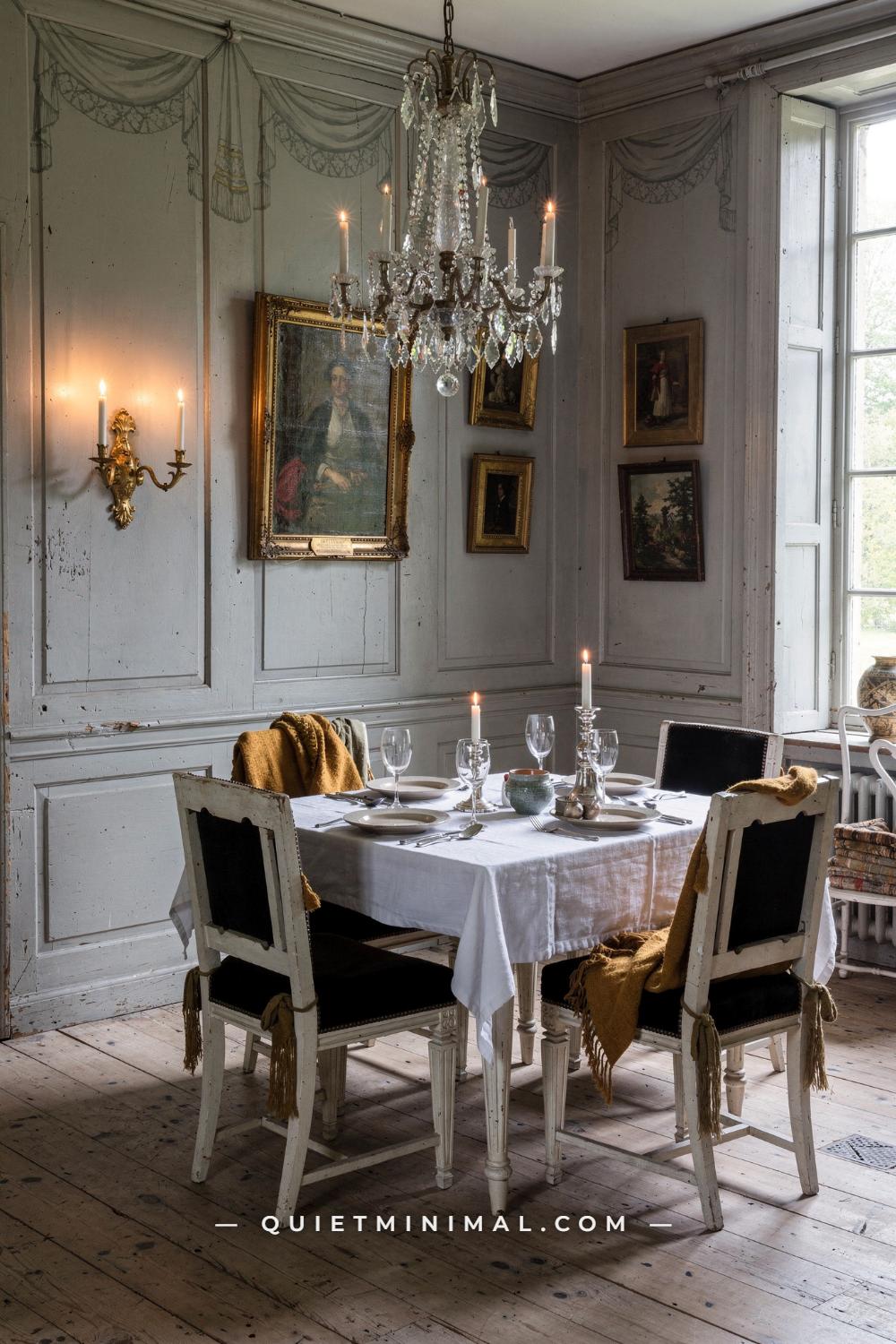
The single most common mistake in Gustavian interiors is starting with the furniture and working backward to a wall color. The palette is the foundation. In authentic Swedish Neoclassical rooms, the walls are almost always a toned, greyed colour, never a true white or a saturated hue. Think Swedish grey, which reads as a warm mid-grey with a slight stone or putty undertone. The trim, furniture frames, and table linen work in antique white, never a cold or blue-tinged white. Against that, accent tones of soft warm gold (for sconces and frames), and black for upholstered seat pads, complete the near-monochrome field.
The specific relationships matter. In a dining room, the walls should be two or three values darker than the chair frames. If both are the same antique white, the furniture disappears into the wall and the room reads as blank rather than restrained. The floor, in bleached or worn pine planks roughly 10 to 14 inches (25 to 36 cm) wide, provides the warmth that the grey walls hold back. Without that warm floor tone underneath, the room tips cold.
Gold is a secondary colour in this palette, not a primary one. A single gold sconce on one wall, projecting roughly 18 inches (46 cm), carries the warmth the room needs. More than two or three gilt objects in a standard dining room turns the gold into noise. One source of gilt at a time, placed deliberately, does the work that a dozen casual gold accessories cannot.
Trompe-l’oeil grey-on-grey swag garlands painted above the chair rail are one of the most distinctly Gustavian surface treatments and they are technically paint, not wallpaper. If you are working in a rental or with a limited budget, a printed wallpaper panel above the chair rail that reads as grey-on-grey swags achieves a similar effect. The key is that the motif and ground are nearly the same value: high contrast ruins the effect.
Key Takeaway: Lock your palette to Swedish grey walls, antique white trim and furniture frames, and one restrained gold accent before purchasing a single piece of furniture.

Stage 2: Understand the Enfilade Before You Arrange Furniture
 Save
The enfilade, a sequence of rooms whose doorways align on a single axis so you can see through all of them at once, is the spatial skeleton of the Swedish manor. Even if you are decorating one room in a modern apartment, understanding the enfilade tells you where to place your major objects: on the axis, or as visible anchors from the doorway.
In a corridor, the visual drama comes from three things working together: the floor plane extending uninterrupted through the space, the doors themselves painted in a dusty blue-grey approximately the value of the walls but clearly distinct from the antique white trim, and the overhead element. Here, rough-hewn timber ceiling beams painted in a deep Swedish red, close to a warm iron-oxide terracotta, provide the one moment of colour saturation in an otherwise muted scheme. The rule is that colour lives at the top of the room (beams, a painted ceiling) or at the floor (a worn bleached plank), not on the mid-height walls.
Wide-plank oak floor boards at 10 to 14 inches (25 to 36 cm) wide are not decorative fussiness: they are a proportion decision. Narrow boards, say 3-inch (8 cm) standard strip flooring, create a restless horizontal pattern that undermines the calm of the Swedish palette above it. If you are working with existing narrow strip floors, a room-width natural sisal or undyed wool flatweave can read as a single plane and recover some of that calm.
Glass hall lanterns hung on chains, at approximately 12 inches (30 cm) tall, give the corridor its vertical rhythm without adding visual weight. The temptation is to use more decorative fixtures, but in a Gustavian hallway the lantern is deliberately simple. Its transparency lets the architecture carry the room. If you use an opaque pendant shade, you interrupt the sightline down the enfilade and the whole effect collapses.
Gold-framed oil paintings in various sizes hung salon-style along the walls are the final layer, not the first. Set the palette, the floor, and the doors before you decide where the paintings go.
Key Takeaway: Treat every doorway as a picture frame: what you see when you stand at one end of your hallway should compose itself like a painting, with a clear floor plane, receding door rhythm, and one overhead colour note.

Stage 3: Choose Your Signature Wall Treatment and Finish It Completely
 Save
Once the palette is settled, the wall treatment is your next commitment, and it must be resolved before any furniture moves in. Gustavian walls are almost never flat drywall. They are either raised wood-panel sections in the classical wainscot format, or plaster walls with painted trompe-l’oeil panel frames, or, as in this reception room, sage-green paneled walls with delicate hand-painted floral garland motifs within the raised frames.
The sage green here is muted and slightly greyed, sitting between a terracotta kakelugn on one wall and the bleached blonde pine floor below. The pairing works because neither the sage green nor the terracotta is saturated: both are chalky, period pigment-derived tones. If you were to substitute a bright sage or a coral-orange terracotta, the palette would push from Gustavian into something altogether different.
The panel proportions in an authentic room typically place the chair rail at 32 to 36 inches (81 to 91 cm) from the floor, with lower panels occupying roughly one-third of the total wall height and upper panels two-thirds. If you are building false panels with applied moulding rather than true raised-and-fielded panels, the moulding profile matters: an ogee or ovolo profile reads as period-correct; a flat MDF shadow-gap profile does not.
Floral garland motifs painted within the raised frames are the layer that takes the wall from simply old-fashioned to distinctly Gustavian. These are not elaborate frescoes: they are slender, delicate vine-and-leaf or swag-and-ribbon motifs in a tone barely distinguishable from the ground. A skilled painter can complete a single panel in a few hours. The failure mode is painting the motifs too dark or too detailed: they should read as texture at normal viewing distance, not as illustration.
Wide bleached pine planks at 10 to 12 inches (25 to 30 cm) set the warmth threshold below the sage-green walls. If the walls are correctly muted and the floor is correctly pale, the shield-back chair with its faded red-pink stripe seat becomes exactly the right accent: a single warm note that the eye finds without being steered.
Key Takeaway: Complete your wall treatment, including panels, moulding, and any painted motifs, before placing any furniture, because the furniture scale is calibrated against a finished wall.

Stage 4: Map Your Furniture Types Before Buying Individual Pieces
 Save
Before you purchase a single Gustavian chair, map the full furniture vocabulary the style requires, because pieces work as a paired or grouped system. A single Gustavian shield-back chair against a wall with no companion reads as lonely rather than restrained. Two chairs flanking a mora clock read as deliberate and composed. Four chairs around a round breakfast table in a nook create a rhythm that any Gustavian room depends on.
The core furniture types in the Gustavian vocabulary are: the daybed with grey linen upholstery and bolster cushions, which functions as the bedroom’s principal seating surface; the wingback chair in natural pine or painted white, often paired with a mora clock in an entry vignette; the carved tester or canopy bed as the bedroom’s structural anchor; the gilded oval mirror above a white or painted settee; the round dining table for a breakfast nook or dining alcove; and the daybed with gilded iron frame as an alternative to the full tester bed. Each of these is a specific type with specific proportions, not an aesthetic mood applied to random furniture.
The failure mode at this stage is mixing Gustavian furniture with pieces that share nothing but a white finish. A white IKEA shelf unit is not Gustavian; neither is a white modern wingback. The identifying features of true Gustavian furniture are fluted legs at approximately 1.5 to 2 inches (4 to 5 cm) in diameter, carved rosettes on the apron corners, shield-back or barrel-back profiles, and a painted finish in antique white that shows slight distress at the edges, not heavy chipping throughout.
The palette coherence here, Swedish grey through antique white through aged gold through warm linen, works because all of these tones are low-saturation and similarly warm in temperature. Cold grey, stark white, or bright gold disrupts the field. When shopping across multiple sources, test swatches against each other in your actual room light before buying.
Key Takeaway: Map all six core furniture types you need before purchasing the first piece, and confirm each has Gustavian’s specific identifying features: fluted legs, carved rosettes, and a chalky distressed painted finish.

Stage 5: Source or Commission the Canopy Bed as Your Bedroom’s Structural Anchor
 Save
The tester bed is the non-negotiable centrepiece of a Gustavian bedroom. Without it, even a correctly painted room with the right chairs and the right floor will read as Swedish-inspired rather than Gustavian. The tester bed’s deep cornice canopy, at approximately 90 inches (229 cm) high, establishes the vertical scale that the rest of the room is built around.
The painted canopy frame here is in a grey-white distressed finish, the same antique white-grey field that covers the walls. This means the bed does not contrast the walls in colour: it contrasts them in form. The carved cornice and the volume of the canopy create the room’s drama, not a colour difference. If you paint a canopy bed in a tone that contrasts the walls, you fight the room rather than composing it.
The curtain fabric hanging from the cornice is black-and-white small floral printed cotton, roughly a 2-inch (5 cm) repeat scale. Two things define this choice: the scale (small-print, not large graphic) and the palette (black-and-white on a cream ground, no colour). The moment you introduce a coloured curtain fabric in a Gustavian bedroom, you shift the room’s register from period to eclectic. Blue gingham on one flanking chair provides the one note of pattern colour in the room, and it works precisely because it is the only one.
The crystal-and-bronze chandelier, at approximately 24 inches (61 cm) in diameter, is hung centrally over the bed rather than centred in the room. This is the Gustavian convention: lighting follows the furniture, not the architectural centre. Centring the chandelier in the room rather than over the bed is one of the most common layout mistakes and it makes the room read as unresolved.
Portrait paintings in gilt frames, at roughly 30 by 40 inches (76 by 102 cm) or larger, flank the bed on smooth plaster walls. Two paintings at this scale read as intentional; one reads as afterthought; four on one wall read as gallery rather than bedroom. Start with two.
Key Takeaway: Source the tester bed before any other bedroom furniture and hang the chandelier directly above it, not at the room’s geometric centre.

Stage 6: Build the Sitting Room Wall Vignette Around One Axis
 Save
The wall vignette is the compositional unit of Gustavian sitting rooms. Rather than arranging furniture in the middle of the room and decorating the walls separately, Gustavian interiors organize the seating against a specific wall and build the vignette outward from a central vertical axis. Here, the axis runs through the gilt-framed pastoral engraving, through the settee directly below it, to the floor.
The mora clock, at approximately 84 inches (213 cm) tall in its white painted case with a soft green face, stands to the left of this axis. It is not centred. It anchors the left side of the vignette and provides the vertical mass that the shorter settee and the relatively low-hung print cannot provide on their own. The linen curtain panel at the right edge of the composition provides a soft balancing element on the opposite side. Without it, the vignette reads as top-heavy on the clock side.
The settee is approximately 60 inches (152 cm) long in a carved white painted frame with blue-white ticking stripe cushions. The ticking stripe is one of the signature Gustavian upholstery fabrics, and its direction matters: vertical stripes make a seat back read taller, horizontal stripes make the settee read wider. For a settee of this proportion in a sitting room, horizontal stripes are the more grounded choice.
The gilt-framed pastoral print centred above the settee is roughly 20 by 24 inches (51 by 61 cm). The frame size should be at least two-thirds the width of the object below it: a narrow frame above a 60-inch (152 cm) settee reads as timid. The powder-blue wall behind is the field that makes both the antique white frame and the ticking stripe visible. If the wall were Swedish grey, the white elements would recede.
Key Takeaway: Build each sitting room wall around one vertical axis first (settee, print above, clock to one side) before adding any secondary seating or loose accessories.

Stage 7: Layer Folk-Art Painted Motifs for Farmhouse-Gustavian Rooms
 Save
Provincial or farmhouse Gustavian, sometimes called Gustavian folk, is the version of the style that moved out of the manor houses and into rural Sweden around 1780 to 1820. It layers hand-painted decorative motifs directly onto plaster walls, bypassing the formal raised paneling of the aristocratic interior. The visual logic is the same, but the execution is rougher and warmer.
Here, the cream-white plaster walls carry trompe-l’oeil panel frames painted in a dusty pink-red border, roughly the colour of iron oxide red pigment. Inside each frame, a delicate green vine-and-leaf trellis motif fills the field. The border and the motif together create the structure that formal paneling creates in the manor: a repeated rectangular grid that gives the room its discipline. Without that painted structure, the folk-art elements would read as random decoration rather than a system.
The dusty pink-red border sits against cream-white plaster rather than grey. This is the key difference between farmhouse Gustavian and formal Gustavian. The farm interior works in a warm cream-white field with warm accent tones: the pink-red border, the sage green vine, the natural gilded wood of the oval-back chair with its tan-and-cream check seat pad. The formal manor interior works in a cool Swedish grey field with cool accent tones. Both are valid Gustavian, but mixing the two palettes in one room produces confusion.
The alcove four-poster bed with polka-dot blush cotton curtains, at roughly 54 inches (137 cm) wide, reads as folk precisely because of the curtain fabric: the small-scale polka dot on blush is a domestic, provincial pattern, not the black-and-white formal floral of the manor tester bed. If you are building a farmhouse Gustavian bedroom, the curtain fabric should be small-print, warm-ground, and without any formal repeat structure.
The low plaid armchair at approximately 28 inches (71 cm) wide introduces a second woven pattern. In a formal Gustavian room, two patterns on upholstery is one too many. In a folk Gustavian room, two modest patterns that share a common warm ground can coexist if neither is high-contrast.
Key Takeaway: Folk Gustavian rooms use a cream-white field with iron oxide red and sage green accents rather than the cool Swedish grey of the formal manor, and painted panel frames do the structural work that raised woodwork does in the aristocratic interior.

Stage 8: Use the Enfilade of Rooms to Control Colour Recession
 Save
When you can see three rooms at once through aligned doorways, the walls of each room should be related but not identical. A Gustavian manor achieves depth by graduating colour values from the foreground room to the rooms beyond: the nearest room carries a slightly deeper or more saturated wall tone, and each successive room reads lighter. The eye reads this as atmospheric depth, the same principle painters use to push backgrounds away.
In this view, the foreground room carries a dusty lavender-blue limewash wall, noticeably deeper in value than the pale blue-grey rooms visible through the doorways. The rough limewash texture in the foreground room gives a visual weight that the smoother walls beyond do not have. Both are in the same cool blue-grey family, which is what keeps the sequence coherent: related hues at varying values, not different colour families from room to room.
The console here is approximately 48 inches (122 cm) wide with a marble-topped grey-painted base. It functions as the vignette anchor in the foreground room. The silver candlesticks at roughly 10 inches (25 cm) tall are deliberately tarnished rather than polished: Gustavian silver is meant to be aged. Polished bright silver reads as modern or formal-English rather than Swedish. The gilded Baroque mirror on the right wall at approximately 30 by 48 inches (76 by 122 cm) reflects ambient light across the room and adds a warm note against the cool lavender-blue field.
The stone garden urn draped with ivy on a pedestal is the kind of object that travels between Swedish manor interiors and the garden: a heavy, rough-textured mass that absorbs light rather than reflects it. It balances the mirror’s reflective quality. The combination of one matte, heavy object and one reflective, gilded object in each room is a Gustavian compositional habit worth following.
Key Takeaway: If you can see from room to room, paint each successive room one or two values lighter in the same hue family, and anchor each foreground with one reflective object (a mirror or silver) balanced by one matte, heavy object (a stone urn or painted chest).

Stage 9: Introduce Distressed Painted Objects as Period Anchors
 Save
Gustavian interiors almost always contain objects from multiple periods. A Baroque armoire from the early 1700s, predating Gustav III’s reign, sits alongside Gustavian chairs from the 1790s. The key to making this work without the room reading as antique shop is deliberate distressing: all surfaces read as aged by the same process of time, even if they were not.
The tall armoire here, at approximately 48 inches (122 cm) wide by 96 inches (244 cm) high, carries a grey-blue paint in a chalky, slightly dusty finish. Its carved scrolled pediment is a Baroque detail, not a Neoclassical one, but the grey-blue paint connects it to the Gustavian palette. The low painted chest in the foreground at roughly 48 inches (122 cm) wide by 18 inches (46 cm) high uses the same grey-blue, at the same level of distress. This colour consistency is what lets the two pieces from different periods read as a curated pair rather than a random accumulation.
The distressed coral-terracotta mirror frame, at approximately 30 by 60 inches (76 by 152 cm), is the room’s wildcard. Its heavily worn paint exposing raw plaster beneath, combined with a smooth gilded Rococo cartouche, reads as a period Swedish or Italian object that has aged in place. The coral against the grey-blue is a complementary contrast, but both tones are sufficiently desaturated that they harmonise rather than clash. A fresh, saturated coral against a clean blue-grey would fight; a worn, chalky coral-terracotta against a dusty grey-blue holds together.
The crystal Empire chandelier at roughly 24 inches (61 cm) in diameter is the room’s one modern-quality object: its crystals are clear and relatively bright. The contrast between the chandelier’s sparkle and the deliberately aged painted surfaces below is intentional. Every Gustavian room contains at least one object that reflects and amplifies ambient light: a mirror, a chandelier, or polished silver. It keeps the aged palette from reading as simply sad.
Key Takeaway: Paint objects from different periods in the same chalky palette at the same level of distress, and include one light-reflecting object (clear crystal, gilt frame, polished silver) to prevent the aged palette from reading as dull.

Stage 10: Compose the Gallery Dining Room With a Mirror-Console Axis
 Save
The gallery dining room is the most theatrical version of the Gustavian interior. It organizes a round table at the centre, flanks it with six Gustavian chairs, and structures the surrounding walls as a dense field of portrait paintings anchored by a single gilded Rococo mirror on the primary wall. The mirror, at approximately 36 inches (91 cm) wide by 72 inches (183 cm) high, functions as the room’s focal point. Everything else, including the console table below it, the silver candelabra on the console, and the portrait gallery surrounding it, radiates from this axis.
The heavily distressed pale blue-grey paneled walls here are critical to the room’s character. The flaking paint that exposes raw wood and plaster beneath is not a problem to be fixed: it is the surface quality that gives the portrait gallery its sense of accumulated history. In a freshly painted room, even with authentic period furniture, the gallery wall reads as theatrical prop. In a room with genuinely aged or deliberately patinated plaster, the portraits read as they would in situ.
The round dining table at approximately 54 inches (137 cm) in diameter seats six Gustavian chairs comfortably with 30 inches (76 cm) of clearance to the nearest wall. This clearance is the minimum: less than 24 inches (61 cm) and chairs cannot be drawn out without scraping the wall. A common mistake is choosing a round table that is too small for the room: in a Gustavian gallery dining room, the table should occupy roughly one-third of the room’s floor area, not one-fifth.
You've saved it, wanted it. Here's the how: codes, measurements, order. Your choices make it yours.

Six chairs in antique white with cream linen seat pads, at approximately 18 inches (46 cm) in seat width, create the repeating oval rhythm around the table. The cream linen is a warmer, slightly more golden fabric than antique white upholstery fabric. This small difference, linen versus painted white, provides the texture contrast the room needs at seated eye level.
Key Takeaway: Anchor the Gustavian gallery dining room with a gilded mirror on the primary wall at eye-plus-height level, hang dense portrait paintings around it, and size the round table so it occupies at least one-third of the floor area.

Stage 11: Set the Sitting Corner With a Mora Clock as Vertical Anchor
 Save
The mora clock is the Gustavian interior’s most recognizable single object, and it needs to be placed before any other furniture in the sitting room. The clock is tall, at approximately 84 inches (213 cm) high, and its white painted case with a soft green or cream face functions as a vertical exclamation mark at the far edge of a seating vignette. Place it first, then build the seating around it.
The correct placement is off to one side of the sitting corner, not centred on the wall. Here it anchors the left, and two gilded Louis XVI bergère armchairs at approximately 24 inches (61 cm) wide face each other symmetrically to its right. The chairs are close to but slightly further into the room than the clock, creating a layered composition: clock against the wall, chairs pulled forward, small oval pedestal table between them at the focal centre.
The bergère armchairs here are gilded-carved frames with cream-ivory upholstery, placing them at the French-Swedish hybrid end of the Gustavian spectrum. The Louis XVI bergère frame, with its enclosed upholstered sides and slightly flared seat, is historically accurate to the period Gustav III admired in France. The cream-ivory woven upholstery is distinct from the white of the paneled wall: it is warmer and softer in value. If you use the same tone for both chair upholstery and wall, the chairs vanish.
The oval pedestal side table at approximately 20 inches (51 cm) in diameter holds a white orchid, two teacups, and a small mantel clock. In a Gustavian vignette, a tabletop display has exactly three elements: the tall element (orchid, small vase with branches), the mid element (teacup and saucer, small ceramic object), and the low element (a folded linen, a small book). More than three elements reads as cluttered; fewer than two reads as bare.
The gold two-arm candle sconce on the wall directly above the clock, at roughly 10 inches (25 cm) projection, ties the clock to the wall and completes the vertical axis of the vignette.
Key Takeaway: Place the mora clock first, build the seating symmetrically around it, and limit the side table display to exactly three elements at three different heights.

Stage 12: Position the Kakelugn as a Structural Object, Not a Decorative One
 Save
The kakelugn (tiled stove) is not a decorative accent. It is a structural object on the scale of a fireplace, and its placement on the wall must be decided before the furniture arrangement. A kakelugn at approximately 24 inches (61 cm) wide by 96 inches (244 cm) or more high occupies the same wall presence as a double-door wardrobe. Whatever wall it goes on becomes the primary focal wall of the room.
In authentic Swedish manor interiors, the kakelugn was positioned symmetrically on the main wall with flanking objects placed in mirror image on either side. Here, two white plaster portrait roundels at approximately 18 inches (46 cm) in diameter are mounted symmetrically on the distressed pale aqua-green limewash walls. Two Gustavian chairs with grey painted frames and blush-pink upholstered seats flank the stove at floor level. This creates a formal axial composition with the stove as the dominant vertical element.
The blue-and-white Delft-style tiles on the kakelugn carry arched cartouche panels, swag-and-tassel ornament, and a central flower urn, all hand-painted on a white glazed ground. The initial cobalt blue decoration on Swedish kakelugns was historically derived from the Delft tradition, with Marieberg and Rörstrand factories among the earliest Swedish producers. For a modern installation, reproduction Delft-tile panels applied to a wood or plaster structure can achieve a comparable effect, though at a fraction of the weight of an antique stove.
The pale aqua-green limewash walls are the most distinctive wall colour in the Gustavian palette, rarely covered in design articles focused on the grey-and-white version of the style. The aqua-green is heavily distressed, with the limewash flaking to reveal aged plaster beneath. Against it, the smooth white plaster roundels and the hard-glazed blue-and-white tile surface of the kakelugn provide all the contrast the room needs.
Blush-pink upholstered chairs are the unexpected colour note here. Against the aqua-green and blue-and-white, blush pink reads as a period accent rather than a modern intervention, because both colours were present in 18th-century Swedish interiors.
Key Takeaway: Decide the kakelugn’s wall first, then build the entire room’s furniture arrangement as a mirror-image composition flanking it.

Stage 13: Treat Every Doorway Surround as an Architectural Feature, Not a Pass-Through
 Save
In authentic Swedish farmhouse Gustavian interiors, the doorway surround is treated with a paint colour different from both the adjacent wall and the door itself. Here, the heavy double doors carry a chippy ochre-yellow, heavily distressed, that reads as historic Swedish ochre milk paint. This ochre surround is seen from a darker antechamber, and through it lies a pale grey-blue dining room. The colour contrast between the ochre threshold and the grey-blue interior is the composition’s drama.
The practical rule: the darkest or most saturated paint in a Gustavian interior should live at the threshold, not on the main room walls. This keeps the threshold visually active and draws the eye forward into the room. If you reverse this and paint the threshold paler than the interior, the perspective collapses and rooms read as smaller.
Each double door is approximately 36 inches (91 cm) wide, with full panel moulding in the Neoclassical format: a central large panel flanked by two smaller panels, with the rail heights following the chair-rail proportion of the wall. If the doors are not paneled (flat hollow-core, for example), adding applied moulding in the same profile as the wall wainscot panels is the most cost-effective fix.
Within the dining room visible through the doorway, the round white table at approximately 42 inches (107 cm) in diameter, the mora clock at 84 inches (213 cm) against the wall, and a small crystal chandelier at roughly 16 inches (41 cm) in diameter hanging above create exactly the three-element composition that a properly scaled Gustavian dining nook requires. The mora clock is the vertical anchor, the chandelier is the overhead connection, and the round table with its stripe-seat chairs is the functional centre.
Key Takeaway: Paint doorway surrounds in a slightly more saturated or deeper tone than the adjacent walls, and treat each doorway as a picture frame whose interior composition you design in advance.

Stage 14: Build the Gustavian Kitchen Around the Dresser and the Range
 Save
The Gustavian kitchen is organized around two structural objects: the painted dresser hutch as the display wall, and the range as the focal centrepiece. Before any other kitchen decision, locate these two elements and confirm they are on separate walls or in a clear visual relationship. If both end up on the same wall, neither reads clearly.
The large painted dresser hutch here is approximately 60 inches (152 cm) wide by 84 inches (213 cm) high in a grey-blue matte finish. Its open upper shelves carry a blue-and-white transferware china collection of more than sixty pieces: teapots, plates, and pitchers in a consistent blue-and-white pattern. This is not a casual accumulation. It is a deliberate collection assembled to cover every shelf without gaps. Gaps in a dresser display read as incompleteness; a fully loaded dresser reads as abundance. The criterion for inclusion is simple: if the piece is blue-and-white and in approximately the right scale for the shelf, it belongs.
The black cast-iron range at approximately 36 inches (91 cm) wide is framed by a blue Delft tile surround. The Delft tile on the surround ties the range to the dresser china collection: both carry the same blue-and-white language. Without this tiled surround, the black range would sit as an isolated industrial element rather than a composed piece of the room.
Three wicker baskets hanging on iron hooks from the ceiling beam above the range, combined with copper pots at varying heights, create the room’s vertical layer above counter height. The ceiling beam itself, left in warm wood or painted in a period-appropriate tone, provides the structural line that organises the hanging objects. Do not hang objects from a beam that is less than 7 feet (213 cm) from the floor: clearance is a safety requirement, and hanging objects lower than that impede kitchen movement.
Terracotta quarry tiles at approximately 10 inches (25 cm) square provide the warm floor tone that balances the cool grey-blue dresser above. The simple wooden farm table with Gustavian slat-back chairs to the right is deliberately plain: in a kitchen with this much visual information on the dresser and the range, the table furniture should be simple.
Key Takeaway: Position the painted dresser hutch and the range on separate walls first, link them visually with a shared blue-and-white tile or china language, and keep the table furniture as simple as possible.

Stage 15: Create the Pale Bedroom With a Daybed and a Fresco Cornice
 Save
The lightest possible version of the Gustavian bedroom palette is nearly monochrome in whisper pink and antique white. This is the bedroom as it appeared in smaller Swedish manor rooms, stripped of the monumental tester bed and the heavy portrait gallery. It is quieter, more intimate, and more directly achievable in a modern home with limited ceiling height.
The key object is the Gustavian daybed settee at approximately 72 inches (183 cm) long in a white carved fluted-leg frame with blush pale pink linen cushioning. This is not a sofa: the daybed’s low, horizontal profile, with its scroll end and single long cushion, reads as distinctly period and identifies the room as Gustavian rather than just Scandinavian-white. The blush pink linen is the room’s only colour, and it reads correctly because the antique white walls, the bleached pine floor, and the white carved frame around it are all in the same value family.
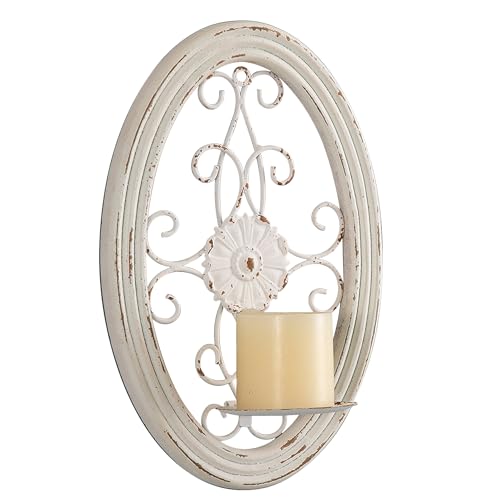
The oval carved white mirror with two candle arms, at approximately 20 inches (51 cm) wide by 30 inches (76 cm) high, is hung above the daybed at the standard Gustavian height: the centre of the mirror at approximately 60 to 64 inches (152 to 163 cm) from the floor, meaning its lower edge sits 10 to 12 inches (25 to 30 cm) above the back of the daybed. Lower than this and the mirror is obscured by anyone seated; higher and it becomes compositionally disconnected.
The faint painted swag garland fresco at the cornice, in a tone barely distinguishable from the antique white wall, is the wall treatment for this specific bedroom register. It is more subdued than the trompe-l’oeil grey-on-grey of the formal dining room and more delicate than the vine-and-leaf of the farmhouse room. At the cornice line, the garland acts as a crown moulding equivalent: it defines the top of the wall plane and connects the high white walls to the ceiling.
Key Takeaway: In a pale Gustavian bedroom, the daybed and its oval mirror directly above it are the two structural objects around which everything else is arranged: the chair, the side table, the door, all play supporting roles.
Stage 16: Distress Wall Paneling Intentionally for the Romantic Dining Room
 Save
Deliberately distressed plaster paneling is a specific technique, not simply neglect. The effect visible here, heavily aged chalky blue-grey paneling with peeling paint layers revealing aged plaster beneath, is produced by applying successive layers of chalk paint or limewash in slightly varying tones (the base layer warmer, the top layer cooler) and then dry-sanding or hand-scraping edges and raised panel elements to expose the layer beneath. It is work done with sandpaper and patience, not a brush.
The specific blue-grey here, at approximately a 40-percent value and a slightly dusty chroma, reads as Stone Blue or a close relative in the cool Swedish grey family. The peeling is concentrated at the corners, the raised moulding edges, and anywhere the wall would receive mechanical wear in a real manor: door frames, chair-rail junctions, and the reveal edges of window openings. Random peeling across flat wall surfaces reads as accident; peeling at structural junctions reads as age.
The round pedestal dining table at approximately 48 inches (122 cm) in diameter is painted chalky white with visible grain and slight distress at the edge. Four Louis XVI dining chairs at approximately 22 inches (56 cm) wide with carved painted frames and cream linen seats complete the table setting. The convention of a round table in a Gustavian dining room is important: a rectangular table emphasizes the room’s length; a round table sits equally in any room shape and creates the conversation intimacy the style values.
The tall Gustavian mirror at approximately 30 by 72 inches (76 by 183 cm) in a gilded Rococo frame dominates the primary wall above a carved console table with silver candelabra. The classical marble bust on a square pedestal column at roughly 30 inches (76 cm) total height anchors the right corner and introduces the one white, hard, and clearly classical object in an otherwise aged-and-soft composition.
Key Takeaway: When distressing wall paneling, concentrate the peeling at structural junctions (moulding edges, corners, chair rail) rather than across flat surfaces, and work in two paint layers with the warmer tone underneath.

Stage 17: Complete the Room With a Monumental Kakelugn and Plaster Medallion Reliefs
 Save
The monumental kakelugn in a reception room, rising to the full ceiling height at approximately 9 feet (274 cm) and hand-painted in Rococo blue-and-white panels, is the completed expression of the Gustavian interior. It is the object that makes the room legible as distinctly Swedish rather than broadly Neoclassical. By the time you reach this stage, every other layer, palette, paneling, furniture placement, textile selection, and decorative objects, should already be resolved. The kakelugn lands into a finished composition, not an empty one.
The blue-and-white Rococo tile panels carry arched cartouche shapes with garland-and-tassel borders and floral urn centrepieces, all hand-painted on a white glazed ground. The cobalt blue is the purest, most saturated tone in the entire Gustavian interior. Everything around it, the heavily patinated sage-green distemper walls, the matte chalky grey of the two flanking side chairs, the worn wide-plank floor, is deliberately desaturated to let the blue-and-white tile read without competition.
The two circular white plaster portrait medallion reliefs, at approximately 18 inches (46 cm) in diameter, are mounted symmetrically on the wall on either side of the kakelugn. Plaster relief medallions are a specifically Gustavian and late Neoclassical wall ornament, derived from the portrait cameo tradition of Greek and Roman antiquity. They are the correct wall-mounted complement to a kakelugn: smooth, pale, and figurative where the tile panels are graphic and decorative.
The two flanking Gustavian side chairs at approximately 18 inches (46 cm) in seat width, in pale grey painted frames with cream or blush upholstered seats, are the room’s only mobile objects. In any completed Gustavian reception room, the chairs may be the only furniture present: the kakelugn, the mirror or console if present, and the plaster medallions do the room’s architectural work. The chairs provide human scale and the invitation to sit. Their role is to make the monumental composition feel inhabited rather than preserved.
Heavily aged sage-green distemper, peeling and patinated to reveal bare plaster beneath, is the wall surface that connects this reception room to the broader Gustavian palette. The sage green here is cooler and greyer than the terracotta-adjacent sage of the farmhouse rooms in stages three and seven. It reads as almost aqueous, a colour that has been in place for decades and has lost its original intensity.
Key Takeaway: The kakelugn is always the last major object installed in a Gustavian room because it is the structural centrepiece around which the entire composition is calibrated; arrive at this stage only after every other layer is fully resolved.

—
The Gustavian sequence is fundamentally about discipline in order: palette before furniture, structural objects before moveable ones, textile layers before ornamental ones, and the kakelugn last. Every room in this guide functions because its maker solved one layer completely before starting the next. The most important decisions are the earliest: get the muted Swedish grey or sage-green palette right, commit to the right floor plank width, and choose the one primary structural object (tester bed, mora clock, or kakelugn) before anything else enters the room. From there, the style has enough internal logic to guide the rest of the choices almost automatically. Start with the palette, identify your room’s structural anchor, and work outward one deliberate layer at a time.
You've saved it, wanted it. Here's the how: codes, measurements, order. Your choices make it yours.
 Save