 Georgia
The question behind every search for japandi lights is a simple one: why does a room that looks calm and finished in daylight go flat, or harsh, the moment the sun drops and the ceiling light comes on? The answer is that Japandi rooms are lit in daylight by one huge, soft source, the window, and at night most people replace that with one small, hard source in the middle of the ceiling. Nothing about the furniture changed. The light did. This page is the hub for fixing that: the three heights every room needs, the exact bulb warmth in kelvin, how many lumens each room actually wants, how washi, linen, rattan and ceramic shades behave over ten years, and which pieces of technology to hide so the room stays quiet. Pendant drop height and shade diameter have their own page; this one covers everything else. Read it with a tape measure nearby, because almost every decision here comes down to a number.
What Are Japandi Lights Actually Supposed to Do in a Room?
 Save
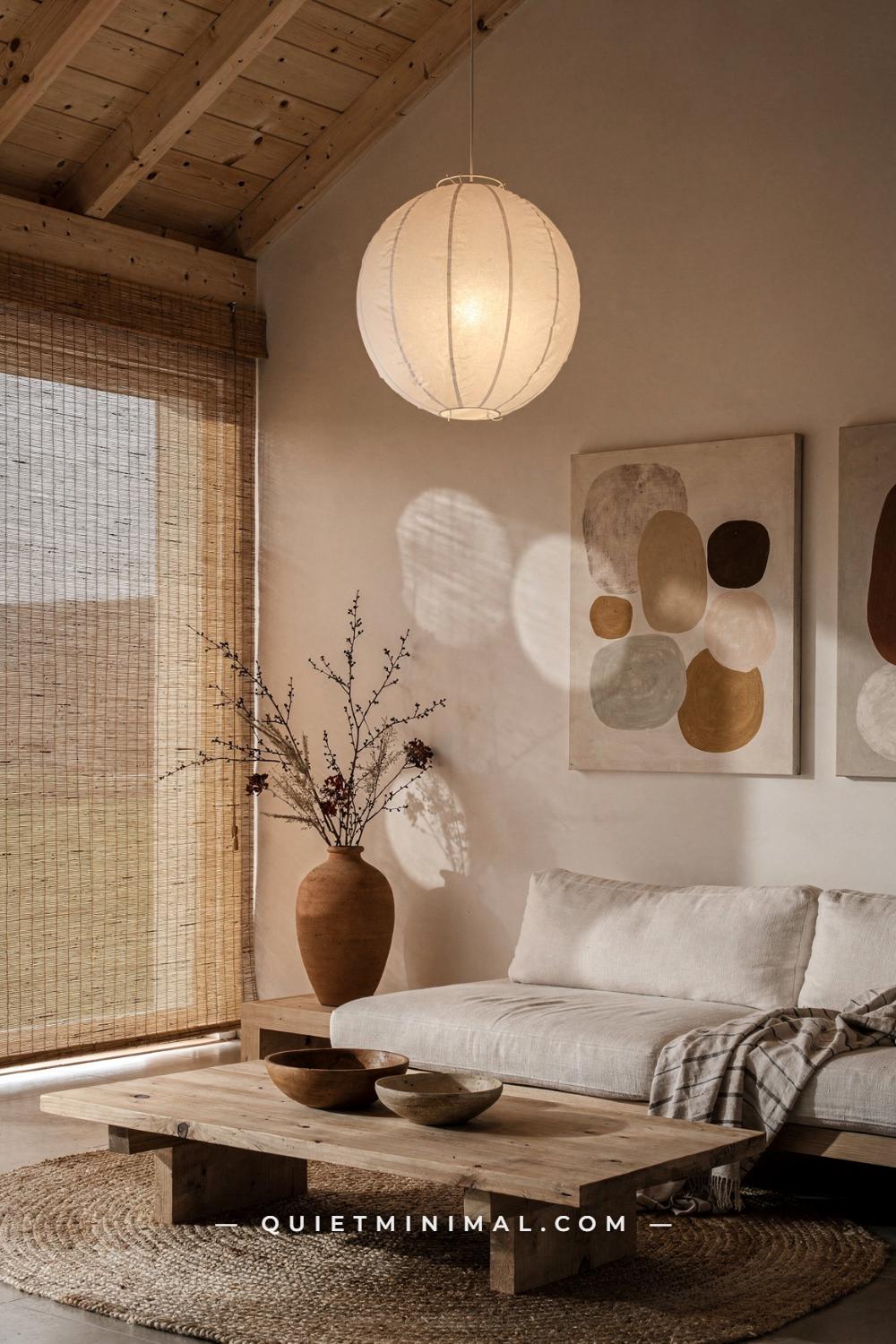
A Japandi room is lit by surfaces, not by bulbs. In daylight that happens on its own: a wall of bamboo roller blinds turns a hard afternoon sun into a warm, even wash that lands on pale pine, cream linen and a jute rug, and every one of those materials bounces a slightly different warmth back into the room. The job of japandi lights is to do the same thing after dark, and the first rule follows from that: no light source should ever be the thing you look at. You look at the plaster, the wood grain, the weave of the rug. The bulb stays behind paper, linen, rattan or clay, and what reaches your eye has already been softened once.
The second rule is height. Daylight arrives from the side, at window level, which is roughly the height of a standing person. Ceiling light arrives from directly above, which is how nobody experiences light outdoors except at noon. So a Japandi room after dark needs light at three heights: one source near the ceiling that is large and dim, one at eye level for the things you do, and one low, near the floor, that gives the room a horizon. A single 20 in (50 cm) rice paper globe overhead, a floor lamp beside the sofa and a small lamp on a low table is the entire formula. Three sources. Not one, and not nine.
From the guides
You've saved it, wanted it. Here's the how: codes, measurements, order. Your choices make it yours.
 The Japandi Honest PlaybookThe honest version of the style: what to keep, what to skip, and the order to do it in.See inside →
 The Room Refresh PlaybookA repeatable four-step method, room by room, in ten minutes, thirty minutes, or one weekend.See inside →
 Make Any Room Feel Cozy on PurposeWhy some rooms hold people and others empty out, and the moves that change it.See inside →
The third rule is that the ceiling source, if there is one, has to be big and soft enough to read as a second window rather than a spotlight. A paper globe of 18 to 24 in (46 to 61 cm) under a 10 ft (305 cm) vaulted ceiling works because its surface is enormous relative to the bulb inside it; a 6 in (15 cm) glass fixture in the same spot would draw the eye to a hot point and throw every shadow straight down. When the overhead fixture is small, it is better to skip it entirely and let the two lower heights carry the room. That is the honest answer to what these lights are for: they replace the window, one soft layer at a time, and every section below is one of those layers measured out.
Key Takeaway: Japandi lights exist to replace the window after dark, which means three heights of soft, shaded light and never a bare source you look straight at.

How Tall Should a Floor Lamp Stand Beside a Sofa or Reading Chair?
 Save
The floor lamp is the eye-level layer, and its height is set by one measurement: sit on the sofa and measure from the floor to your eyes. For most adults that lands between 38 and 42 in (97 and 107 cm). The bottom of the shade should sit at that line or an inch above it, so the bulb is hidden whether you are seated or standing next to it. Work upward from there: a 20 in (50 cm) tall woven-linen cylinder needs a stand that puts its lower rim at about 40 in (102 cm), which means a lamp of roughly 58 to 64 in (147 to 163 cm) overall. That is the range almost every sofa lamp should fall into, and it is why the tall, slim cylinder on a walnut disc base has become the Japandi default: the shade is long enough to hide the bulb from both positions without the lamp towering.
A reading chair changes the number. Beside a chair you want the light to fall on the page, not spread across the room, so the shade bottom drops to shoulder height when seated, roughly 51 to 57 in (130 to 145 cm) measured to the top of the shade and 40 to 46 in (102 to 117 cm) to the bottom. A lamp that is right beside a sofa is about 6 in (15 cm) too tall beside a low armchair, and the tell is a bright band across your forehead every time you look up.
Placement is the second half. The lamp base sits 6 to 12 in (15 to 30 cm) from the sofa arm, and the shade should overlap the arm slightly in plan, never hang out in the walkway. A linen shade of 10 in (25 cm) diameter is deliberately narrow for this reason: it lights a reading zone about 4 ft (122 cm) across and leaves the rest of the wall in a soft gradient, which is what makes the branch shadow on sand plaster read as decoration rather than clutter. The failure mode is a wide drum shade of 18 in (46 cm) or more on a 5 ft (152 cm) stand: it lights the whole corner evenly, kills the gradient, and the room goes flat exactly the way an overhead light flattens it.
Inside the shade, use a 450 to 800 lumen bulb, 2700K, and nothing brighter. A linen weave passes about half the light and warms it a shade further, so 800 lumens behind linen reads like a candlelit 400. If you want it brighter than that, you want a second lamp, not a hotter bulb.
Key Takeaway: Put the bottom of a sofa floor lamp’s shade at seated eye level, 38 to 42 in (97 to 107 cm) off the floor, and drop it about 6 in (15 cm) beside a reading chair.

Why Does a Ceramic Shade Belong Over the Dining Table, and How Does It Age?
 Save
Of the four Japandi shade materials, ceramic is the only one that is fully opaque, and that is the reason it belongs where food is. A clay pod with an open mouth sends all of its light downward through a 3 in (7 cm) opal glass globe, so the table is lit and the ceiling stays dark. Paper does the opposite: it glows in every direction and lights faces, walls and ceiling equally, which is lovely in a living room and slightly wrong over plates, where you want the food brighter than the room. A trio of chalky-white pods of 8 to 12 in (20 to 30 cm) over a 40 in (100 cm) round charcoal table gives three tight pools that overlap in the centre, and the dark matte tabletop absorbs the spill so the pools stay defined.
The aging question is where ceramic wins outright. A porous, unglazed clay shade does not yellow, does not sag and does not tear. It collects dust in its texture, which you remove with a dry paintbrush twice a year, and if a pod chips the chip reads as wabi-sabi rather than damage. Grease is the one enemy: over a dining table that is 8 ft (244 cm) or more from the stove, it is not an issue; in an open-plan kitchen-diner closer than that, the chalky surface will slowly take on a warm film. Wipe it with a barely damp cloth and mild soap, never anything abrasive, and never soak unglazed clay because it drinks water and can spot permanently.
Weight is the practical catch. A ceramic pendant of that size runs 4 to 9 lb (1.8 to 4.1 kg), and three of them on one canopy need a ceiling box rated for the load, not a plastic hook. Plan the mount before you fall for the shape. The cord also matters more than it does with paper, because ceramic is heavy enough that the cord hangs dead straight, and a matte black cord against warm plaster becomes a drawn line in the room. Three of those lines at staggered heights is a composition; three at the same height on a round table is a row, which suits a rectangle and not a circle.
Inside, the opal globe already diffuses, so use a 2700K bulb of 400 to 600 lumens per pod. Three pods put 1,200 to 1,800 lumens on the table, which is the whole dining budget for a room of this size, and it comes from a source you can only see when you look straight up.
Key Takeaway: Ceramic sends all its light down and never yellows, which makes it the shade for tables and food, provided the ceiling box can take its weight.

How Warm Should the Bulb Be? Kelvin for Every Japandi Room
 Save
Bulb colour is measured in kelvin, and the whole Japandi register lives between 2200K and 3000K. The number to memorise is 2700K. That is the colour of the old incandescent bulb, warm without being orange, and it is the correct choice for every living room, bedroom and dining room in the house. Behind a rice paper globe it comes through as the amber you see in every saved photo of this style, because paper filters out a little of the blue end and adds its own cream. Put a 4000K bulb inside the same globe and it turns hospital-white, and the pale ash table under it goes grey. Nothing about the fixture changed. That single number is the most common reason a Japandi room fails after dark.
Kitchens and bathrooms are the exception, and only there. At a counter or a mirror you are doing something that needs a truer colour, so 3000K is right: still warm, slightly cleaner, and close enough to 2700K that a kitchen open to a dining room does not show a visible seam between the two. Never go above 3000K anywhere in a home decorated in cream, flax and walnut; those colours were chosen because they are warm, and a cool bulb argues with all of them at once.
The lower end is for evenings. 2200K to 2400K, sold as amber or “vintage” warm, is the colour of a candle and suits a single lamp that stays on late: the table lamp on a sideboard, or the lowest lamp in a bedroom. It is too warm for a whole room and too dim to read by, so it is a layer, not a base.
Two more numbers on the box matter. The first is CRI, the colour rendering index, and you want 90 or above; a cheap 80 CRI bulb makes walnut look muddy and flax look yellow, and it is the reason two bulbs marked 2700K can look completely different. The second is the phrase “warm dim” or “dim to warm”: those bulbs drop toward 2200K as you lower them, the way a filament did, and they are worth the extra cost on any dimmed circuit. On a cluster of five paper globes at staggered heights, the globes at 12 in (30 cm) can take 400 lumen bulbs and the 20 in (50 cm) ones 800, all at 2700K and 90 CRI, and the mix of sizes will read as one warm cloud instead of five separate lamps.
Key Takeaway: Use 2700K and 90 CRI everywhere you sit and eat, 3000K only where you work at a counter or a mirror, and 2200K for the one lamp that stays on last.

How Many Lumens Does Each Room Actually Need?
 Save
Watts tell you what a bulb costs to run; lumens tell you how much light it makes. Japandi rooms run on the low side of the standard tables, on purpose, and the totals are easier to hold than you would think. Living rooms and bedrooms want 10 to 20 lumens per sq ft (108 to 215 per sq m). A 15 by 18 ft (4.6 by 5.5 m) living room is 270 sq ft (25 sq m), so 2,700 to 5,400 lumens total; aim at the bottom of that, spread across three fixtures, because the whole point of shaded light is that you never need all of it on at once. A 12 by 14 ft (3.7 by 4.3 m) bedroom at 168 sq ft (15.6 sq m) wants 1,700 to 3,400 lumens, of which about 400 per bedside lamp is the reading share.
Dining is a pool, not a wash. Three sandy clay domes of 14 in (35 cm) at a matching height over a 72 in (183 cm) blond ash table need 500 to 700 lumens each, 1,500 to 2,100 total, and that is the entire dining budget for a table of six. Anything more and the food looks like a photo shoot; anything less and the far ends of the table fall into shadow behind the wishbone chairs.
Kitchens are where the numbers jump, and it is the one place Japandi has to concede to function. General kitchen light runs 30 to 40 lumens per sq ft (323 to 430 per sq m), and the counters themselves want 70 to 80 lumens per sq ft (753 to 861 per sq m) from a source close to the work. In an open-plan room that means a dark grey stone backsplash under white flat-front cabinets gets a hidden strip under the upper cabinets, warm 3000K, delivering the task light, while the dining pendants stay at their gentle 2700K over the table. The two zones are a few steps apart and 300K apart, and that is exactly the right gap.
The failure mode runs both ways. The under-lit Japandi room is the one lit by a single 800 lumen paper pendant, where people squint and someone eventually installs a ceiling fixture. The over-lit one is the 4,000 lumen flush mount in the centre of the ceiling that gives the room a supermarket floor. The fix for both is the same arithmetic: add the room, split it three ways by height, put the largest share at the ceiling only if the fixture there is soft enough to carry it, and dim everything by a third from the moment the sun goes down.
Key Takeaway: Budget 10 to 20 lumens per sq ft (108 to 215 per sq m) in rooms where you sit, 1,500 to 2,100 total over a dining table, and 70 to 80 per sq ft (753 to 861 per sq m) at kitchen counters, split across three heights.

How Do You Layer Ambient, Task and Accent Light in a Living Room?
 Save
The three heights have proper names, and the names tell you what each one does. Ambient light is the top layer, the one that stops the ceiling from disappearing after dark. Task light is the middle layer, at eye level, for reading and faces. Accent light is the low layer, near the floor, that gives the room a horizon and makes a wall of plaster look like it has depth. A Japandi living room works when all three are on, each dimmer than you expect, and it fails when any one of them is asked to do the others’ jobs.
The ambient layer here is a pair of pitted concrete discs of 12 to 14 in (30 to 35 cm) on oak stems, hung over a 40 in (100 cm) travertine drum. Discs throw light down and slightly out, so the coffee table and the rug are lit and the ceiling receives only bounce. That is right for a low, round table where nobody needs to read. The rust braided cord is the one saturated colour in a cream and sand room, which is a good rule in itself: if you want an accent colour in a Japandi room, put it in the cord, where it is a thin line, rather than on a cushion, where it is a block.
The task layer is a floor lamp behind the curved bouclé sofa, shade bottom at 40 in (102 cm), or a low lamp beside the rattan lounge chair. Only one of the seats in a living room needs real reading light; the other seat gets to be dim. Designing every seat for reading is how the living room ends up with five lamps and no rest.
The accent layer is the one most people skip. It is a small lamp on the floor behind the potted tree, or a low uplight in the plaster arch niche, at 200 to 300 lumens, 2200K to 2700K. Its job is not to light anything you use; it is to put a soft glow low on the wall so that the room reads as having three levels of brightness from floor to ceiling. Without it the room has a lit centre and dark edges, which is the look of a stage, not a home. With it, the tree throws a shadow on the arch, the travertine picks up a warm edge, and the room settles.
Run the three on separate switches or separate dimmers. The evening sequence is all three at dusk, ambient off an hour later, and by the end of the night only the accent and one task lamp remain. That progression is what people mean when they say a room feels calm; it is just the light stepping down in stages.
Key Takeaway: Every Japandi living room needs a soft overhead, one real reading lamp, and one low accent glow, on three separate switches, with the overhead turned off first each evening.

How Does Washi Paper Age, and Where Should It Never Hang?
 Save
Washi is the material that made this style, and it is also the one that people are most nervous about buying, because paper sounds like something that will be ruined in a year. It will not, provided it hangs in the right room. Washi is long-fibre paper, stronger than it looks, stretched over a wire or bamboo rib and finished with a ring cap in black metal or walnut. Away from grease, smoke, damp and direct sun, a washi shade lasts ten years and often much longer, and it ages the way linen does: the cream deepens a shade toward ivory, the ribs show a little more, and the light gets slightly warmer. That is the patina you want, and a wide 18 in (45 cm) oblate lantern beside a tall 12 by 22 in (30 by 55 cm) oval one over a dark oak console will look better in year six than in year one.
The rooms it should never hang in are the kitchen, the bathroom, and any wall that gets afternoon sun straight through the glass. Kitchen grease is the main cause of yellowing, and it is not the warm even yellow of age but a blotchy film that catches dust and cannot be washed off, because washi cannot be washed at all. Steam does something similar and adds sag. Direct sun bleaches one side, so a lantern in a west window ends up two-tone. A living corner with a plaster arch and a console, lit only from within the lanterns, is where washi is at its best, and a bedroom is a close second.
Cleaning is dry only. A soft wide paintbrush or a feather duster every few weeks, working with the ribs rather than across them, and an art gum eraser on the rare mark. A tear along a rib is repairable with a strip of thin Japanese mending tissue and wheat paste, applied from the inside; the patch shows faintly as a slightly denser line when the lamp is on, which is acceptable in a lantern that already has ribs.
The bulb limit is the one rule that is not optional. Paper shades are rated for 40W-equivalent sockets, which in LED terms means a bulb of 450 to 500 lumens drawing 5 to 7 watts, and never a halogen or an incandescent, which run hot enough to scorch. Two 450 lumen bulbs at 2700K inside two lanterns is plenty for a corner; paper glows on far less than you expect because every square inch of the shade becomes the lamp.
Key Takeaway: Washi lasts a decade if it hangs away from grease, steam and direct sun, is dusted dry, and carries an LED of 500 lumens or less.

Do You Need a Dimmer, and How Do You Hide the Technology?
 Save
Yes, you need a dimmer, and it is the single cheapest improvement in this whole guide. A Japandi room is a room of gradients, and a switch gives you two settings, both wrong: full brightness is too much for any evening, and off is off. A dimmer lets a wood-veneer pendant of 28 in (70 cm) run at a full 800 lumens while the table is being set, then drop to a third of that once everyone sits down, when the light climbing the fins and bouncing off a soft grey ceiling is doing more for the room than the light on the plates. The fins are the reason a wood pendant wants dimming more than any other: at full power the layered veneer throws hard stripes on the ceiling, and at 30 percent those stripes soften into a warm halo.
The technology has to disappear, and there are three ways to make it. The first is a wall dimmer with a plain paddle or a slim rotary knob, in a plate that matches the wall colour or the switch plates already in the room. Avoid anything with a glowing indicator, a touch strip or a screen. The second is the smart bulb, which puts the dimming inside the lamp and leaves the wall untouched: a 2700K warm-dim smart bulb inside the pendant, controlled from a phone or a small remote kept in a drawer, and the existing switch left permanently on. This is the renter’s route and it needs no wiring. The third is a plug-in dimmer on the cord of a floor or table lamp, tucked behind the furniture.
Whichever route you take, the bulb must be marked dimmable, and the dimmer must be rated for LED loads. A non-dimmable LED on a dimmer flickers and buzzes, and an old incandescent dimmer with a low-wattage LED often will not dim below 40 percent. The phrase to look for on both is “LED compatible” or “trailing edge”. If you use smart bulbs, buy them all from the same maker, because two brands’ versions of 2700K rarely match and a table lit by two slightly different warms looks accidental.
The hidden failure is the hub. Smart systems often want a small box with a status light plugged in somewhere, and that box ends up on the oak table or a shelf, blinking. Put it in a drawer, behind a door or inside the cabinet with the router, and if it will not work from there, choose bulbs that talk directly over the home wifi and need no hub at all. The test for the whole section is simple: when the light is at its lowest evening setting, nothing in the room should tell you how it got there.
Key Takeaway: Put every fixture on a trailing-edge dimmer or a warm-dim smart bulb, keep the switch plate plain, and hide any hub in a drawer.

How Tall Should a Table Lamp Be for the Surface Beneath It?
 Save
The table lamp is the most misjudged light in the house, because people buy the lamp first and the surface second. The rule runs the other way: the surface sets the lamp. On a nightstand, the lamp’s total height should be close to the height of the nightstand itself, within 2 in (5 cm) either way. A 24 in (61 cm) nightstand takes a 22 to 26 in (56 to 66 cm) lamp, and the check is that when you sit up in bed, the bottom of the shade lands at about chin level, so you read by it without seeing the bulb. Japandi nightstands are low, often 18 to 22 in (46 to 56 cm), and that is why the lamps on them are small: a 10 in (25 cm) rice paper globe on a low base, or a 6 by 6 by 10 in (15 by 15 by 25 cm) shoji box, and not the 30 in (76 cm) ceramic lamp built for a tall dresser.
On a sideboard or console the surface is taller, 30 to 36 in (76 to 91 cm), and the lamp can grow to 14 to 20 in (35 to 50 cm) without the shade bottom rising above standing eye level. A slatted bamboo cylinder of 8 by 14 in (20 by 35 cm) on a 60 in (152 cm) walnut sideboard is about right, and it should sit at one end, never centred, so the vase and the branch have the middle. On a stack of books it is the same arithmetic: the books raise the surface, so the lamp on top can be shorter.
The floor is a surface too, and it is where the accent layer lives. A square washi box of 8 in (20 cm) or a handle lantern of 5 by 8 in (12 by 20 cm) set directly on tatami or a jute rug gives a glow at ankle height that no fixture on a stand can give. Keep floor lanterns out of the walkway, against a wall or beside a piece of furniture, and give them a bulb of 200 lumens at most; the floor is dark and they need very little.
The failure mode is height mismatch, and it has two faces. Too tall a lamp on too low a table puts the bulb in your eye every time you sit down, and you will end up angling the shade or leaving the lamp off. Too short a lamp on a tall surface lights only the surface itself and a 2 ft (61 cm) circle around it, so the room gains a bright spot and no depth. A room lit by five small lanterns at five heights, floor to sideboard, will be far calmer than one lit by two big lamps at one height, provided all five carry bulbs so weak that no single one could light the room alone.
Key Takeaway: Match the lamp to the surface: nightstand height plus or minus 2 in (5 cm) beside a bed, 14 to 20 in (35 to 50 cm) on a sideboard, and 200 lumens or less for anything on the floor.

How Do You Match a Light to the Wood Already in the Room?
 Save
Every Japandi room already has a dominant wood, and the light fixture either belongs to that wood’s family or contrasts with it on purpose. Those are the only two options; the accident in between, a fixture in a third tone that nearly matches, is what makes a room look bought in a hurry. Pale woods are ash, pine, birch and white oak. Dark woods are walnut, smoked oak and teak. A room with a full-height walnut slat wall and a live-edge pine coffee table already holds one of each, so a pendant in warm honey veneer has to decide which it is talking to. Here it sides with the pine: the spiral fins of a 30 in (76 cm) veneer pendant are the same warm natural tone as the slab below it, and the walnut wall behind becomes the dark frame for both.
The bulb decides whether the match holds. Warm wood under 2700K light reads warmer; the same wood under 3000K reads a little grey. Walnut in particular loses its red under cooler light and turns to brown cardboard, so any room with dark wood is a 2700K room without exception. Pale ash under 2700K can drift toward yellow, which some people dislike; the fix is not a cooler bulb but a higher CRI, because a 90 CRI bulb at 2700K keeps ash looking pale and clean while an 80 CRI one makes it look stained.
Metal is the second matching decision, and the answer is to keep it minimal and matte. Black is the neutral: a thin black cord, a black canopy, black ring caps on paper lanterns. It suits pale and dark wood equally and disappears against a walnut wall. Brass is a warm accent that belongs with walnut and looks slightly wrong with ash. Chrome and polished nickel belong to another style entirely. Whichever you choose, use one metal per room; a black cord on the pendant and a brass base on the floor lamp is one metal too many.
The last piece is the surfaces the light will land on. A cream linen sectional of 90 in (229 cm) and a jute-wool rug bounce warm light back up; a dark walnut wall absorbs it. Rooms with a lot of dark wood need about a third more lumens than the tables in this guide suggest, because the wood eats light, and they need that light to come from lower down, where it grazes the grain, rather than from overhead, where it makes the slats look flat. The open shelves in a slat wall are the place for a very small lamp or a hidden warm strip that lights the ceramics from within the wall itself.
Key Takeaway: Choose a fixture in the room’s dominant wood family or in deliberate contrast, keep it under 2700K high-CRI light, and hold to one matte metal per room.

Which Three Habits Flatten a Japandi Room After Dark?
 Save
A Japandi room is flattened by habits, not by fixtures, and the same three habits do it in almost every home. The first is the single overhead. One ceiling light, on one switch, turned on at dusk and left on until bed. It comes from directly above, so every object throws a small shadow straight down, every face is lit from the top, and the walls, which are the whole point of a plaster-and-wood room, receive almost nothing. The room that looked layered in daylight becomes a floor with things on it. The cure is not a better overhead; it is two more lights lower down, and the overhead turned off an hour after dark.
The second habit is the cool bulb. A 4000K or “daylight” LED, bought because the packet said bright, put into a fixture that was chosen for its warmth. Under that light, terracotta goes pink, slate goes blue, and the washi lantern body under a flat disc shield stops glowing amber and starts glowing white, which is the difference between a lantern and a lightbox. Replace every bulb in the room with 2700K and the room comes back without anything else changing. It is the cheapest fix on this page and the one most often skipped, because bulbs feel like a detail.
The third habit is one height. Every light in the room at the same level, usually ceiling or usually table, so the eye has no gradient to travel through. Three table lamps at 24 in (61 cm) each is one height; a pendant and two ceiling spots is one height. The fix is to move one source up and one down: a low lantern on the floor in a corner, and one pendant or sconce that owns the upper third of the wall.
There is a fourth, quieter version of all three, which is too much light. A dim room with a dark slate table and two stoneware bowls under a single lamp on a thin black cord reads as meditative precisely because most of the room is in shadow. Japandi rooms are meant to be darker at night than other styles; that is where the calm comes from. Brightness is a dial, and the calm sits at the lower half of it. If you can read a paperback anywhere in the room, the ambient layer is too high.
Key Takeaway: A single overhead, a cool bulb and every light at one height are what flatten a Japandi room; fix the bulb first, then add one light above and one below.

What Does One Material Per Room Mean When You Mix Paper and Bamboo?
 Save
The one-material rule says that every shade in a room should be made of the same thing, and it exists because shade materials are the loudest surfaces in a room after dark. A linen floor lamp, a rattan pendant and a ceramic table lamp are three textures glowing at once, and the eye keeps switching between them. Two paper globes and a paper floor lamp are one texture at three heights, and the eye rests. That is the whole rule, and in a living room or bedroom it should be applied literally.
From the guides
You've saved it, wanted it. Here's the how: codes, measurements, order. Your choices make it yours.
The Japandi Honest PlaybookThe honest version of the style: what to keep, what to skip, and the order to do it in.See inside →The Room Refresh PlaybookA repeatable four-step method, room by room, in ten minutes, thirty minutes, or one weekend.See inside →Make Any Room Feel Cozy on PurposeWhy some rooms hold people and others empty out, and the moves that change it.See inside →The nuance is what counts as one material. Paper and bamboo are a family: both are plant fibre, both glow warm ivory to honey when lit, and both are finished with the same dark walnut ring at the top. A cluster of oval rice paper lanterns of 10 by 14 in (25 by 35 cm) beside barrel-shaped bamboo-stripe lanterns of 10 by 12 in (25 by 30 cm), all on walnut rings, reads as one idea in two weaves rather than two ideas. Linen and paper are also a family, and so are rattan and bamboo. What breaks the rule is crossing families: fibre with ceramic, or fibre with glass, or fibre with metal. The test is to switch everything on and ask whether the shades look like they were bought on the same day from the same maker. If they do, the room passes even when the shapes differ.
The exception is the working room. A kitchen can hold a ceramic pendant over the table and a rattan one over the island, because the two zones are far enough apart to be read separately and the ceramic is doing a job the rattan cannot. Even there, keep the rings, cords and canopies in one finish, so the family holds at the hardware level if not at the shade.
Six lanterns in one cluster is also a lesson in count. It works in a tall, open space with dark timber posts because the group is treated as one fixture: one canopy, one switch, staggered heights within about 24 in (61 cm) top to bottom, and bulbs so small, 200 to 300 lumens each, that the six together equal one ordinary pendant. The same six spread around a room as separate lights would break every rule on this page. Group them and they are a lantern cloud; scatter them and they are clutter that happens to be lit.
Key Takeaway: Keep every shade in a room within one material family, paper with bamboo or linen, rattan with bamboo, and hold rings, cords and canopies to one finish.

How Do Rattan and Bamboo Age, and What Bulb Goes Inside an Open Weave?
 Save
Rattan and bamboo are the durable end of the fibre family, and they are the shades that can go into a kitchen, where washi cannot. Both are woven from stems rather than made from pulp, so they take heat and humidity that would sag paper, and grease sits on the surface rather than soaking in. They age by darkening: a pale honey rattan dome of 14 in (35 cm) will deepen toward amber over five to ten years, more quickly near a stove or a sunny window, and the darkening is even and handsome as long as the weave is kept clean. Dust monthly with a soft brush, working through the lattice, and wipe twice a year with a wrung-out cloth and a drop of mild soap. Never soak them and never use anything with oil in it, which leaves the weave tacky.
An open weave changes the bulb question completely, because the bulb is visible through the gaps. A frosted bulb behind rattan looks like a white egg trapped in a basket. An exposed filament, the kind with a visible amber coil inside clear glass, becomes part of the design: the coil glows at 2200K to 2400K, the lattice throws a lace of diamond shadows across the ceiling, and the three domes over a 60 in (152 cm) light oak island read as three warm objects rather than three light sources. Keep the filament bulbs dim, 250 to 400 lumens each, because a clear bulb at 800 lumens is a point of glare from every seat at the island.
That is also the honest limit of rattan in a kitchen: it is atmosphere, not task light. Three filament domes over an island put maybe 1,000 lumens onto the oak, which is fine for a bowl of fruit and a mug of tea and not fine for chopping. The counter work still needs the 3000K strip under the upper cabinets, hidden behind a lip so the dark stone backsplash is lit and the strip itself never is. Run the domes and the strip on separate switches; the strip goes on to cook and off to eat, and the domes stay on at low level throughout.
The socket rating on rattan is usually 60W-equivalent, which is generous for any LED filament bulb, so heat is not the issue it is with paper. Weight is modest, 2 to 4 lb (0.9 to 1.8 kg) each, so an ordinary ceiling box carries three. The one thing to check before buying is the ring at the top: a rattan dome with a dark walnut or black ring belongs with the rest of this style, and one with a bright chrome collar will fight every other fixture in the house.
Key Takeaway: Rattan and bamboo take kitchen heat and darken evenly with age, and an open weave wants a dim exposed filament bulb of 250 to 400 lumens, not a frosted one.

How High Should a Sconce Sit Beside a Bed, a Mirror and a Sofa?
 Save
A sconce is the eye-level layer bolted to the wall, and it is the most efficient light in a Japandi room because it lights the plaster, which is the surface you most want lit. The height depends entirely on what is in front of it. Beside a bed, the centre of the fixture sits 30 to 36 in (76 to 91 cm) above the top of the mattress, which puts the bottom of the shade about 20 to 26 in (51 to 66 cm) above it, at the shoulder of someone sitting up to read. Measure from the mattress, not the floor, because Japandi beds are low: a platform with a 10 in (25 cm) mattress puts the sconce centre at about 50 in (127 cm) off the floor, while a conventional bed can push it to 60 in (152 cm). Horizontally, the backplate sits 6 to 12 in (15 to 30 cm) outside the edge of the headboard, so the light falls on the pillow and not on the wall behind it.
Beside a mirror, the rule is eye level. The centre of each sconce goes at 60 to 65 in (152 to 165 cm) from the floor, flanking the glass at roughly 28 to 36 in (71 to 91 cm) apart so the face is lit evenly from both sides without shadows under the eyes. Above a mirror, if there is no room at the sides, the fixture sits at 75 to 80 in (191 to 203 cm), and this is the one Japandi sconce that should run at 3000K rather than 2700K, because it is a working light.
Beside or above a sofa, the sconce is mood, not task, and it climbs. The centre goes at 60 to 66 in (152 to 168 cm), which is above the head of anyone seated, so the bamboo slats are seen edge-on and the light washes up and down the wall in stripes. Two slatted bamboo cylinders of 4 by 8 in (10 by 20 cm), open at top and bottom, hung about 24 in (61 cm) apart over an 80 in (203 cm) cream linen sofa, will light the whole wall with two 300 lumen bulbs. Hanging them at slightly different heights, one 4 to 6 in (10 to 15 cm) above the other, keeps the pair from reading as a pair of eyes, which is the failure mode of every matched sconce set.
The rental version is a plug-in sconce with its cord dropped straight down to an outlet behind the sofa; a wired sconce is the better long-term choice only if the wall is open or an electrician is already coming for something else. Either way, a sconce needs a dimmer more than any other fixture, because it is at eye height and there is no shade between you and the wall it lights.
Key Takeaway: Mount a sconce 30 to 36 in (76 to 91 cm) above the mattress beside a bed, at 60 to 65 in (152 to 165 cm) beside a mirror, and 60 to 66 in (152 to 168 cm) above a sofa, always measured to the fixture centre.

How Do You Run Cords on Plaster and Hide an LED Strip?
 Save
Half of the fixtures in this guide can be plug-in, and plug-in means a cord on a wall. On drywall that is a small problem; on plaster, which is what most Japandi rooms are trying to look like even when they are not, it is a design question. The first rule is to run cords vertically only, straight down from the fixture to the baseboard, and horizontally only along the top of the baseboard. Diagonals are what make a cord look like a mistake. The second is to match the cord to the wall, not the fixture: a cloth-covered cord in warm taupe against taupe plaster all but vanishes, while the thin black cord that looks right dropping from a ceiling canopy becomes a drawn line the moment it touches the wall. Swap the cord, or sleeve it; a braided cotton cord cover in the wall colour costs little and slides on in minutes.
Fixing it is the part renters worry about. On true plaster, avoid nails, which crack it. Use small clear adhesive cord clips every 12 in (30 cm), pressed onto a clean wall and left an hour before the cord goes in, and they come off at the end of the lease with a hair dryer and no mark. On drywall the same clips work, or a paintable cord channel of 0.5 in (13 mm) width, run down a corner where two walls meet so the shadow of the corner hides its edge. Wherever possible, drop the cord behind a piece of furniture: a sconce above a sideboard, a pendant swagged to the wall above a bench, so only 12 to 18 in (30 to 46 cm) of cord is ever visible.
LED strips are the other hidden technology, and the rule for them is that you should see the light and never the strip. The place for one in a Japandi room is a cove: a shallow ledge above a wall panel or a shelf, with the strip laid facing upward so the light washes the ceiling and the plaster above the ledge, and a 1 in (25 mm) lip in front of it so the diodes are hidden from every seat. Above a woven bamboo panel behind a walnut table of 80 by 36 in (203 by 91 cm), a warm strip in the cove makes the whole back wall the ambient layer, and the long ivory linear pendant over the table can then run at a third of its output as the task layer.
Buy the strip at 2700K, high CRI, on a dimmable driver, and put the driver in the cabinet or the ceiling void, never on the shelf. Cheap strips show visible dots on the ceiling; look for ones described as high density or with a diffuser channel, which turns the dots into a line. The test at the end is the same as everywhere in this guide: with the strip on and the room dim, nobody should be able to point to where the light is coming from.
Key Takeaway: Run cords straight down in the wall’s colour on adhesive clips, hide them behind furniture, and put any LED strip in a lipped cove at 2700K where only its light shows.

So, how do you make every room feel calm after dark with japandi lights? You light it at three heights, ceiling, eye and floor, with every bulb at 2700K and 90 CRI, with the total lumens held at the low end of the tables and everything on a dimmer, and with every shade in the room drawn from one material family: paper or linen where you sit and sleep, ceramic over the food, rattan and bamboo where there is heat and steam. The overhead is the first light off each evening, not the last. Start with the bulbs, because that costs the least and changes the most, then measure the seat you read in and buy the floor lamp to fit it, then add the one low glow that gives the room its horizon. Once those three are in place, the pendant question, how high and how wide, has its own page, and you will be choosing it for a room that already works.
 Save
Types Of Japandi Lights
The original ideas from this article continue below.
You’ve likely heard of Japandi, the design trend harmoniously blending Japanese minimalism with Scandinavian functionality. But have you considered the role of lighting in achieving this aesthetic? It’s not just about brightness levels or energy efficiency; the right fixtures can elevate your Japandi interiors by enhancing their functionality and aesthetic appeal. From the material choice to the style, each fixture is an opportunity to express this design ethos further. Intrigued? There’s much more to explore on this topic.
Key Takeaways
- Select Japandi lights that blend simplicity, functionality, and natural elements to enhance room aesthetics.
- In Japandi interiors, choose pendants, wall sconces, or lanterns for ambient lighting and table or floor lamps for task lighting.
- Opt for LED lights with dimmer switches to adjust light levels, ensuring energy efficiency and functionality.
- Emphasize natural materials, clean lines, neutral colors, and dimmable fixtures to create a warm, serene atmosphere.
- Use indirect lighting to foster tranquility and enhance the aesthetic charm of a Japandi-styled room.
Understanding Japandi Design
 Save
Before you begin choosing lights for your Japandi interior, it’s essential to understand what Japandi design is all about. It fuses Japanese and Scandinavian design principles, focusing on simplicity, minimalism, and functionality.
Blending the warmth, coziness, and rustic elements of Scandinavian design with the elegance, sophistication, and tranquility of Japanese design, Japandi creates a harmonious balance in your home. The color palette is neutral and calming, punctuated with natural elements and textures.
It’s all about creating a space that’s aesthetically pleasing and promotes a sense of well-being and serenity. Remember, it’s not just about the lights; every element should work together to create that perfect Japandi atmosphere.
The Role of Lighting in Japandi Interiors
 Save
Now that you’ve grasped the concept of Japandi design, let’s examine the significance of lighting in these interiors.
Lighting in Japandi interiors isn’t just for illumination; it’s a critical design element that bridges the gap between functionality and aesthetics. It’s all about creating a soft, warm atmosphere that fosters serenity and balance, mirroring the philosophy of Japandi itself.
Poor lighting can disrupt this harmony, so choosing your lights wisely is vital. Think of lighting as a tool that can transform a room’s mood, highlight particular features, or provide practical solutions for tasks.
Remember that Japandi lighting should embody simplicity, minimalism, and naturalness, reflecting a respect for natural light sources and a fondness for subtlety.
Types of Japandi Lights
 Save
Let’s examine the various types of Japandi lights that you can incorporate into your home to achieve the perfect blend of simplicity, minimalism, and naturalness.
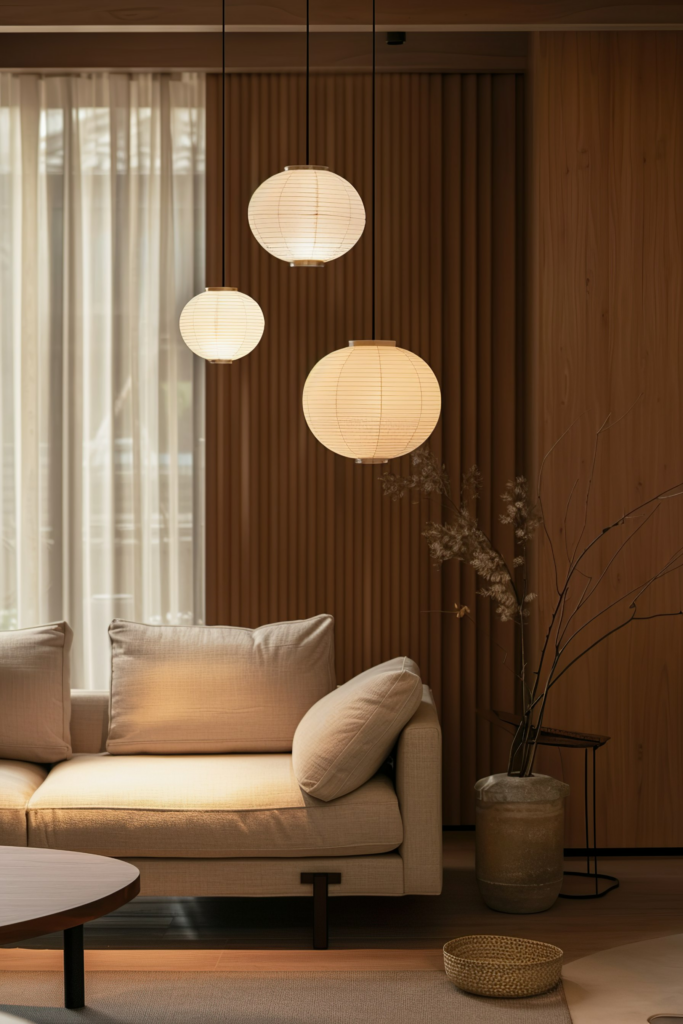
With their clean lines and natural materials, pendant lights are a popular choice. They hang from the ceiling and provide both ambient and task lighting.
Another option is wall sconces, which add a warm touch to your walls and serve as a functional light source.
Table and floor lamps, often featuring minimalist designs and warm tones, are perfect for creating cozy reading corners.
Lastly, consider lanterns. These traditional Japanese fixtures blend beautifully with the Scandinavian aesthetic, offering a soft, diffused light.
Each type brings its charm, enhancing the Japandi style in your space.
Selecting Japandi Lights for Functionality
 Save
After exploring the various types of Japandi lights, it’s equally important to consider their functionality in your space.
When selecting lights, consider the tasks you’ll perform in each area. For instance, you’ll need brighter, direct lights in a work or reading area, while a living room may benefit from softer, ambient lighting.
Remember energy efficiency, too. LED lights are great for Japandi interiors, offering longevity and reduced energy usage.
Dimmer switches can also add functionality, allowing you to adjust the light levels to match your mood or time of day.
Enhancing Aesthetics With Japandi Lights
 Save
Choosing the right Japandi lights can elevate the aesthetic appeal of your home, creating a harmonious blend of simplicity and sophistication. Remember, the Japandi style is about balance and minimalism, so you’ll want to choose lighting fixtures that reflect this philosophy.
Opt for lights with clean lines, natural materials, and neutral colors. Dimmable fixtures can add a soft, warm glow that is perfect for this aesthetic. Pendant lights, table lamps, or floor lamps with wooden or ceramic elements can be great options.
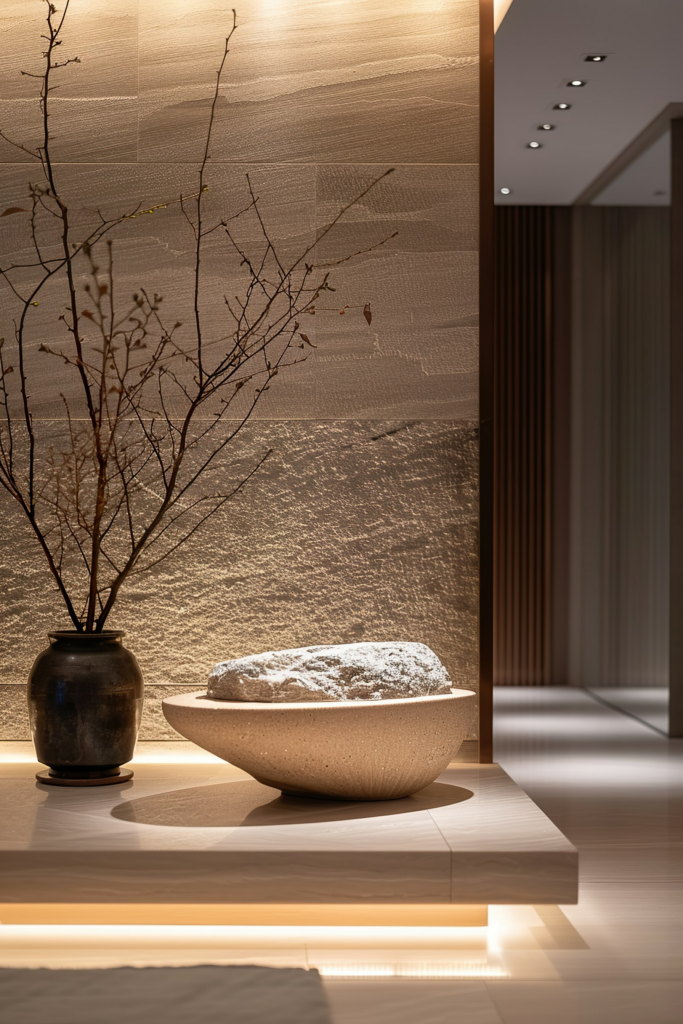
Plus, incorporating indirect lighting can create a calm and peaceful environment. It’s not just about brightening up a room, it’s about enhancing the overall ambience. Let your Japandi lights be integral to your home’s aesthetic charm.
Practical Tips for Japandi Lighting Placement
 Save
When placing your Japandi lights, consider both practicality and design aesthetics. Aim to create a balance between function and form. You can’t just randomly put lights anywhere; there’s an art to it.
Start by assessing your room’s layout. The lights should illuminate critical areas such as workspaces, reading spots, and walkways. Use ceiling lights for general illumination, and add pendant lights for elegance.
 Save
 Save
 Save
 Save
 Save
 Save
 Save
 Save
 Save
 Save
 Save
 Save
 Save
 Save
 Save
 Save
 Save
 Save
 Save
 Save
 Save
 Save
 Save
 Save
 Save
 Save
 Save
 Save
 Save
 Save
 Save
 Save
 Save
 Save
 Save
 Save
 Save
 Save
 Save
 Save
 Save
 Save
 Save
 Save
 Save
 Save
 Save
 Save
 Save
 Save
 Save
 Save
 Save
 Save
 Save
 Save
 Save
 Save
 Save
 Save
 Save
 Save
 Save
 Save
 Save
 Save
 Save
 Save
 Save
 Save
 Save
 Save
 Save
 Save
 Save
 Save
 Save
 Save
 Save
 Save
 Save
 Save
 Save
 Save
 Save
 Save
 Save
 Save
 Save
 Save
 Save
 Save
 Save
 Save
 Save
 Save
 Save
 Save
Consider the height of your lights. They shouldn’t be too low to avoid glare nor too high to preserve the cozy ambiance. And remember, in Japandi style, less is more. Don’t overcrowd your space with lights. Instead, consider using dimmers for versatility. This way, you’ll have control over the mood and intensity of your lighting.
Follow Quiet Minimal on Pinterest for more home design tips and inspiration.
From the guides
You've saved it, wanted it. Here's the how: codes, measurements, order. Your choices make it yours.
The Japandi Honest PlaybookThe honest version of the style: what to keep, what to skip, and the order to do it in.See inside →The Room Refresh PlaybookA repeatable four-step method, room by room, in ten minutes, thirty minutes, or one weekend.See inside →Make Any Room Feel Cozy on PurposeWhy some rooms hold people and others empty out, and the moves that change it.See inside →


