Georgia
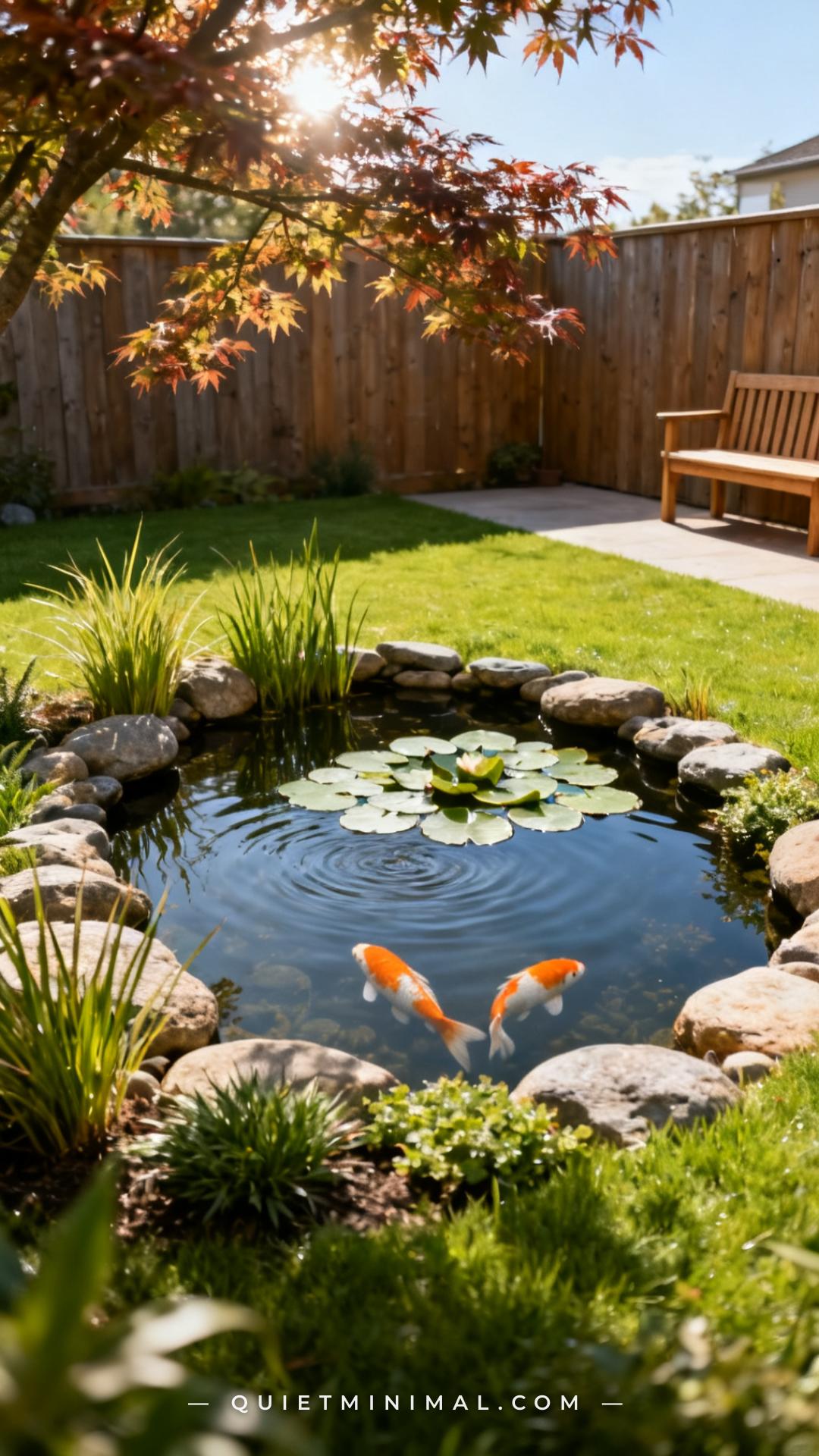
The biggest reason most koi ponds turn into abandoned eyesores isn’t the fish or the water — it’s that they were designed for looks and not for livability. If you’ve been holding off on a backyard water feature because you picture yourself elbow-deep in green water every other Sunday, these koi pond ideas will change your mind. Low maintenance isn’t a lucky outcome; it’s the direct result of about ten decisions you make before a single shovel breaks ground. Get those right, and you end up with a backyard pond that clears itself, balances itself, and honestly runs better the less you interfere.
1. Start With the Right Size — and Go Bigger Than You Think
 Save
The single most counterintuitive thing about low-maintenance koi ponds: bigger is easier. A small pond — anything under 1,000 gallons — swings wildly between clean and green because there isn’t enough water volume to buffer temperature spikes, waste load, or algae blooms. A pond in the 1,500–3,000 gallon range has built-in biological stability. Fish waste dilutes faster, temperature stays more consistent, and your filter doesn’t have to work as hard between cleaning cycles.
Aim for a minimum depth of 24 to 36 inches in at least one zone. Shallow ponds overheat in summer and freeze too quickly in winter — both conditions stress fish and accelerate algae growth. If space is limited, go deeper rather than wider.
Key Takeaway: Plan for at least 1,500 gallons and 24 inches of depth from the beginning — trying to expand later costs far more than sizing up now.

2. Build in a Bog Filter Along One Edge
 Save
A bog filter is the most effective — and most underused — low-maintenance pond upgrade available. It’s a shallow gravel-filled shelf, planted with marginal aquatic plants like iris, rush, or pickerel weed, that sits at the pond’s edge and acts as a natural biological filter. Water is pumped from the pond floor up through the bog, and the gravel plus plant roots strip out nitrates, phosphates, and excess nutrients before the water returns clean to the main pond.
The result is a self-sustaining filtration system that improves over time as plant roots establish. Unlike mechanical filters, it doesn’t clog on a weekly schedule. Plan for the bog to be roughly 10–15% of the total pond surface area, and position it at the opposite end from the pump intake so water flows across the full pond length.
Key Takeaway: A planted bog filter does the heavy biological filtration work so your mechanical filter doesn’t have to — it’s the single best structural decision for a clean pond.
3. Choose a Skimmer That Catches Debris Before It Sinks
 Save
Most pond maintenance headaches begin not with the water chemistry, but with leaves and organic debris that sink to the bottom and decompose into sludge. A skimmer installed at the pond’s surface water line mechanically removes floating debris before it has a chance to sink — dramatically reducing the organic load your biological filter has to process. This single component can cut your hands-in-the-pond cleaning sessions from weekly to a few times per season.
Look for a skimmer with an accessible, easy-clean debris basket rather than a filter mat that requires disassembly to clean. Position it on the downwind side of the pond so prevailing breezes push floating material naturally toward the intake. Match the skimmer’s rated flow to your actual pump GPH.
Key Takeaway: A surface skimmer is the lowest-effort maintenance upgrade that delivers the highest visible return — fewer debris, less sludge, cleaner water.
4. Use Native Aquatic Plants Instead of Tropical Varieties
 Save
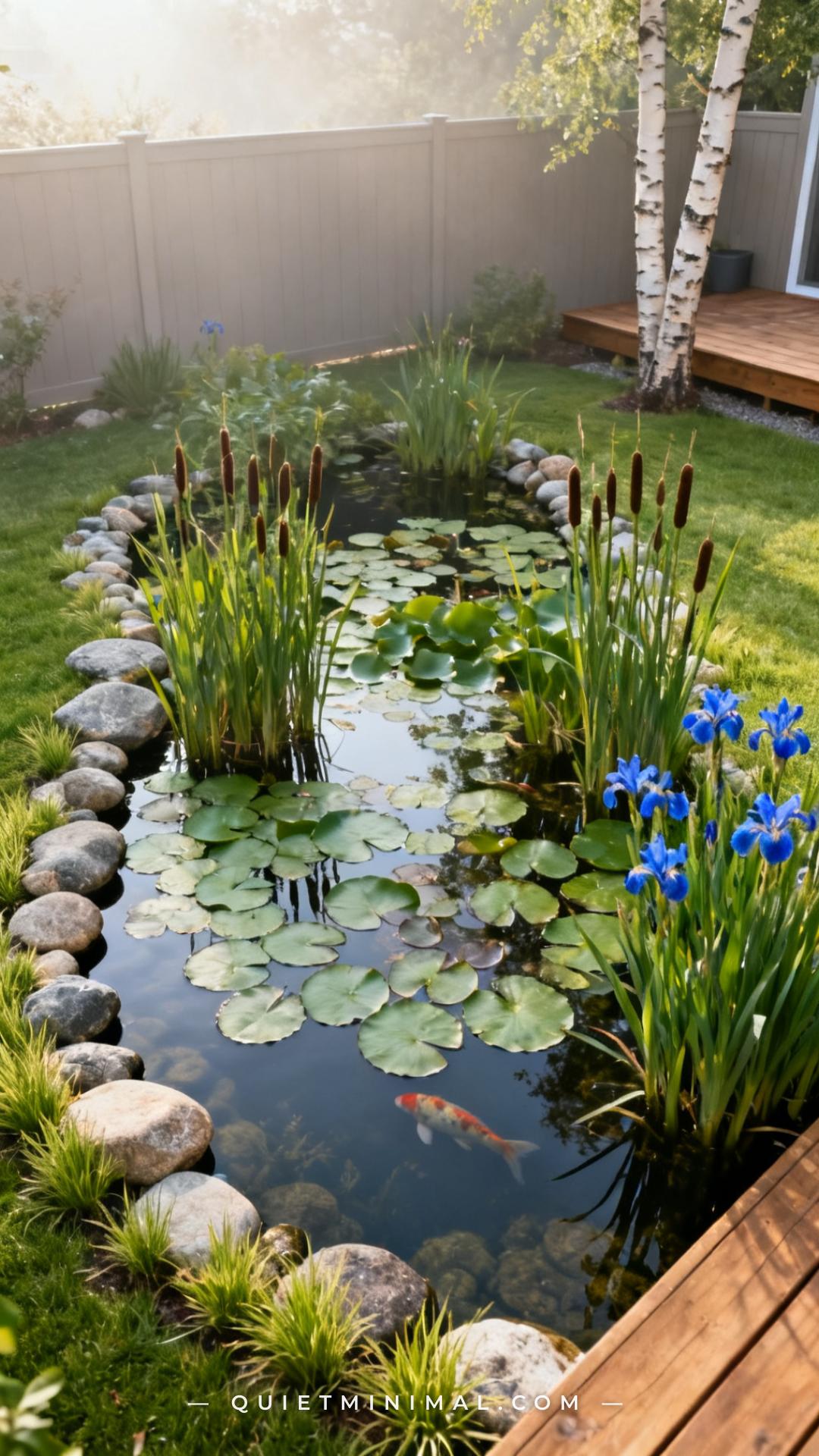
Tropical water lilies are showstopping but demanding — they require removal, overwintering indoors, and annual replanting in most climates. Native aquatic plants, by contrast, go dormant in winter, re-emerge on their own in spring, spread naturally without constant division, and provide the same biological filtration and shading benefits. Hardy water lilies, native blue flag iris, pickerel weed, and arrowhead are all excellent choices for a plant-it-once approach.
Aim to cover 40–60% of the pond surface with floating or emergent vegetation. This shading reduces sunlight penetration to the water column, which is your most effective natural algae control. Don’t overcorrect above 60% coverage — koi need open water for oxygenation and surface gas exchange.
Key Takeaway: Native aquatic plants do triple duty — filtration, algae suppression, and wildlife habitat — without the replanting labor tropical varieties require.

5. Add a UV Clarifier Inline With Your Filter
 Save
Green water — the soup-like algae bloom that turns ponds into opaque pea-colored pools — is the number one complaint among new pond owners, and it’s almost entirely solvable with a UV clarifier. These inline devices use ultraviolet light to rupture algae cells as water passes through, preventing the free-floating algae that cause green water without chemicals or constant intervention.
A UV clarifier is installed inline between your pump and your biological filter. It doesn’t kill beneficial bacteria (which are attached to filter media surfaces, not free-floating) and it doesn’t require much maintenance beyond an annual bulb replacement. Size it to turn your pond’s total volume over at least once per hour.
Key Takeaway: A UV clarifier is the single most effective insurance against green water — run it continuously from spring through fall, and it eliminates the problem before it starts.

6. Line the Bottom With River Rock, Not Bare Liner
 Save
Bare rubber liner on a pond floor looks clean on day one and becomes a high-maintenance nightmare within months. Debris accumulates on the flat, smooth surface in concentrated piles that must be manually vacuumed. River rock on the pond floor, by contrast, provides enormous surface area for beneficial bacteria colonization — the same biological filter you’d otherwise have to maintain in a box.
Use rounded river rock in the 1–3 inch diameter range (sharp edges trap fine debris and are hard on koi fins). Avoid gravel smaller than pea-sized, which compacts too densely to host bacteria colonies effectively. Yes, you’ll need to occasionally disturb the rocks with a gentle pond vac, but the intervals are measured in seasons, not weeks.
Key Takeaway: A river-rock bottom makes your pond floor a biological filter, dramatically extending the time between cleanouts compared to bare liner.
7. Design a Raised Edge That Keeps Lawn Runoff Out
 Save
One of the most overlooked sources of pond maintenance is nutrient runoff from the surrounding lawn. Fertilizers, pesticides, and organic decomposition products from turf grass wash directly into the pond after every rain or irrigation cycle — adding phosphates and nitrates that feed algae and destabilize water chemistry. The fix is architectural: build the pond edge 3–4 inches above grade so water flows away from, not into, the pond.
If your terrain makes this impossible, install a planted buffer strip of moisture-tolerant groundcover (creeping jenny, blue star creeper) around the perimeter. This acts as a bioswale, capturing and filtering runoff before it reaches the water. Avoid using fertilizer within 10 feet of any pond edge as a standing practice.
Key Takeaway: Raising the pond edge above lawn grade is a one-time construction decision that prevents a continuous source of water quality problems for the life of the pond.
You've saved it, wanted it. Here's the how: codes, measurements, order. Your choices make it yours.



8. Stock Fewer Koi Than You Think You Need
 Save
Overstocking is the root cause of most koi pond problems. Koi produce ammonia as a metabolic waste product; the more fish you have per gallon, the faster ammonia accumulates and the faster water quality deteriorates. A correctly stocked pond — roughly one inch of fish per 10 gallons of water at a minimum — gives your biological filter time to process waste between feeding cycles and keeps water chemistry stable without daily intervention.
Resist the urge to fill the pond immediately. Start with 3–4 fish in a well-established pond, observe water quality parameters over a full season, and add fish slowly. Fewer, larger fish are also visually superior to many small fish — one 12-inch kohaku commands far more visual attention than a dozen 4-inch juveniles.
Key Takeaway: Understocking is the most reliable way to reduce filtration demand and extend the interval between water quality interventions — it’s a design strategy, not a compromise.
9. Install an Automatic Water Top-Off System
 Save
Evaporation drops pond water levels faster than most owners expect — especially in warm climates or during summer heat — and low water levels stress both fish and the pump (which can run dry and burn out). An automatic top-off system, essentially a float-valve connected to your outdoor irrigation line, maintains a consistent water level without any manual intervention.
Installation is straightforward: the float valve sits at the desired water level and opens a small water feed when the surface drops below that point, exactly like a toilet fill valve. The investment is minimal (under $50 for most setups) and it eliminates one of the most common sources of equipment failure — dry-running pumps. Always condition any top-off water with a dechlorinator at the inlet.
Key Takeaway: An automatic top-off valve eliminates manual water-adding, protects your pump from dry-run damage, and keeps fish stress-free through evaporation cycles.
10. Plant Overhanging Trees Strategically — or Screen Existing Ones
 Save
Deciduous trees and ponds are not naturally compatible. A large oak or maple directly overhead drops leaves into the pond all autumn, overwhelming your skimmer, decomposing into sludge, and dramatically spiking tannin levels in the water. The fix is site selection: position the pond away from existing large deciduous canopy, or install a removable pond net from October through early December to intercept leaves before they enter the water.
If you’re planting new trees near the pond for shade and aesthetics — which is a good idea for summer temperature control — choose fine-textured, low-dropping species like Japanese maple, ornamental cherry, or weeping willow. These provide the dappled shade that moderates summer water temperature without a heavy seasonal debris load.
Key Takeaway: Tree placement relative to the pond is a 50-year decision — choose fine-textured ornamental species and position large deciduous trees upwind and outside the leaf-fall radius.

The difference between a koi pond that thrives on its own and one that becomes a chore is almost entirely decided in the planning phase — not the maintenance phase. Build the right size, filter the right way, stock responsibly, and let aquatic plants carry the biological load. When those foundations are in place, a koi pond doesn’t demand your weekend; it rewards your evening. Start with two or three of these decisions on your next build, and you’ll find yourself spending time watching the water rather than cleaning it.
You've saved it, wanted it. Here's the how: codes, measurements, order. Your choices make it yours.
 Save