Georgia
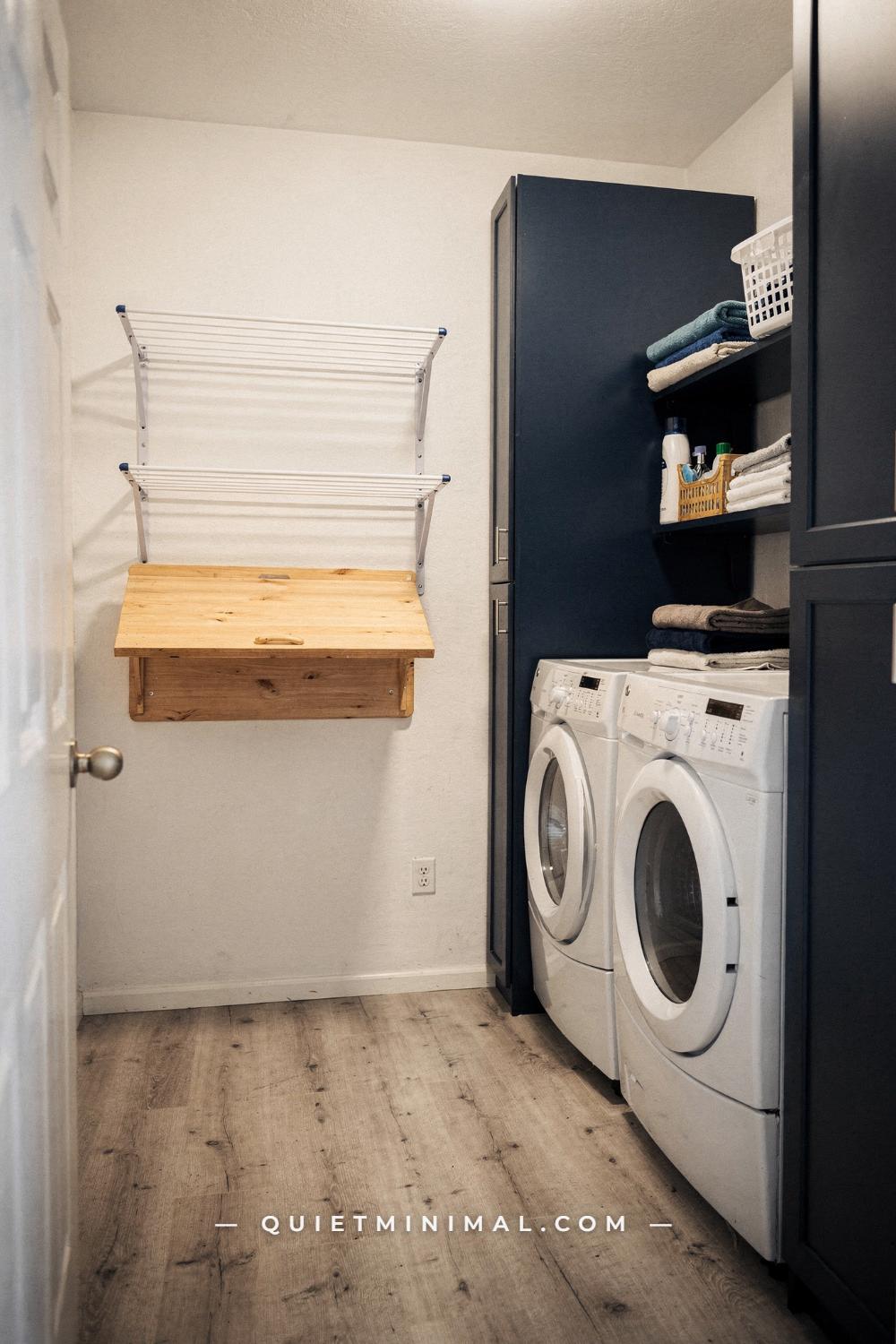
Clean laundry ends up on the bed in most houses, because the bed is the only surface big enough to fold on. That is the actual problem laundry folding tables solve, and it is why the search usually starts with a photograph of a beautiful counter and ends with a tape measure and a lot of confusion. The pictures make it look like a styling decision. It is not. It is an ergonomics decision wearing a decor costume, and the difference between a folding surface used every single week and one that quietly becomes a shelf for detergent bottles comes down to four numbers: how high it sits, how deep it runs, how much floor stays open in front of it, and how much weight the wall behind it can genuinely carry.
Those four numbers are almost never in the caption of the photograph. What follows works through them one at a time, along with the smaller decisions that hang off them: whether a wall-mounted drop-leaf beats a fixed counter in a narrow room, what happens when a front-loader door meets a table edge, which surface material survives a hot stack straight out of the dryer, and how to keep the counter empty enough that folding on it stays possible.
The Height That Decides Whether Folding Hurts
 Save
Almost every folding counter in America is set at 36 inches (91 cm), for one reason that has nothing to do with laundry: a standard base cabinet is 34.5 inches (88 cm), a countertop is about 1.5 inches (4 cm) thick, and 36 is what you get. That number was arrived at for chopping vegetables, which is a downward press through a straight arm. Folding is the opposite motion. Your forearms float just above the surface and you pull fabric toward your body, and doing that at press-down height for two loads is what people are describing when they say their back hurts after laundry day.
The number you want comes from your own body, not from the cabinet catalog. Stand upright with your shoulders relaxed, bend your elbows to 90 degrees, and have someone measure from the floor to the point of your elbow. Subtract 2 to 4 inches (5 to 10 cm). For most adults that elbow measurement falls somewhere between 39 and 45 inches (99 and 114 cm), which puts a comfortable folding surface between roughly 35 and 41 inches (89 and 104 cm). The published planning range for a working surface is 30 to 42 inches (76 to 107 cm), so nearly everyone lands inside it, just not all in the same spot. Someone around 5 feet 3 inches (160 cm) is usually happiest near 34 to 36 inches (86 to 91 cm). Someone at 5 feet 10 inches (178 cm) is often reaching down all week at that same 36 and would be far better served at 39 or 40 inches (99 or 102 cm).
This is the single strongest argument for a wall-mounted surface over a cabinet-based one. A counter on base cabinets has to sit at 36 inches unless you build a custom box. A drop-leaf or a fixed shelf mounted straight to studs can be set at 38.5 inches, or 34, or whatever your elbow measurement asks for, at no extra cost, because the wall does not care where the brackets land. If two people of different heights share the work, set the surface for whoever folds most and give the shorter person a low, stable step stool that lives underneath rather than splitting the difference and suiting neither.
Key Takeaway: Set the folding surface at your own elbow height minus 2 to 4 inches (5 to 10 cm) rather than defaulting to 36 inches, and wall mount it if that number falls between standard cabinet heights.

A Surface Too Shallow for a Fitted Sheet
 Save
A folded shirt occupies about 12 by 14 inches (30 by 36 cm), so a shallow ledge handles clothing perfectly well. Bedding is where a narrow surface falls apart. A queen fitted sheet starts at 60 by 80 inches (152 by 203 cm) and a queen flat sheet is commonly 90 by 102 inches (229 by 259 cm). Fold either one in half and then in half again and you are working with a piece roughly 30 by 20 inches (76 by 51 cm) at the intermediate stage. On a counter only 20 or 22 inches (51 or 56 cm) deep, that intermediate fold hangs over the front lip, catches on your body, slides, and pulls the whole thing out of square. That is not a technique problem. It is a depth problem.
The working numbers are straightforward. For clothing only, 20 to 24 inches (51 to 61 cm) of depth is enough. If you fold sheets, duvet covers, or bath towels for a whole household, aim for 28 to 30 inches (71 to 76 cm), because that is the depth that lets the halfway state sit fully supported. Width matters less than people assume: 36 inches (91 cm) is a workable minimum for one stack at a time, and 48 to 60 inches (122 to 152 cm) is where you can build two or three sorted piles side by side and stop restacking everything at the end.
Two details make a deep surface behave better than its dimensions suggest. First, the front edge should be eased or rounded rather than square, because a sharp laminate or stone arris is exactly what snags a knit sleeve as you drag it toward you. Second, keep the front 4 inches (10 cm) of the surface permanently clear of jars, baskets, and stain sticks. That strip is where your forearms rest and where fabric gets pulled across, and once it is colonized by storage the usable depth of the counter drops by a fifth without anyone noticing.
Key Takeaway: Give the surface 28 to 30 inches (71 to 76 cm) of depth if you fold bedding, and keep the front 4 inches (10 cm) clear so the whole depth stays usable.

The Counter Over the Machines That Stops Five Inches Short
 Save
The most photographed version of this project is a single slab of counter running over side-by-side front-loaders, and it is also the version most likely to go wrong at the ordering stage. A front-load washer or dryer is about 27 inches (69 cm) wide and roughly 30 to 34 inches (76 to 86 cm) deep once you count the door and the control panel. Behind it you need another 4 to 6 inches (10 to 15 cm) for the dryer vent elbow and the water hoses, and gas dryers or long multi-elbow duct runs often want 6 to 12 inches (15 to 30 cm). Add it up and the machines occupy 34 to 40 inches (86 to 102 cm) measured from the finished wall. A stock countertop is about 25.5 inches (65 cm) deep. Set one on top and the machines stick out in front of it by roughly 5 inches (13 cm), which looks like a mistake because it is one.
There are three honest solutions. Order a made-to-size top, which usually means laminate sheet applied to a plywood substrate or two boards spliced to reach 30 to 36 inches (76 to 91 cm) of depth, and expect to pay a few hundred dollars rather than the price of a stock slab. Build a bridge counter carried on a cleat screwed into studs at the back and short cabinets or legs at either end, so the depth is whatever you cut it to. Or pull the whole run forward on purpose, finish the front edge with a nosing, and let the counter overhang the machine faces by the 1 to 2 inches (2.5 to 5 cm) that reads as intentional rather than accidental.
One height warning that catches people after the counter is in. A front-load machine stands about 38 to 39 inches (97 to 99 cm) tall on its own, so a counter bridging over the top lands near 40 inches (102 cm). That suits someone tall and is genuinely too high for a lot of people, and it cannot be adjusted afterward. Measure your elbow number first and, if the bridge would overshoot it, put the folding surface on the opposite wall at your height and let the counter over the machines be a landing shelf instead.
Whatever you build, keep it removable. Machines need to come out for service, so fasten the top with screws you can find again rather than construction adhesive.
Key Takeaway: Reconcile the depth before you order, because a 25.5 inch (65 cm) stock top over 34 inch (86 cm) deep machines leaves a 5 inch (13 cm) protrusion that no styling fixes.

A Front-Loader Door That Hits the Table Every Time
 Save
A front-loading door is a hinged disc 24 to 26 inches (61 to 66 cm) across, and it swings through a full quarter circle. General planning guidance puts the walking minimum in front of a washer and dryer at 36 inches (91 cm), but that figure assumes you are passing through. To stand in front of an open front-loader with a basket and actually unload it, you want closer to 48 inches (122 cm) of clear floor, because the arc of the door claims most of the first 26 inches and your body needs the rest.
This is the measurement that kills fixed folding tables in narrow rooms. A 24 inch (61 cm) deep counter along one wall plus 48 inches (122 cm) of door and body clearance needs a room about 6 feet (183 cm) wide before you have even accounted for baseboards. Before you buy anything, mark it: put painter’s tape on the floor at the machine face, swing the door fully open, and tape the arc it sweeps. Then tape the front edge of the table you are considering. If the two lines touch, you have your answer for free.
Two fixes cost almost nothing. Most dryers, and some washers, ship with reversible doors, so the hinge can be moved to the other side and the door swung toward a wall instead of into the aisle; check your model’s manual for whether it is field-reversible or needs a kit. And a wall-mounted drop-leaf folds down to about 4 to 7 inches (10 to 18 cm) of wall projection when it is not in use, which means the aisle only narrows while you are actually standing there folding, with the machine doors closed.
Pedestals are worth a mention here, since they change the geometry as much as the ergonomics. Raising a front-loader 10 to 15.5 inches (25 to 39 cm) lifts the door arc above basket height and saves the squat at the end of every cycle. They run roughly $200 to $700 per machine, which is real money, so treat them as an alternative to a renovation rather than an accessory to one.
Key Takeaway: Tape the door’s full swing arc on the floor before you buy a table, and plan 48 inches (122 cm) of clear floor in front of a front-loader rather than the 36 inch (91 cm) walking minimum.

Drop-Leaf, Fixed Counter, or Rolling Cart: Which One the Room Can Take
 Save
The decision between a fold-down leaf, a fixed counter, and a cart is a room-width decision, not a taste decision, and it resolves quickly once you measure the short dimension of the room wall to wall.
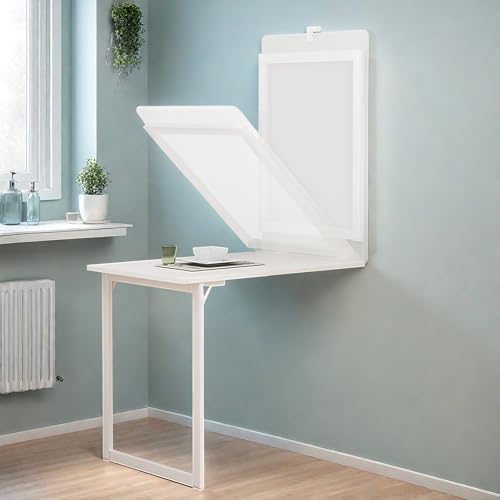
Under 5 feet (152 cm) wide, a fixed table on the wall opposite the machines cannot coexist with the door swing, so the surface has to disappear when it is not in use. That means a wall-mounted drop-leaf, or a pull-out board that slides out from under an existing counter and retracts. As a real reference point, the VEVOR wall-mounted folding table measures 43.3 by 18.1 inches (110 by 46 cm), is rated to 110 lbs (50 kg), sells for around $50.99, and its instructions are explicit that both brackets have to land on a stud. Note the depth: 18 inches (46 cm) is fine for clothing and short of what bedding wants, so if you fold a lot of sheets, look for a leaf closer to 24 inches (61 cm) deep or plan to finish sheets on a bed.
Between 5 and 7 feet (152 and 213 cm), you can usually combine: a bridge counter over the machines for landing and sorting, plus a leaf on the opposite wall at your own folding height. That split solves the problem in the previous section, where a bridge counter lands near 40 inches (102 cm) whether it suits you or not.
Over 7 feet (213 cm), or in a dedicated laundry room, a fixed counter run with cabinets or open baskets beneath is the better buy, because it gives continuous depth, has nothing to deploy, and holds its height without hardware fatigue.
A rolling cart is the most oversold option in this category. Carts 16 to 24 inches (41 to 61 cm) wide are useful for moving a stack from the machines to the closet, and useless as a folding surface, because a top that rolls slides away from you exactly when you push fabric across it. Buy one for transport, not for folding, and only if there is a parking spot for it that is not the aisle. The narrow gap between two machines, usually 9 to 12 inches (23 to 30 cm), is the classic home for a slim version.
Key Takeaway: Let room width choose the format: a drop-leaf under 5 feet (152 cm), a leaf plus a bridge counter between 5 and 7 feet (152 and 213 cm), and a fixed run beyond that.
Fixings That Hold a Wet Basket, Not Just a Folded Shirt
 Save
A wall-mounted folding surface fails in one of two ways, and neither is gradual. Either the fasteners pull out of the drywall, or the leaf sags because the brackets were spaced too far apart. Both are avoidable with numbers that are published on the hardware.
Start with the studs. Framing in most homes runs 16 inches (41 cm) on center, some older and some newer construction at 24 inches (61 cm), and bracket load ratings are quoted on the assumption that the brackets are anchored at that 16 inch spacing. Spread them wider and the rating drops, quietly. MechWares folding brackets, a common choice for this job, are rated to 130 lbs (59 kg) per pair using #10 by 2 inch (5 cm) screws driven into studs. The VEVOR table above is rated to 110 lbs (50 kg) with the same requirement. Those are the honest numbers only when the screws are in wood.
Then size for the real load, which is not the weight of folded clothes. A folding leaf gets a full wet basket set down on it in one motion, someone leaning a hip against it, and a toddler occasionally hanging off the front edge. That is dynamic loading, and it spikes well above static weight. Buy hardware rated for at least three times the load you expect to place on it, which for a household folding surface means looking at 100 lbs (45 kg) or more per pair rather than the light-duty shelf brackets sold for picture ledges.
If the wall genuinely has no stud where the bracket needs to go, do not solve it with anchors alone. A drop-down leaf loads the upper fasteners in tension, pulling straight out of the wall, which is the single worst direction for a drywall anchor. The right fix is a horizontal ledger board, a 1 by 4 or a French cleat, screwed across three studs and then used as the mounting surface for the brackets wherever you want them. It spreads the load across framing, gives you free horizontal placement, and reads as a deliberate detail rather than a compromise. In a laundry with tile or cement board on the wall, add the thickness of that surface to your screw length so you still get a full 1.5 inches (4 cm) of bite into the stud.
Key Takeaway: Mount into studs at 16 inch (41 cm) centers with hardware rated to at least three times your expected load, and use a ledger board across three studs when the framing does not line up.

The Aisle That Disappears the Day the Table Goes In
 Save
The table always fits on paper. What stops fitting is the floor, and it stops fitting on the day the table goes in rather than the day it was drawn.
Work with three figures. A walkway needs 36 inches (91 cm) to pass through comfortably. Standing at an open front-loader with a basket wants roughly 48 inches (122 cm). And standing at a folding surface, with your elbows out and fabric being pulled toward you, wants about 40 to 42 inches (102 to 107 cm) of body space behind the counter edge. In a galley-shaped laundry, those needs overlap, which is the good news: you are not standing at the machine and the counter simultaneously. What you cannot do is have both a fixed 24 inch (61 cm) counter and a fully open machine door in the same 48 inches.
So the sequencing matters more than the total. In a room under 6 feet (183 cm) wide, put the folding surface on the same wall as the machines wherever possible, over them or beside them, so the aisle is a place you stand rather than a place two pieces of furniture compete for. In a room 6 to 8 feet (183 to 244 cm) wide, a counter on one wall and machines on the other works, and the aisle takes the remainder. Beyond 8 feet (244 cm) you can put a counter on both walls, and it is worth doing, because a second surface is where the sorted piles live while the first one stays clear to work on.
One more piece of floor to protect: the swing of the room’s own door. A standard 30 inch (76 cm) interior door sweeps a 30 inch arc into the room, and in a small laundry that arc very often lands exactly where the folding surface wants to be. Rehanging the door to swing outward, or changing it to a pocket or barn slider, frees the single most contested piece of floor in the room and costs less than moving plumbing.
Key Takeaway: Keep 36 inches (91 cm) to walk, 48 inches (122 cm) to open a machine, and 40 inches (102 cm) to stand and fold, then arrange the room so those three never have to happen in the same strip of floor.

Nowhere to Set the Basket While Both Hands Are Full
 Save
Here is the moment that decides whether a folding surface gets used. You pull a full load out of the dryer into a basket, carry it with both hands, arrive at the counter, and have nowhere to put the basket down except the floor or the counter itself. Put it on the floor and you spend the next ten minutes bending to hip level and back for every single item, which is exactly the back strain the height calculation was supposed to prevent. Put it on the counter and you have just occupied the surface you came to fold on.
The fix is a second surface at basket height, and it does not need to be big. A shelf 12 to 16 inches (30 to 41 cm) deep set at about 30 inches (76 cm) high, immediately beside or below the folding counter, takes the basket at a height where you can reach in without bending. A standard plastic laundry basket is roughly 22 by 16 by 11 inches (56 by 41 by 28 cm), so size any cubby or shelf to that footprint plus an inch of clearance on each side and it will accept the baskets you already own instead of the ones you would have to buy.
Under-counter open cubbies do this job better than closed cabinets in a laundry, because you slide a basket in with one hand and no door has to swing into the aisle you already fought for. Two cubbies is the useful number: one for the load waiting to be folded, one for the folded stacks waiting to be carried out. If the counter bridges over the machines and there is no room beneath, a wall shelf at 30 inches (76 cm) on the adjacent wall does the same work.
The narrow gap between two side-by-side machines, usually 9 to 12 inches (23 to 30 cm), is the other overlooked spot. A slim cart parked there holds detergent, stain sticks, and lint, all of which otherwise migrate onto the folding surface and stay.
You've saved it, wanted it. Here's the how: codes, measurements, order. Your choices make it yours.


Key Takeaway: Add a basket-height shelf or cubby at about 30 inches (76 cm) beside the counter, sized to the 22 by 16 inch (56 by 41 cm) baskets you already own, so the folding surface stays empty for folding.

A Folding Surface That Stains, Snags, or Scorches
 Save
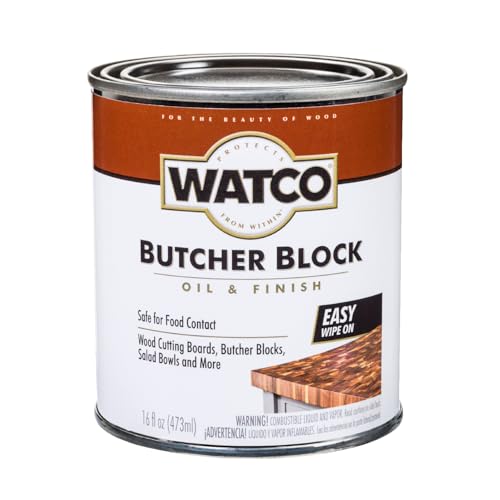
The material question gets answered on Pinterest by whichever counter photographs best, and butcher block wins that vote every time. It is worth knowing what designers are actually specifying today and why: quartz and solid surface, chosen because they resist water staining, tolerate a hot stack straight out of the dryer without scorching, and wipe clean when a capful of detergent goes over the edge. A laundry is a wet room with heat in it, which is a harder brief than a kitchen island.
Wood still works, and it still looks warmer than anything else in a small utility space, but it needs the right finish and honest maintenance. IKEA’s KARLBY countertops come pretreated with hard wax oil, and IKEA’s own product information flags the birch version as unsuitable for damp rooms, which is a fair warning for a room containing a washing machine. If you want wood, choose a species and a finish rated for humidity, re-oil every 6 to 12 months, and never let standing water sit along the front edge where drips collect. The upside is repairability: a scorch mark or a stain sands out of solid wood, which is not true of laminate.
Laminate is the value option and perfectly serviceable, with one specification that matters. Choose a postformed rounded front edge rather than a square edge with a glued strip, because the glued strip is what eventually lifts at a corner and catches every knit sleeve that crosses it.
Two finish notes apply regardless of material. Avoid heavily textured surfaces, including matte stones with a leathered finish, because a rough surface pills wool and grabs delicate fabric as you drag it. And skip the extremes of value: high-gloss white shows every dark thread and matte black shows every speck of lint, while a mid-tone warm white, pale gray, or honey wood hides both. The same logic is behind the current palette shift in these rooms, away from all-white utility toward soft sage, warm white, pale terracotta, and muted navy.
Key Takeaway: Choose quartz or solid surface for a wet room with heat in it, and if you want wood, specify a humidity-rated finish and re-oil it twice a year.
Folded Clothes With Nowhere to Hang or Land
 Save
A folding surface only handles the things that fold. Everything else, shirts that wrinkle, dresses, anything line-dried, needs somewhere to hang within arm’s reach of where it comes out of the machine, or it goes over a door frame and stays there.
A hanging rod needs two dimensions to work. Set it 12 inches (30 cm) out from the wall so a hanger sits square instead of angled, and 66 to 72 inches (168 to 183 cm) off the floor so a full-length dress clears the ground. If you are hanging shirts and trousers rather than dresses, 40 inches (102 cm) of clear space below the rod is enough, which means a rod can live above a counter as long as the counter is not more than about 30 inches (76 cm) high. Above a 36 inch (91 cm) folding counter, a rod becomes a place for pressed shirts and short items only, which is still useful and worth doing.
Wall-mounted accordion drying racks are the other half of this. They fold to about 3 to 4 inches (8 to 10 cm) of wall projection when closed, which means they cost almost nothing in a narrow room, and a pair of them mounted on the same wall provides on the order of 20 linear feet (6 m) of drying line. Mount them on the wall the folding surface is on, above it, so the same standing spot serves both jobs.
The last piece is where folded stacks go once they leave the counter. If the answer is “back in the basket,” the counter refills within a day and the whole system stalls. A shelf per person, or a small stack of labeled bins by household member, gives finished laundry a destination that is not the room it was folded in. This is the difference between a laundry that resets to empty after every load and one that runs at permanent capacity.
Key Takeaway: Put a rod 12 inches (30 cm) off the wall and a pair of folding drying racks above the counter, and give finished stacks a destination shelf so the folding surface empties out.

Light That Hides the Stain You Just Washed
 Save
Most laundry rooms have one ceiling fixture, positioned in the middle of the room, which means it sits behind you when you stand at the counter. Your own body casts a shadow across exactly the surface you are trying to see. That is why stains get missed, why navy and black end up in the same stack, and why the room feels dim no matter how many watts are in the fixture.
The fix is light at the counter rather than more light overhead. A linear LED bar under the upper cabinets, or mounted to the wall just above the folding surface, puts illumination between your body and the work. Aim for roughly 800 to 1,000 lumens across a 4 foot (122 cm) run, which is bright enough to inspect a collar without turning the room into a garage.
Two specifications matter more than brightness. Color temperature should be 3000K, warm enough that the room matches the rest of the house rather than reading as a utility closet, and consistent with whatever the ceiling fixture is doing, because one cool bulb among warm ones reads as an error rather than a choice. And the color rendering index, printed on the box as CRI, should be 90 or higher. Below that, colors flatten and dark neutrals converge, which is exactly the failure that has you carrying a black sock to the window to check whether it is actually navy.
Put the counter light on its own switch. The point of a task light is that it goes on when you are working and off when you are not, and a light wired to the same switch as the ceiling gives you no control over which one you get.
Key Takeaway: Light the counter, not the ceiling, with an 800 to 1,000 lumen bar at 3000K and CRI 90 or higher, on its own switch.

The Narrow Room Where Nothing Standard Fits
 Save
Under about 5 feet (152 cm) of width, the standard advice stops applying, because there is no arrangement in which a 24 inch (61 cm) counter, a 27 inch (69 cm) machine, and a 48 inch (122 cm) door swing all coexist across the short dimension. Something has to change shape.
The highest-value move is stacking. Front-load machines stack to roughly 76 to 80 inches (193 to 203 cm) tall in a 27 inch (69 cm) wide footprint, which frees an entire wall that was previously occupied by an appliance. That reclaimed wall is where the folding surface goes, at your own elbow height, at whatever depth the room allows. Stacking kits are model-specific, so check that yours exists before planning around it.
If stacking is not possible, put the surface on hardware that retracts. A pull-out board mounted on full-extension drawer slides beneath an existing counter gives you 18 to 24 inches (46 to 61 cm) of depth only while it is out, and returns 100 percent of the aisle when it is in. A drop-leaf on the wall opposite the machines works the same way, with the discipline that it stays down while a machine door is open.
For a laundry closet rather than a room, the door itself is usually the constraint. Bifold doors eat the wall on both sides of the opening; a curtain on a rod, or a single slider, releases a full stud bay of wall for a fold-down leaf. A shallow shelf at 40 inches (102 cm) directly above front-loaders can serve as a landing ledge for baskets even when it is too high to fold on comfortably, which is a fair trade in a space this tight.
One visual note that costs nothing: keeping the counter, the wall, and the cabinet fronts within one narrow value range stops the eye from reading a horizontal band across a small room, which is what makes a narrow laundry feel like a corridor. Light oak flooring and warm white walls do more for the sense of width here than any single furnishing decision.
Key Takeaway: In a room under 5 feet (152 cm) wide, stack the machines to free a whole wall, and if you cannot stack, put the folding surface on a pull-out or a drop-leaf that gives the aisle back.

Sorting That Happens Everywhere Except the Table
 Save
The most common reason a beautifully built folding counter goes unused has nothing to do with height, depth, or clearance. It is that the counter is never empty. Detergent, a bottle of stain remover, a jar of clothespins, three odd socks, a stack of things nobody claimed, and by week three there is a 12 inch (30 cm) working strip left at one end and the bed is back in service.
The rule that holds is simple: every item that touches the counter needs a home within one arm’s reach of it, or it stays on the counter permanently. That means a closed upper cabinet directly above for detergents and supplies, which is also where current laundry design has landed, with closed-door uppers replacing the open wire shelving that put every bottle on display. It means a small hanging basket or drawer for lint, clips, and mesh bags. And it means somewhere for the orphan socks that is not a pile.
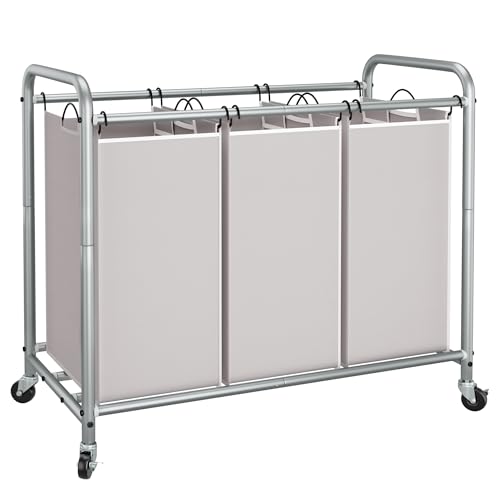
Sorting is the other half. A three-compartment sorter, typically about 30 inches (76 cm) wide, tucked beneath the counter or beside the machines, does the pre-wash separation that otherwise happens in a heap on the folding surface. Sort as clothes arrive rather than as they are washed and the counter never becomes a staging area at all.
Then there is the maintenance step everyone skips: clear the surface completely at the end of each session, not at the end of the week. A folding counter is a work surface, and work surfaces only stay usable if resetting them is part of the task rather than a separate chore. Wipe it, put the two or three things back that belong elsewhere, and leave it empty. The next load takes ten minutes instead of thirty, and the room stops being somewhere you have to clean before you can use it.
Key Takeaway: Give every object that lands on the counter a home within arm’s reach and reset the surface to empty at the end of each load, because a folding table that is never clear is not a folding table.
None of this requires a bigger laundry room. It requires four measurements taken before anything gets ordered: your elbow height minus 2 to 4 inches (5 to 10 cm) for the surface, 28 to 30 inches (71 to 76 cm) of depth if bedding is part of the job, the full swing arc of the machine door taped out on the floor, and the load rating of hardware that will actually be screwed into studs. Get those right and the rest is finish selection, which is the fun part and the part that matters least. Start with the tape measure and a roll of painter’s tape this weekend, mark the arc, mark the counter edge, and see what the room tells you. Most people find the answer is not the wide fixed counter in the photograph, but a well-placed leaf at exactly the right height, which is the version that actually gets used every week.
You've saved it, wanted it. Here's the how: codes, measurements, order. Your choices make it yours.
 Save