 Georgia
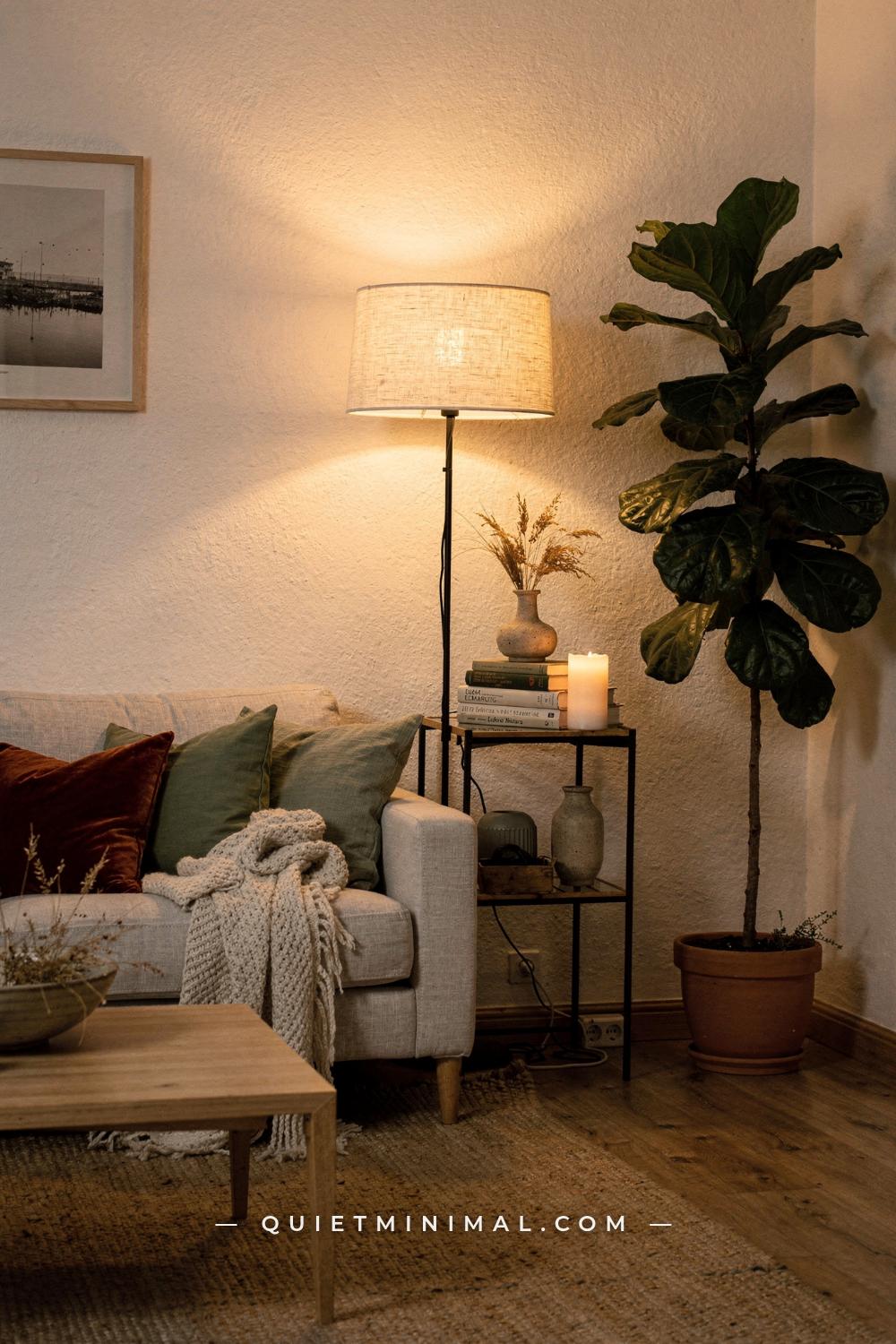
There is one square foot in almost every living room that no amount of ceiling light ever reaches, and it is the corner. You can add bulbs overhead, change the fixture, put in a brighter one, and that wedge behind the sofa stays a shade darker than everything around it. The room reads unfinished at night for a reason that has nothing to do with what is in the corner and everything to do with where the light is coming from.
A corner lamp is not a decorative object that happens to glow. It is the only fixture in the room bouncing light off two walls at once, which means the corner gives you more light per watt than any other position in the room and punishes the wrong shade height more than any other position too. What follows works through the numbers that decide whether a corner lamp actually lights the corner: how high the shade sits relative to your eyes when you are sitting down, when an arc beats a straight pole, what the bulb has to be doing, and how to solve the corner that has no outlet anywhere near it.
Why the Corner Is the Darkest Square Foot in the Room
 Save
Most living rooms are lit from a single point in the middle of the ceiling. That fixture throws light outward and downward in a cone, and a cone leaving the center of a rectangular room reaches the middle of every wall long before it reaches the place where two walls meet. The corner sits at the greatest distance from the source in the horizontal plane, and light falls off with the square of that distance. Double the distance and you have a quarter of the light. That is not a fixture problem you can fix by going brighter, because making the middle of the room uncomfortably bright still leaves the corner reading dim by comparison.
Your eye does not measure absolute brightness anyway. It measures contrast. A room where the center is bright and the corners are dark reads as smaller and more closed in than a room lit evenly at half the level, which is why a single strong ceiling light so often makes a space feel like a stage set rather than somewhere to sit. Designers describe this as flattening: everything in the middle looks lit, everything at the edges looks like backdrop.
The corner is also where the fix is cheapest. Put a lamp in it and the light hits two vertical surfaces at close range instead of one at a distance. Those two walls become secondary sources, spreading a soft wash outward at very low cost. A 15W LED in a corner does visible work that the same bulb in the middle of a wall simply does not do, because in the middle of a wall it is lighting one plane and losing the rest to the room.
From the guides
You've saved it, wanted it. Here's the how: codes, measurements, order. Your choices make it yours.
 The Japandi Honest PlaybookThe honest version of the style: what to keep, what to skip, and the order to do it in.See inside →
 The Room Refresh PlaybookA repeatable four-step method, room by room, in ten minutes, thirty minutes, or one weekend.See inside →
 Make Any Room Feel Cozy on PurposeWhy some rooms hold people and others empty out, and the moves that change it.See inside →
That is the whole argument for corner lighting, and it holds in a rental, a first apartment, or a house you own. You are not adding a lamp to fill an empty spot. You are moving a light source to the one position that pays you back twice.
Key Takeaway: A corner lamp lights two walls at once, so it returns more usable light per watt than the same lamp anywhere else in the room.

The Shade Height That Decides Whether You See Glare
 Save
Here is the single number that separates a corner lamp that works from one that annoys everyone in the room. When you sit on a normal sofa, your eyes end up somewhere between 42 and 47 inches (107 and 119 cm) off the floor. The bottom edge of the lampshade needs to sit at that level or just below it. If it sits above your eye line you are looking straight at the bulb, and a bare source in your peripheral vision reads as glare no matter how warm or dim it is.
Work backward from that and the lamp height answers itself. For a general living room corner lamp, 58 to 64 inches (147 to 163 cm) overall is the range that puts the shade edge where it belongs. If the lamp is going next to a chair for reading, drop to 48 to 58 inches (122 to 147 cm), because you want the light coming in below eye level and landing on the page rather than sweeping across the room.
Two things change the math. A deep, low sofa drops your seated eye height by 3 or 4 inches (8 or 10 cm), which means the same lamp that suited a firm upright sofa now shows you its bulb. And a tall lamp with a very short shade behaves like a shorter lamp with a deep one, because what matters is the position of the bottom edge, not the top of the pole. When you are comparing two lamps on a product page, look for the shade dimensions, not just the overall height, and subtract.
If the lamp you love is 3 inches (8 cm) too tall, the cheap fix is a deeper shade rather than a different lamp. A drum shade 12 inches (30 cm) tall instead of 9 inches (23 cm) moves the bottom edge down without touching the fixture, and on most harp-mounted lamps it is a twenty dollar swap.
Key Takeaway: Put the bottom of the shade at or just below 42 to 47 inches (107 to 119 cm), which means a 58 to 64 inch (147 to 163 cm) lamp for general light and a shorter one for reading.

When an Arc Lamp Beats a Straight Pole
 Save
A straight floor lamp lights the corner it stands in. An arc lamp stands in the corner and lights the seating, which is a different job entirely, and knowing which one you actually need saves a return.
The arc is the answer when there is no side table and no room for one. A common living room arc reaches roughly 45 inches (114 cm) from its base, which means the shade can hang over the middle of a sofa while the weighted foot stays flat against the corner, out of the walkway. You get a reading light exactly where a table lamp would sit if you had somewhere to put one, without giving up any floor space at all. That is why arcs keep appearing in current lighting roundups for small living rooms: they solve a furniture problem, not just a lighting one.
Three practical cautions before you order one. Check the base. Arc lamps carry a lot of leverage, so the good ones use a heavy marble or steel disc 10 to 14 inches (25 to 36 cm) across, and the cheap ones tip. Check the reach against your sofa depth: an arc reaching 45 inches (114 cm) hanging over a 38 inch (97 cm) deep sofa is fine, and one reaching 60 inches (152 cm) puts the shade past the front edge where people walk into it. And check the hanging height, which on most arcs lands around 60 to 66 inches (152 to 168 cm) at the shade. That is well above a seated head, so an arc almost always wants a diffused or downward-facing shade rather than a bare bulb.
A straight lamp is the better buy when the corner already has a chair and a small table, when the ceiling is under 8 feet (244 cm) and the curve would feel like it is pressing down, or when you want the corner itself to glow rather than the seat.
Key Takeaway: Choose an arc when there is no side table and the sofa needs overhead reading light, and a straight pole when the corner itself is what you want lit.

The Corner With No Outlet Anywhere Near It
 Save
Corners are where builders stop putting outlets. Electrical code requires receptacles at intervals along a wall so that no point is more than 6 feet (183 cm) from one, but corners absorb two walls’ worth of that measurement and often end up with the nearest outlet 8 or 9 feet (244 or 274 cm) away behind a sofa. This is the reason a lot of beautiful corner lamps end up somewhere else in the room.
There are three honest solutions and one bad one. The bad one is running the cord across an open floor and taping it down, because it is a trip hazard and it looks like a temporary decision that became permanent.
The first good option is a flat paintable cord channel. These are adhesive PVC or metal raceways about a half inch (1 cm) thick that stick along the baseline of the wall, take the cord inside, and get painted the wall color. Run the cord along the baseboard to the nearest outlet and it disappears completely from three feet away. Budget an hour and about twenty dollars.
The second is a rechargeable lamp. This category has gotten genuinely good: portable table lamps with 6 to 20 hours of runtime on a charge, USB-C charging, and a stepped dimmer, in the same shapes as their corded versions. They are the only real answer for a corner where the cord would have to cross a doorway. Runtime is the specification that matters, and warm output at 2700K matters more than maximum brightness, since these are rarely the room’s main light.
The third is to change what the corner holds. A tall narrow bookcase or a slim console in the corner gives you a surface at 30 to 34 inches (76 to 86 cm), a place to hide a power strip behind, and a cord that runs down the back of the furniture instead of across the wall. This is also the version that fixes an empty corner and a dark one in the same purchase.
Key Takeaway: Solve the outlet problem with a painted flat cord channel, a rechargeable lamp, or a slim corner console that hides the cord behind it, and never with tape across the floor.

Uplight, Downlight, or Both
 Save
Corner lamps split into three optical types, and they are not interchangeable.
An uplight, or torchiere, throws everything at the ceiling and gives you back a soft, shadowless wash. This is the most flattering light in the category and the most dependent on your ceiling. It needs a flat, pale, matte ceiling to bounce off. Give a torchiere a white 8 to 9 foot (244 to 274 cm) ceiling and it fills a whole room. Give it a dark ceiling, heavy texture, or exposed beams and most of the output is absorbed and you have bought a very inefficient lamp.
A downlight sends output to the floor in a defined pool. It is task light, and in a corner it works only when there is something in that corner to light, a chair, a book, a plant. On its own in an empty corner a downlight makes a bright circle on the floor and leaves the walls as dark as they were.
A diffused drum or paper shade does both at a lower intensity, spilling up, down, and sideways through the fabric. It is the safest choice for a general corner lamp because it lights the two walls, the ceiling above, and the floor below all at once, which is exactly the corner’s advantage.
If the corner is the only light you are adding, choose diffused. If the room already has good ambient light and the corner has a reading chair in it, choose a downlight or an adjustable head. If the ceiling is pale and flat and the room feels dim overall, an uplight will do more with less than anything else on the list. And if you cannot decide, a lamp with a diffused shade and a second small downward-facing head at the base covers both jobs from one plug.
Key Takeaway: Match the optics to the room: diffused for a general corner, downlight for a reading chair, uplight only when the ceiling is pale, flat and low enough to bounce.
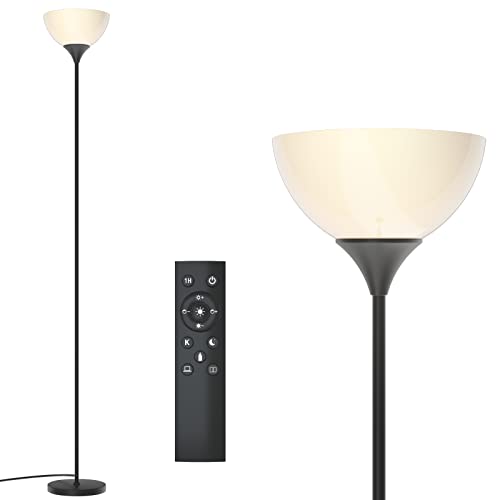
The Bulb Numbers That Matter More Than the Lamp
 Save
You can spend three hundred dollars on a lamp and ruin it with a four dollar bulb. Three specifications do almost all the work.
Brightness first. Lumens, not watts. For a diffused corner lamp doing general ambient duty, 800 to 1,100 lumens is the useful band, roughly what a traditional 60 to 75 watt bulb used to give. For a reading lamp beside a chair, 1,100 to 1,600 lumens puts enough light on a page without a second fixture. Above that in a residential corner you are into glare and the room starts to feel like a waiting area.
Color temperature second, and this is where most rooms go wrong. 2700K is warm, slightly amber, and is what a living room should be at night. 3000K is a touch cleaner and works if the rest of the house is at 3000K. Mixing the two in one room is the most visible lighting error there is, because the eye reads the cooler lamp as broken rather than different. Pick one number and put it in every socket in the room, including the ceiling.
Color rendering third. The CRI is printed on the box, and anything at 90 or above renders fabric, wood, and skin honestly. Below 80, warm neutrals go muddy and a sage green cushion turns gray after dark. On a corner lamp this matters more than average, because that lamp is lighting the walls, and walls are the largest color surface in the room.
Then add dimming. A corner lamp is doing evening duty, and evening light should not be a single fixed level. Either buy a lamp with a built-in three-way or stepped dimmer, or use a dimmable bulb with a plug-in dimmer module. It costs almost nothing and it is the difference between a lamp you switch on at seven and one you switch on at four in the afternoon in winter.
Key Takeaway: Fit 800 to 1,100 lumens at 2700K with a CRI of 90 or higher, dimmable, and use the same color temperature in every socket in the room.

Building a Reading Corner Around the Lamp
 Save
A reading corner is a geometry problem with three points: your head, the page, and the lamp. Get the triangle wrong and you read in your own shadow.
The lamp goes behind and to the side, not in front and not directly overhead. Set it just behind the shoulder of the chair, offset 12 to 20 inches (30 to 51 cm) from the center line, so the light comes over your shoulder and lands on the page without your head interrupting it. If you are right-handed, put the lamp behind the left shoulder, because your right hand and forearm cast the shadow that matters when you turn a page.
Shade height changes for reading. In a chair your seated eye level is often a little higher than on a sofa, but the shade still needs to sit at or below it, which is why 48 to 58 inches (122 to 147 cm) is the reading range rather than the 58 to 64 (147 to 163 cm) used for general light. An adjustable swing-arm or a pharmacy lamp solves this outright, because the head moves to the page instead of the page moving to the head.
The chair itself has to leave room. A standard armchair is 30 to 34 inches (76 to 86 cm) deep, and if it is pushed hard into the corner the lamp has nowhere to stand. Angling the chair at 45 degrees into the corner opens a wedge of floor behind it that is exactly where the lamp base belongs, hides the cord, and makes the corner read as a deliberate arrangement rather than furniture shoved out of the way.
Add one small surface. A side table 20 to 24 inches (51 to 61 cm) high, level with the chair arm, is what turns a chair with a lamp into a place people actually sit. Without it, a mug goes on the floor and the corner stops being used within a week.
Key Takeaway: Put the lamp behind and 12 to 20 inches (30 to 51 cm) to the side of the chair, at 48 to 58 inches (122 to 147 cm), and angle the chair into the corner so the base has somewhere to stand.

The Wedge Behind a Floating Sofa
 Save
When a sofa sits at an angle, or floats away from the wall to define a seating zone, it creates a triangular dead space behind it. That wedge is usually treated as a problem. It is actually the single best place in the room for a lamp.
Light coming from behind and above a seating group is what photographers call separation. It puts a soft edge on the back of the sofa and pushes the seating forward from the wall, which is exactly the perception you were after when you floated the sofa in the first place. A lamp in that wedge does more for how the room reads than the same lamp anywhere else, because it is lighting the space between the furniture and the wall, and that gap is what tells the eye the room has depth.
Practically, the wedge is also where the cord problem solves itself. The lamp base is behind the sofa, the cord runs along the baseboard behind the sofa, and nobody ever sees it. If the sofa floats far enough for a narrow console, 10 to 14 inches (25 to 36 cm) deep, the console hides a power strip and gives you a second surface at the same time.
Height changes slightly here. Because the lamp is behind the seat rather than beside it, the shade can sit a little higher without putting the bulb in anyone’s eye line, since you are looking away from it when you sit. That gives you room to use a taller 64 to 68 inch (163 to 173 cm) lamp, which throws light further across the ceiling and is often what an open-plan room needs.
One caution: keep the base out of the walking line. Floating a sofa creates a circulation path behind it, and that path needs 30 to 36 inches (76 to 91 cm) of clear width. A weighted lamp base 12 inches (30 cm) across sitting in the middle of that path becomes a thing people catch with a foot in the dark.
From the guides
You've saved it, wanted it. Here's the how: codes, measurements, order. Your choices make it yours.
The Japandi Honest PlaybookThe honest version of the style: what to keep, what to skip, and the order to do it in.See inside →The Room Refresh PlaybookA repeatable four-step method, room by room, in ten minutes, thirty minutes, or one weekend.See inside →Make Any Room Feel Cozy on PurposeWhy some rooms hold people and others empty out, and the moves that change it.See inside →Key Takeaway: Put the lamp in the wedge behind a floating sofa, where it separates the seating from the wall, hides its own cord, and can run taller at 64 to 68 inches (163 to 173 cm).

Small Living Rooms: Slim Poles and Wall-Hugging Bases
 Save
In a small room the corner lamp is competing for floor area with everything else, and the specification that decides whether it fits is the base, not the shade.
Bases come in three shapes. A weighted disc, typically 9 to 12 inches (23 to 30 cm) across, sits closest to the wall and takes the least floor. A tripod spreads three legs over an 18 to 22 inch (46 to 56 cm) footprint, looks lighter than a disc, and takes far more actual floor, which is the opposite of what people expect. And a low-profile flat plate, sometimes under a half inch (1 cm) thick, can slide under the front edge of a sofa or chair so the lamp effectively occupies no new floor at all. In a tight room, the flat plate wins.
The pole matters visually more than dimensionally. A half-inch (1 cm) black or brass rod reads as a line rather than an object and disappears against a wall, while a 2 inch (5 cm) turned wooden pole reads as furniture. In a room under about 12 by 12 feet (366 by 366 cm), choose the line.
Shade diameter is where people overbuy. A 16 to 18 inch (41 to 46 cm) drum shade is standard for a living room and is genuinely too wide for a small corner, where it collides with the sofa arm and blocks the walkway. A 10 to 13 inch (25 to 33 cm) shade gives up very little light in a corner, because the two walls are doing the spreading for you.
Wall-mounted is the last resort worth taking seriously. A plug-in swing-arm sconce mounted 60 inches (152 cm) up on one of the corner’s two walls uses zero floor, casts across the corner and out into the room, and comes with a fabric cord you can run down inside a channel. In a rental it is two anchors and a patch of spackle when you leave.
Key Takeaway: In a small room choose a flat low-profile base and a 10 to 13 inch (25 to 33 cm) shade, and remember a tripod takes more floor than a disc despite looking lighter.

The Table Lamp Version, and Its Own Height Math
 Save
Not every corner wants a floor lamp. If there is already a console, a bookcase, or a small chest in the corner, a table lamp on it is often the better answer, and it comes with its own arithmetic.
Add the table height and the lamp height together and aim for the same 58 to 64 inches (147 to 163 cm) you were targeting on the floor. A 30 inch (76 cm) console wants a 28 to 32 inch (71 to 81 cm) lamp. A 24 inch (61 cm) chest wants a lamp closer to 34 inches (86 cm). The bottom of the shade lands at seated eye level either way, which is the whole point, and this is why a small lamp on a low table always feels like it is not doing anything: the shade sits below the sightline and the light goes into the tabletop.
Proportion between lamp and surface is the second rule. The lamp base should read as about a third of the visible height of the arrangement, and the shade should not overhang the front edge of the table. On a console 12 inches (30 cm) deep, that caps the shade at roughly 12 to 14 inches (30 to 36 cm) across. Anything wider is going to get knocked.
Setting the console diagonally across the corner rather than flat against one wall is worth the floor it costs. It opens a triangle behind it for the cord and a power strip, it lets the lamp light both walls evenly instead of one, and it softens the hard 90 degree line that makes a corner look like a corner.
A pair of small lamps beats one large one when the corner is wide and holds a long console. Two 24 inch (61 cm) lamps at either end give you a symmetrical wash instead of a single hotspot, and each can be a lower wattage, which is easier on the eye at night.
Key Takeaway: Add table height and lamp height together and land in the same 58 to 64 inch (147 to 163 cm) band, and keep the shade narrower than the table is deep.
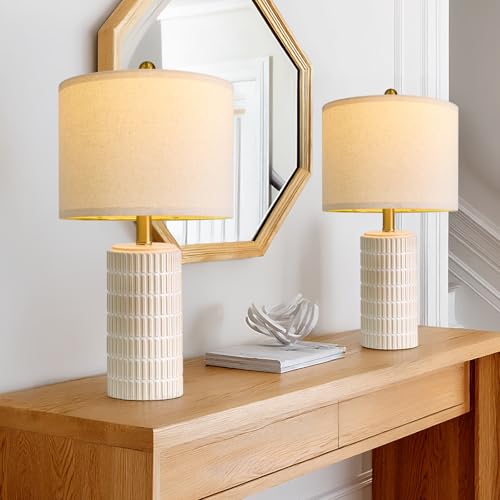
Two Corners, One Room, and the Triangle Between Them
 Save
One corner lamp fixes one corner. A room reads finished when there are three points of light at different heights, and the corners give you two of them almost for free.
The principle is straightforward: place your light sources so that a line drawn between them forms a triangle across the room rather than a straight line along one wall. A floor lamp in one corner, a table lamp on a console across the room, and a third source somewhere between them, a picture light, a small lamp on a shelf, or even a candle on the coffee table, gives you overlapping soft pools instead of a single bright zone. Every shadow gets filled from a different angle, which is what makes a room look like a photograph rather than a room with the lights on.
Do not match the heights. Two lamps at exactly 62 inches (157 cm) in opposite corners read as a showroom. Put the tall one at 62 inches (157 cm), the table lamp at 52 inches (132 cm) from the floor once its surface is counted, and let the third sit low. The unevenness is the part that reads as considered.
Do match the color temperature. This is the rule that overrides taste. All three at 2700K, or all three at 3000K. One cool source among warm ones is the single most noticeable lighting error in a home, and it is entirely free to avoid.
Wattage should step down as you move away from where people sit. The lamp beside the seating is the brightest, the far corner is the fill, and the third source is atmosphere. If you dim all three to the same level the room goes flat again, so put the far corner on the lowest setting and let it just lift the wall out of black.
Key Takeaway: Aim for three light sources at three different heights forming a triangle across the room, all at the same color temperature, at three different brightness levels.
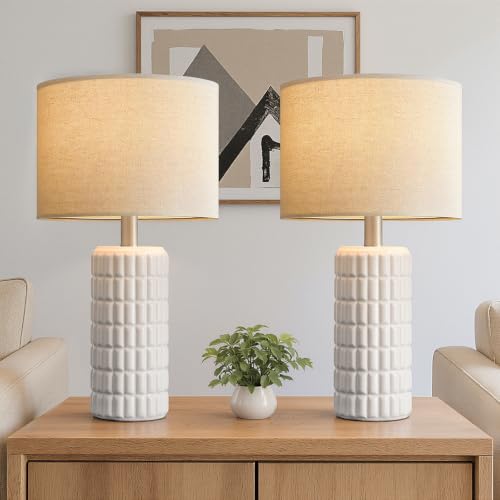
Rattan, Paper, Glass, and What the Shade Does to the Light
 Save
Shade material is usually chosen from a photograph, which is a shame, because it is the component that changes the light most and the one you can swap for the least money.
Linen and cotton drum shades are the default for a reason. They transmit a substantial share of the output sideways as a soft even glow while sending the rest up and down. In a corner, that sideways transmission is exactly what lights the two walls. A white or ivory liner keeps the light neutral; a gold or bronze liner warms it noticeably, which is lovely in a room with warm wood and wrong in a room with cool gray floors.
Paper and rice paper shades are the most diffuse of all and give the softest light in the category, at the cost of durability. They yellow slowly, they mark, and they do not like being knocked. In a low-traffic corner they are the best value in lighting.
Woven rattan and cane are the current favorite, and they behave differently: the weave throws a patterned wash onto the surrounding walls, which is a genuine feature in a corner where two walls are close enough to catch it. Choose a tight weave if you want light and a loose one if you want pattern, and be aware that an open weave lets you see the bulb from some angles, so pair it with a frosted or opal bulb rather than a clear filament one.
Glass shades divide sharply. Opal and frosted glass diffuse beautifully and are easy to live with. Smoked and amber glass, which is showing up across the latest collections, looks superb switched off and cuts real output significantly, so treat a smoked glass lamp as atmosphere and put your reading light somewhere else.
Metal shades are pure downlight. Whatever the finish outside, look at the inside: a white interior bounces usable light down, a raw metal interior absorbs a surprising amount of it.
Key Takeaway: Pick the shade for what it does to the light, linen and paper for a soft wash across both walls, rattan for pattern, smoked glass for atmosphere only.

The Lamp Nobody Turns On
 Save
There is a version of this project that ends with a well chosen lamp standing in a well chosen corner, switched off every night, because turning it on means walking across a dark room and feeling for a switch behind a shade.
Solve the switching before you buy, because it is the reason lamps go unused. Four options, in rough order of how well they work.
A foot switch on the cord is the cheapest and the most reliably used, because it is where your foot already is when you sit down. Many floor lamps ship with one; if yours did not, an inline foot switch is a five dollar part.
A smart plug is the best value in the whole category. It turns the lamp on by schedule at sunset without anyone touching anything, which is precisely the behavior you want from a corner lamp, and it gives you voice or phone control as a bonus. Fifteen dollars, no wiring, and it leaves with you at the end of a lease.
A switched outlet, if the room has one, means the corner lamp comes on with the wall switch by the door. This is the version builders intend and almost nobody realizes they have. Test the outlets in the room with a lamp and the wall switch before assuming you do not.
A pole-mounted rotary or a touch dimmer on the lamp body is the least good of the four, because it requires walking to the lamp in the dark, but it is far better than a switch tucked up under the shade where you have to reach past a hot bulb to find it.
Whichever you choose, put the corner lamp on the same trigger as the rest of your evening lighting. A room lit by three lamps that all come on together at sunset is a different room to live in than one where each has to be remembered.
Key Takeaway: Decide how the lamp gets switched before you buy it, and a fifteen dollar smart plug on a sunset schedule is the single change that makes a corner lamp get used.

None of this is really about lamps. It is about moving light to the one position in the room that pays back twice, then getting four numbers right: the shade at or just below seated eye level around 42 to 47 inches (107 to 119 cm), 800 to 1,100 lumens for general light, 2700K in every socket in the room, and a switch you will actually reach. Everything else, the rattan versus linen, the arc versus the pole, the plant behind it, is preference, and preference is the easy part. Start by sitting down on your own sofa tonight and measuring where your eyes land. That one measurement tells you which lamps on your saved board would have worked and which ones were always going to shine straight into your face, and it costs nothing but a tape measure.
From the guides
You've saved it, wanted it. Here's the how: codes, measurements, order. Your choices make it yours.
The Japandi Honest PlaybookThe honest version of the style: what to keep, what to skip, and the order to do it in.See inside →The Room Refresh PlaybookA repeatable four-step method, room by room, in ten minutes, thirty minutes, or one weekend.See inside →Make Any Room Feel Cozy on PurposeWhy some rooms hold people and others empty out, and the moves that change it.See inside → Save


