 Georgia
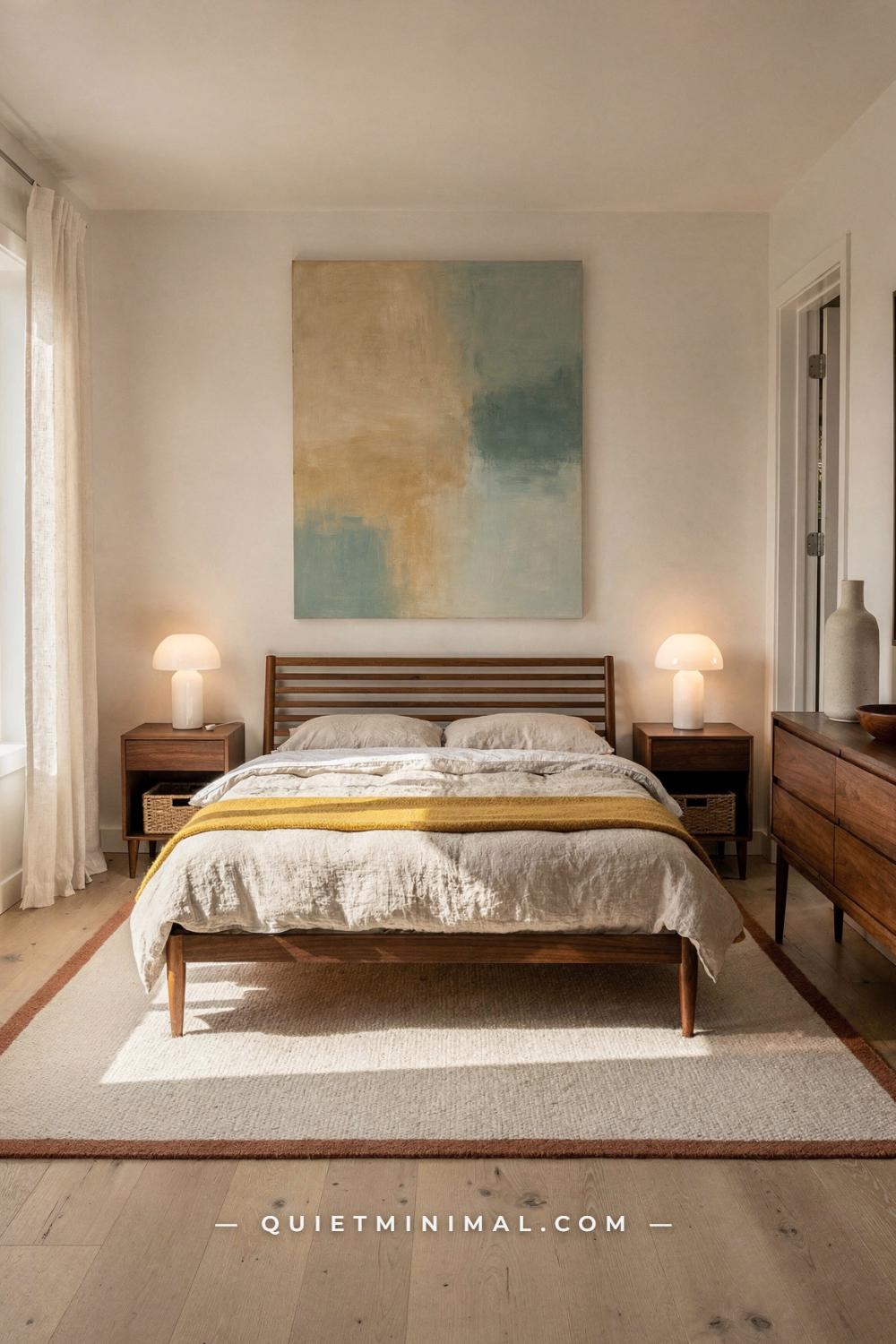
A mid century modern bedroom is a room before it is a bed. The furniture, color, texture, lighting and accent notes further down this page still hold; what they leave out is the room around those pieces, measured. Where does the bed go in a 10 x 12 ft room? How low is low? Which wall gets the mustard, and how far above the pillow does the sconce sit? This block sits above the originals as the plan. Eight sections are drawn as charts you can save: room plans, the low-profile rule, paint cards, wood pairs, a lighting plan, rug math, a vintage checklist and a cost ladder. The other eight show the rooms those numbers produce. The furniture pieces have their own pages on this site; this one is about the space they share.
What Makes a Mid-Century Bedroom Read as One Room
 Save
The common disappointment is the showroom bedroom: walnut bed, matching nightstands, matching dresser, every piece correct and the room still flat. A set repeats one wood, one height and one leg, so the eye finds nothing to compare and reads catalog furniture standing in a box.
Rooms that hold together share four continuities instead. A low horizon: bed, nightstands and dresser all below about 34 in (86 cm), so the walls above read as open space. Floor showing under every piece, on legs roughly 6 to 8 in (15 to 20 cm) tall. Two woods, never three. And one color carried at least three times.
In the photograph, the teak bed, the white oak armchair and the olive textiles do that work. Nothing matches and everything agrees: one height band, visible legs, olive on the bed and on the chair, and a clear doorway so the room reads in one look.
Key Takeaway: Plan the room by four continuities, a low horizon, visible floor, two woods and one repeated color, and stop trying to make the pieces match.
From the guides
You've saved it, wanted it. Here's the how: codes, measurements, order. Your choices make it yours.
 The Japandi Honest PlaybookThe honest version of the style: what to keep, what to skip, and the order to do it in.See inside →
 The Room Refresh PlaybookA repeatable four-step method, room by room, in ten minutes, thirty minutes, or one weekend.See inside →
 Make Any Room Feel Cozy on PurposeWhy some rooms hold people and others empty out, and the moves that change it.See inside →

Three Bedroom Sizes, Drawn in Inches
 Save
Plans fail when the bed lands on the longest wall by instinct and one side shrinks to a shuffle. Start from the frame: a mid-century queen frame runs about 64 x 86 in (163 x 218 cm), a king about 80 x 86 in (203 x 218 cm), and each side needs 24 to 36 in (61 to 91 cm) to walk.
In a 10 x 12 ft (3 x 3.7 m) room, a queen on the 10 ft wall leaves 28 in (71 cm) a side and 58 in (147 cm) past the foot, where a 48 in (122 cm) low dresser fits on the long wall.
In a 12 x 14 ft (3.7 x 4.3 m) room, a king on the 12 ft wall leaves 32 in (81 cm) a side and 82 in (208 cm) past the foot, enough for a 60 in (152 cm) dresser on the long wall.
In a 14 x 16 ft (4.3 x 4.9 m) room, a king on the 14 ft wall leaves 44 in (112 cm) a side, so an 18 in (46 cm) deep dresser beside the bed still leaves 26 in (66 cm). The 106 in (269 cm) past the foot holds a 16 in (41 cm) bench, a 36 in (91 cm) lane and an armchair.
Key Takeaway: Measure the frame, subtract it from the bed wall, and keep 24 to 36 in (61 to 91 cm) a side before any dresser earns a place.

The Bed Wall Carries the Room
 Save
One small frame floating high over a low bed is the room’s most visible miss, and the low bed makes the empty plane above it look larger still.
Compose that wall as one horizontal. The art runs about two-thirds of the bed’s width: roughly 40 in (102 cm) over a 60 in (152 cm) queen, about 50 in (127 cm) over a 76 in (193 cm) king. Its bottom edge sits 8 to 10 in (20 to 25 cm) above the headboard, so the two read as one piece. Two swing-arm sconces bracket it and free both nightstand tops.
Keep windows off the bed wall if the plan allows: art beside a window fights glare all day. In the photograph the window sits on the side wall, so the print, the walnut headboard and the brass arms read as one calm line from the doorway.
Key Takeaway: Hang art about two-thirds the bed’s width, 8 to 10 in (20 to 25 cm) above the headboard, flanked by two sconces, on a wall with no window.

The Low-Profile Rule, in Inches
 Save
The mid-century line is low on purpose, and the mattress is what usually breaks it: a 14 in (36 cm) pillow-top on a platform frame pushes the sleeping surface to 26 in (66 cm), the nightstands drop below it, and the horizon breaks.
Five heights keep it intact. The mattress top lands at 20 to 24 in (51 to 61 cm): a platform deck at 12 in (30 cm) plus a 10 in (25 cm) mattress gives 22 in (56 cm). The nightstand top sits within 2 in (5 cm) of the mattress top, between 20 and 24 in for that bed. The legs run 6 to 8 in (15 to 20 cm) on every piece, so the floor shows under all of them. The headboard rises about 14 to 20 in (36 to 51 cm) above the mattress top. And the low dresser tops out at 30 to 34 in (76 to 86 cm), which is why the style favors lowboys over tall chests. A 10 to 12 in (25 to 30 cm) mattress keeps all five in line.
Key Takeaway: Keep the mattress top at 20 to 24 in (51 to 61 cm), the nightstand within 2 in (5 cm) of it, and 6 to 8 in (15 to 20 cm) of leg under everything.

One Accent Wall Behind the Bed, and Only That Wall
 Save
The accent wall goes wrong in two ways. On the window wall, daylight from behind turns the color into a dark frame around a bright hole. On a side wall, it pulls the eye off the bed and the room seems to tip.
Paint the wall behind the bed, all of it: floor to ceiling, corner to corner, no stripe and no half-wall. The headboard then sits on the color the way art sits on a mat. Keep the other three walls and the ceiling one warm white. Benjamin Moore Turmeric 2160-20, the ocher in this photograph, is the mustard to test against walnut; it reads warm without turning yellow beside the wood.
Then carry the color off the wall at least twice, here in the geometric throw, with teal answering it on the pillow and the armchair cushion. A color that appears once looks like a paint decision; three times looks like a plan.
Key Takeaway: Paint only the bed wall, all of it, keep the rest warm white, and repeat the color twice more in textiles.

Paint Cards for a Mid-Century Bedroom, Wall by Wall
 Save
Pick the card and its walls together. Every code below is checked on the brand’s own site; LRV, the light reflectance value, runs from 0 (black) to 100 (white).
The cards. Benjamin Moore Alabaster OC-129, LRV 85.08, the warm white that sits beside walnut without looking stark. Benjamin Moore Turmeric 2160-20, LRV 26.62, mustard. Sherwin-Williams Cavern Clay SW 7701, LRV about 20, burnt orange clay. Benjamin Moore Pacific Rim 678, LRV 19.11, muted teal. Benjamin Moore Saybrook Sage HC-114, LRV 45.46, soft green; for a deeper olive, Sherwin-Williams Relentless Olive SW 6425. Benjamin Moore Hale Navy HC-154, LRV 8.36, deep blue. Sherwin-Williams Urbane Bronze SW 7048, LRV about 8, the darkest neutral.
The matrix. All-white with walnut: Alabaster on walls, ceiling and trim, color only in textiles. One accent wall: Turmeric, Cavern Clay or Pacific Rim behind the bed, Alabaster elsewhere. Color-drenched moody: Hale Navy or Urbane Bronze on walls, trim and ceiling alike. Boho warm: Cavern Clay behind the bed, Alabaster elsewhere, cane and jute in the textiles.
Key Takeaway: Choose the card and the walls together: one warm white field, one accent behind the bed, or one dark color everywhere.

Two Woods That Look Collected, Not Matched
 Save
Three wood tones in one bedroom rarely look intentional. A walnut bed, a cherry nightstand and a pine dresser each look fine alone and together read as three hand-me-downs, because the eye compares every grain and finds no rule.
Two woods give it the rule. The dominant one carries the big piece, usually the bed; the second answers on the smaller pieces. In the photograph, walnut takes the bed and the mirror frame, and pale white oak takes the nightstands, the bench and the dresser. Dark against pale is what makes the pairing look chosen, and each wood appears at least twice, so neither reads as a stray.
Count the floor. White oak boards are already one of your two woods, which is why this room adds walnut and stops. The rust throw then picks up the walnut’s red undertone, so the bed and the bedding belong together.
Key Takeaway: Use one dominant wood on the bed and one contrasting wood on the smaller pieces, count the floor as one of the two, and stop there.

Which Wood Tones Pair in a Mid-Century Bedroom
 Save
Wood pairs fail when two tones are close enough to compare and different enough to clash. Walnut and teak are the classic trap: side by side, the teak looks like walnut that faded.
The grid, pair by pair. Walnut with white oak works, the strongest contrast, dark against pale. Teak with white oak works, warm orange against pale. Rosewood-look with white oak works on one piece, because its heavy figure needs a quiet partner. Walnut with teak: use with care, with a rug, a painted piece or a textile between them. Rosewood-look with walnut: skip, two busy dark grains compete. Rosewood-look with teak: skip. Any three woods: skip.
Then the split. Give the dominant wood about two-thirds of the visible wood and the second about one-third, a 2 to 1 split, and repeat each at least twice. The floor always counts: on white oak boards, choose one furniture wood and you already have your pair.
Key Takeaway: Pair a dark wood with a pale one, split them 2 to 1, count the floor, and never let a third wood in.

Lamplight That Makes the Walnut Glow After Dark
 Save
A single bright ceiling light at a cool color temperature is the quickest way to flatten a mid-century bedroom. Light from one overhead point shines straight down onto walnut and the grain loses its depth, and a bulb around 4000K pulls the red out of the wood until it looks gray-brown.
The fix is several low sources at one warm temperature. Side light from below eye level rakes across the grain: the figure shows, the edges catch, the color reads amber. Use 2700K bulbs in every fixture, the ceiling included, so a warm lamp never fights a cool ceiling.
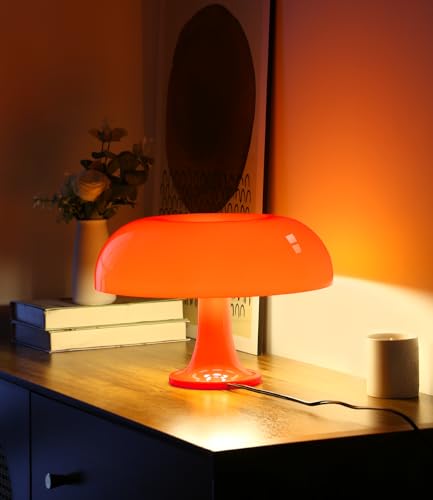
In the photograph, the globe overhead is dimmed to a glow and the two mushroom lamps do the real work, their opal glass softening the bulb so nothing glares at the pillow. Opal glass, linen and paper all diffuse; a bare filament reads harsh at bedtime.
Key Takeaway: Light the bedroom from several low sources, all at 2700K, and let the ceiling fixture glow rather than lead.
A Lighting Plan for the Mid-Century Bedroom
 Save
One ceiling fixture on one switch is not a plan. Use three layers, each with a height.
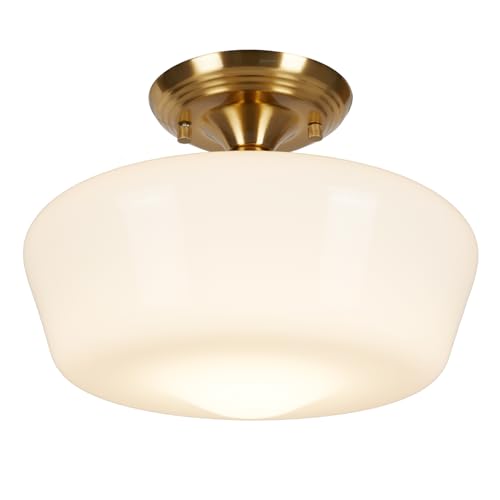
The ceiling. Center a globe or sputnik on the room, its bottom at least 7 ft (213 cm) above the floor where people walk. Under an 8 ft (244 cm) ceiling that means a semi-flush globe 12 to 16 in (30 to 41 cm) across; under a 9 ft (274 cm) ceiling, a pendant or sputnik can drop 12 to 24 in (30 to 61 cm).
The wall. Mount swing-arm sconces about 30 in (76 cm) above the mattress top, 52 in (132 cm) from the floor on a 22 in (56 cm) mattress, and 6 to 12 in (15 to 30 cm) outside each mattress edge. Sit up against the headboard before drilling: the shade should clear your shoulder.
The table: one mushroom or ceramic lamp per nightstand. Then two rules for all of it: 2700K in every bulb, and three switch points, one at the door and one on each side of the bed.
Key Takeaway: Plan three layers with heights: the ceiling fixture 7 ft (213 cm) clear, sconces 30 in (76 cm) over the mattress, lamps on the nightstands, all at 2700K.
Pattern That Holds Still: Geometric Throw, Solid Linen, Deep Rug
 Save
The busy bed is a common misstep: a geometric duvet, geometric pillows, a geometric rug, each fine alone and together a room that never stops moving. The style is graphic, but the original rooms used pattern sparingly against plain upholstery and plain walls.
Let one pattern lead and make it large. Here it is the throw, big interlocking arcs in rust, cream and mustard that read from the doorway. The bedding under it is solid olive linen, the pillows plain cream. Everything else gets texture instead of print: washed linen, wool and deep shag underfoot give the eye something to rest on without decoding a second motif.
Wool and linen are the honest fibers here. Both breathe, both soften with use, and both take mustard, rust and olive without a synthetic sheen. The rust cushion on the teak armchair repeats the throw and ties the far corner back to the bed.
Key Takeaway: Give the bed one large pattern, keep the bedding solid, and let wool, linen and shag carry the rest as texture.

Rug Sizes and Pattern Scale Under the Bed
 Save
A rug that stops at the nightstands is the classic sizing mistake. The fix: rug width minus bed width, divided by 2, is what shows on each side. Aim for 18 to 24 in (46 to 61 cm).
For a queen, 60 in (152 cm) wide, an 8 x 10 ft (244 x 305 cm) rug with the 8 ft side across shows 18 in (46 cm) each side; turned, with 10 ft across, it shows 30 in (76 cm). For a king, 76 in (193 cm) wide, a 9 x 12 ft (274 x 366 cm) rug shows 16 in (41 cm) with 9 ft across, just short, or 34 in (86 cm) turned. A 10 x 14 ft (305 x 427 cm) rug with 10 ft across shows 22 in (56 cm). Measure the frame, not just the mattress.
Start the rug about a third of the way down the bed so the nightstands stand on bare floor with their legs visible.
From the guides
You've saved it, wanted it. Here's the how: codes, measurements, order. Your choices make it yours.
The Japandi Honest PlaybookThe honest version of the style: what to keep, what to skip, and the order to do it in.See inside →The Room Refresh PlaybookA repeatable four-step method, room by room, in ten minutes, thirty minutes, or one weekend.See inside →Make Any Room Feel Cozy on PurposeWhy some rooms hold people and others empty out, and the moves that change it.See inside →Pattern scale: one large, one medium, the rest solid.
Key Takeaway: Subtract the bed width from the rug width, halve it, and size for 18 to 24 in (46 to 61 cm) each side.

Abstract Art and the Gallery Shelf Above the Dresser
 Save
The dresser wall is where mid-century bedrooms collect clutter: small frames at random heights, a poster or two, every surface filled, the lowboy’s long line lost. The art is where the style’s color and shape live, so give it room.
Edit it to three kinds of object. A sunburst mirror, its center at roughly eye level, about 57 to 60 in (145 to 152 cm) from the floor. One abstract print beside it in the room’s own palette, ocher and teal here, so the art belongs to the color plan. And one floating shelf of ceramic vessels in odd numbers and varied heights, with about a third of the shelf left empty.
Keep the art off the window wall. Glass and glossy prints near a window throw glare, and the sunburst needs a solid wall behind it to read as a shape.
Key Takeaway: Edit the dresser wall to a sunburst mirror, one abstract print and a shelf of ceramics, hung off the window wall with a third of the shelf left open.

Vintage or Reproduction: The Five-Point Check
 Save
On a listing photo, a 1960s original, a 1990s reproduction and a particle-board copy look the same. Five in-person checks tell them apart.
One, dovetails at the drawer corners. Lane, Drexel and Bassett dovetailed drawers through the 1950s to 1970s; even, machine-cut dovetails are normal for the period, but staples or nails in a drawer box are the warning. Two, solid wood or veneer. Veneer is no red flag, since authentic pieces used it widely, but drawer sides and backs should be solid wood; particle board inside a piece sold as 1960s means walk away. Three, the maker stamp or label, inside a drawer, underneath or on the back; a missing one proves nothing, because labels wear off. Four, the wobble test: push the case and rock each leg, and anything that racks needs regluing. Five, the smell test: if mildew or smoke stays after airing, budget for refinishing.
Key Takeaway: Check five things in person, dovetails, the wood inside, the label, the wobble and the smell, before trusting any vintage listing.

A Vintage-Led Room That Still Feels Lived In
 Save
An all-vintage room can tip into a period set: every piece from the same decade, every finish the same age, a display nobody sleeps in. The age is the appeal, but the room needs one layer that is plainly current.
Let one or two vintage anchors lead and keep everything around them new and soft. In the photograph the anchors are the walnut lowboy, its brass pulls dulled by decades of hands, and the teak armchair with its faded cushions. The bed, bedding, lamp, rug and globe light are current, so the old pieces read as finds rather than inventory. Rumpled linen and a blanket left where it landed do the rest; the most inviting mid-century rooms look slept in.
Two good vintage pieces bought slowly, after the five-point check, carry more of the room than six rushed ones.
Key Takeaway: Let one or two vintage pieces lead, keep the bed, textiles and lighting new, and leave the bedding looking slept in.

What a Mid-Century Modern Bedroom Costs at Three Levels
 Save
Budgets go wrong when the bed takes everything and the new frame sits on a too-small rug. These levels, at prices at the time of writing, spread the money.
The $800 restyle keeps your bed: two gallons of premium paint at about $50 to $60 a gallon, two IKEA DEJSA mushroom lamps at $54.99 each, a West Elm clear globe pendant at $99, a Target Threshold 7 x 10 ft woven rug at $200 laid with the 10 ft side across a queen, then linen bedding, a geometric throw and two abstract prints.
The $4,000 reproduction room buys the frame: a solid wood queen with round tapered legs at $674.99 from Cymax, two CB2 Mantis swing-arm sconces at $129 each, a Wayfair six-light sputnik at $629 and an 8 x 10 ft wool flatweave from about $1,049 to $1,726, with nightstands, a dresser, paint and bedding taking the rest.
The $10,000 and up vintage-led room climbs fast: walnut dressers ask $1,470 and $2,200 on Chairish, 1stDibs puts its average used mid-century dresser at $2,801, sconces run $485 to $749 each, and a designer sputnik can reach $7,500.
Key Takeaway: Spend across the room, paint, light and rug first, and let the vintage budget grow only as the room around it is finished.
The original ideas from this article continue below.
The mid-century modern style offers a blend of simplicity and elegance that’s hard to ignore when it comes to the delicate task of designing your sleeping sanctuary. You’ll find that choosing furniture with clean lines and organic shapes creates a timeless feel. Don’t forget the power of a well-chosen color palette; neutrals paired with earthy tones can transform the space.
- Choose wooden furniture with clean lines and tapered legs for a classic mid-century look.
- Use a neutral color palette with pops of earthy hues and bold accents for balance.
- Incorporate natural wood and metallic accents in brass or chrome for texture.
- Select iconic lighting fixtures like Sputnik chandeliers or sleek wall sconces for style and function.
- Add geometric patterned pillows, abstract wall art, and minimalist houseplants for decorative accents.
Furniture Selection
Selecting the right furniture is crucial to achieving an authentic mid-century modern bedroom. Start by choosing pieces with clean lines and organic shapes. Look for wooden furniture with tapered legs, which are iconic in mid-century design.
A platform bed with a minimalist headboard can serve as a striking focal point. Nightstands and dressers should feature simple, functional designs and natural wood finishes. Incorporate a sleek, low-profile dresser to enhance the room’s open feel.
Don’t forget a comfortable lounge chair or bench with smooth, curved lines. Finally, add a touch of metal or glass to bring in a modern flair. By carefully selecting these elements, you’ll create a cohesive and stylish mid-century modern bedroom that feels both timeless and contemporary.
Color Palette
A well-chosen color palette will breathe life into your mid-century modern bedroom, balancing warmth and vibrancy with understated elegance. Start with a base of neutral tones like white, beige, or light gray to create a clean canvas.
Then, introduce pops of color with rich, earthy hues such as mustard yellow, burnt orange, or olive green. These shades evoke the essence of mid-century design and provide a cozy yet sophisticated atmosphere.
Opt for bold accents through accessories like throw pillows, artwork, or a statement rug. Don’t avoid incorporating darker colors like navy or charcoal for added depth and contrast.
Textures and Materials
Combining textures and materials can elevate your mid-century modern bedroom, infusing it with depth and tactile interest. Start with natural wood for furniture pieces, adding warmth and a classic feel. Introduce metals like brass or chrome for accents, giving a sleek, polished look. Soft textiles like velvet or linen for bedding and cushions add comfort and richness. Don’t forget a statement rug to harmonize the room, blending patterns and materials.
Here’s a quick guide:
| Element | Material | Texture |
|---|---|---|
| Furniture | Wood | Smooth, Warm |
| Accents | Brass/Chrome | Polished |
| Bedding | Velvet/Linen | Soft, Rich |
| Rugs | Wool/Jute | Coarse, Cozy |
| Decor Pieces | Ceramic/Glass | Sleek, Glossy |
Mix these elements to create a balanced, inviting space.
Lighting Choices
Lighting plays a crucial role in creating the perfect mid-century modern bedroom ambiance. You’ll want to focus on fixtures that blend form and function. Consider incorporating iconic pieces like Sputnik chandeliers or globe pendant lights to make a statement. These designs provide ample light and serve as eye-catching focal points.
Don’t forget about task lighting. Consider sleek, adjustable wall sconces for reading or bedside table lamps with clean lines and metallic finishes. Natural light is equally important, so opt for sheer curtains that allow sunlight to filter in softly.
Layering lighting—combining ambient, task, and accent lights—will ensure your bedroom is both functional and stylish. Choose warm bulbs to create a cozy, inviting atmosphere.
Decorative Accents
Decorative accents add personality and charm to your mid-century modern bedroom, making it uniquely yours. Start with geometric patterns on throw pillows or bedspreads. Incorporate sleek metal or wooden picture frames for a vintage touch. Don’t forget a stylish, sculptural lamp on your nightstand. Houseplants in minimalist pots can bring life and color to the space.
Here are some ideas for decorative accents:
| Accent Type | Material | Placement |
|---|---|---|
| Throw Pillows | Geometric Fabric | Bed or Chair |
| Picture Frames | Metal/Wood | Walls/Nightstand |
| Sculptural Lamp | Metal/Ceramic | Nightstand |
| Houseplants | Minimalist Pots | Shelves/Nightstand |
| Wall Art | Abstract Prints | Above Bed |
These accents will transform your bedroom into a cozy, stylish retreat.
Follow Quiet Minimal on Pinterest for more home design tips and inspiration.
From the guides
You've saved it, wanted it. Here's the how: codes, measurements, order. Your choices make it yours.
The Japandi Honest PlaybookThe honest version of the style: what to keep, what to skip, and the order to do it in.See inside →The Room Refresh PlaybookA repeatable four-step method, room by room, in ten minutes, thirty minutes, or one weekend.See inside →Make Any Room Feel Cozy on PurposeWhy some rooms hold people and others empty out, and the moves that change it.See inside →


