 Georgia

The version of minimalism that looks good on a Pinterest board but feels wrong to live in — you know it. The one where the room looks staged for a real estate listing, not styled for a real person. Every throw pillow has been removed. The walls are bare. The surfaces are pristine. And it feels like nobody lives there, because nobody would want to.
Warm minimalism fixes that. It keeps the intention — fewer things, better things, nothing without purpose — but it layers in texture, natural material, and considered detail so the room reads as calm instead of cold. The difference is specific and learnable. These 15 minimalist decor ideas walk you through exactly where to make the moves that matter, so your space looks edited, not emptied.
1. Start With a Warm Neutral on Every Wall
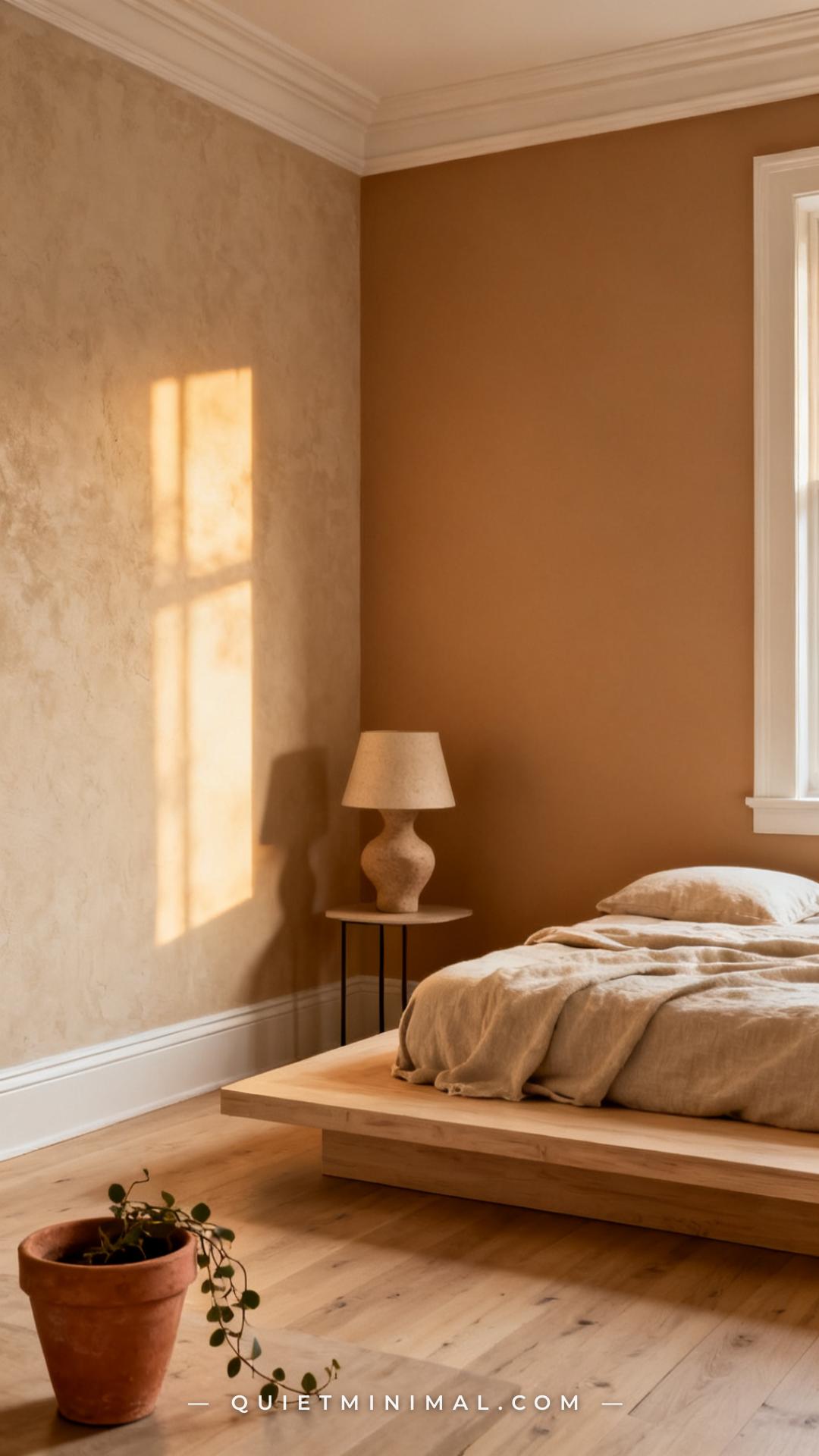
The biggest mistake in minimalist rooms is choosing the wrong white. A bright, cool white (anything with blue or grey undertone) will make your room feel clinical before a single piece of furniture is placed. Warm minimalism begins on the walls, and the right warm neutral does half the work for you. Sherwin-Williams “Accessible Beige” (SW 7036) reads as an almost-white in natural light but brings a subtle sand warmth that keeps the room grounded. Benjamin Moore “White Dove” (OC-17) is a softer creamy white that pairs beautifully with natural wood tones without reading as yellow. For rooms with less natural light, Farrow & Ball “Elephant’s Breath” (No. 229) — a greyed-lavender that photographs warmer than it sounds — adds depth without visual noise.
The wall color is your canvas, not a backdrop. In minimalist rooms where you’re working with fewer decorative elements, it does more emotional lifting than in a maximalist space. Choose it last, after you’ve confirmed your furniture tones, so you can pull from the warmth already in the room rather than fighting it.
From the guides
You've saved it, wanted it. Here's the how: codes, measurements, order. Your choices make it yours.
 The Japandi Honest PlaybookThe honest version of the style: what to keep, what to skip, and the order to do it in.See inside →
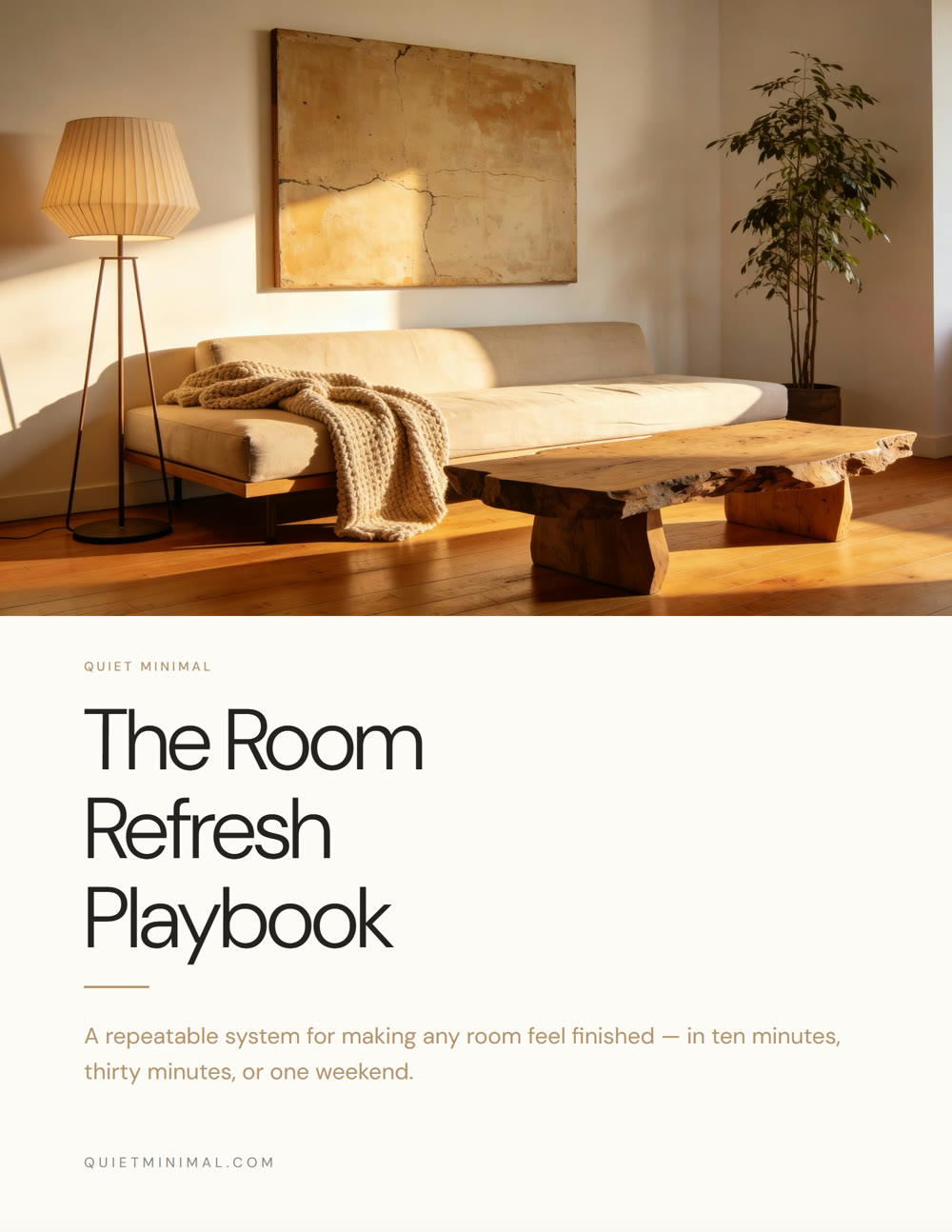 The Room Refresh PlaybookA repeatable four-step method, room by room, in ten minutes, thirty minutes, or one weekend.See inside →
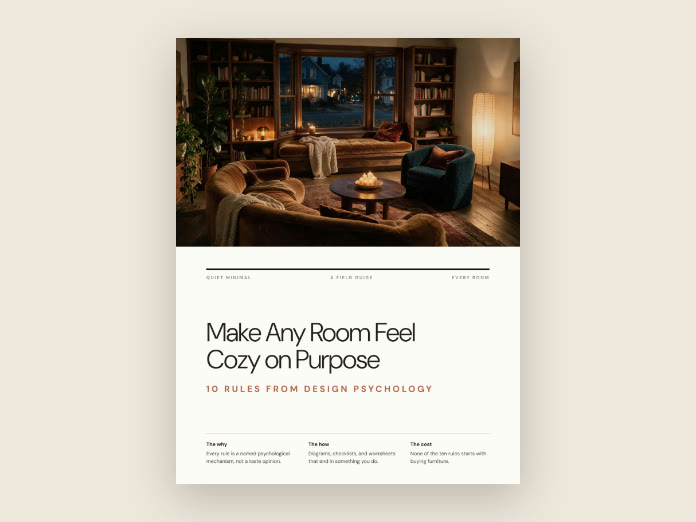 Make Any Room Feel Cozy on PurposeWhy some rooms hold people and others empty out, and the moves that change it.See inside →
Key Takeaway: A warm-toned neutral on your walls does more work than any single decor piece in a minimalist room — choose one with cream, sand, or greige undertone, never cool grey or stark white.
 Save

2. Choose One Natural Material and Commit to It
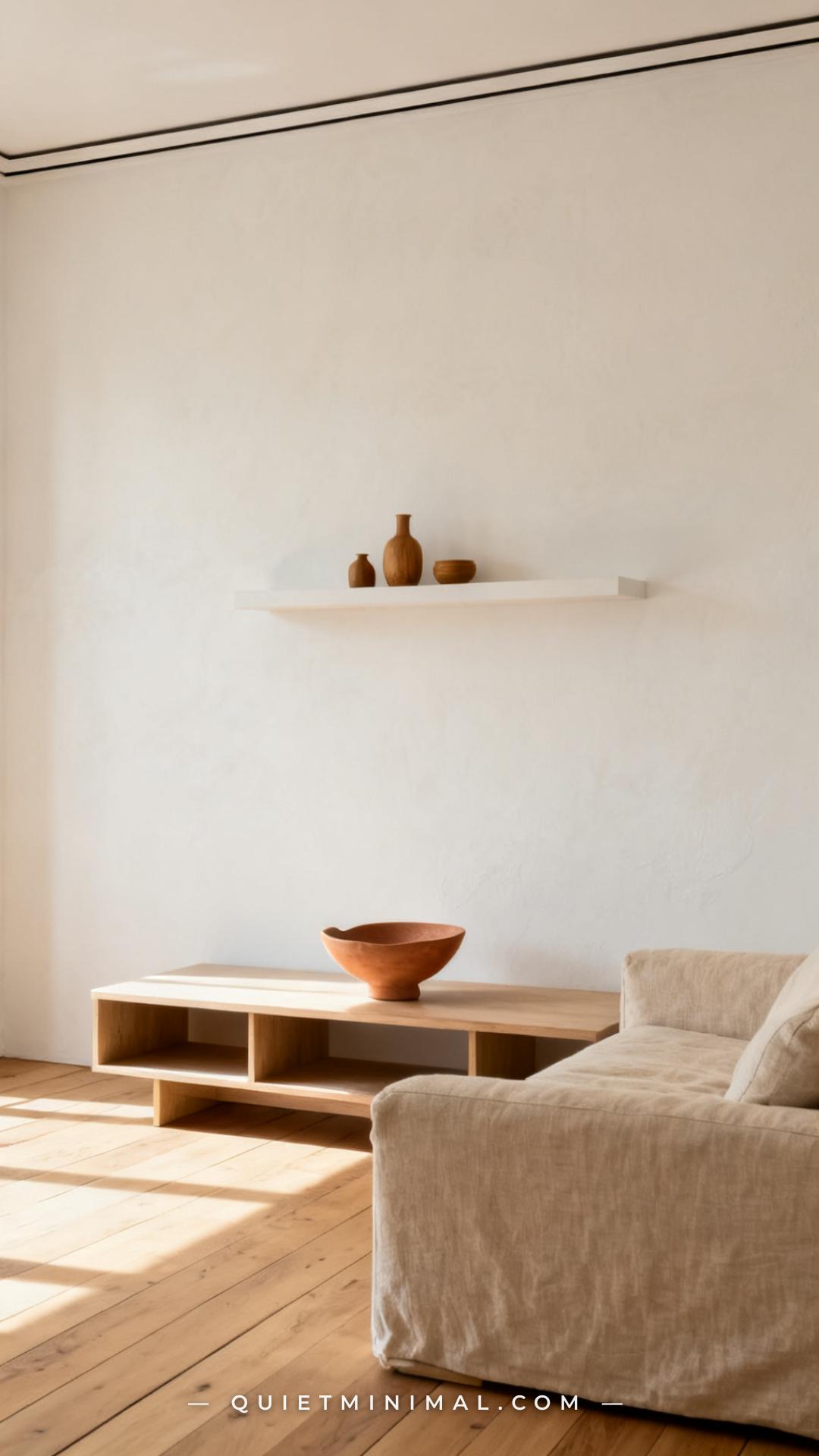
Minimalism loses the plot when natural materials are scattered randomly — a bamboo tray here, a jute rug there, a rattan mirror, a terracotta vase, unrelated driftwood on a shelf. The eye doesn’t rest; it searches. Warm minimalism picks one primary natural material and lets it recur across the room in different scales and functions. Pale oak is currently the strongest performer in this category: it appears as flooring, as a coffee table, as small decorative vessels, and as frame details on artwork. The repetition creates a visual thread without adding clutter.
The secondary material can introduce contrast — matte black metal as hardware, or raw linen as upholstery — but it should stay subordinate. One natural material as the star, one contrasting material as the foil, everything else neutral. That’s the framework that keeps a room feeling intentional rather than assembled.
Key Takeaway: Choose one primary natural material — pale oak, raw linen, rattan, or marble — and let it repeat across the room in different forms; a consistent material thread unifies a minimalist space better than matching furniture sets.
 Save
 Save
3. Edit Your Surfaces Down to Three Objects or Fewer
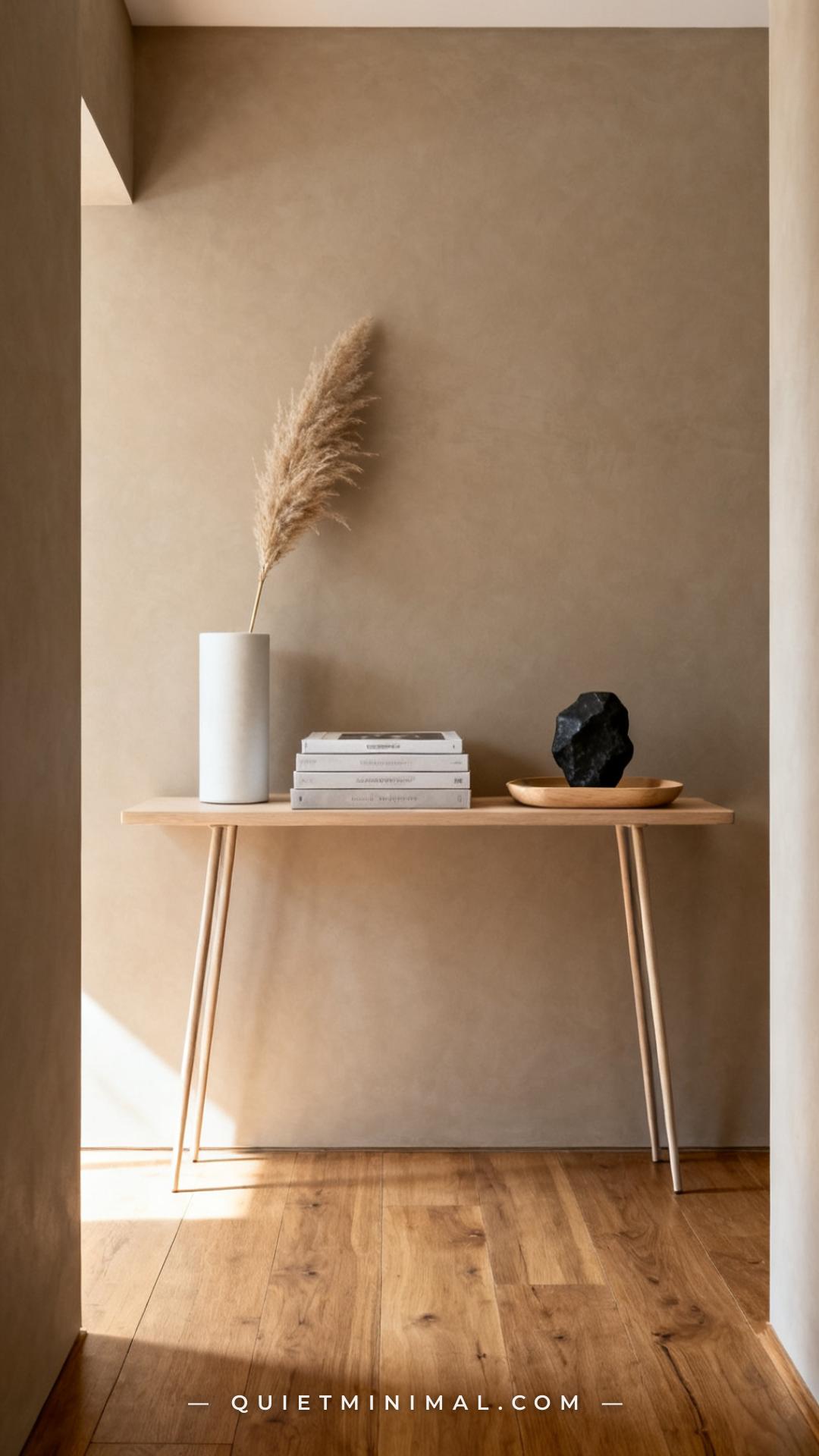
The rule of three isn’t aesthetic superstition — it’s a functional constraint that prevents visual overload in low-furniture spaces. In a minimalist room, every surface is exposed: bookshelves, coffee tables, nightstands, console tables, open kitchen counters. Without the visual “noise” of many smaller items to fill peripheral vision, each surface reads like a deliberate composition. Three objects on a surface (varying height, shape, and material) create a scene. Four becomes a collection. Five becomes clutter.
Practice the edit: clear every surface completely, then reintroduce objects one at a time with purpose. Ask whether each object earns its square footage — whether it’s beautiful, functional, or both. A sculptural ceramic bowl, a stack of two or three books with spines facing the same direction, and a single stem in a bud vase: that’s a composed surface. That’s the move.
Key Takeaway: Limit every exposed surface to three objects maximum, varying height, shape, and material — this is the simplest single discipline that separates a curated minimalist room from an undecided one.
 Save
 Save
4. Let One Piece of Art Do All the Work
Gallery walls are not minimalist. Not because they’re inherently wrong — but because in a room already stripped of decorative objects, a gallery wall becomes the loudest thing in the space and competes with the intentional calm you’re building. One piece of art, correctly scaled and correctly placed, does more emotional work than twelve. It becomes a focal point. The room organizes around it.
Scale is the non-negotiable variable. Most people under-scale art in minimalist rooms because they’re used to filling space with multiple pieces and adjust down when working alone. In a room with a sofa spanning eight feet, the art above it should span at least half that width — ideally two-thirds. A 16×20 print above an eight-foot sofa will float and look accidental. A 40×50 print centered above the same sofa reads as intentional architecture. Abstract works in warm earthy tones — ochre, raw umber, terracotta, cream — integrate naturally into the warm neutral palette without demanding a style-specific commitment.
Key Takeaway: One oversized piece of art — at least half the width of the furniture below it — does more for a minimalist room than any gallery wall; scale up dramatically and choose abstract in warm earth tones.
 Save
 Save
5. Add Texture Through Fabric, Not More Objects
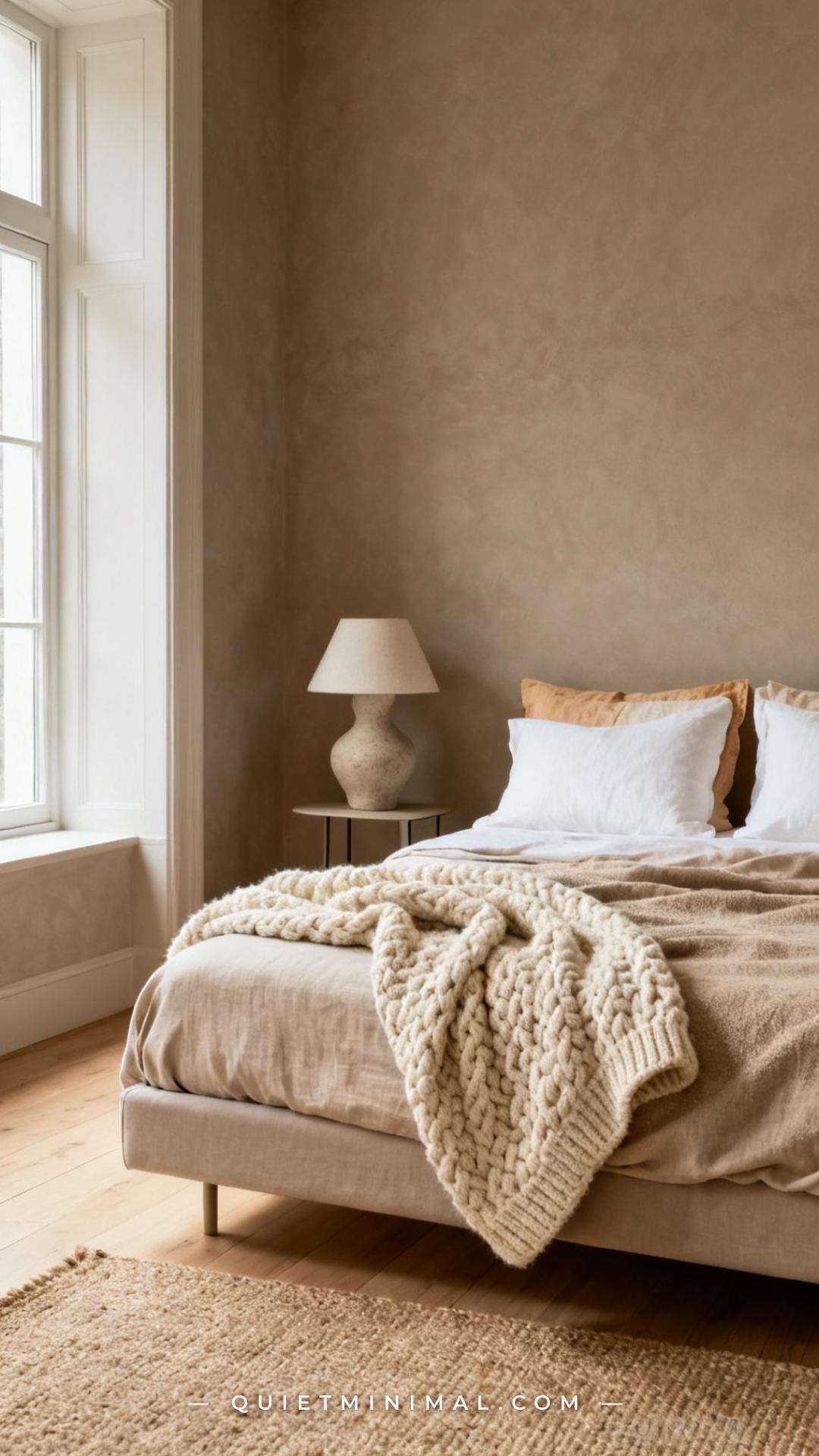
The most common complaint about minimalist rooms — “it feels empty” — is almost always a texture problem, not a quantity problem. When rooms are stripped of objects, the surfaces and textiles have to carry the tactile load. A room with a flat microfiber sofa, smooth cotton bedding, a flat-weave rug, and lacquered side tables will feel cold even if it’s technically “warm” in color. The eye and the body need something to read as soft, uneven, woven, or napped.
Raw linen upholstery (or linen-blend throws and cushion covers) is the fastest fix — it photographs beautifully, drapes naturally, and resists looking “decorated.” A chunky-knit throw folded once and draped over a sofa arm reads as lived-in without adding visual clutter. A wool bouclé cushion in oatmeal on a pale oak chair introduces a contrast in texture at the smallest possible scale. Layer two or three fabric textures in the same neutral family, and the room instantly reads warmer and more complete without a single additional object on a surface.
Key Takeaway: Solve the “looks empty” problem with fabric texture — layer raw linen, chunky knit, and bouclé in the same neutral family across your sofa and bed rather than adding more objects to your surfaces.
 Save
 Save
6. Use a Round Mirror as Your Most Versatile Tool
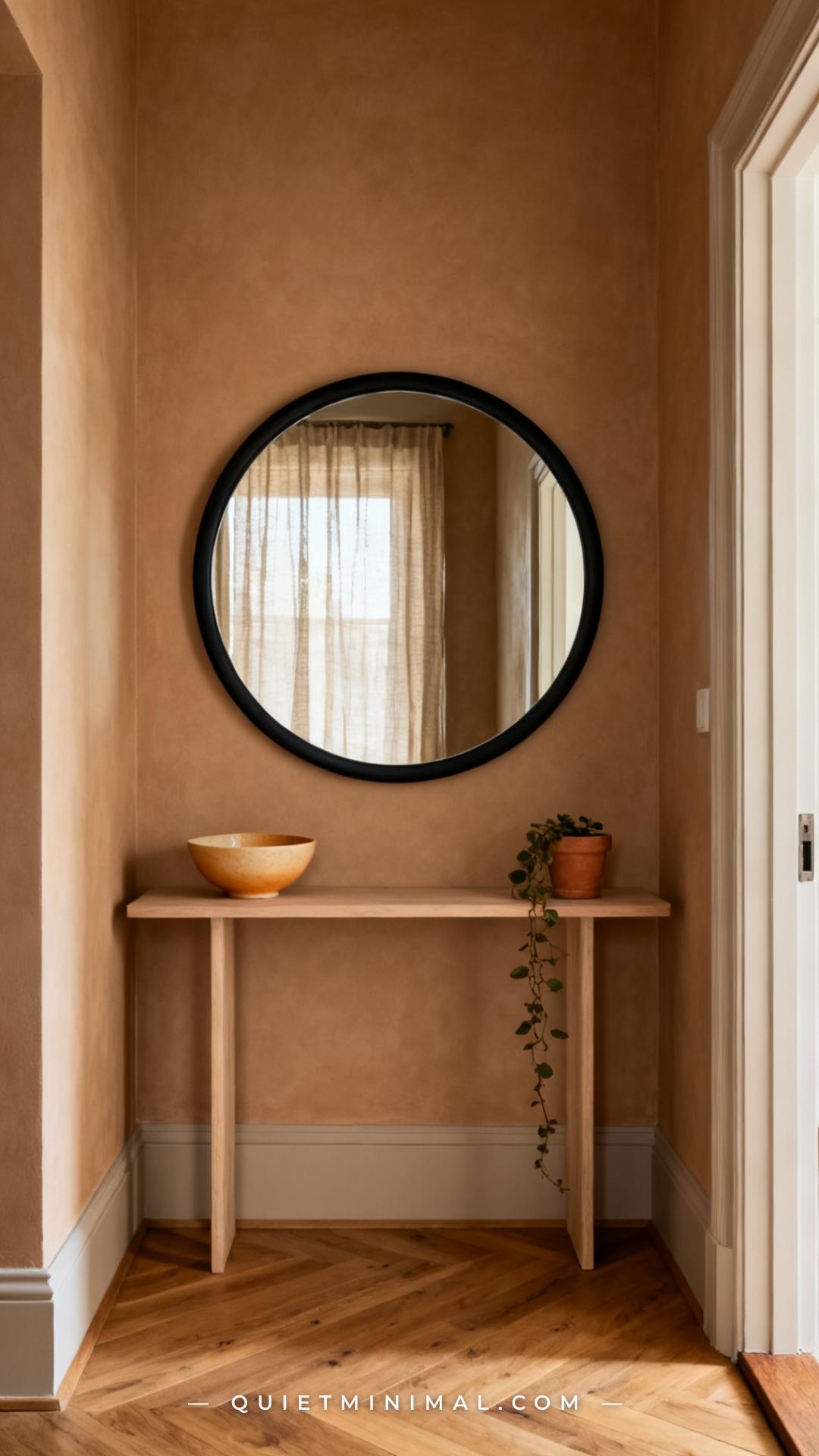
Round mirrors do three things simultaneously that most single decor pieces cannot: they bounce light, they introduce a soft organic shape that contrasts with the rectilinear geometry of furniture and architecture, and they fill vertical wall space without requiring a gallery wall or oversized artwork. In warm minimalism, a round mirror in matte black, aged brass, or natural rattan frame is frequently the piece that makes a room feel finished.
Placement matters more than size. Above a console table in an entryway: the mirror replaces a second surface object and doubles the perceived depth of the space. On a blank wall in a bedroom: position it at seated eye-level beside a chair or reading nook rather than centered above furniture, and it reads as intentional asymmetry rather than decorative habit. In a small living room: lean it on the floor against the wall behind a sofa for a layered, studio-apartment effect that feels Parisian without the effort.
Key Takeaway: A round mirror in matte black or aged brass is the single most versatile minimalist decor piece — it adds light, organic shape, and perceived depth simultaneously without crowding a surface or wall.
 Save
 Save
7. Bring in One Plant — Then Stop
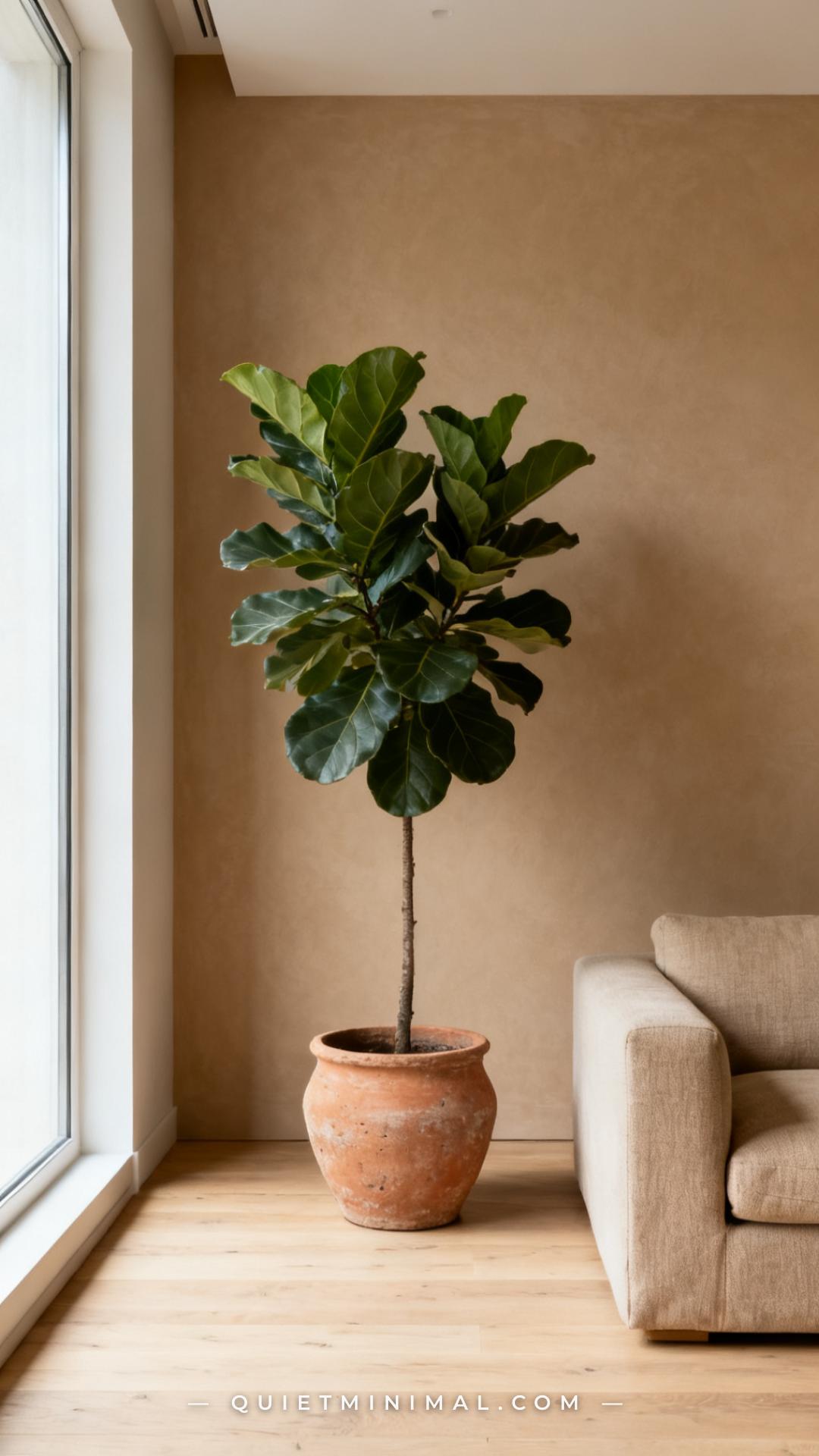
Plants in minimalist rooms are a permission slip to introduce organic irregularity without breaking the visual discipline. One plant, well-chosen and correctly scaled to the room, is a design element. Four plants become a collection and start to read as maximalist. The plant should be sculptural — meaning its form is interesting on its own, independent of its pot. Fiddle-leaf figs, olive trees, monstera in a large format, snake plants in a cluster of three matching black pots, and trailing pothos in a hanging planter above a reading chair all work because the form is architectural.
The pot is as important as the plant. In warm minimalism, the pot is a decor piece that sits on the floor or on a surface as a deliberate object. A terracotta pot with a slightly rough-thrown finish, a matte white ceramic with no decoration, or a pale stone-effect planter all integrate cleanly. Avoid pots with pattern, bright color, or novelty shape — they pull the eye away from the plant’s form, which is the point.
Key Takeaway: One sculptural plant in a simple terracotta or matte white ceramic pot is a design decision in a minimalist room — more than one shifts the room into collection territory and breaks the visual calm.
 Save
 Save
8. Replace Open Shelving Clutter With Floating Shelves Done Right
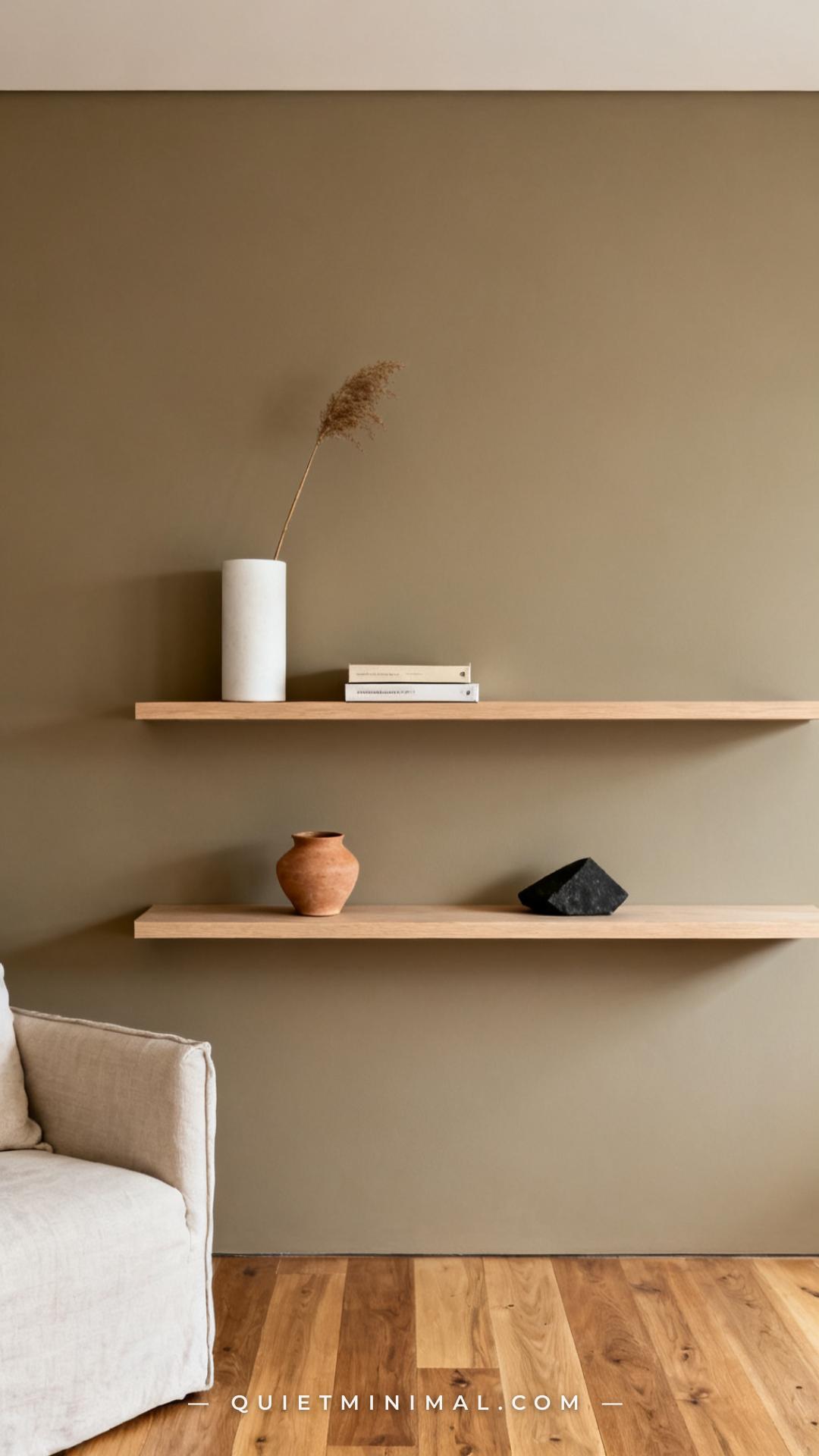
Open shelving is one of the most contested elements in minimalist design — and the reason it usually fails isn’t the shelves themselves, it’s the approach. Most people treat open shelves as extra surface area and fill them with everything that doesn’t have a home elsewhere. In a minimalist room, floating shelves work when they hold a curated composition, not a curated collection. The difference: a composition has negative space. A collection fills the shelf.
The formula for a minimalist floating shelf: maximum three objects per shelf, always odd-numbered groupings, one tall object (a vase or sculptural object over twelve inches), one mid-height object (a book on its side or a small ceramic), and one small object with strong shape (a single stone, a taper candle, a small succulent in a plain pot). The shelf between them — the empty shelf space — is as much a design element as the objects. Resist filling it. That empty space is what makes the whole arrangement breathe.
Key Takeaway: Minimalist floating shelves work when the empty space on the shelf is treated as a design element equal to the objects — resist filling gaps, and limit each shelf to three items maximum in an odd-numbered grouping.
 Save
 Save
9. Control Your Lighting in Three Layers
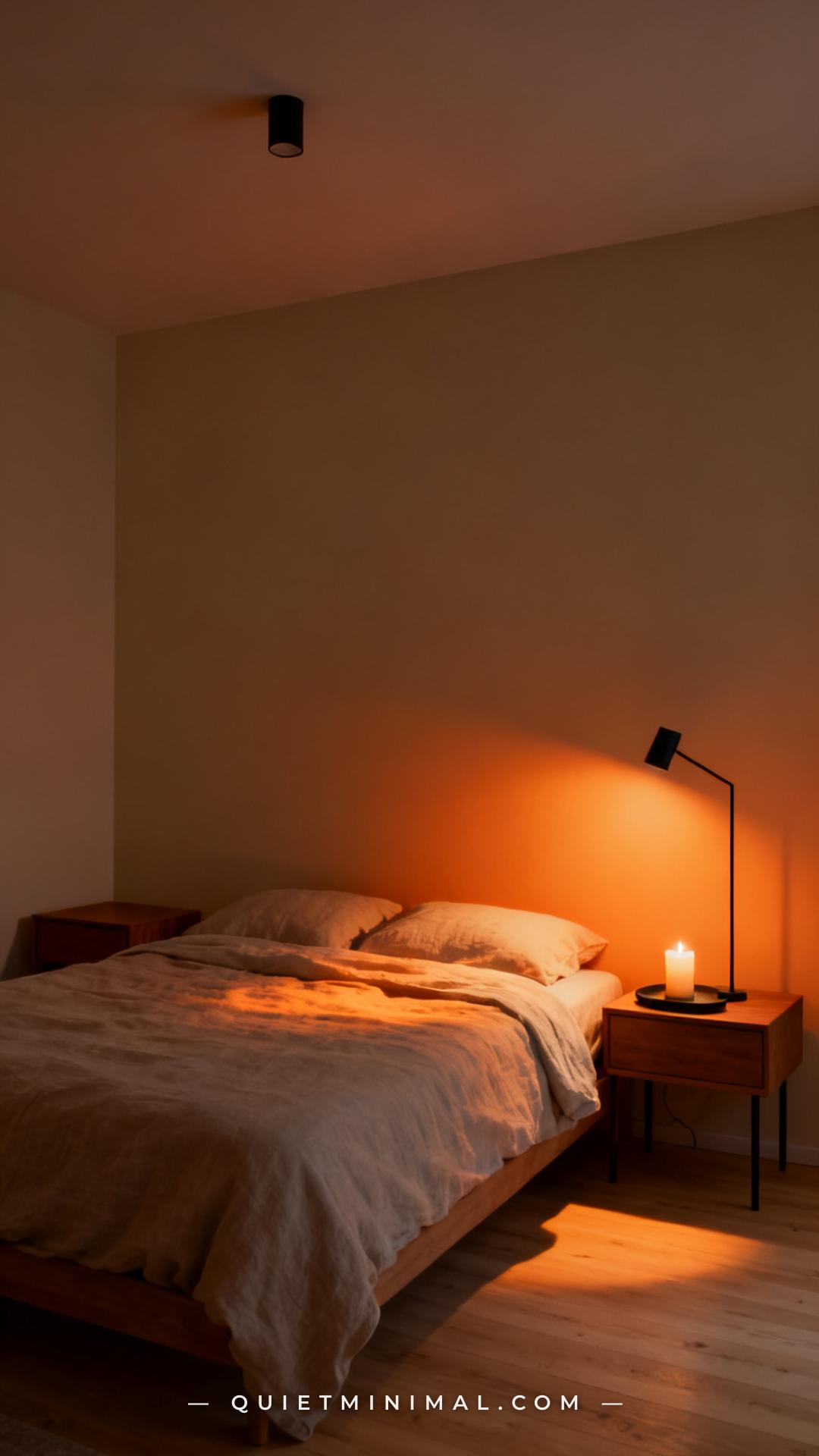
Overhead lighting is the enemy of minimalist warmth — not because it’s inherently wrong, but because a single overhead source flattens the room, washes out texture, and makes every surface read at the same brightness. Warm minimalism uses three layers of light: ambient (the overhead, kept dim or on a dimmer), task (a focused reading lamp or pendant), and accent (a warm-toned candle, a small table lamp, a plug-in wall sconce). The layering creates depth and dimensionality in a room where furniture and objects aren’t doing that work the way a maximalist space would.
From the guides
You've saved it, wanted it. Here's the how: codes, measurements, order. Your choices make it yours.
The Japandi Honest PlaybookThe honest version of the style: what to keep, what to skip, and the order to do it in.See inside →The Room Refresh PlaybookA repeatable four-step method, room by room, in ten minutes, thirty minutes, or one weekend.See inside →Make Any Room Feel Cozy on PurposeWhy some rooms hold people and others empty out, and the moves that change it.See inside →The color temperature of every bulb matters. In minimalist rooms, go 2700K across every fixture — this is a warm, slightly amber white that reads as “golden hour inside.” Any fixture running a 4000K or 5000K bulb (daylight or cool white) will make even warm wall colors look institutional. Replace every bulb in the room at once so the light temperature is consistent, and the effect of all three layers adds up instead of competing.
Key Takeaway: Swap every bulb in a minimalist room to 2700K and use three lighting layers — ambient on a dimmer, one focused task lamp, and one warm accent source — to create depth that furniture alone can’t provide.
 Save
 Save
10. Invest in One Statement Nightstand Per Side
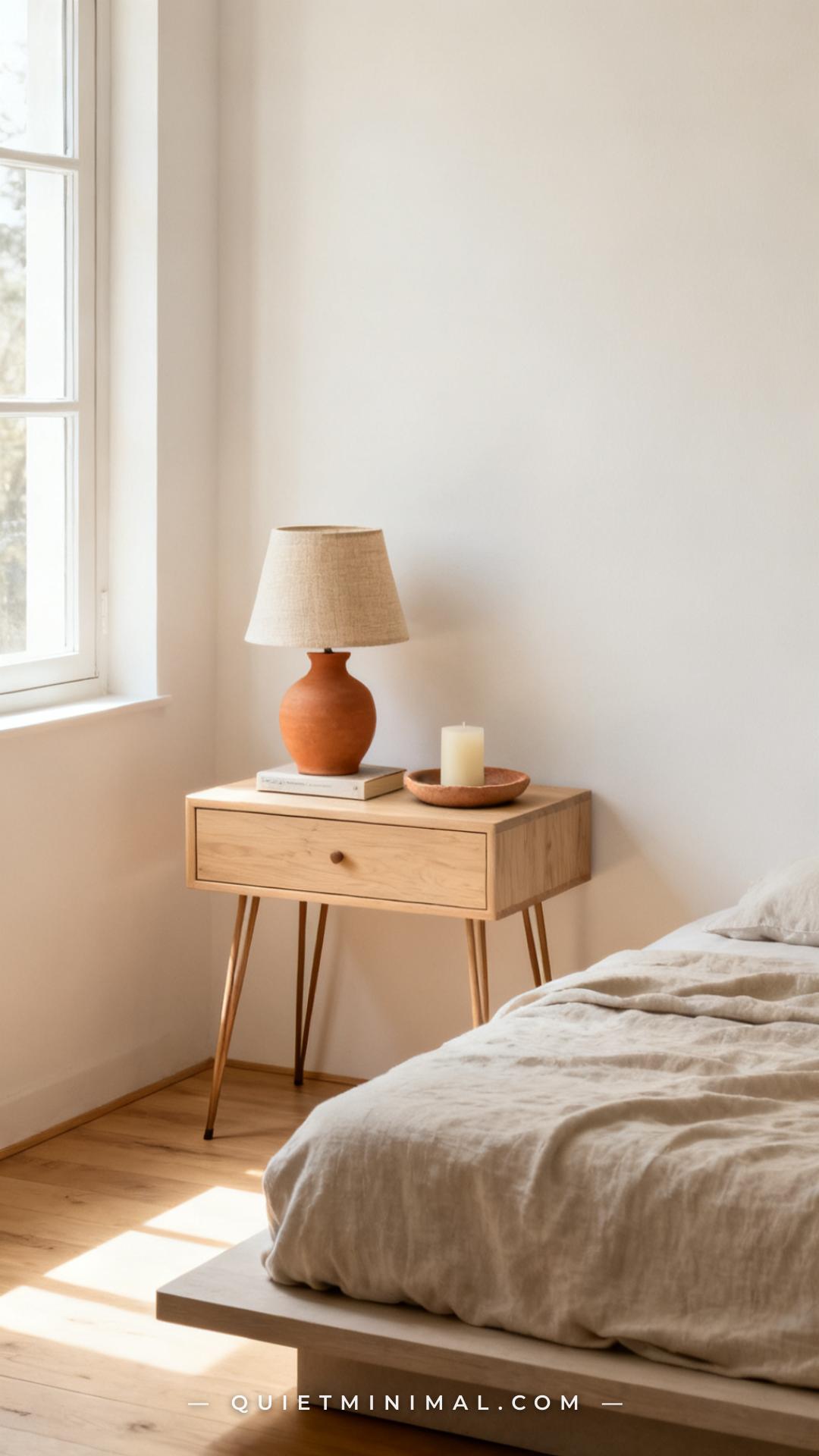
The nightstand is the most overlooked surface in a minimalist bedroom, and consistently where the room either holds together or falls apart. Most nightstands are chosen for storage function — drawers, shelves, a place to charge devices — without considering what the piece looks like as a design element in the room. In warm minimalism, the nightstand is a piece of furniture that earns its place visually, not just functionally.
A slim nightstand in pale oak with a single drawer does three things: it adds natural material at eye-level when lying in bed (the most intimate sightline in the room), it keeps the floor visible underneath it (which makes the room read larger), and it limits surface clutter by offering only one small platform for objects. Style the top with two items maximum: a lamp and one small object beneath it (a book, a ceramic coaster, a small candle). That’s the edit. Charging cables go through a cable management clip on the back of the nightstand leg — invisible, intentional.
Key Takeaway: Treat your nightstand as a design piece, not a storage unit — a slim pale oak stand with a single drawer, styled with just a lamp and one small object on top, is the edit that holds a minimalist bedroom together.
 Save
 Save
11. Treat Your Rug as a Foundational Layer, Not an Afterthought
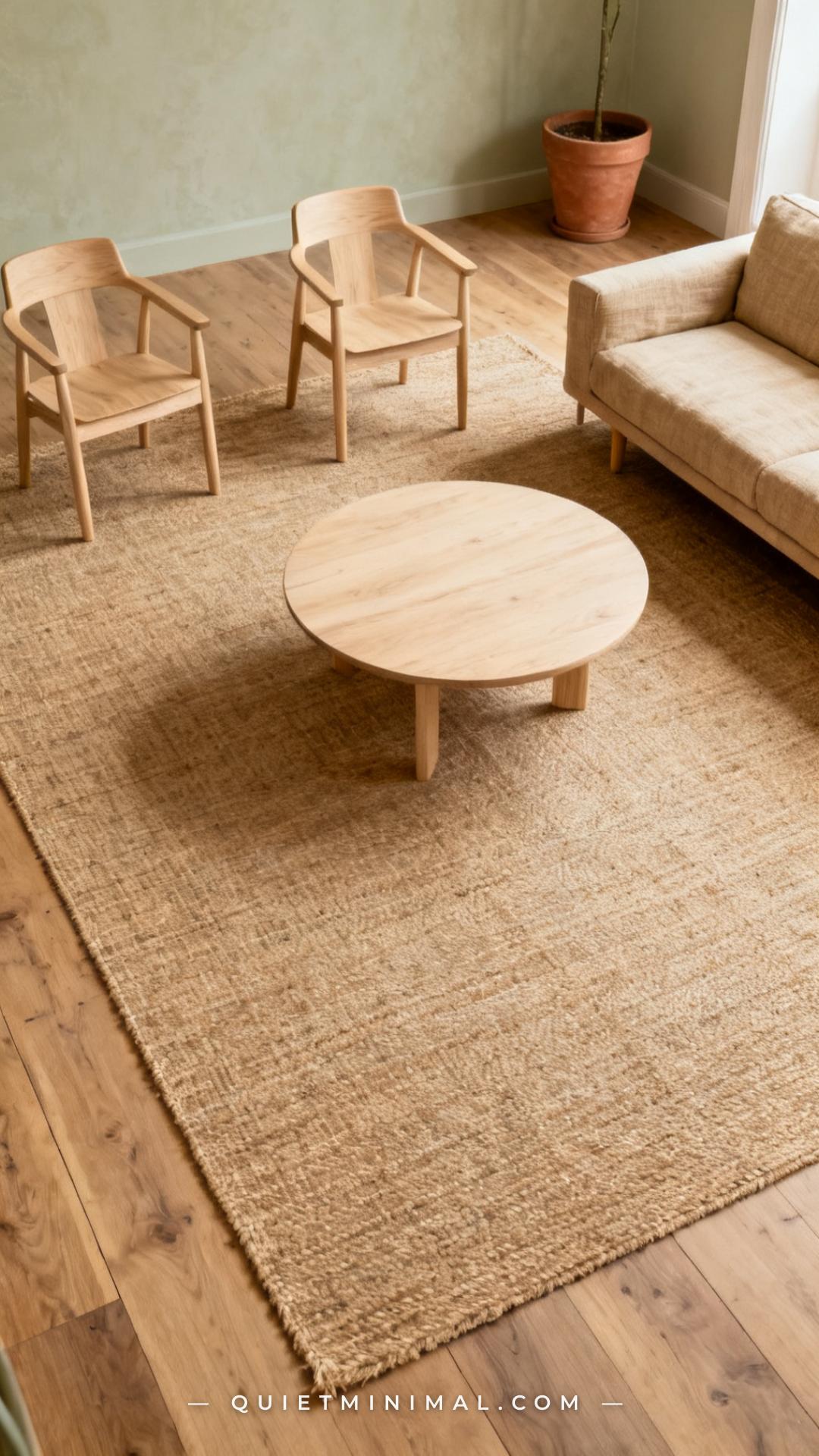
In rooms with minimal furniture and few decorative objects, the rug is visible as a full design element — not partially hidden under a coffee table or sofa, but read as a complete field of texture and tone. Most minimalist rooms undersize their rugs, which immediately signals the rug as an afterthought rather than a foundational layer. In a living room with a three-seat sofa, the rug should be large enough that all front sofa legs (and ideally all four) sit on it. In a bedroom, the rug should extend at least eighteen to twenty-four inches beyond the foot and sides of the bed.
For warm minimalism, the rug material matters as much as the size. A jute or sisal rug introduces natural texture that photographs beautifully and ages gracefully. A Moroccan-style flatweave in warm cream and natural introduces low-key pattern without competing with a neutral wall. A wool boucle rug in oatmeal is the current high-end standard — high pile, warm tone, subtle tactile richness. The rug color should always be within one tone family of the wall color to avoid the rug becoming a competing element in a room that’s working hard to stay visually quiet.
Key Takeaway: Size your rug so furniture legs sit on it, and choose a natural material — jute, wool boucle, or Moroccan flatweave — in a tone that matches your wall color family to anchor the room without competing with it.
 Save
 Save
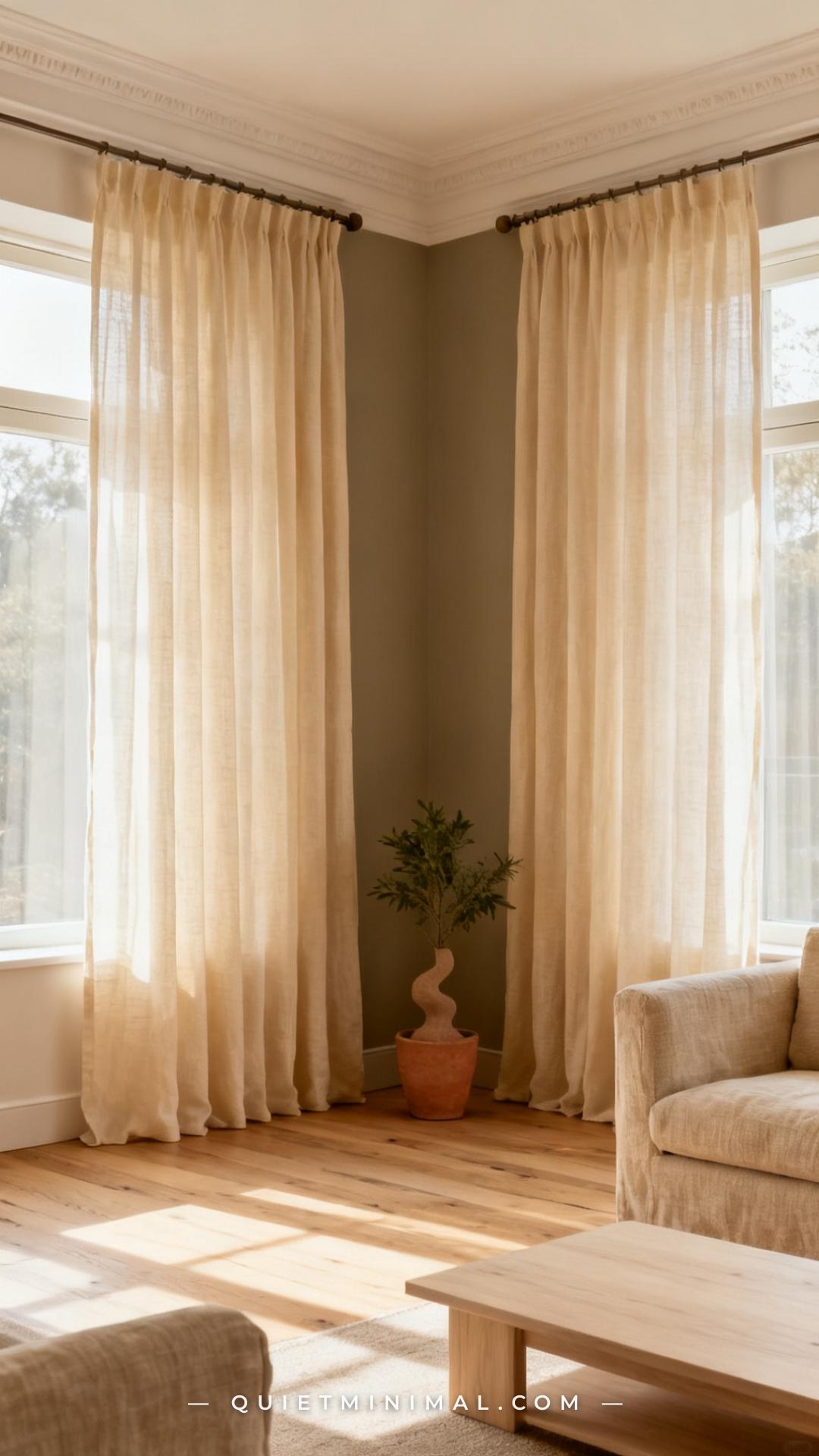
12. Hang Curtains High and Wide, Even in Small Rooms
Curtain placement is one of the highest-leverage moves in minimalist rooms because it changes the perceived scale of the entire space without adding any furniture or objects. The standard error — hanging curtains just above the window frame at the exact window width — makes windows look small, ceilings look low, and rooms look unfinished. In warm minimalism, curtains are hung as close to the ceiling as possible (ideally within two to four inches of the crown molding) and extend at least eight to twelve inches beyond the window frame on each side.
The effect is immediate: the ceiling visually rises, the window appears larger, and the room reads more spacious without changing its dimensions. Fabric choice is critical — in a minimalist room, curtains are a major surface area of fabric texture. Linen or linen-look panels in a warm ivory or oatmeal tone work universally with warm neutral walls. They drape naturally, filter light beautifully, and never compete with the room’s palette. Floor-length only: the panel should graze the floor or break one inch on it, not hover above it.
Key Takeaway: Hang curtains within four inches of the ceiling and extend them twelve inches beyond the window frame on each side — this single adjustment makes every room read taller, larger, and more intentionally designed.
 Save
 Save
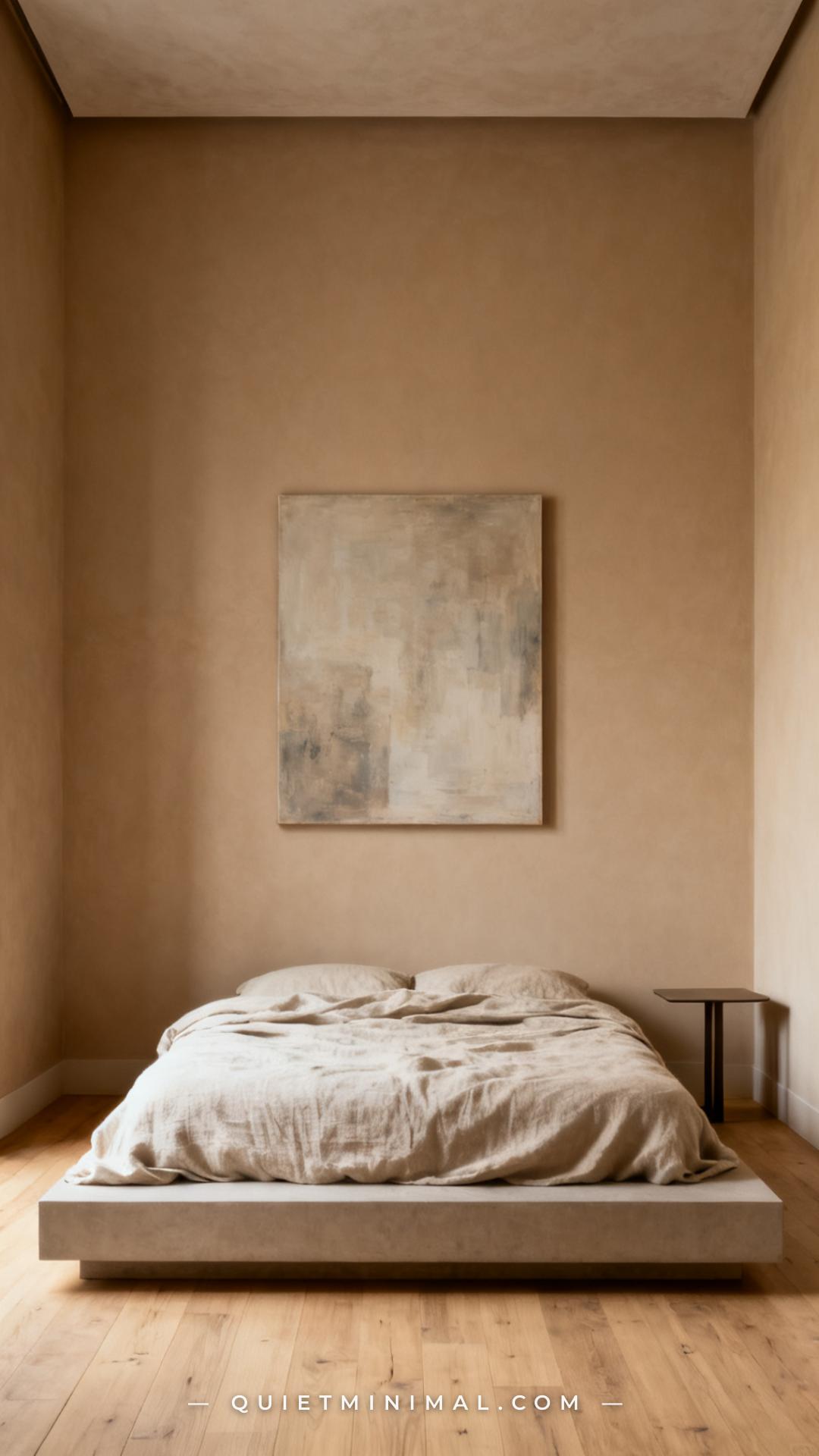
13. Use Negative Space as a Design Element
In maximalist rooms, every inch of wall and floor is occupied. In minimalist rooms, the empty space — the wall between objects, the floor area between the rug and the baseboard, the gap between furniture pieces — is as deliberate as what fills it. This is the hardest concept to execute because it requires resisting the urge to fill every pause in the room, and most people feel uncomfortable with rooms that have visible empty space.
The reframe that makes this work: empty space is not neglect, it’s editorial decision-making. A wall with one piece of art and twelve inches of clear wall on either side is making a statement. A floor with a rug and six inches of bare oak between it and the baseboard is grounded. When you start treating negative space as something you’re placing intentionally — choosing where it goes and how wide it is — the room stops feeling empty and starts feeling edited. That’s the perceptual shift that separates a minimalist room from an under-decorated one.
Key Takeaway: Treat every empty section of wall and floor as a deliberate design decision, not a gap waiting to be filled — minimalist rooms read as calm and curated only when the empty space is as intentional as the objects within it.
 Save
 Save
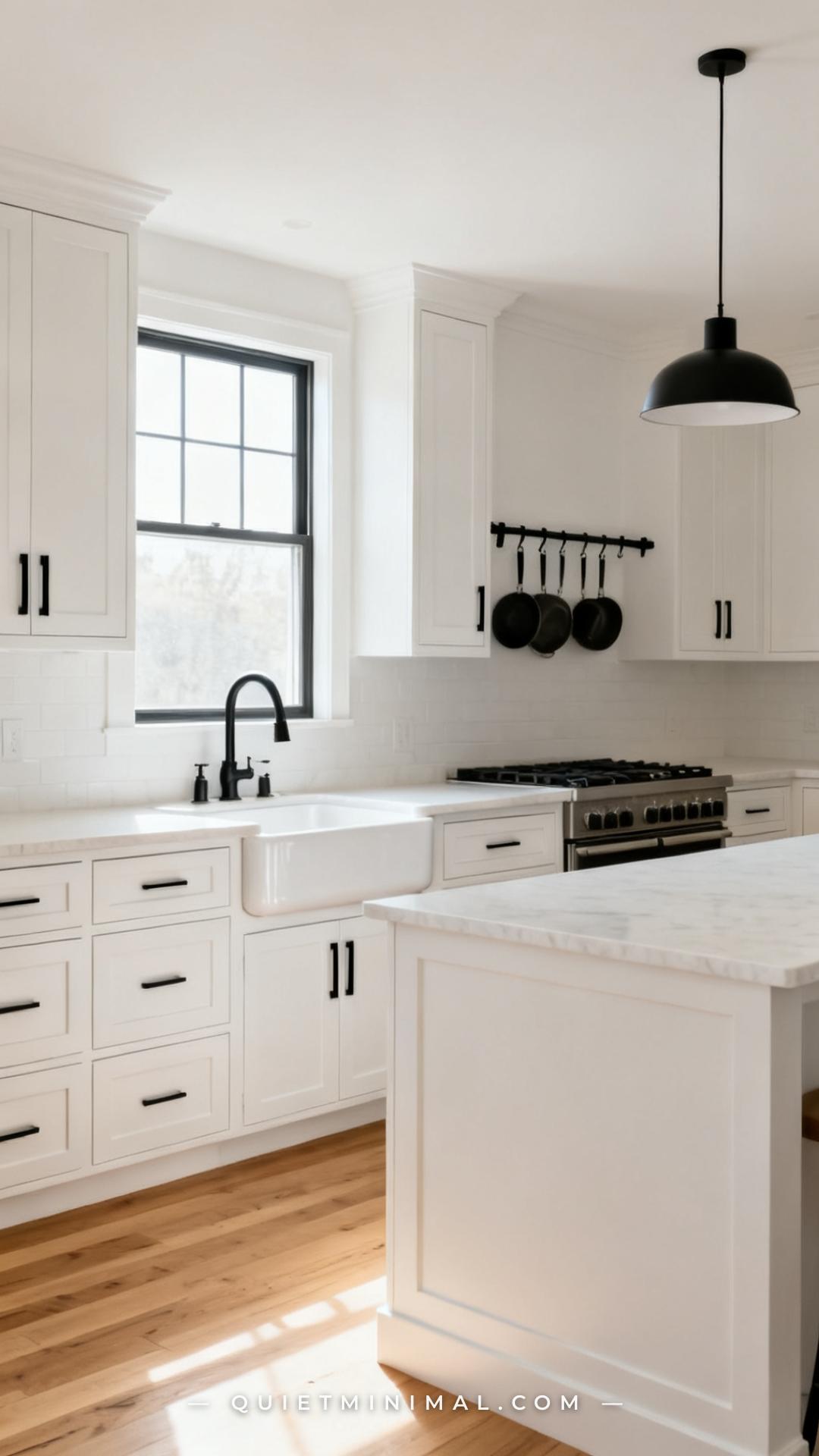
14. Edit Your Hardware and Fixtures to One Finish
Mixed metal finishes used to be a design rule — now it’s a design excuse for inconsistency. In minimalist rooms where nothing competes for attention, mixed metals become distracting at the exact moment the room should feel unified. Warm minimalism picks one metal finish across every hardware and fixture in the room and stays consistent: cabinet pulls, door knobs, lamp bases, curtain rods, picture-hanging hardware, towel bars, faucet handles. One finish. Not two.
The current strongest performers for warm minimalist spaces: matte black (the most versatile, pairs with every wood tone and neutral), brushed brass (warm, slightly aged, works with terracotta and warm whites), and brushed nickel (cooler, cleaner, better for rooms leaning towards Scandinavian grey-toned neutrals rather than warm oatmeal). Choose based on the warm or cool lean of your existing palette, then audit every fixture and hardware piece in the room against that single standard. The items that don’t match get replaced — they’re inexpensive and the payoff in visual coherence is significant.
Key Takeaway: Choose one metal finish for every hardware and fixture in your room — matte black, brushed brass, or brushed nickel — and replace anything that doesn’t match; this single edit creates the visual coherence that makes a minimalist room look designed rather than assembled.
 Save
 Save
15. Create One Styled Moment, Then Leave the Rest Alone
The final and most important minimalist discipline: pick one corner, one surface, or one wall to style with full intention — then leave the rest of the room alone. This is the “hero moment” approach used by professional interior stylists when shooting minimalist spaces for editorial. The styled moment becomes the room’s focal point and
From the guides
You've saved it, wanted it. Here's the how: codes, measurements, order. Your choices make it yours.
The Japandi Honest PlaybookThe honest version of the style: what to keep, what to skip, and the order to do it in.See inside →The Room Refresh PlaybookA repeatable four-step method, room by room, in ten minutes, thirty minutes, or one weekend.See inside →Make Any Room Feel Cozy on PurposeWhy some rooms hold people and others empty out, and the moves that change it.See inside → Save


