 Georgia
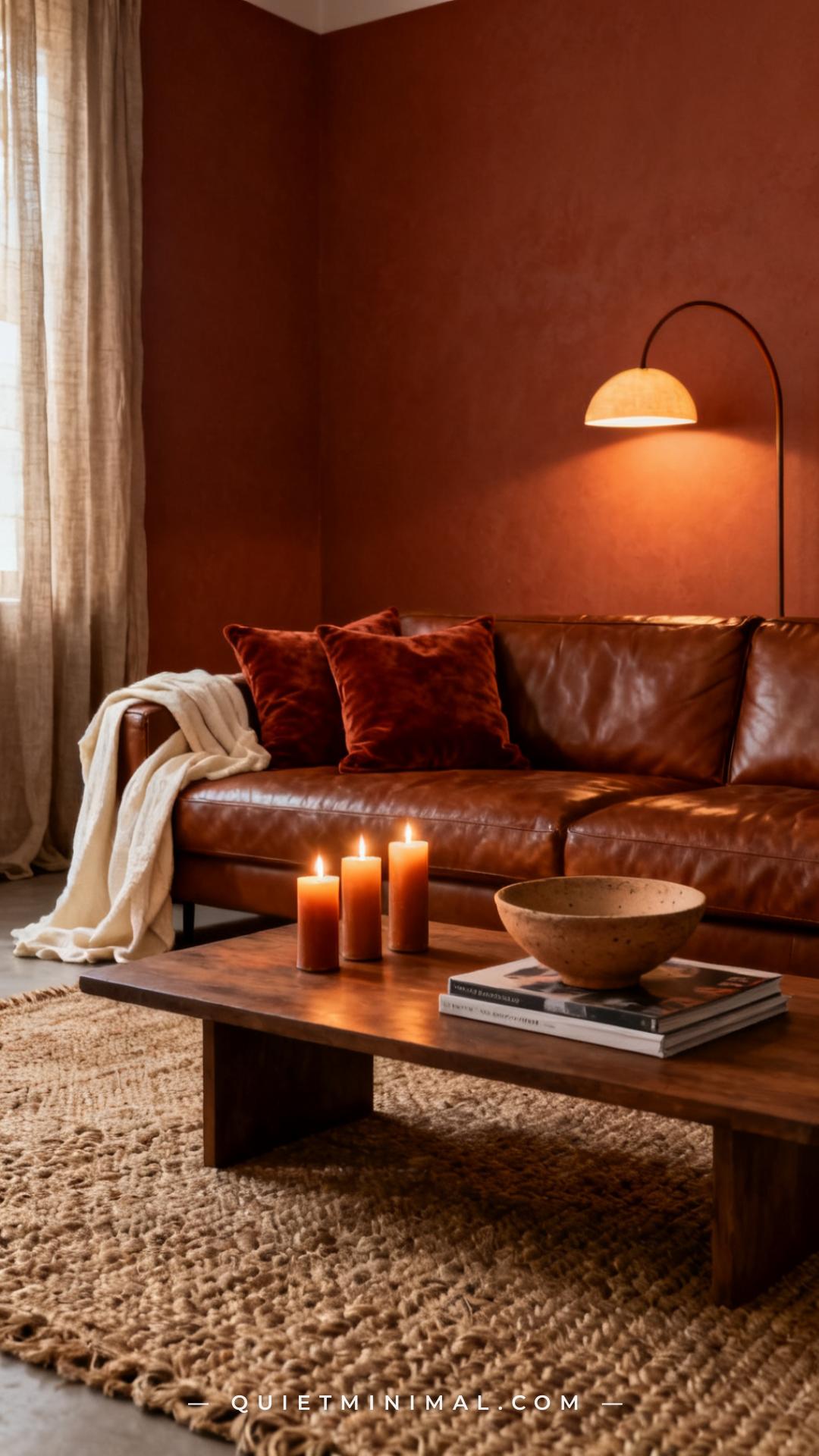
There is a specific kind of living room that feels impossible to leave — one where the light is warm, the textures are rich, and the whole space has a quiet, pulled-together atmosphere that doesn’t try too hard. A leather sofa anchored in warm earth tones with candles scattered at the right heights gets you exactly there. The problem is that most attempts at this look end up feeling dim and accidental rather than intentionally moody. The difference is almost always in the details: which earth tones you choose, how you layer the candle light, and what you place around that leather sofa to give it warmth instead of weight. These 15 ideas break down exactly how to do it right.
1. Choose the Right Leather Tone First — Everything Else Follows
 Save
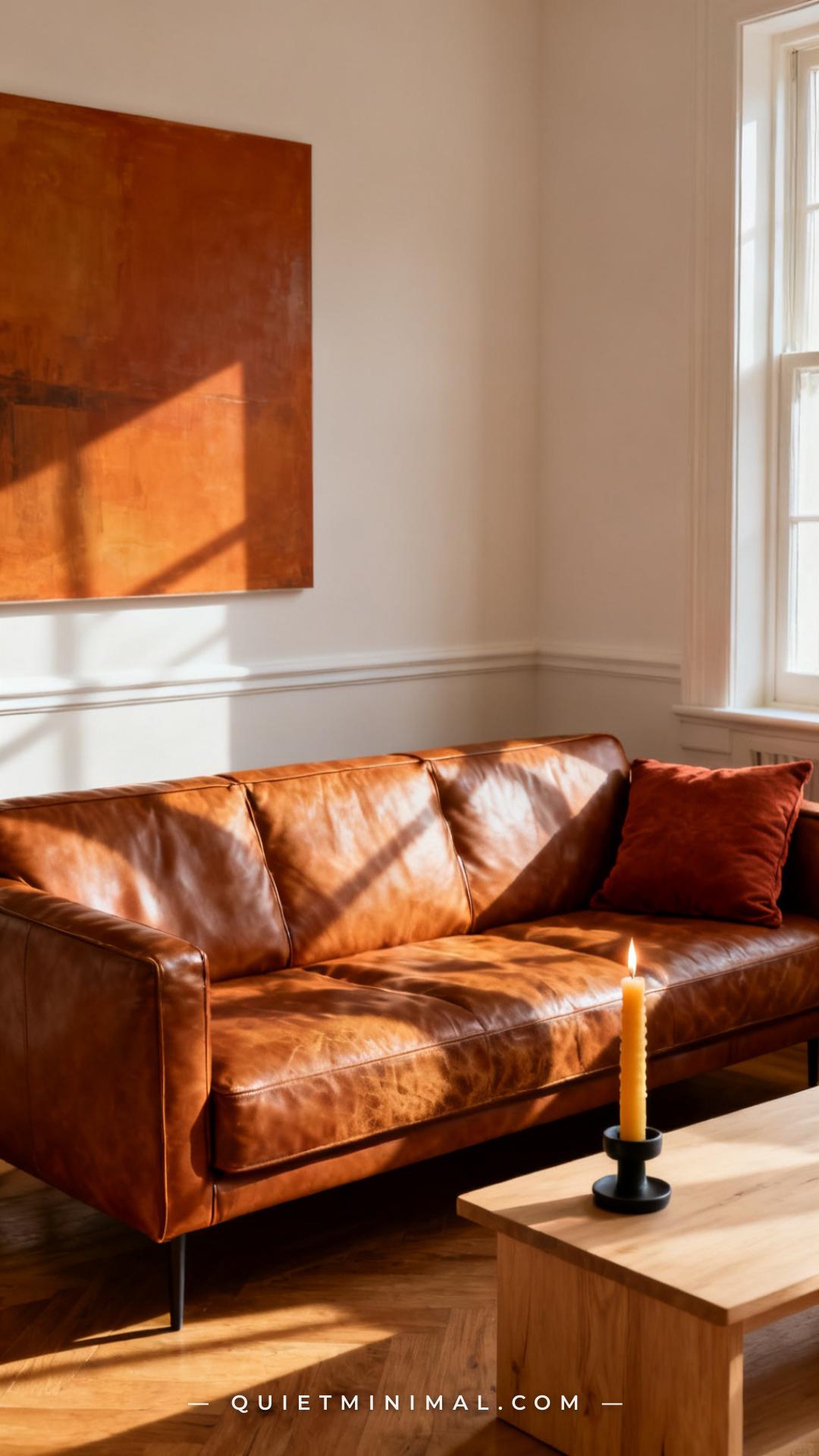
Not all leather reads the same way in a moody room. A honey or cognac leather pulls warm — it reads amber in low light and anchors earth tones beautifully. A cold chocolate brown with blue undertones will fight your warm candle palette no matter what you do around it. Before you commit to a single paint color or rug, hold your leather’s tone up against a terracotta swatch and a warm cream swatch. If the leather looks right between those two, you’re working with a warm leather and you can proceed with confidence.
The undertone conversation matters more than the darkness level. A medium cognac in a bright room can go moody with the right layering. A cold espresso leather will resist the warm earth palette at every step. When shopping secondhand or choosing a sofa, look specifically for words like cognac, saddle, chestnut, or caramel — these signal warm undertones. Avoid anything described as “cool mocha” or “slate brown.”
From the guides
You've saved it, wanted it. Here's the how: codes, measurements, order. Your choices make it yours.
 The Japandi Honest PlaybookThe honest version of the style: what to keep, what to skip, and the order to do it in.See inside →
 The Room Refresh PlaybookA repeatable four-step method, room by room, in ten minutes, thirty minutes, or one weekend.See inside →
 Make Any Room Feel Cozy on PurposeWhy some rooms hold people and others empty out, and the moves that change it.See inside →
Key Takeaway: Identify your leather’s undertone before choosing anything else — warm cognac tones drive the whole earth-tone palette forward.
2. Anchor the Room with a Warm-Toned Area Rug
 Save
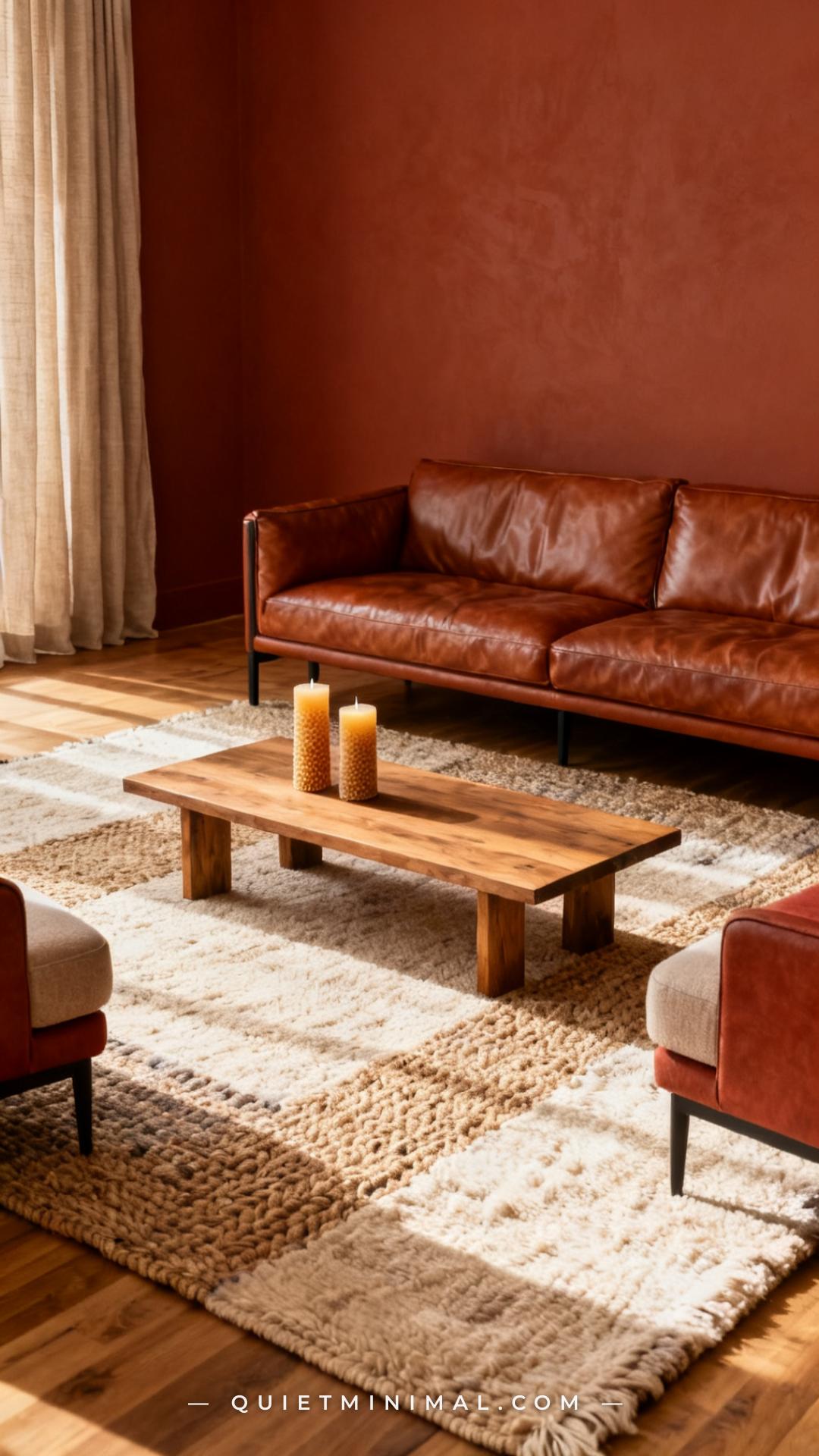
The rug is the first layer of warmth that stops a leather sofa from floating in cold, hard space. For a moody living room, avoid cool gray rugs entirely — they pull the leather toward a corporate, masculine reading that works against the warm atmosphere you’re after. Instead, reach for natural fiber rugs in jute, sisal, or a jute-wool blend, or choose a low-pile wool rug in terracotta, rust, camel, or dark mushroom. The rug should feel like it belongs to the earth-tone palette, not sit on top of it as an afterthought.
Size is a common mistake that kills the mood before candles even enter the picture. Go larger than you think you need — ideally large enough that the front legs of the sofa and chairs rest on the rug. A too-small rug makes the seating group look adrift and diminishes the cocooning effect that makes moody rooms work.
Key Takeaway: A natural fiber or warm-toned wool rug sized generously under the seating group creates the cocooning foundation the whole moody look depends on.
3. Layer Candles at Three Heights, Not One
 Save
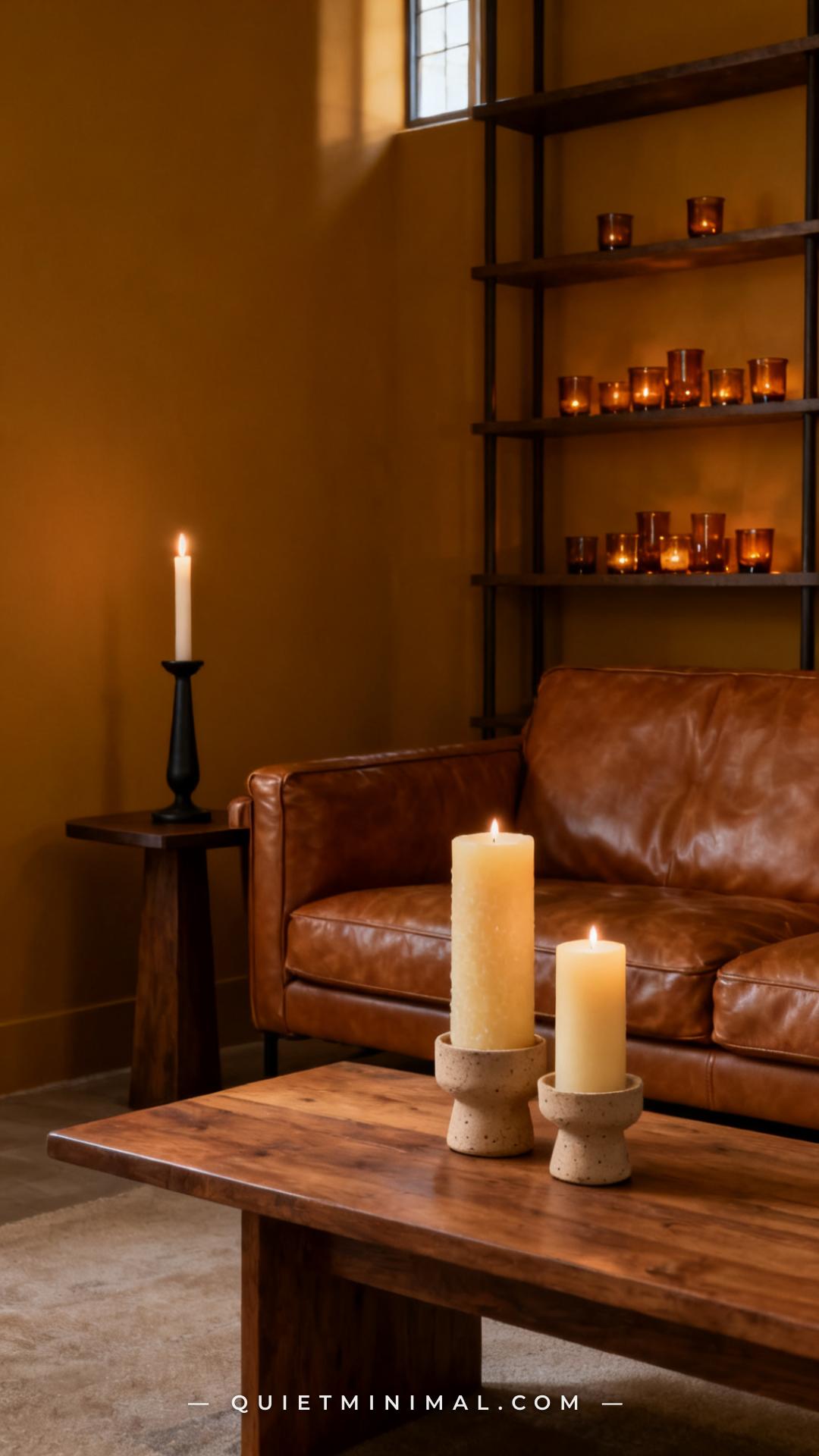
Single-height candle placement is the reason so many moody living rooms feel flat instead of atmospheric. The goal is to create a vertical spread of warm light so the eye moves up and down naturally through the room rather than landing on one flat plane. Use pillar candles on the coffee table, a taper or small lantern at side-table height, and votives or small clusters at shelf height. Three heights minimum — four is better in a larger room.
The type of candle matters too. Beeswax and soy candles in unbleached cream or ivory tones read more natural and warm than stark white paraffin candles, which can look clinical against dark walls. Amber glass holders scatter light differently than clear glass — they cast a warm golden hue on surrounding surfaces that amplifies the moody effect. Save the pillar clusters for the coffee table where the light sits low and illuminates textures from below.
Key Takeaway: Three candle heights — low, mid, and high — create the layered atmospheric glow that makes a moody room feel intentional rather than just dim.
4. Choose a Wall Color That Supports the Candle Palette
 Save
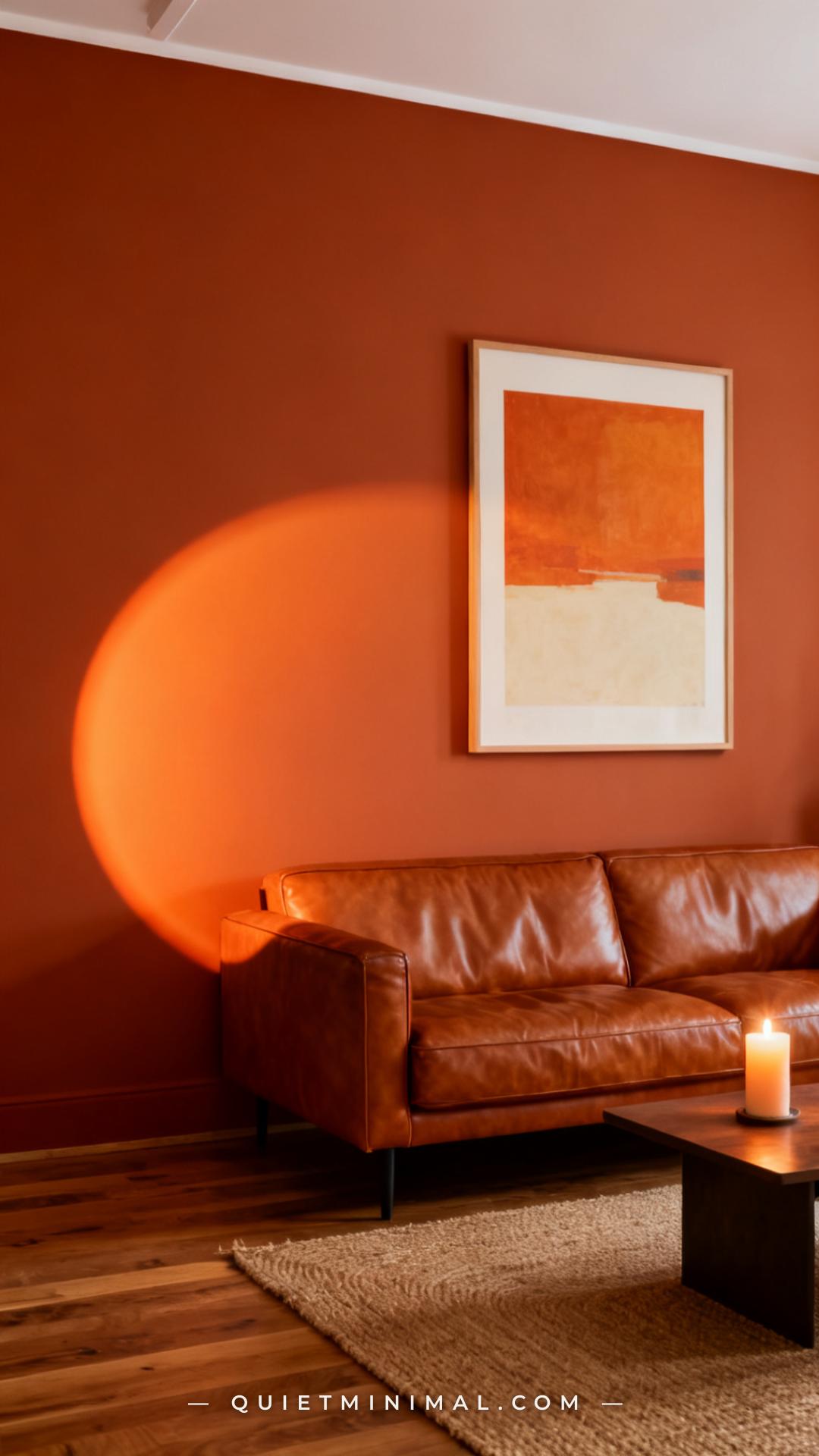
Dark paint is not mandatory for a moody living room — but warm, saturated paint is. The mistake most people make is going straight to black or charcoal gray, which drains warmth from a leather sofa and fights the candle glow rather than amplifying it. What actually works for this palette are deep, warm earthy tones: a smoked terracotta, a burnt umber, a deep ochre, or a rich mushroom brown. These colors absorb and reflect candlelight in a way that cool darks never will.
Current verified options worth researching include Sherwin-Williams’ “Cavern Clay” (SW 7701) and “Copper Mountain” (SW 9005), and Benjamin Moore’s “Pale Pumpkin” (2169-40) taken several shades deeper using custom mixing. Farrow & Ball’s “Dead Salmon” (No. 28) and “Red Earth” (No. 64) also sit in this warm-moody range. Test any of these in your actual room with candlelight before committing — paint looks dramatically different under warm flame light versus overhead LEDs.
Key Takeaway: A warm, saturated earth-tone wall color — terracotta, ochre, or deep mushroom — amplifies candlelight and wraps the leather sofa in warmth instead of fighting it.
5. Use Velvet Throw Pillows to Soften the Leather
 Save
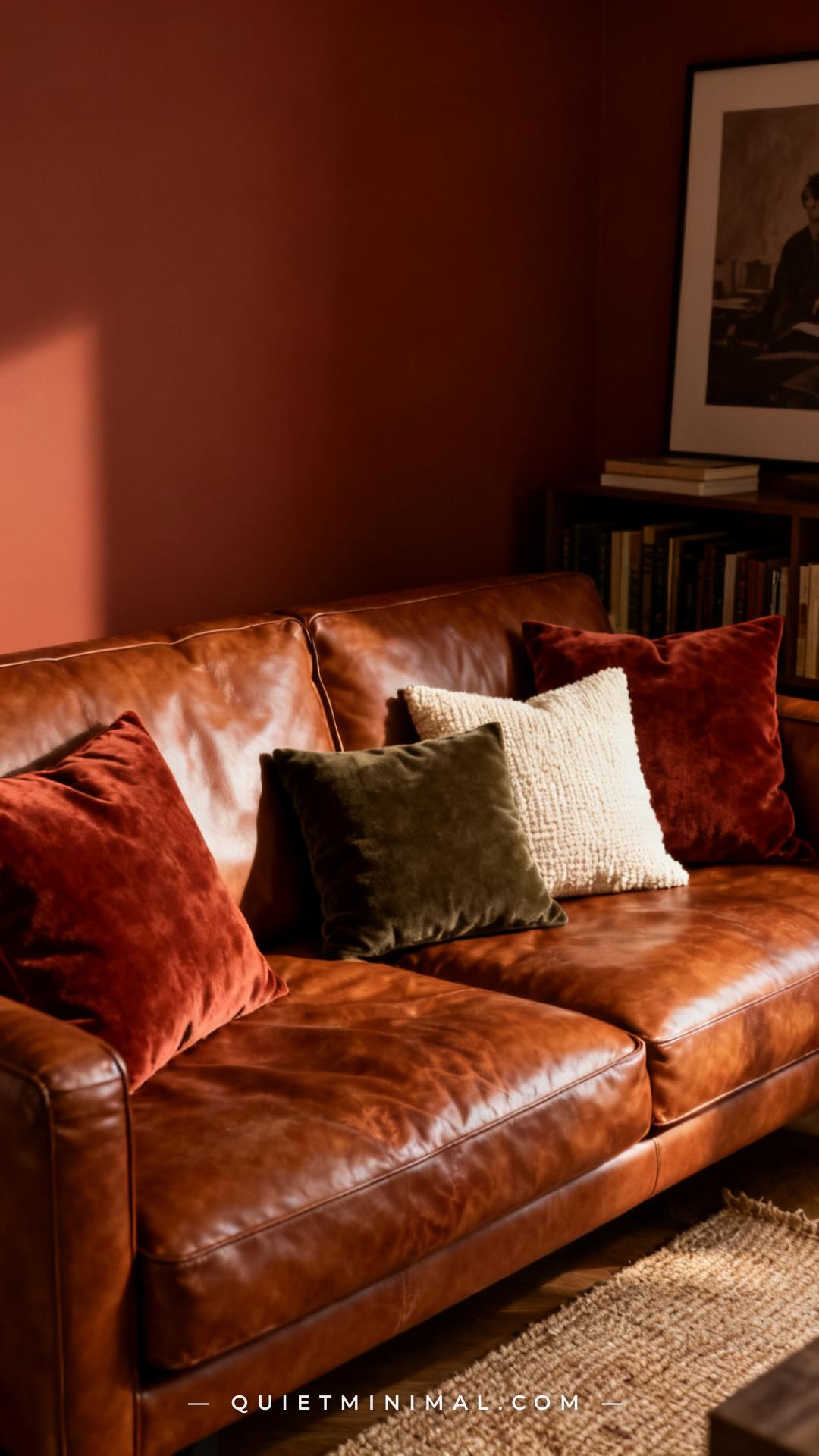
Leather and velvet have an almost perfect textural relationship — the smooth cool surface of leather and the soft nap of velvet create contrast that reads as intentional and expensive. For a moody earth-tone room, pull your pillow palette directly from the earth: rust, burnt orange, dark olive, deep terracotta, raw umber brown, and aged cream. Avoid cold colors entirely — even a single navy or steel blue pillow will break the warmth of the palette.
The arrangement matters as much as the colors. Odd numbers of pillows always read more natural than even — try three or five rather than four or six. Mix sizes: two large squares anchoring each end, one lumbar in the middle, and one slightly oversized square leaning casually at one corner. Let them look slightly lived-in rather than showroom-straight. A leather sofa with perfectly upright pillows reads as furniture store display; a leather sofa with slightly rumpled velvet pillows reads as a room someone actually lives and relaxes in.
Key Takeaway: Rust, olive, and terracotta velvet throw pillows in odd numbers soften the leather and pull the whole earth-tone palette together without a single cold note.
6. Add a Natural Fiber Blanket as a Daily Layer
 Save
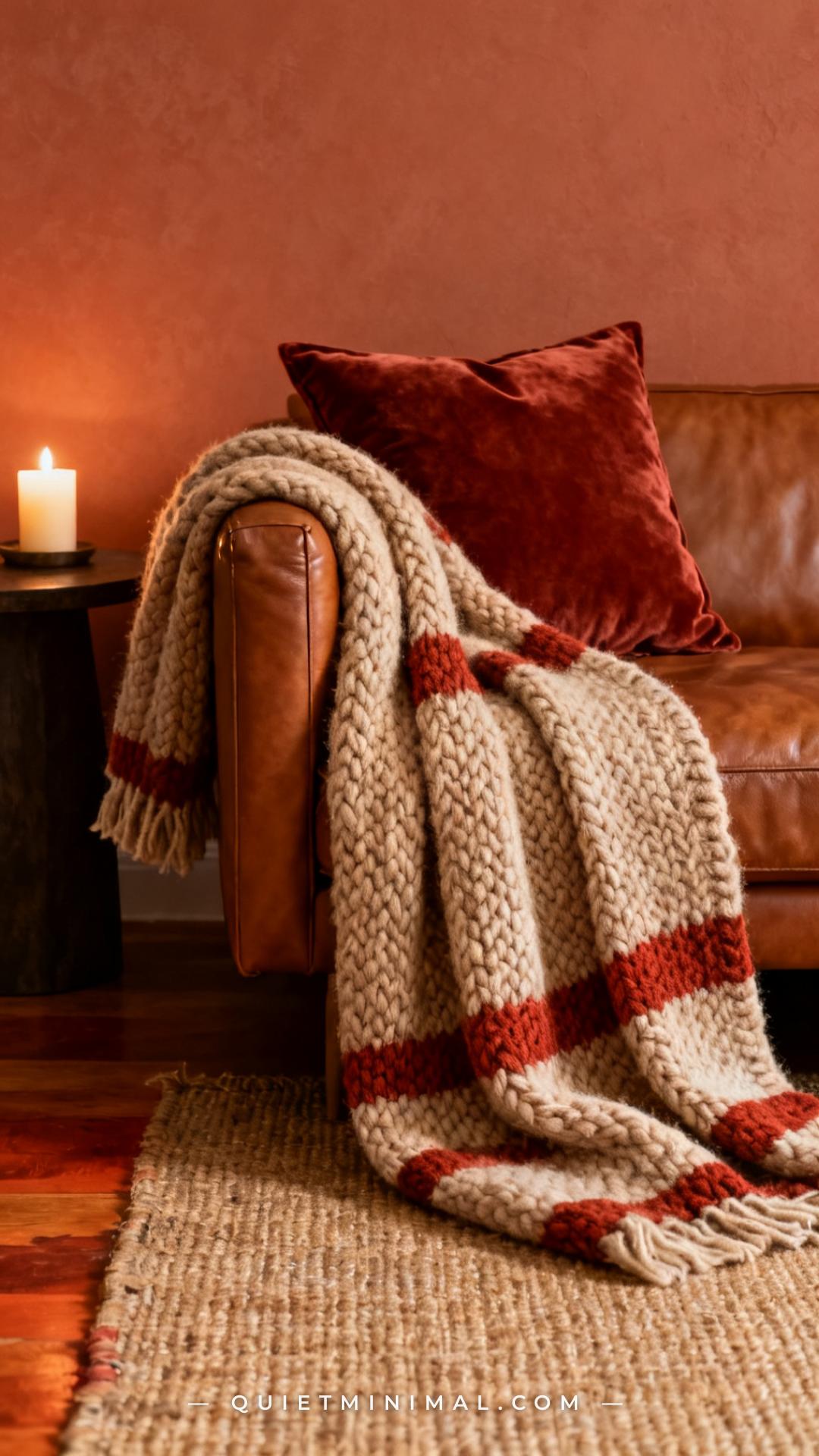
A throw blanket on a leather sofa does two things simultaneously: it adds warmth (literal and visual) and it signals that the room is meant to be lived in rather than admired from a distance. For a moody room, material matters. Skip the machine-made polyester throws that look flat and synthetic — they fight the richness of leather. Instead choose a chunky-knit or loosely woven wool, a raw-edge linen blanket in camel or off-white, or a cotton waffle-weave in deep terracotta. Any of these will photograph beautifully and feel right in real life too.
Draping technique is where most people overthink it. The blanket doesn’t need to be arranged perfectly — a casual fold over one sofa arm with the edge trailing slightly toward the floor is all you need. The asymmetry reads as effortless rather than staged, which is exactly the mood a moody living room is trying to achieve. Avoid symmetrical placement over the sofa back — it reads as a slipcover rather than a styling choice.
Key Takeaway: A chunky wool or raw linen throw draped casually over one sofa arm adds tactile warmth and signals a lived-in intentionality that styled-flat rooms miss.
7. Introduce Raw Clay and Ceramic Vessels as Decor Anchors
 Save
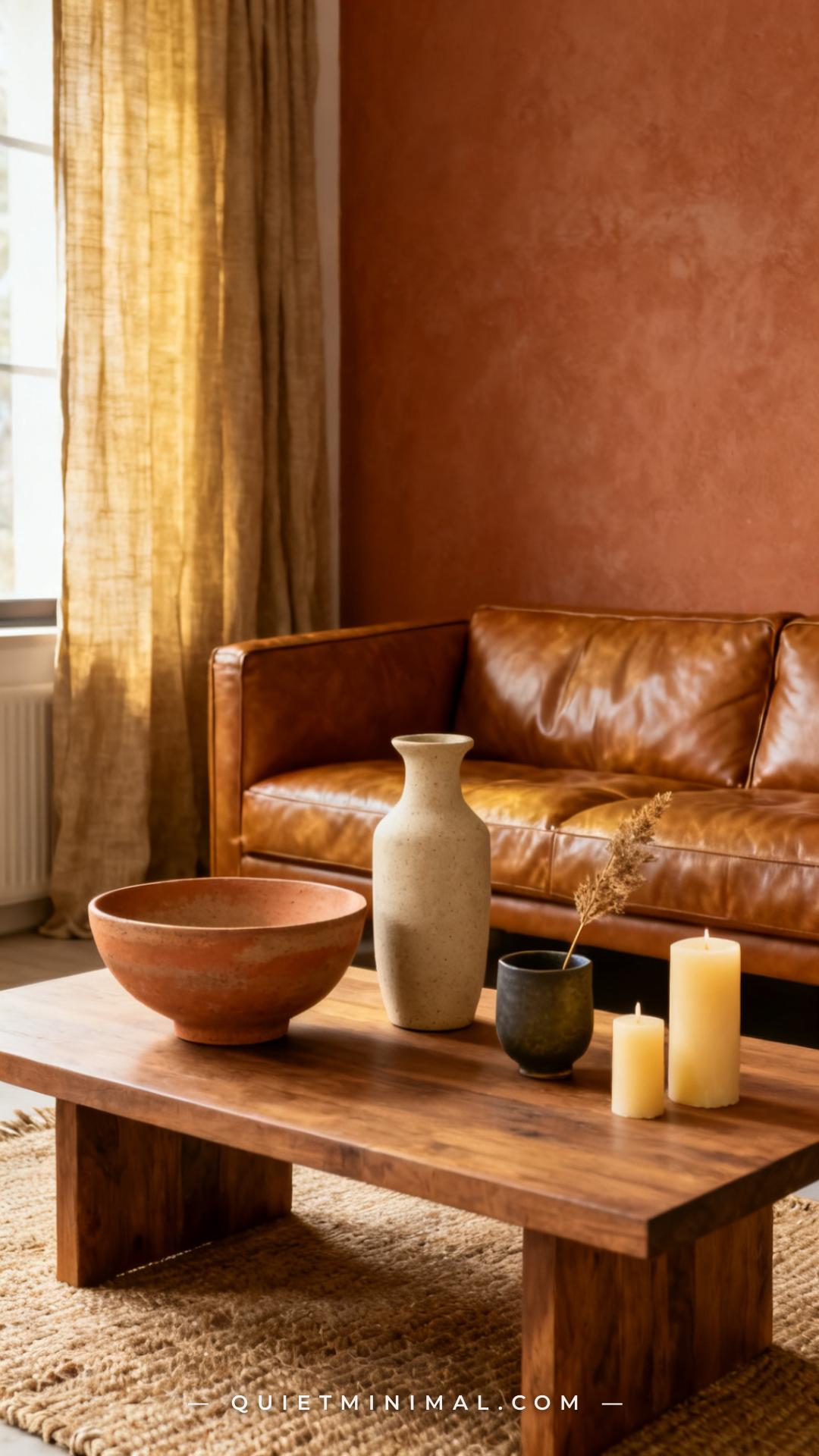
Ceramic and raw clay vessels are the connective tissue between the leather sofa, the earth-tone walls, and the candles. They belong to the same material family — natural, matte, tactile — and they ground a coffee table or shelf arrangement without competing for attention. The key is to choose vessels with matte or low-gloss finishes in earth tones: raw terracotta, sandy oatmeal, dark olive, or a smoky charcoal. High-gloss or metallic vessels break the palette.
Use them in clusters of three or five at different heights on the coffee table, pulled into an asymmetrical grouping rather than a straight line. A tall slender vase with a dried pampas stem, a medium squat bowl left empty to show its glaze, and a small cup holding a taper candle make an effortless three-part grouping. The dried botanicals — pampas, dried eucalyptus, bleached lunaria — keep the organic quality of the room alive without requiring fresh flower maintenance.
Key Takeaway: Raw clay and matte ceramic vessels in earth tones anchor the coffee table and shelf arrangements with organic texture that connects every element of the moody palette.
8. Hang Dark, Warm-Toned Art at the Right Scale
 Save
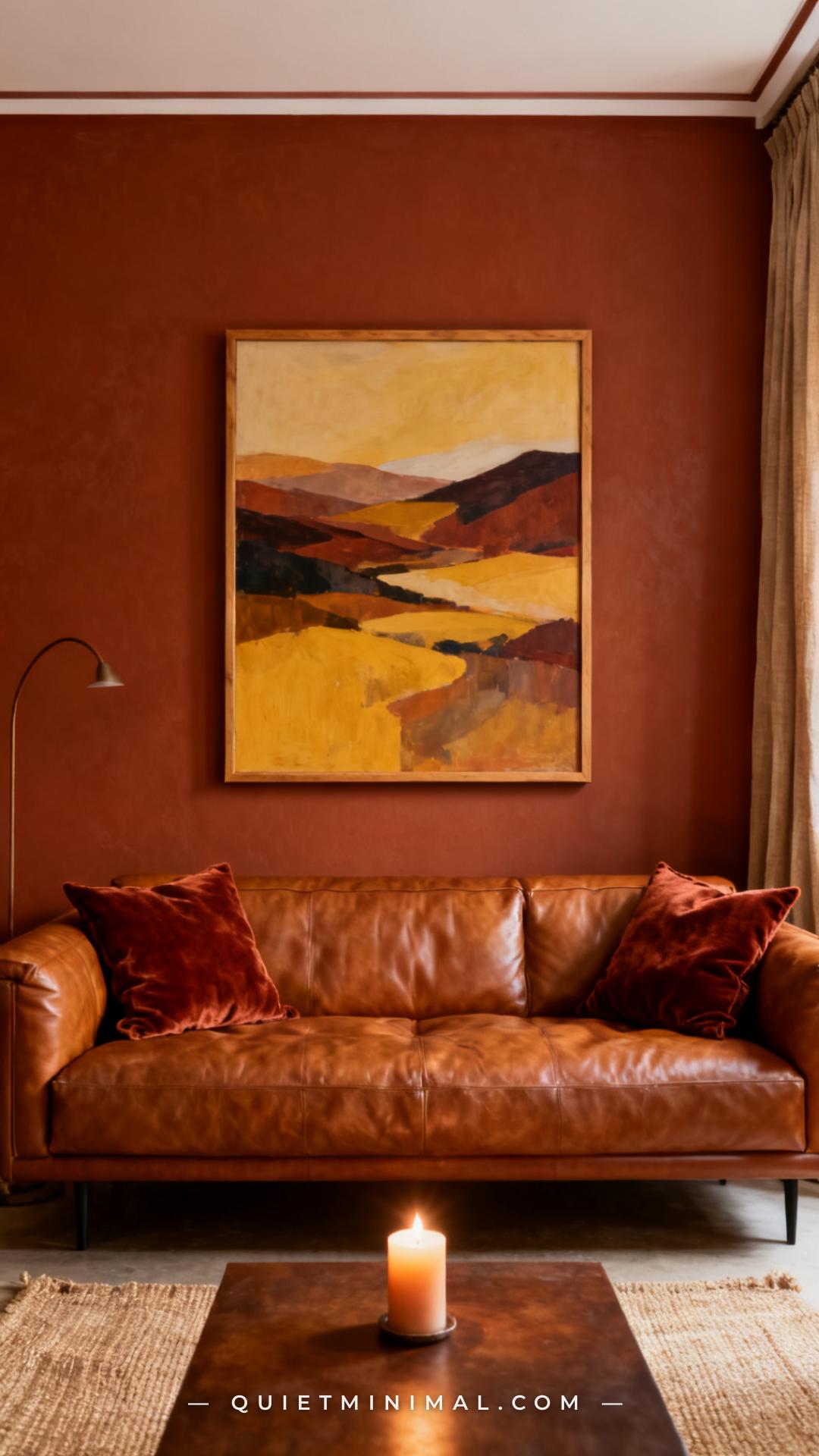
Art is the fastest way to kill a moody living room if you get it wrong. Small prints grouped in a gallery wall above a leather sofa read as eclectic and busy — the opposite of the quiet, atmospheric mood you’re building. For this look, go large and singular: one substantial print or canvas, centered above the sofa, sized so it spans at least two-thirds of the sofa’s width. Larger is almost always better than smaller here.
The subject matter and color palette of the art should live entirely within the warm earth-tone range. Abstract landscapes, organic shapes, and loose gestural paintings in ochre, rust, raw umber, and warm black read beautifully against both terracotta walls and leather. Frame in natural wood — dark walnut or light oak depending on your wall color — rather than black metal, which can push the room toward industrial rather than warm-moody. One well-chosen large piece does more for the atmosphere than six smaller ones.
Key Takeaway: One large art piece in warm earth tones, scaled to span most of the sofa’s width, anchors the wall without disrupting the quiet atmospheric mood.
9. Position an Arched Floor Lamp for Ambient Layering
 Save
Overhead lighting is the enemy of a moody living room. Recessed ceiling lights at full brightness erase every shadow and texture that makes the atmosphere work. The fix is not to eliminate overhead light entirely — it’s to redirect the room’s primary light sources to the lower half of the room, so the ceiling fades into shadow and the living space glows. An arched floor lamp placed behind the sofa does exactly this: it casts a warm downward pool of light over the seating area without illuminating the ceiling.
For a warm-moody room, choose a lamp with a linen or opaque shade that diffuses light rather than letting the bare bulb show. Use a warm-toned Edison or LED bulb at 2700K or below — anything cooler will undermine the amber palette. The arc of the lamp should peak above sofa height and sweep the light forward over the seating zone. Pair it with your candles running simultaneously, and the ceiling will recede naturally while the room settles into a warm, layered glow.
From the guides
You've saved it, wanted it. Here's the how: codes, measurements, order. Your choices make it yours.
The Japandi Honest PlaybookThe honest version of the style: what to keep, what to skip, and the order to do it in.See inside →The Room Refresh PlaybookA repeatable four-step method, room by room, in ten minutes, thirty minutes, or one weekend.See inside →Make Any Room Feel Cozy on PurposeWhy some rooms hold people and others empty out, and the moves that change it.See inside →Key Takeaway: An arched floor lamp with a warm bulb (2700K or below) behind the sofa redirects light to the lower room and lets the ceiling fall into shadow — the core of the moody effect.
10. Build a Candle Cluster on a Wooden Tray
 Save
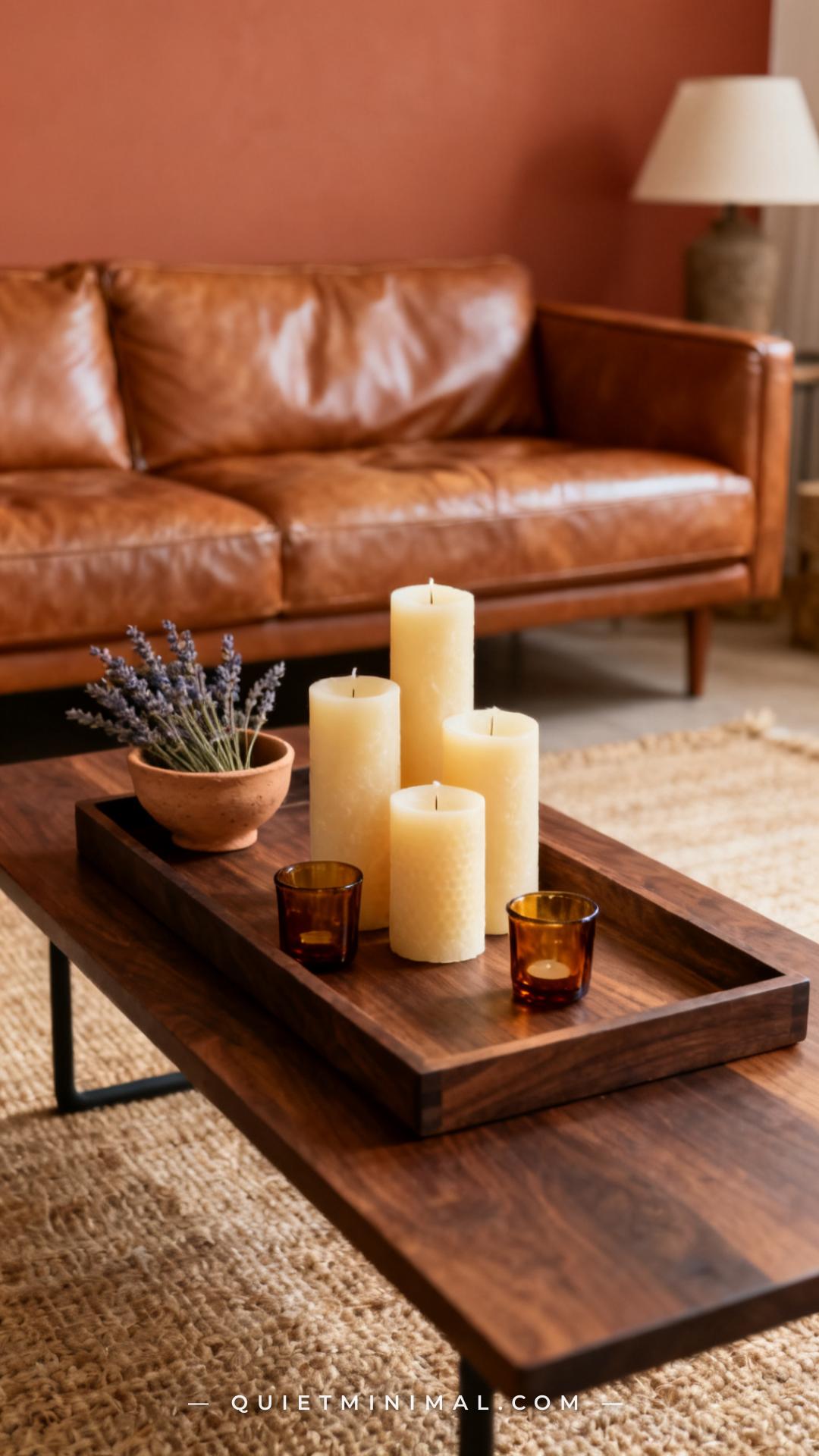
A wooden tray on the coffee table solves one of the most common moody living room problems: scattered candles that look random rather than intentional. Grouping candles on a tray creates a defined vignette that reads as a deliberate design moment rather than an accumulation of candlesticks. Dark walnut or medium oak trays work best for this palette — avoid white lacquer or metal trays, which introduce a cool surface that fights the warmth.
Build the tray cluster with height variation: start with a tall pillar candle in the center-back, bring a medium pillar forward and slightly to one side, and anchor the front corners with small votives or tea light holders. Fill the remaining space with a small ceramic bowl, a couple of smooth dark stones, or a short dried stem in a bud vase. The rule is that every object in the tray should share the same warm, natural material language: clay, wood, wax, dried organic matter. Nothing metallic, nothing shiny.
Key Takeaway: A dark wood tray corrals the candle cluster into an intentional vignette rather than a scattered arrangement — the difference between purposeful and accidental moody.
11. Use Dark Wood Furniture to Bridge Leather and Earth Tones
 Save
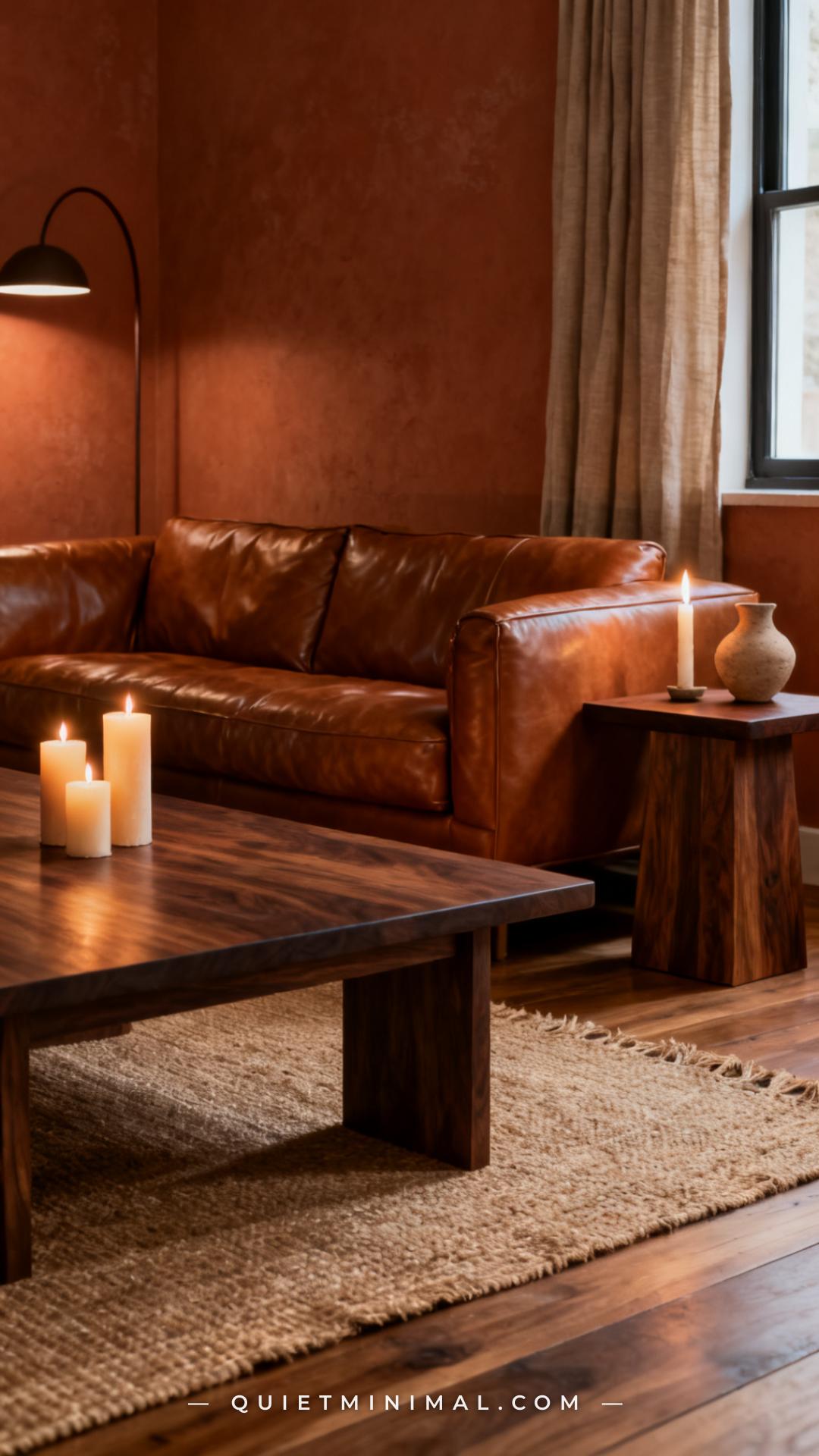
The furniture around a leather sofa should feel like it came from the same material family. Dark walnut, reclaimed oak, and raw mango wood all share the warm brown tones that anchor a moody earth palette. Cold metals — chrome, brushed nickel, polished stainless — break the warmth immediately. If your existing furniture has cold metal frames or legs, this is worth addressing: simple furniture leg caps in matte black or dark bronze can shift the reading considerably at low cost.
The coffee table is the most important furniture decision after the sofa itself. A low, rectangular slab in dark walnut or reclaimed wood does double duty: it provides the right surface for candle arrangements and it grounds the seating group visually. Avoid glass-top coffee tables for this aesthetic — transparency removes the visual weight that moody rooms depend on. The table should feel substantial and tactile, not invisible.
Key Takeaway: Dark walnut or reclaimed wood furniture with warm undertones bridges the leather and earth-tone palette without introducing cold materials that break the atmosphere.
12. Introduce Plants with Moody, Architectural Forms
 Save
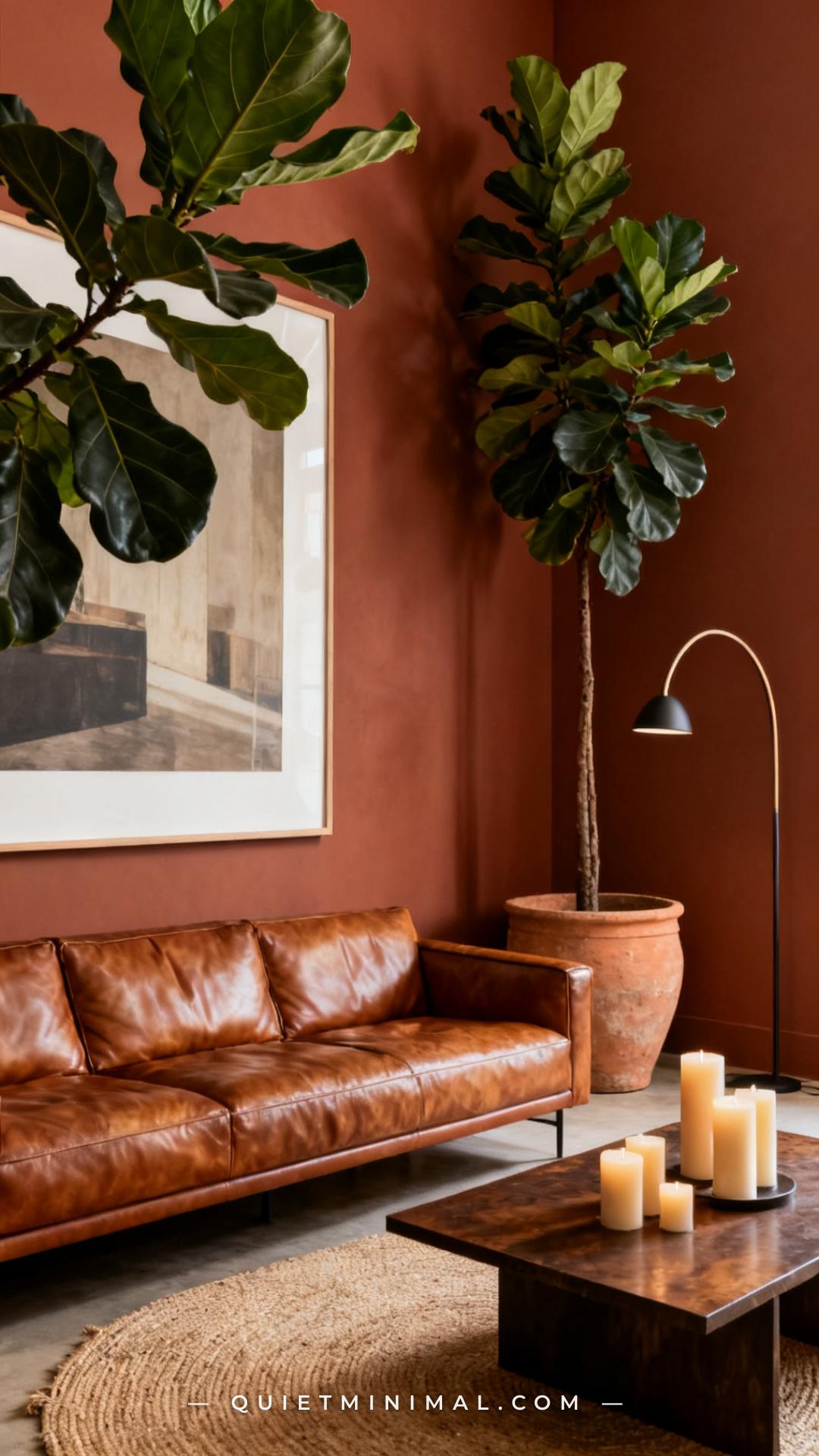
Plants are often left out of moody living room styling, which is a missed opportunity. A single large, architectural plant in a raw terracotta or dark matte ceramic pot adds an organic vertical element that no piece of furniture or art can replicate. The key is choosing plants with structure and drama rather than soft, trailing varieties that read as cottage-style. A fiddle-leaf fig, a tall snake plant, a Monstera deliciosa, or an olive tree in a large pot all fit the moody-earthy brief.
Place the plant in a corner or beside the sofa’s end, not centered or symmetric. The goal is to let it feel like it grew there rather than being placed for a photo. The pot material matters: raw terracotta, matte stone-look ceramics, or dark charcoal glazed pots all sit comfortably in the earth-tone palette. Avoid bright white nursery pots — they pull the eye immediately and break the warmth of the composition.
Key Takeaway: One large architectural plant in a raw terracotta or dark ceramic pot adds organic vertical presence that anchors the moody room’s natural material story.
13. Style the Bookshelf as a Moody Backdrop, Not a Display Case
 Save
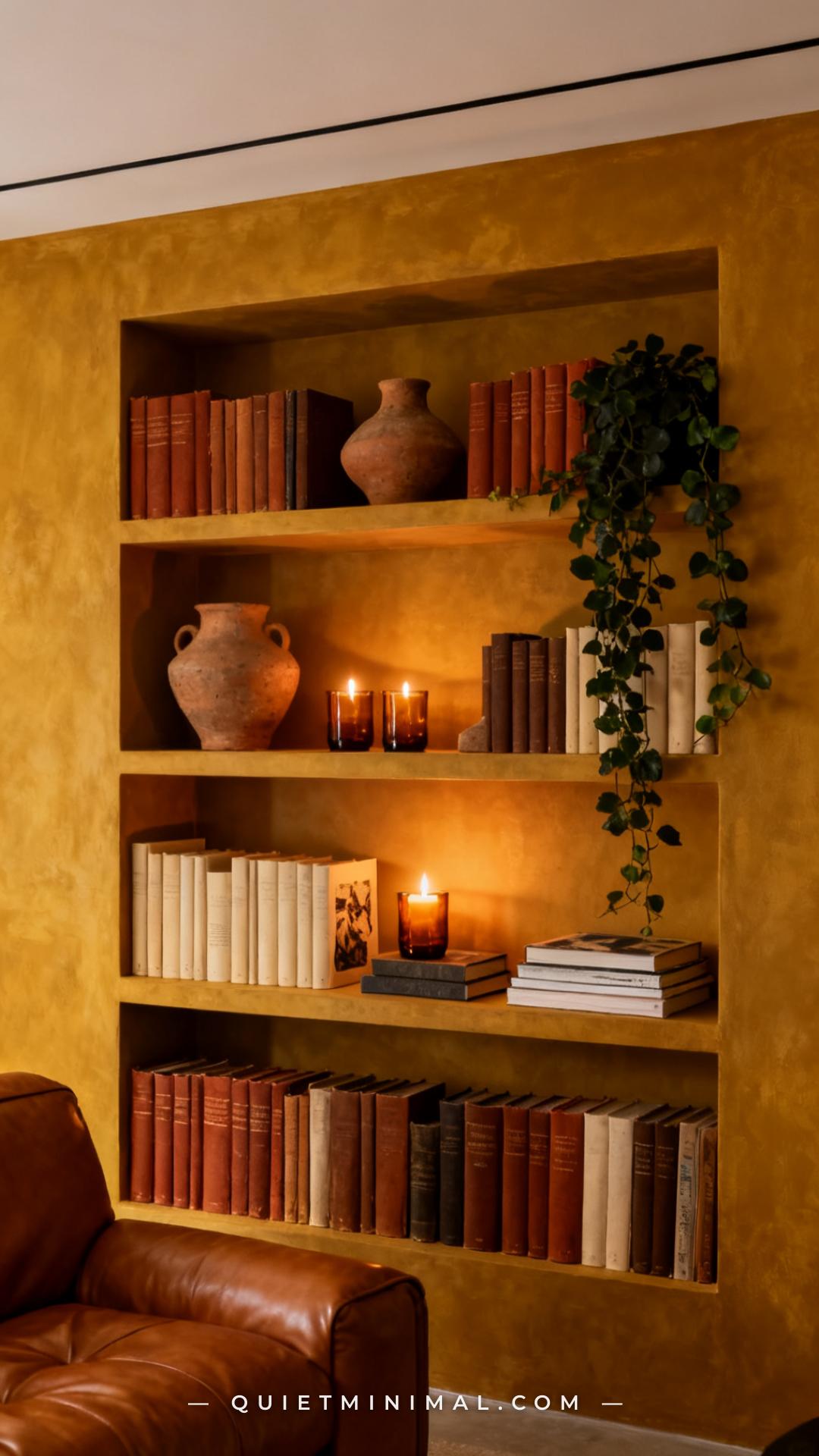
A bookshelf in a moody living room should feel like a curated extension of the earth-tone palette, not a library archive. The most common mistake is leaving every book spine-out with no variation in color, height, or texture — the result looks flat and office-like. To style a bookshelf for a moody room, start by removing anything that introduces a cold color (bright blue, white covers, silver frames) and group what remains in warm-toned clusters.
Use the shelves to extend the candle atmosphere upward: place small amber glass votives or short taper candles in matte black holders on the middle and upper shelves. Stack books horizontally as risers for ceramic vessels. Place one trailing plant at a corner shelf to soften the geometry. Leave some shelves intentionally sparse — negative space on a bookshelf reads as editorial confidence, not laziness. The shelf becomes a backdrop for the candle cluster on the coffee table below, not a competing focal point.
Key Takeaway: Style bookshelves with warm-toned spines, clay vessels, and small candles to extend the earth-tone atmosphere vertically and make the shelf feel like part of the room’s mood rather than storage.
14. Control Natural Light with Linen Curtains
 Save
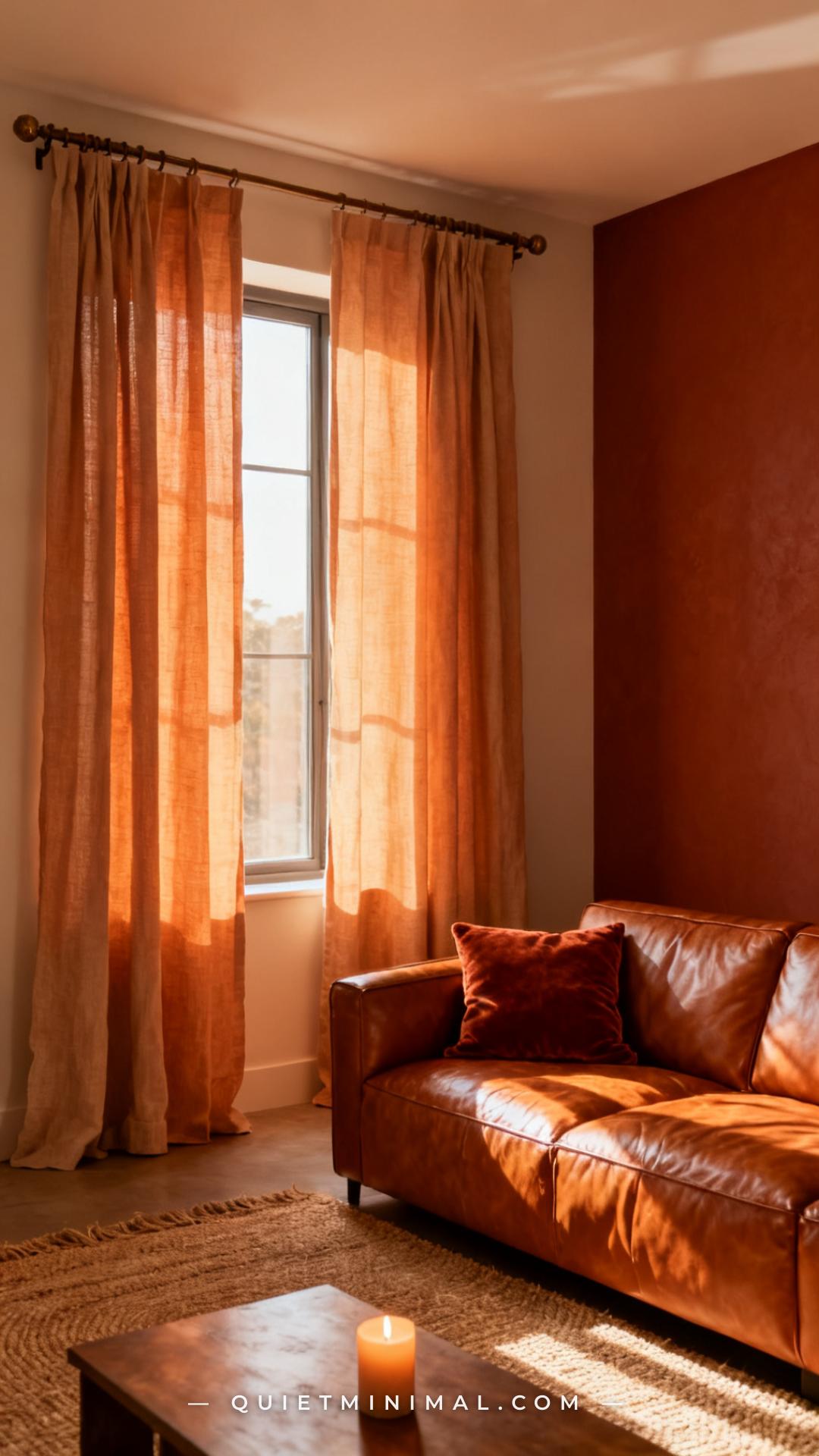
Natural light is not the enemy of a moody living room — unfiltered, harsh natural light is. The solution is linen curtains in a warm tone (oatmeal, aged cream, warm flax) that diffuse afternoon light into a soft amber glow rather than blocking it entirely. Linen’s natural weave filters light beautifully and moves gently in any air current, which adds a subtle organic quality that heavier drapes eliminate.
Hang the curtains high and wide — mount the rod as close to the ceiling as possible, and extend the rod 8–12 inches beyond the window frame on each side. This makes the window appear larger, lets more diffused light into the room, and gives the curtains the floor-length drape that elevates the whole composition. When closed partially at midday, warm linen curtains with afternoon light behind them create almost the same amber quality as candlelight — an effect that makes the whole room read warmer before a single candle is lit.
Key Takeaway: Warm oatmeal linen curtains hung high and wide diffuse natural light into the same amber quality as candlelight, amplifying the moody atmosphere from the moment daylight enters the room.
15. Finish with Scent as the Final Atmospheric Layer
 Save
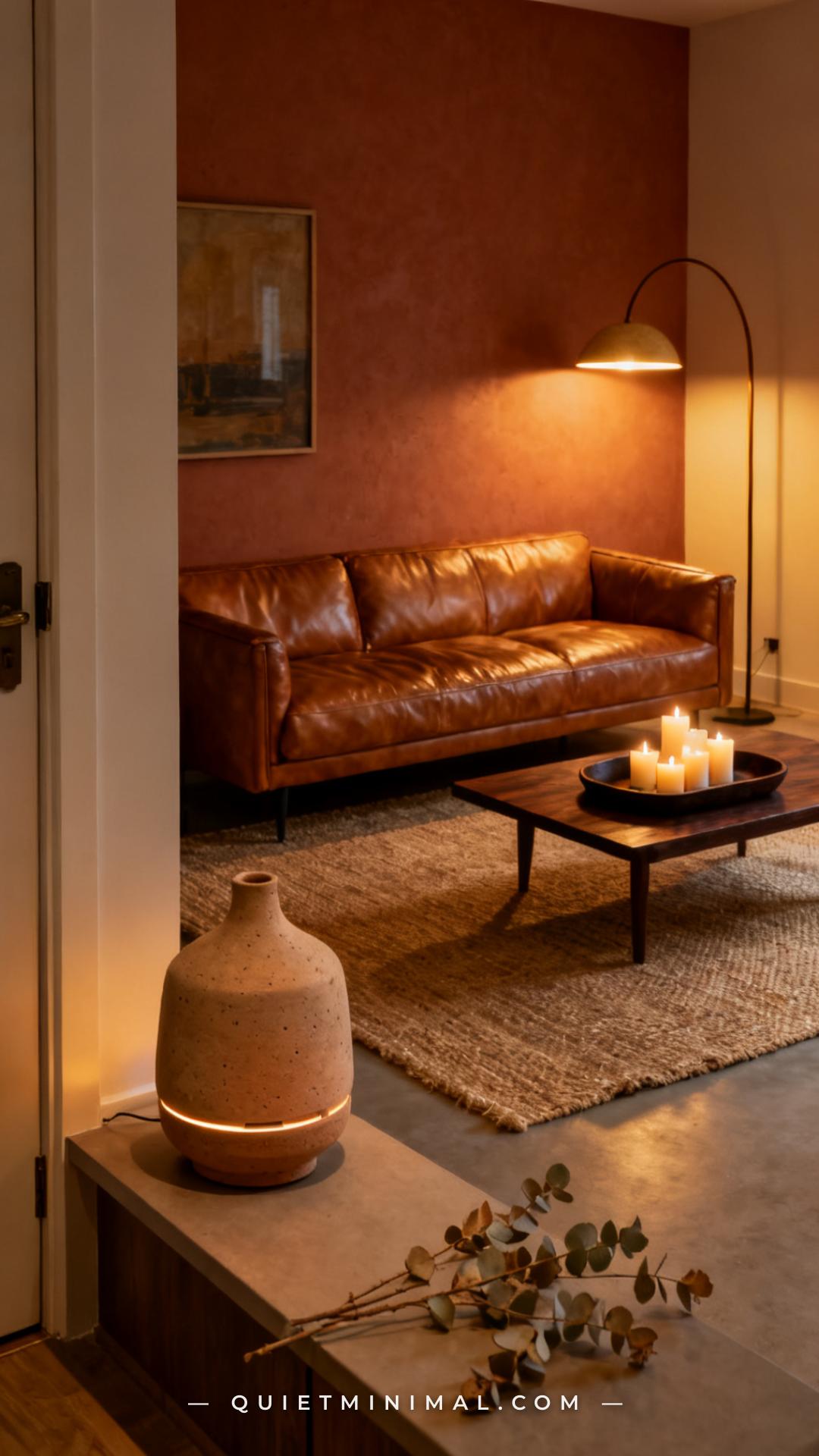
Every element discussed so far works on the visual and tactile senses. The final layer works on a completely different register: scent. A moody living room that smells like warm sandalwood, cedar, amber, or dried herbs creates a sensory completeness that makes the atmosphere feel three-dimensional rather than decorative. The scent layer is what turns a well-styled room into an experience.
For a room built around beeswax or soy candles, the candles themselves contribute to the scent. Supplement with a ceramic or raw clay reed diffuser in the room’s entry zone — the scent greets before the visual does. Choose fragrance families that match the material palette: woody, smoky, resinous, or lightly herbal. Avoid florals or aquatic scents, which signal a completely different aesthetic and undermine the earthy, grounded atmosphere you’ve built. Sandalwood, amber, tobacco leaf, cedar, and dried sage all sit naturally within the moody earth-tone world.
Key Takeaway: Grounding the room’s scent in woody, resinous, or earthy fragrance notes completes the atmospheric layering that makes a moody living room feel immersive rather than simply well-decorated.
A moody living room built around a leather sofa, warm earth tones, and candles succeeds or fails on specificity. The leather tone has to be warm. The candles have to hit three heights. The wall color has to amplify rather than absorb the warmth. Get those three things right, and every additional layer — the rug, the velvet pillows, the ceramic vessels, the linen curtains — compounds the effect. Start with whichever of these 15 ideas addresses the biggest gap in your current room, make that change, then step back and let it tell you what comes next. Moody rooms are built incrementally, not all at once, and the best ones always look like they happened naturally.
From the guides
You've saved it, wanted it. Here's the how: codes, measurements, order. Your choices make it yours.
The Japandi Honest PlaybookThe honest version of the style: what to keep, what to skip, and the order to do it in.See inside →The Room Refresh PlaybookA repeatable four-step method, room by room, in ten minutes, thirty minutes, or one weekend.See inside →Make Any Room Feel Cozy on PurposeWhy some rooms hold people and others empty out, and the moves that change it.See inside → Save


