 Georgia
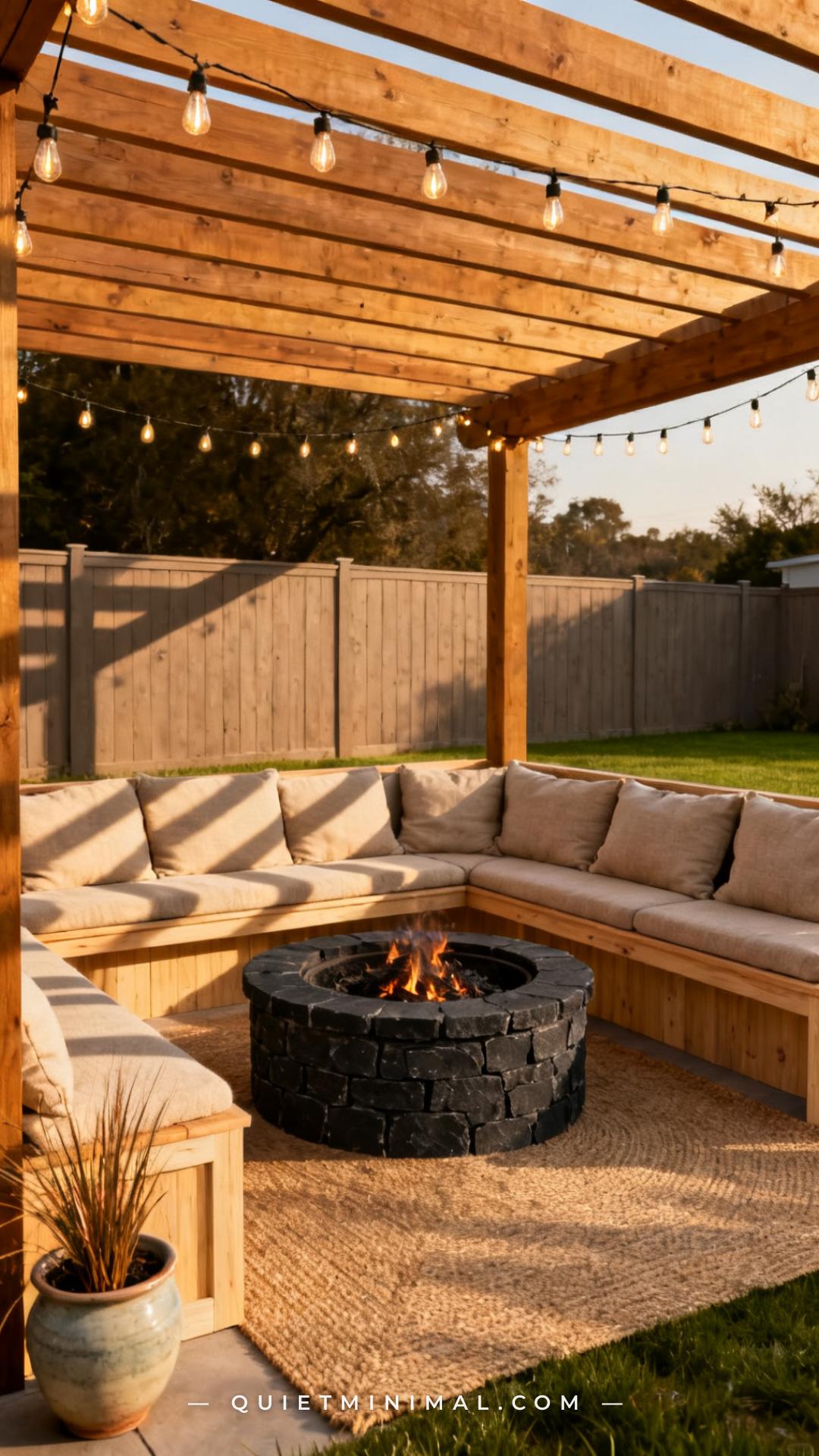
If you’ve ever pinned a gorgeous fire pit circle under a pergola and then stared at your backyard wondering where to even start, you’re not alone. The reason most of these projects stall — or worse, get built and never used — is that nobody explains the sequence. Built-in benches go in before the fire pit. Fire pit clearance determines pergola placement. Cushion depth decides whether anyone actually sits there after dark. This article breaks down 14 specific ideas that cover the full system: the structure, the seating, the cushions, and the finishing layers. Each one is designed to be copied, not just admired.
1. Set the Bench Radius Before You Pour Anything
 Save
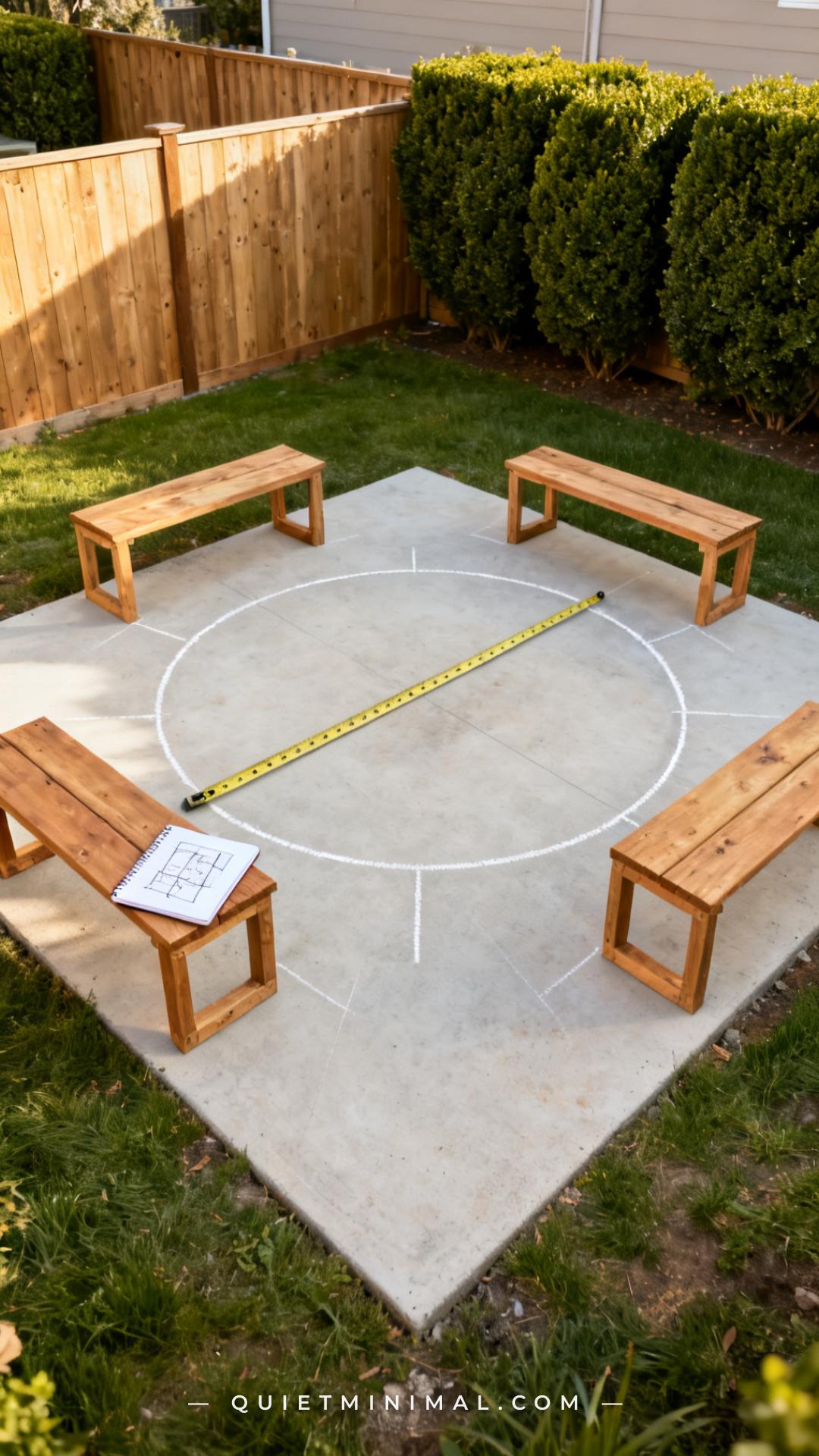
Most built-in bench fire pit circles fail at step one: people set the fire pit first and build the bench around it. The correct order is the reverse. Start by marking your bench radius on the ground — the National Fire Protection Association recommends a minimum 7-foot clearance from the fire source to any combustible seating. For a standard 44-inch fire pit bowl, that means your bench inner edge should sit no closer than 7 feet from the pit center, making the full circle diameter at least 18–20 feet across. Mark this with chalk or stakes before a single bag of concrete is mixed.
This matters even more when a pergola is involved, because the posts set the outer boundary. If you mark the bench first, you can position pergola posts outside the bench perimeter rather than crowding the seating. A good rule of thumb: pergola posts should be at least 18 inches outside the bench outer edge so the structure feels open, not like a cage.
From the guides
You've saved it, wanted it. Here's the how: codes, measurements, order. Your choices make it yours.
 The Japandi Honest PlaybookThe honest version of the style: what to keep, what to skip, and the order to do it in.See inside →
 The Room Refresh PlaybookA repeatable four-step method, room by room, in ten minutes, thirty minutes, or one weekend.See inside →
 Make Any Room Feel Cozy on PurposeWhy some rooms hold people and others empty out, and the moves that change it.See inside →
Key Takeaway: Always set your bench radius first — fire pit clearance and pergola post placement both depend on it.

2. Choose a Fire Pit That Fits the Circle, Not Just the Aesthetic
 Save
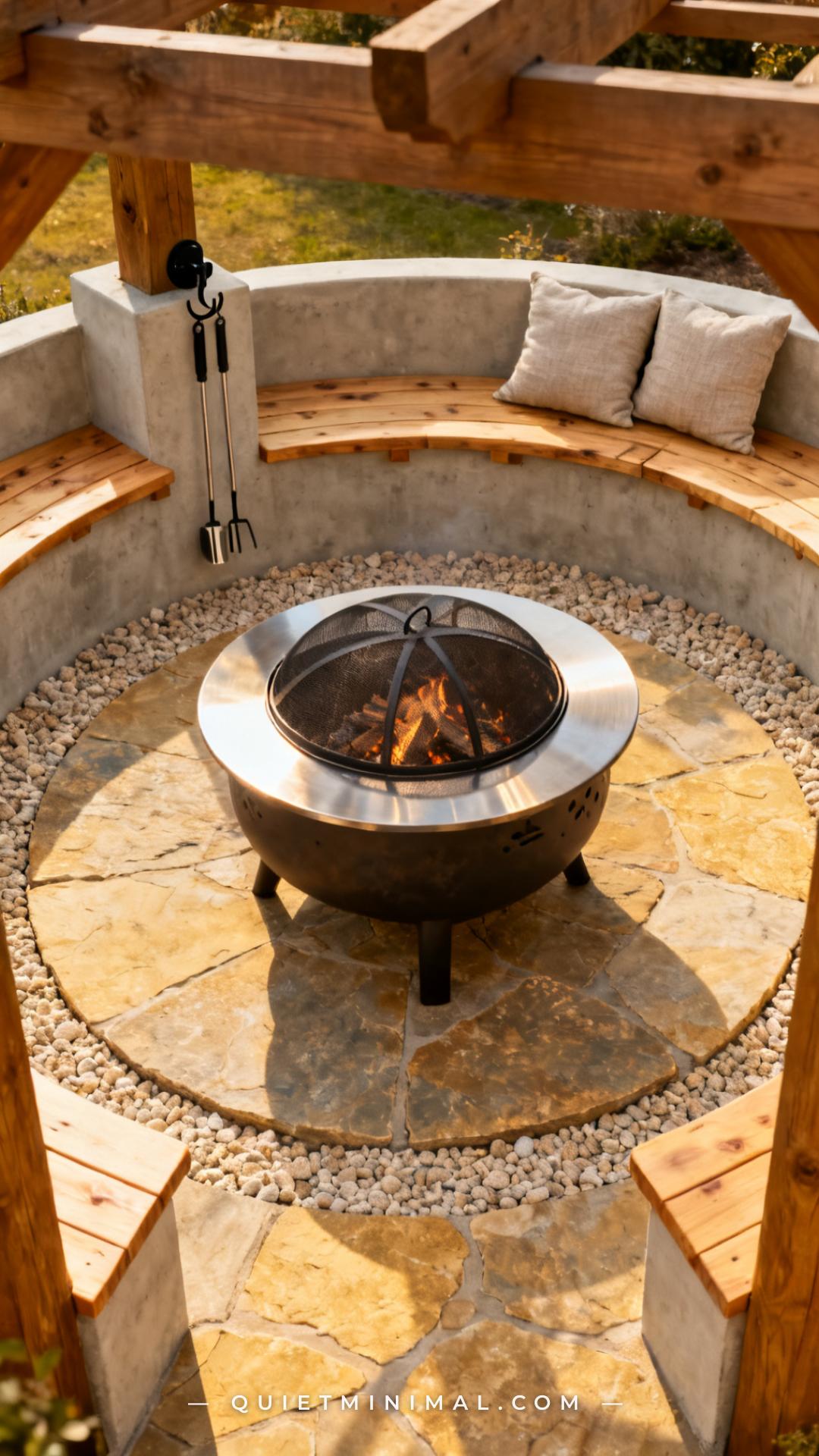
The fire pit itself needs to be chosen before the bench concrete sets, because the size determines the gravel or flagstone apron you’ll need between the pit and the bench. A 44-inch steel fire pit bowl is the most common size for an 18–20-foot circle — it provides enough visual weight to anchor the space without generating so much heat that sitting becomes uncomfortable. If you prefer a gas insert, plan for a slightly wider gravel apron because gas pits often emit radiant heat more directionally than wood-burning ones.
Wood-burning steel fire pits with mesh screens are the most forgiving for this layout — they’re movable if you ever want to rearrange, they don’t require gas line installation, and they read as intentional rather than permanent in rental situations. Look for a pit with legs that hold the bowl at least 8 inches off the ground, which helps air circulate under the base and keeps heat from conducting into the paving below.
Key Takeaway: Match fire pit diameter to your circle radius first — then finalize the flagstone apron width and bench placement.

3. Pour the Bench Foundation in Sections, Not One Continuous Slab
 Save
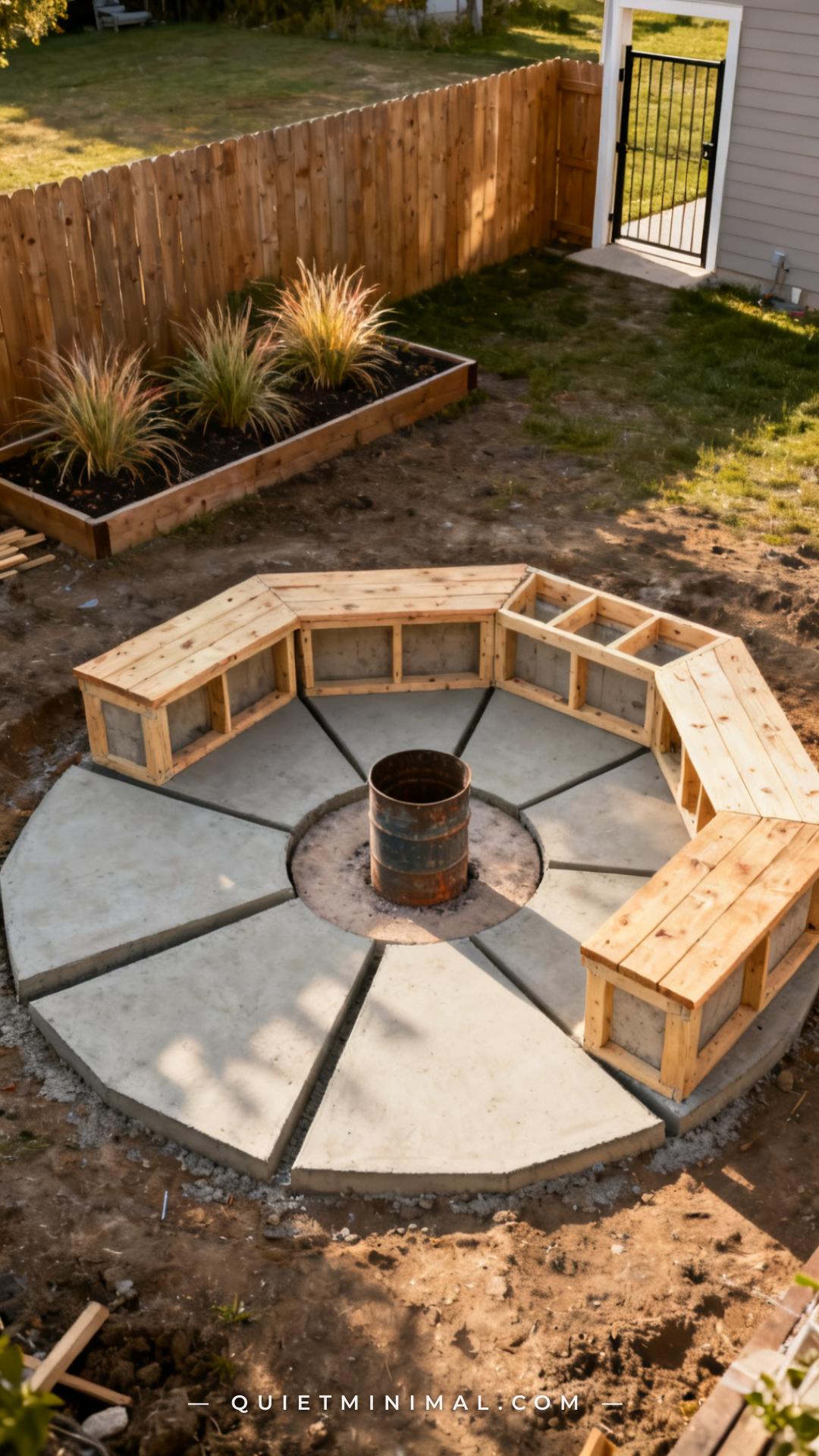
Built-in benches around a circle are almost always poured as one continuous curved slab, which creates two problems: cracking as the ground shifts seasonally, and no drainage path for rain collecting under the cushion frames. The better approach is to pour individual pad sections — one per bench segment — with a small gap between sections. Each gap acts as a drainage channel and also provides a natural expansion joint that prevents cracking.
Standard bench depth is 20–22 inches for a comfortable seat. For a fire pit circle, slightly deeper — 24 inches — gives room for a thick cushion pad plus a small storage lip at the back. Frame the top with pressure-treated 2×6 lumber or composite decking boards, both of which handle outdoor moisture without warping the way standard pine does.
Key Takeaway: Pour benches in segmented pads with drainage gaps rather than one continuous slab — your cushions and the concrete both last longer.

4. Size Your Pergola to the Circle, Not to the House
 Save
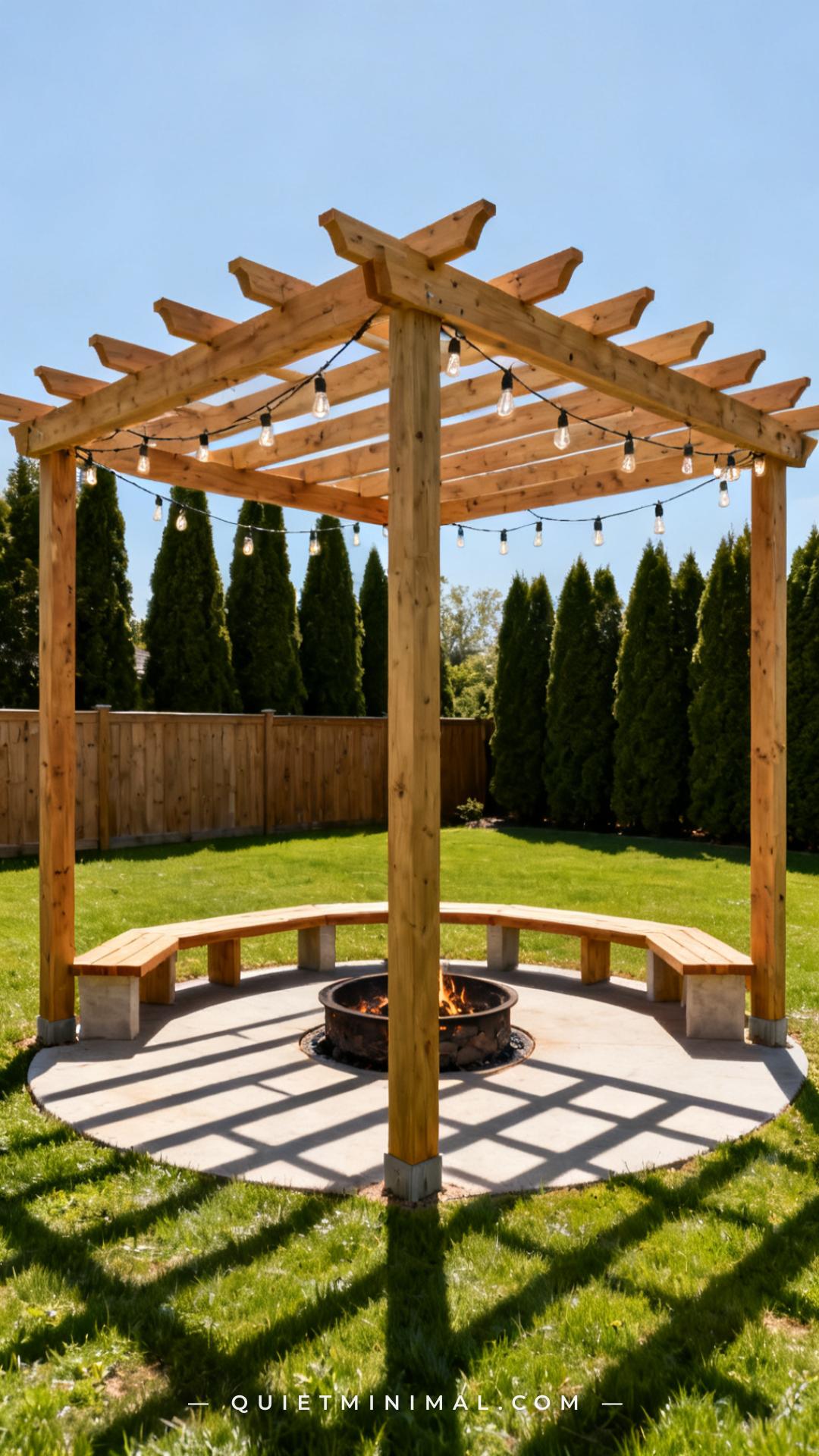
The most common pergola mistake for this setup is sizing it relative to the house — building a 10×12 attached pergola when the fire pit circle actually needs a freestanding 16×16. The pergola should be sized to the circle, not to a wall or door. As a general rule, the pergola footprint should be at least 2 feet wider than the bench ring on every side. For an 18-foot bench circle, that means a minimum 22-foot pergola span.
Freestanding pergolas with 6×6 posts are the right structural choice here — they’re rated for wind loads and don’t rely on an existing structure for support. Cedar and pressure-treated pine are both solid material choices; vinyl is easier to maintain but can look lightweight against the mass of a stone fire pit circle. For the roof, open-slat construction (rather than solid roofing) lets smoke from the fire pit rise and disperse rather than collecting under the roof and following guests home in their clothes.
Key Takeaway: Size your pergola to the fire pit circle with at least 2 feet of clearance on every side — never size it to the house footprint.

5. String Lights Are Load-Bearing Infrastructure, Not an Afterthought
 Save
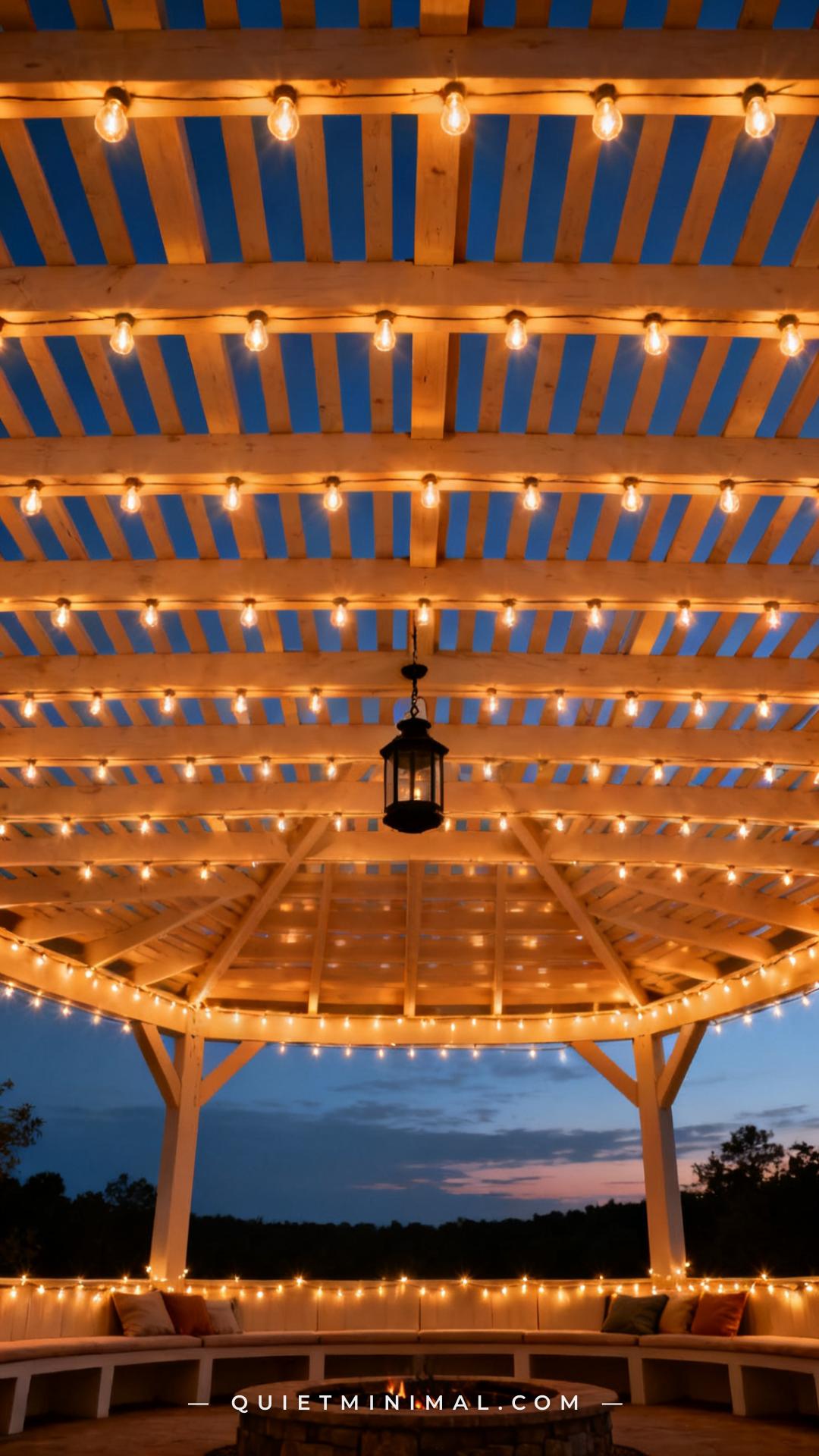
String lights on a pergola fire pit circle are not decorative extras — they’re the primary light source for the space after dark, and they need to be wired or batteried before any cushions or finishing elements go in. Plan your string light runs during the framing phase so you can mount weatherproof hooks and run outdoor-rated cord through the rafter system cleanly, rather than zip-tying cables to finished wood after the fact.
The standard run for a 16×16 pergola is five parallel lines spaced 3 feet apart — that produces even ambient light across the full circle without any dark corners near the bench ends. Use G40 globe bulbs rated at 2200K–2700K color temperature for the warmest, most fire-complementary glow. At that color temperature, the artificial light blends with fire light rather than competing with it, keeping the atmosphere cohesive.
Key Takeaway: Plan your string light mounting points during framing — five parallel runs on a 16×16 pergola at 3-foot spacing produce even, fire-complementary light.

6. Use Cushion Thickness as a Design Variable, Not Just a Comfort Choice
 Save
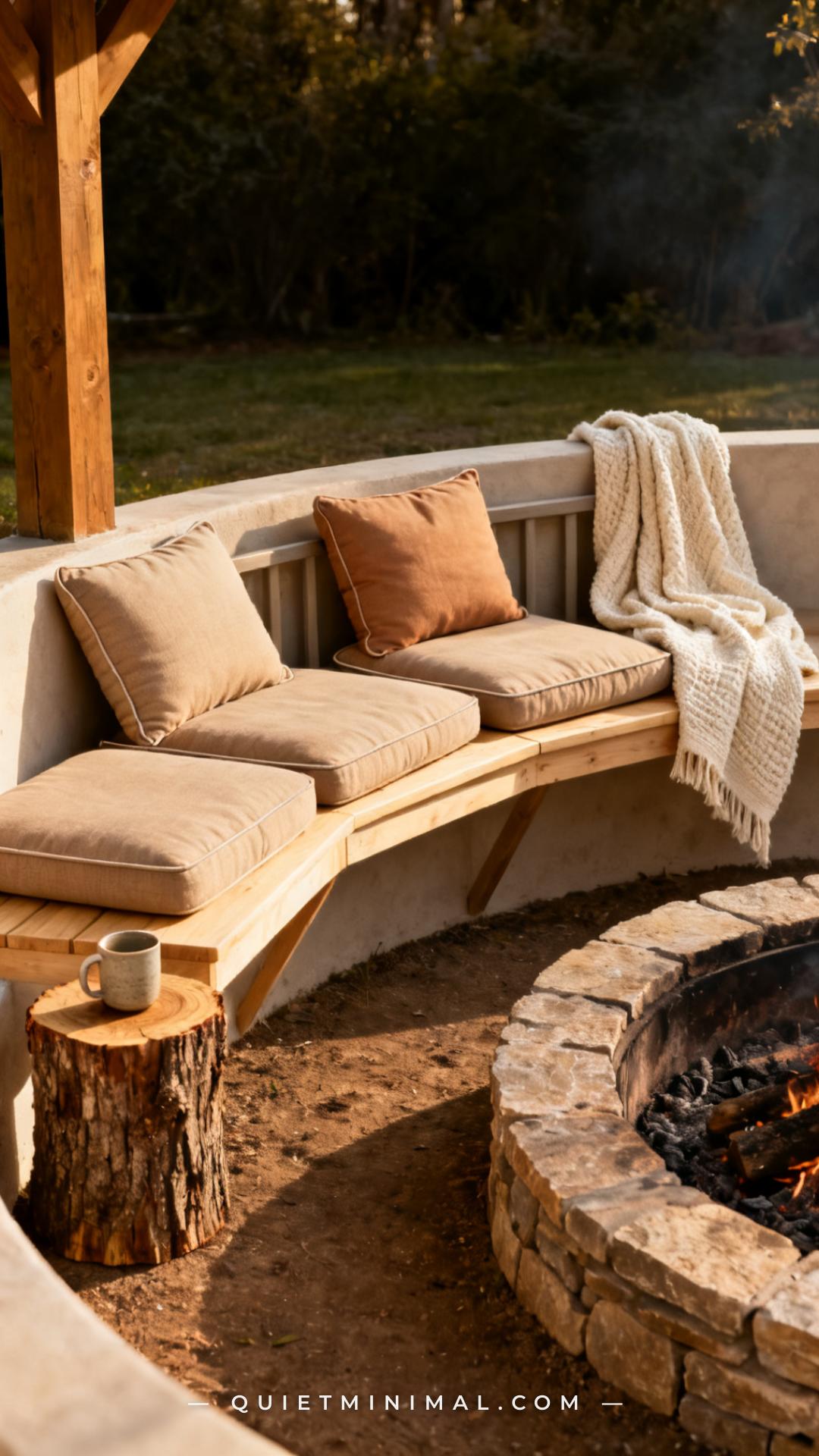
Cushion thickness is the single most visible design decision in a built-in bench fire pit space — thicker cushions (4–5 inches) read as luxurious and intentional; thinner cushions (2–3 inches) read as an afterthought. For a built-in bench where people will sit for extended fire pit sessions, 4-inch minimum foam thickness with a weather-resistant outer fabric is the functional floor. Sunbrella and comparable solution-dyed acrylic fabrics are the material standard because they resist UV fading and mildew at a level that polyester blends cannot match.
Color choice at a fire pit circle should lean into warm neutrals — taupe, oatmeal, linen, warm sand — because firelight is warm-toned and it makes cool colors (slate, blue-grey, navy) look washed out after dark. Warm neutrals glow beautifully under fire light and string light combined. Consider having two sets of covers: a lighter set for summer and a deeper terracotta or rust for fall — both warm enough to read well at night.
Key Takeaway: Go 4-inch minimum cushion thickness in warm neutral tones — cool colors look off under fire light and thin cushions read cheap on built-in benches.

7. Add Back Support Without Installing a Full Backrest
 Save
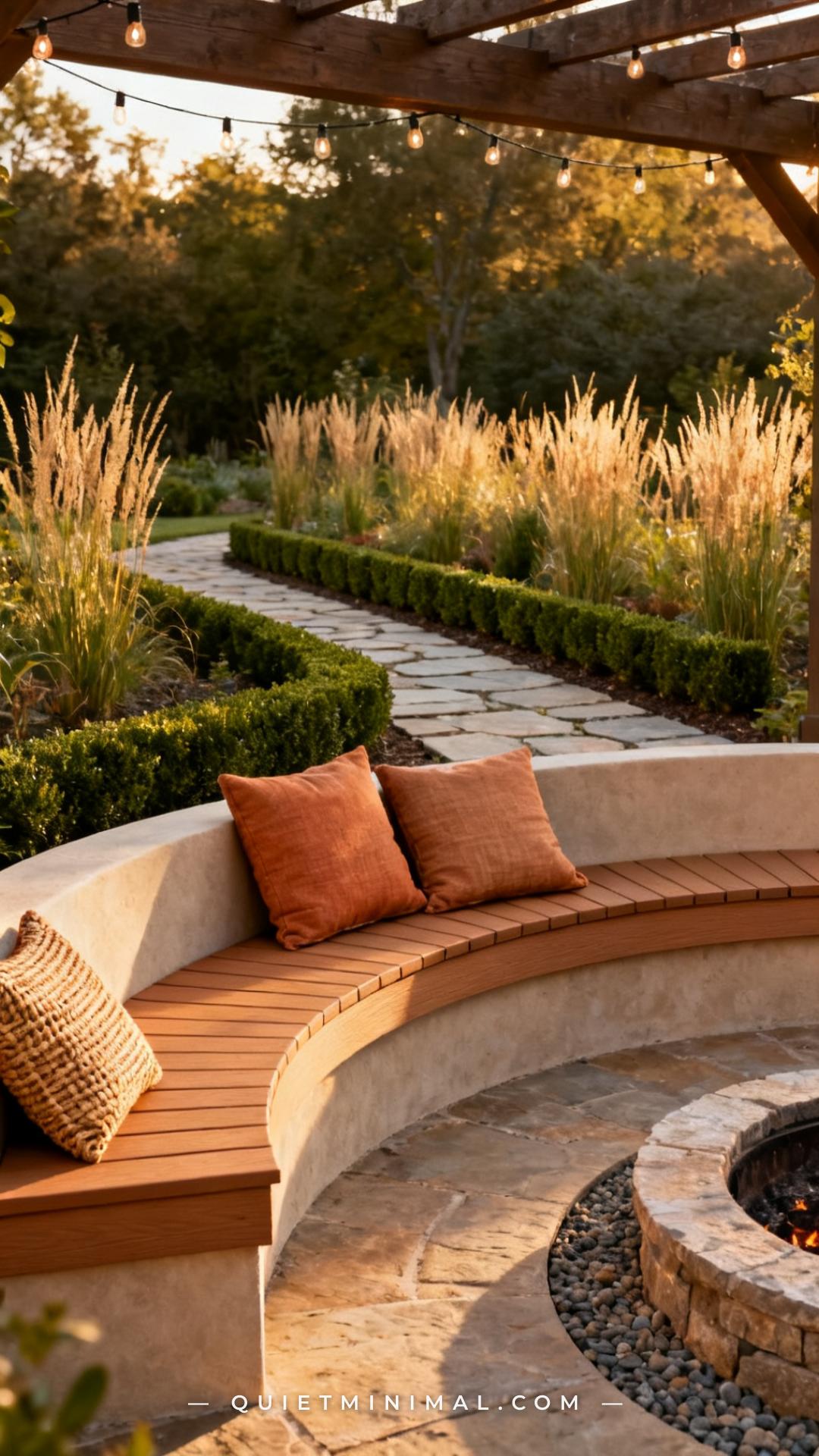
Full wraparound backrests on built-in benches add construction complexity and can make the space feel enclosed rather than open to the fire. The better solution is a low backrest ledge — a 10–12-inch-tall extension of the bench frame — that gives back cushions something to lean against without framing out an entire wall. This detail is widely used by landscape designers because it solves comfort without sacrificing the open sightlines you want around a fire.
Back cushions for this setup should be 20×20-inch or 24×24-inch outdoor throw-style cushions rather than fixed back pads, because they’re easy to store, easy to wash, and easy to replace as trends change. Fill them with a fast-dry polyester insert rather than down — down compresses under moisture and loses its loft; polyester maintains shape through rain cycles.
Key Takeaway: Build a 10–12-inch backrest ledge instead of a full frame — lean back cushions against it for comfort without boxing in the space.

8. Define the Zone With a Gravel or Flagstone Apron
 Save
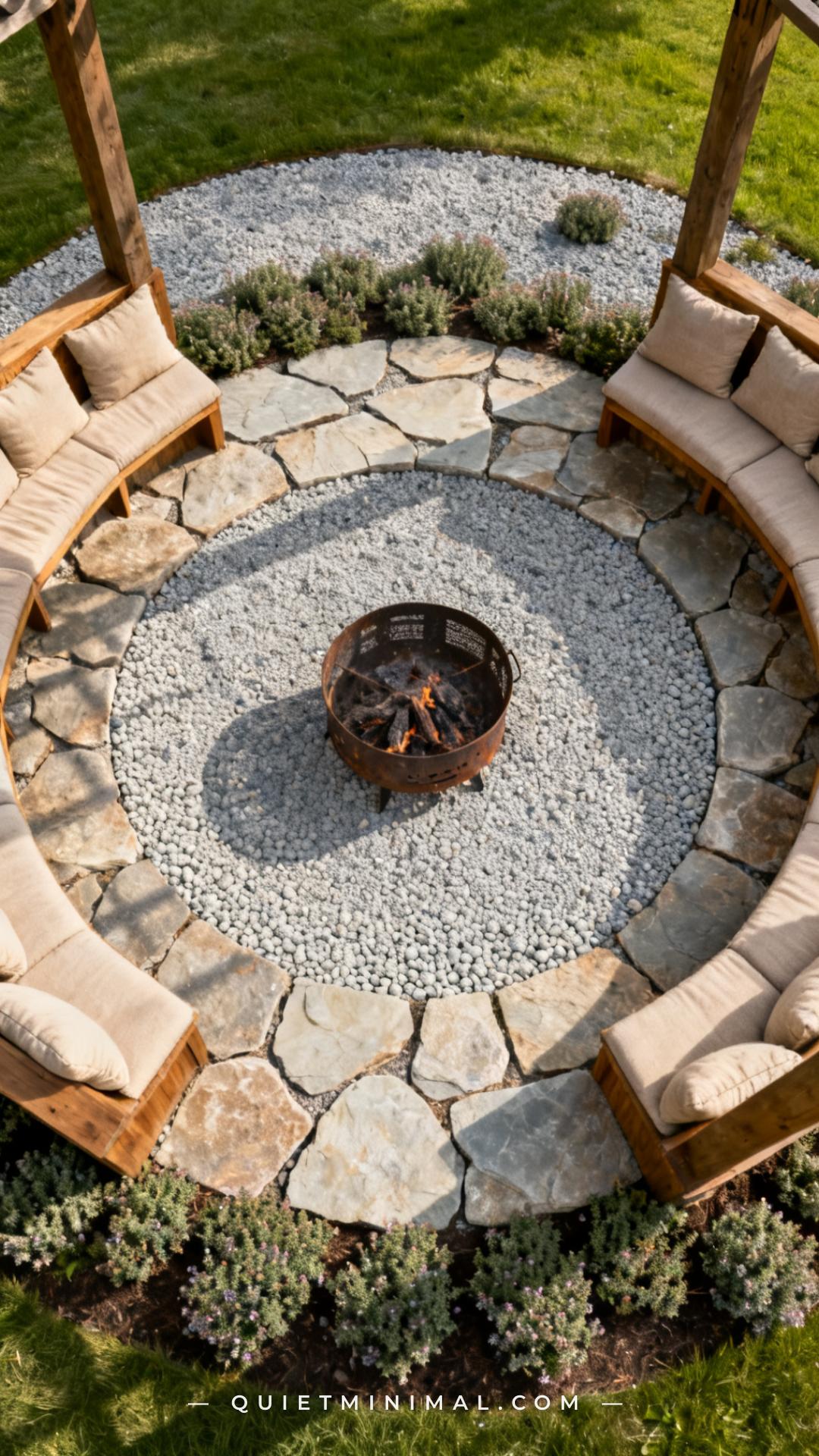
The ground plane inside a fire pit pergola circle is doing a lot of work: it needs to handle heat, ash fallout, foot traffic, drainage, and aesthetics simultaneously. The standard solution is two concentric zones — a gravel apron (18–24 inches wide) directly around the fire pit, transitioning to flagstone or pavers under the bench seating. Pea gravel is the most common choice for the inner apron because it’s non-combustible, drains immediately, and is easy to rake clean of ash and debris.
The flagstone or paver section under the benches should be level and stable — uneven pavers shift under bench legs and create trip hazards. A 1–2-inch crushed stone base compacted before flagstone installation is the minimum prep. If your circle is on an existing concrete pad, you can use self-adhesive faux-flagstone overlays for a comparable look without breaking existing concrete.
Key Takeaway: Use two concentric ground zones — gravel at the fire pit for heat and drainage, flagstone or pavers underfoot at the bench for stability.

9. Add a Side Table at Every Bench Break
 Save
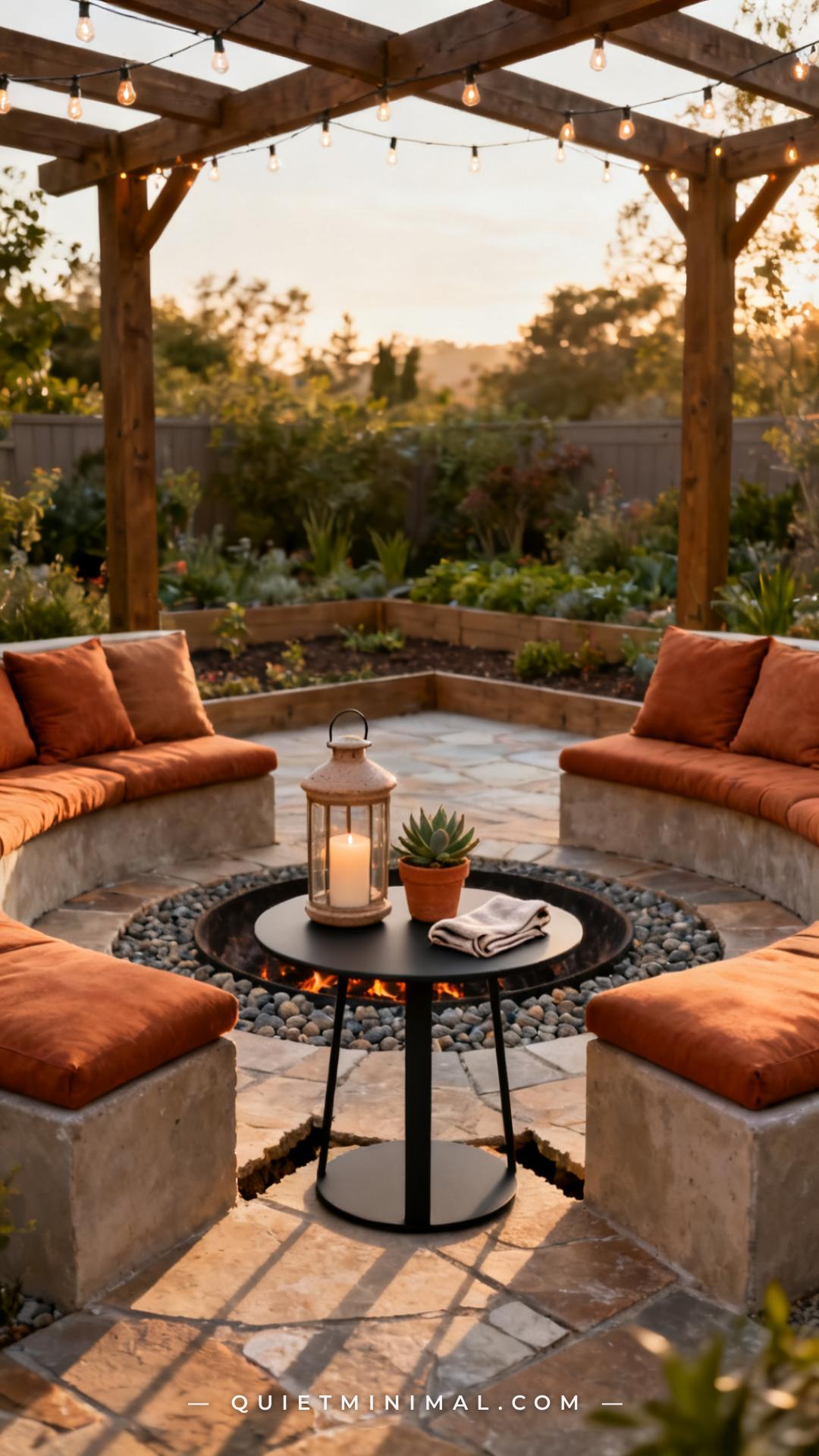
Built-in benches have a critical usability flaw: nowhere to set a drink, a plate, or a phone without leaning off the seat. The solution is to design a side table into every natural break between bench segments. For a four-segment circle, that’s four built-in side table locations — each one positioned in the gap between bench sections so it doesn’t consume any seating width.
From the guides
You've saved it, wanted it. Here's the how: codes, measurements, order. Your choices make it yours.
The Japandi Honest PlaybookThe honest version of the style: what to keep, what to skip, and the order to do it in.See inside →The Room Refresh PlaybookA repeatable four-step method, room by room, in ten minutes, thirty minutes, or one weekend.See inside →Make Any Room Feel Cozy on PurposeWhy some rooms hold people and others empty out, and the moves that change it.See inside →Side tables for this space should be low (same height as the bench seat — typically 17–18 inches) and weather-proof. Cast iron, powder-coated steel, and teak are the best material choices. Avoid glass tops at a fire pit — thermal cycling from fire heat and cold nights stresses tempered glass and can cause it to fracture. A solid top in steel or hardwood handles the temperature swings without risk.
Key Takeaway: Place a low side table at every bench break — same height as the seat, no glass tops near the fire.

10. Use Pergola Posts as Vertical Styling Anchors
 Save
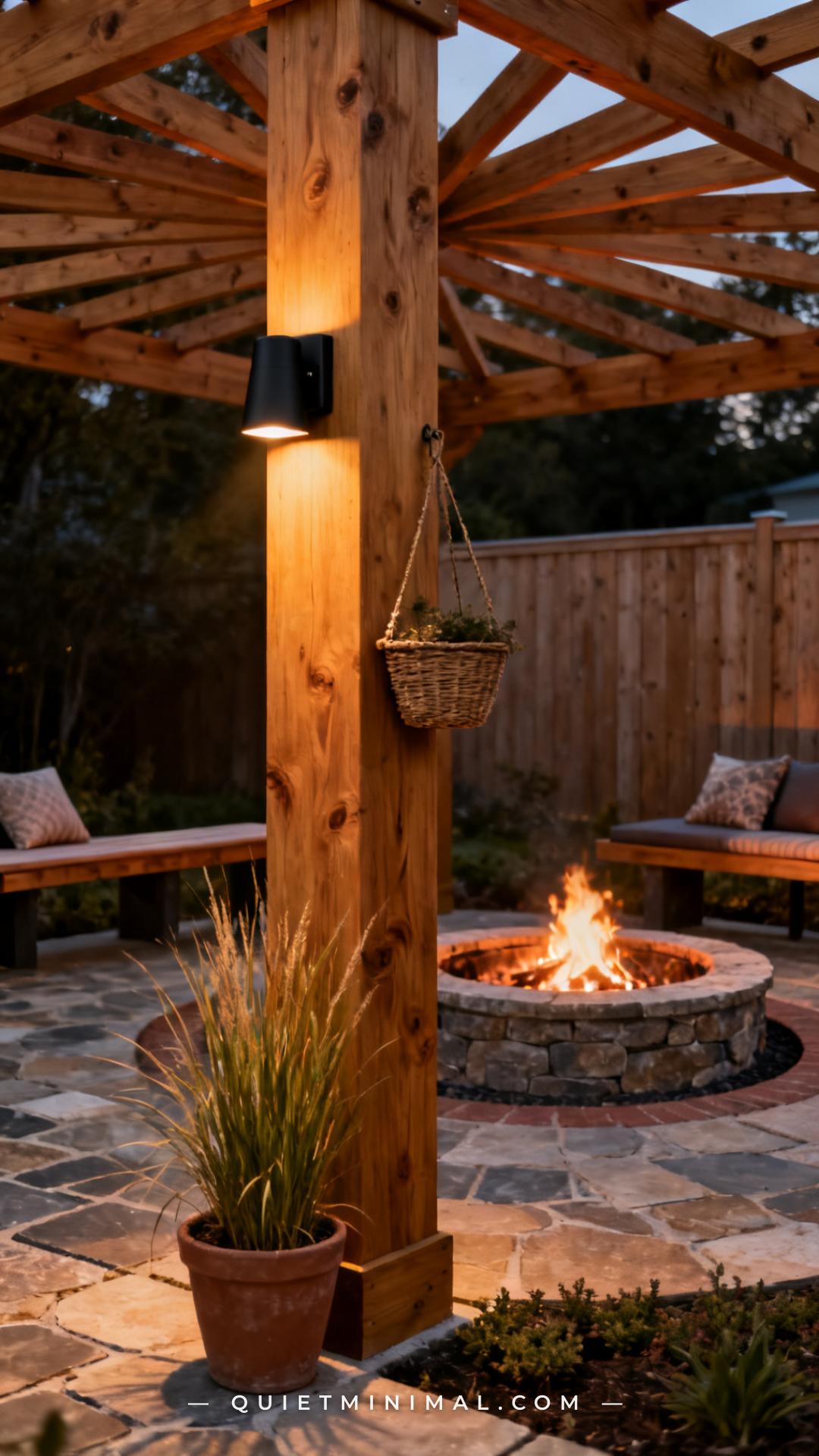
Pergola posts are underused in most fire pit circle designs — they’re structural necessities that most people leave bare, when they’re actually ideal vertical styling anchors. Each post is an opportunity to mount an outdoor sconce (for task light at the bench end), hang a trailing planter, or add a subtle hook for hanging lanterns on colder nights.
Outdoor-rated wall sconces on pergola posts solve a real problem: string lights produce ambient top-down light, but they don’t give enough light for reading a menu or checking a phone. A single sconce per post, positioned at eye level for a seated person (about 4 feet from the ground), fills the ambient gap without over-lighting the space. Use sconces rated for wet locations — damp-rated fixtures fail within two seasons in outdoor environments.
Key Takeaway: Mount a wet-rated outdoor sconce at seated eye height on each pergola post — this fills the ambient light gap that string lights alone can’t cover.

11. Choose a Pergola Shade Element That Handles Fire Smoke
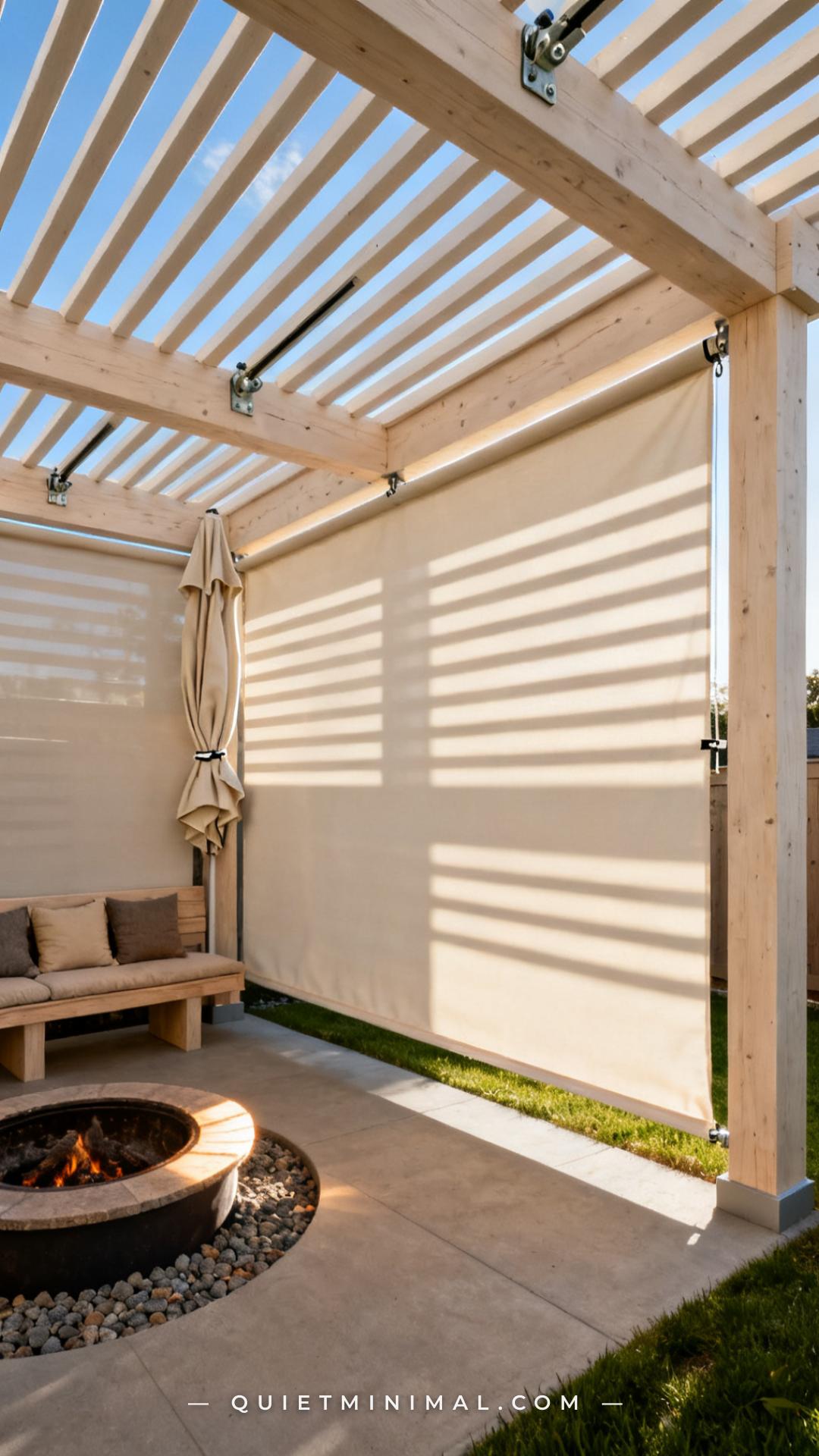 Save
Adding shade to a pergola fire pit circle requires a material choice that handles smoke differently than it would handle sun. Solid shade sails and retractable canvas roofs trap smoke under the canopy — even with open rafters, if a shade material covers more than 60% of the ceiling, smoke dwell time increases and the seating area becomes uncomfortable in still air. The right solution is adjustable: either louvered pergola roofing panels (which can be opened on low-wind nights to let smoke rise) or a shade sail on a retractable track that can be pulled back when the fire is lit.
Polycarbonate pergola panels are popular but are not recommended for fire pit pergolas — they’re non-breathable and they amplify heat on warm evenings. Stick with fabric-based shade elements (solution-dyed acrylic, not standard canvas) or adjustable louvered panels that give you control over the open-to-covered ratio based on wind and smoke conditions.
Key Takeaway: Use adjustable shade — louvered panels or retractable sail — never a fixed solid roof on a fire pit pergola.

12. Layer Rugs Under the Bench Perimeter, Not the Fire Pit
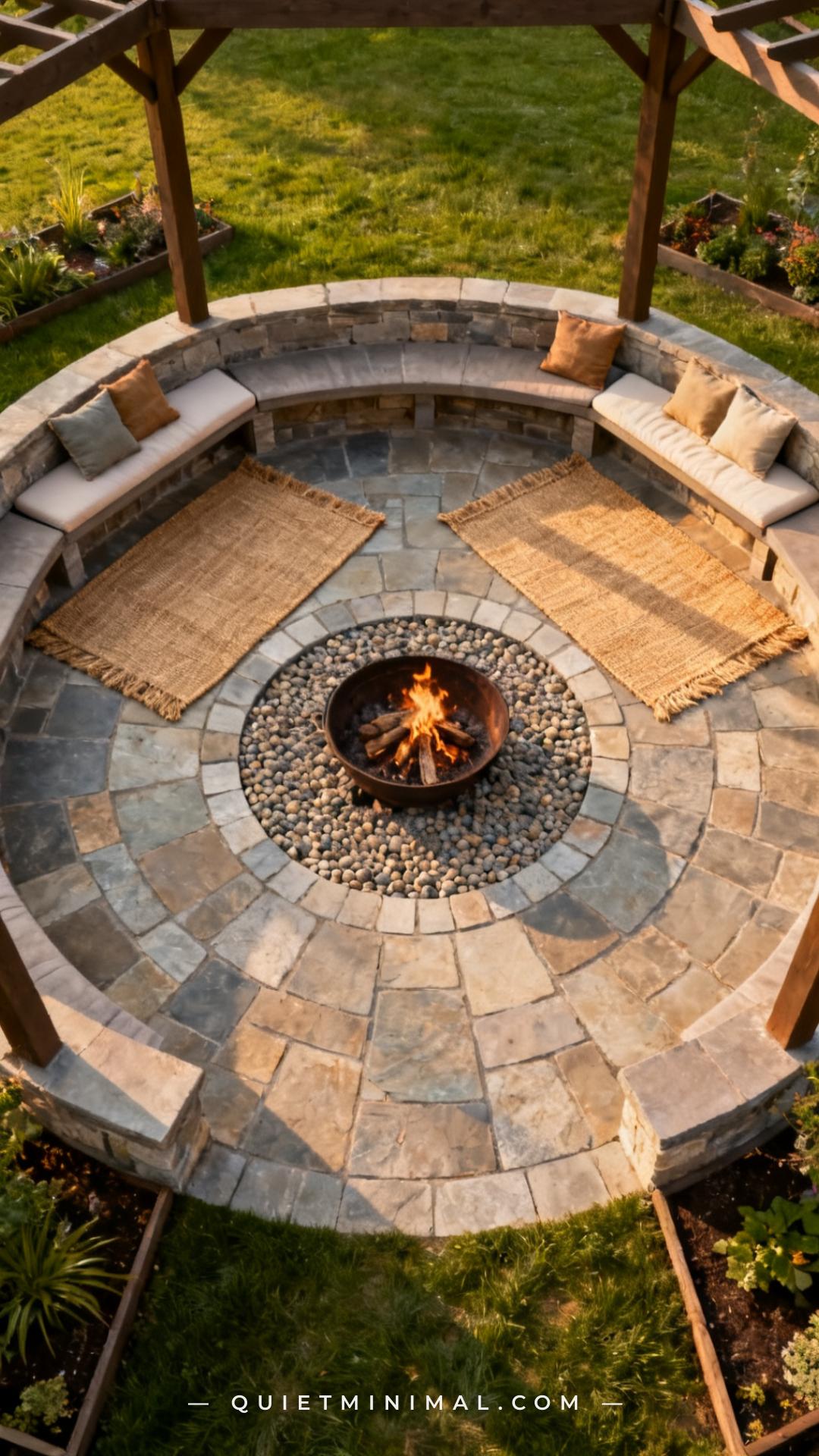 Save
Outdoor rugs in a fire pit space are commonly placed in the worst possible location — under the fire pit itself, where embers, ash, and heat will destroy them within a season. The correct approach is to position rugs under the bench perimeter only, outside the fire’s heat and ember radius. This defines the seating zone visually while keeping the rug away from the risk zone.
For this placement, natural fiber outdoor rugs (jute, sisal, or polypropylene that mimics them) work well because they’re wide enough to extend under the bench base and in front of the seated position, creating a visual frame for each bench section. Use individual rug sections per bench segment rather than one giant circular rug — individual pieces are easier to store, rotate, and replace.
Key Takeaway: Position outdoor rugs under the bench segments only — never under or near the fire pit where embers and heat will destroy them.

13. Create a Cushion Storage System Inside the Bench Frame
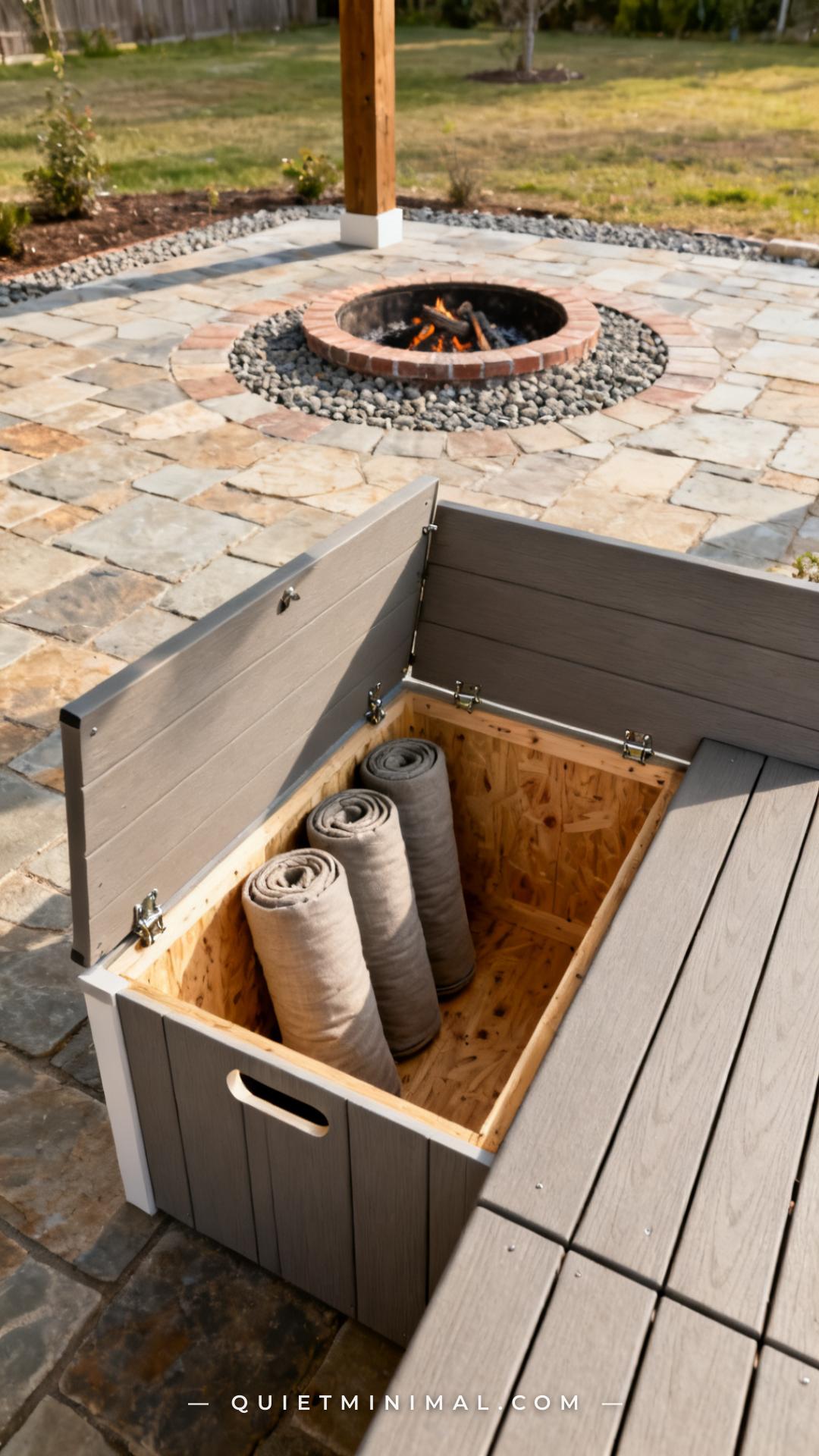 Save
One of the best design moves in a built-in bench fire pit circle is hiding the cushion storage inside the bench frames. A bench depth of 24 inches creates a cavity deep enough — when framed with a hinged seat lid — to store folded or rolled seat cushions, back cushions, and throw blankets in one accessible spot. No shed trips, no cushion stacking in a corner, no excuse not to put them away before rain.
The seat lid needs piano hinge hardware rated for exterior use (stainless steel, not zinc-coated), and the interior should be lined with pressure-treated lumber and left with a 1-inch gap at the bottom for drainage. Add a small rubber weatherstrip around the lid perimeter to reduce water ingress. This converts the bench from a pure seating structure into a functional storage unit — a detail that adds real value if you’re designing for a home you might sell.
Key Takeaway: Frame built-in benches with hinged storage lids to keep cushions dry and eliminate the shed run every time it rains.

14. Finish With Layered Greenery Around the Pergola Base
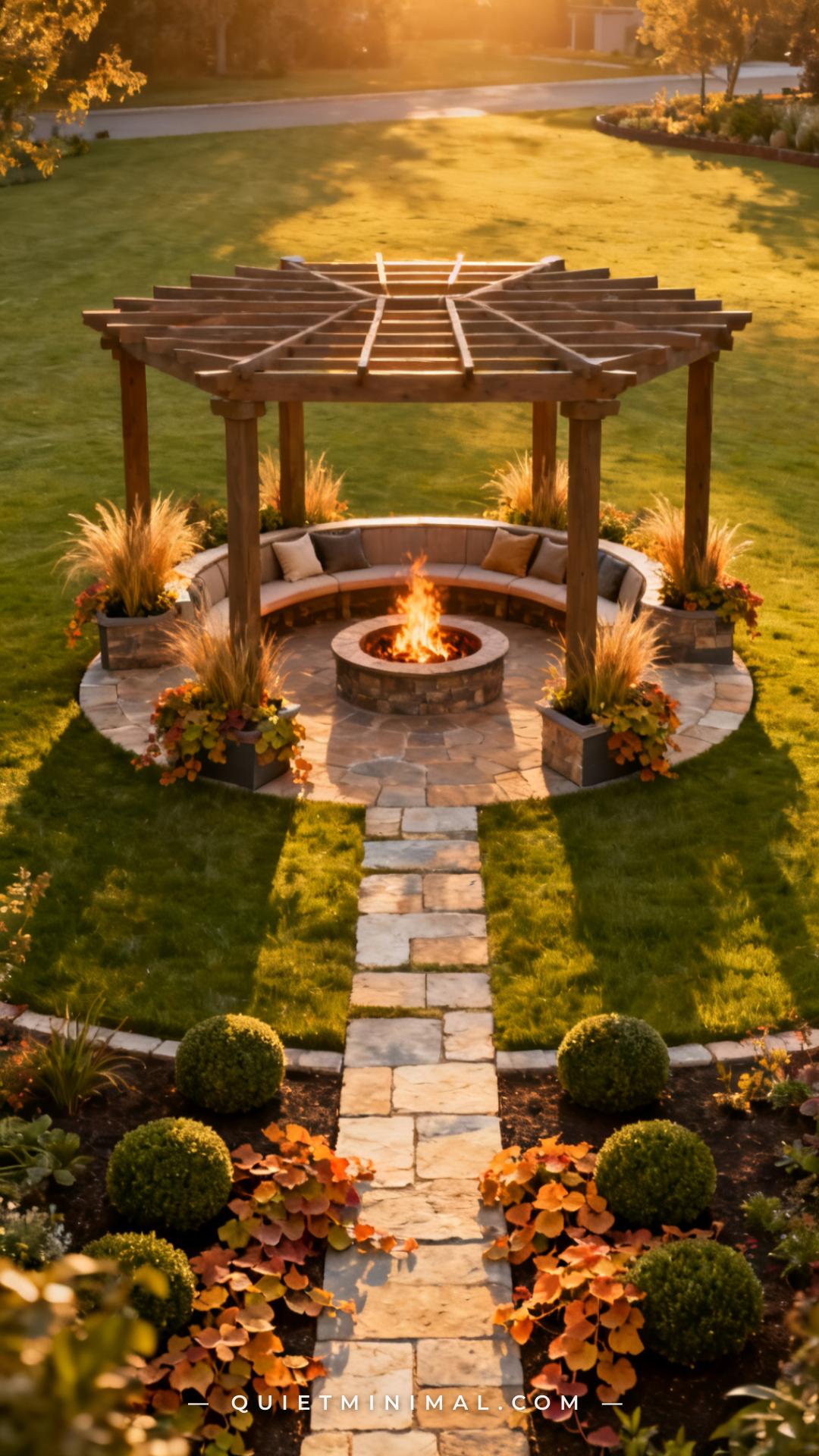 Save
The perimeter of a pergola fire pit circle is where the whole project either looks finished or looks like a construction site. Layered greenery around the four pergola post bases closes the gap between structure and landscape, making the pergola feel like it grew there rather than landed from a showroom. A simple planting formula that works: one tall grass or screening shrub per post corner (for height), two medium-scale plants beside it (for volume), and a low trailing ground cover as the edge border.
Keep the plants at a minimum of 24 inches from the pergola posts — close enough to soften the structure, far enough to avoid root pressure against the post footings over time. Drought-tolerant species are worth the slightly higher upfront cost for this placement — they’ll get irrigation runoff from the surrounding lawn but not reliable watering, and resilient plants look intentional while stressed plants look neglected.
Key Takeaway: Use a three-layer planting formula at each pergola post base — tall anchor, medium volume, low trailing edge — to make the structure look embedded in the landscape.

Build the System, Not Just the Vibe
A built-in bench fire pit circle under a pergola is one of the most used — and most often abandoned — backyard projects out there. The ones that get abandoned share the same problems: benches that weren’t sized to the fire pit clearance, pergolas that smoke out, cushions that have nowhere to live. The ones that get used every weekend share the same foundation: the sequence was right. Bench radius first, fire pit placement second, pergola sized to the circle, shade element chosen for smoke management, cushions stored where they actually get put away.
Start with the radius chalk line. Everything else follows from that.
From the guides
You've saved it, wanted it. Here's the how: codes, measurements, order. Your choices make it yours.
The Japandi Honest PlaybookThe honest version of the style: what to keep, what to skip, and the order to do it in.See inside →The Room Refresh PlaybookA repeatable four-step method, room by room, in ten minutes, thirty minutes, or one weekend.See inside →Make Any Room Feel Cozy on PurposeWhy some rooms hold people and others empty out, and the moves that change it.See inside → Save


