 Georgia
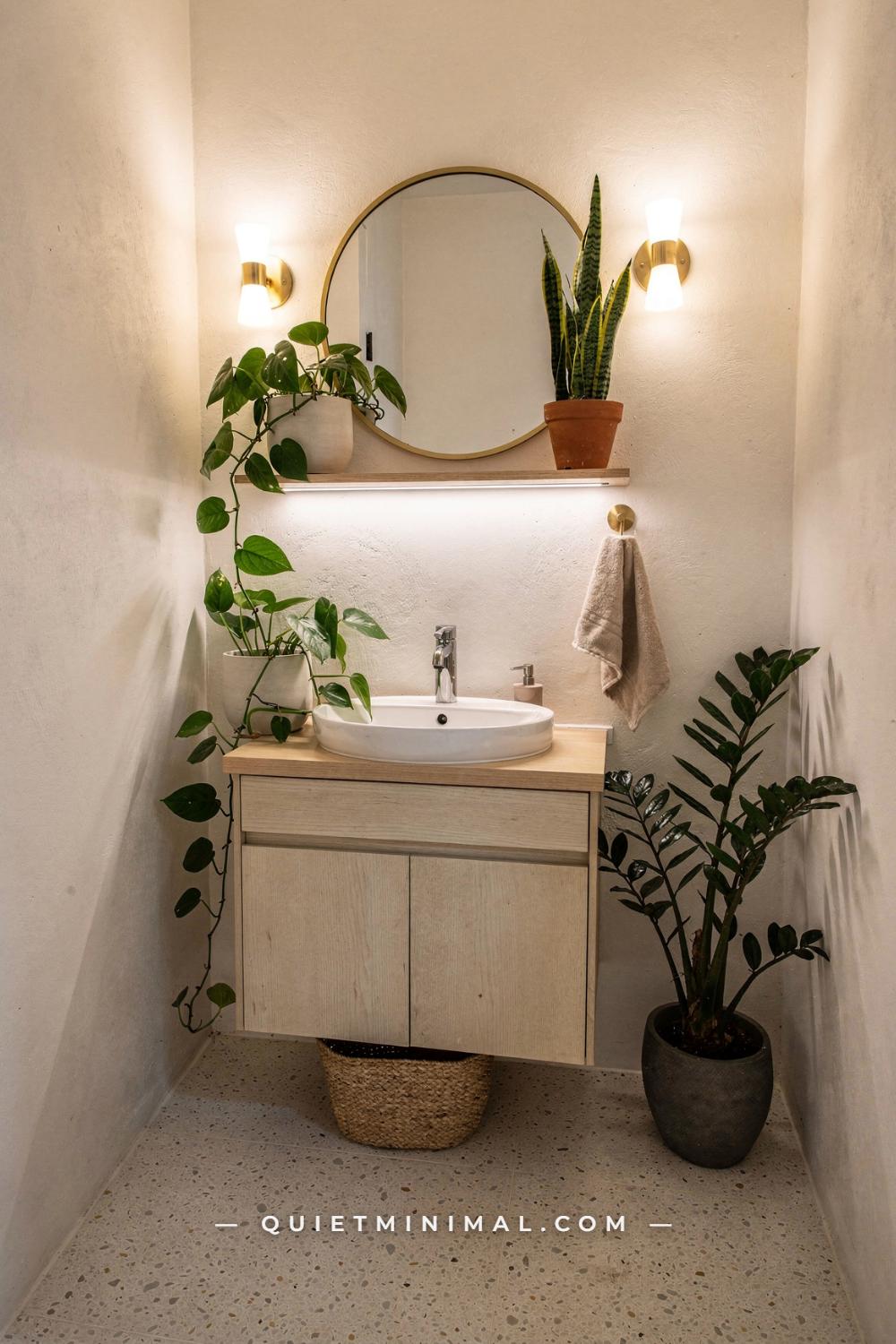
Every list of plants for a bathroom without a window promises the same thing: pick a tough plant and it will be fine. Then the pothos stretches toward the door, the new leaves come in smaller, and the soil stays wet for a month. The six plants further down this page are still the right ones; what the lists leave out is the light. A windowless bathroom runs on a light budget, and once you can read it in numbers, keeping plants in it stops being luck. This block sits above the plant guide as that missing layer: what your vanity light delivers, the grow light and where to mount it, humidity, rotation, watering, the fake-it options and a starter kit priced three ways.
What a Windowless Bathroom Actually Hands a Plant
 Save
A plant reads light the way a bank account reads deposits: how much arrives, and for how long. A bathroom with a window gets a steady deposit all day. A bathroom without one gets a short burst whenever someone flips the switch.
That burst is real light. A frosted ceiling fixture over cream tile, like this one, puts somewhere around 20 to 50 foot-candles on the vanity, the range lighting engineers design bathrooms for. Light falls away quickly with distance, so a 24 in (61 cm) tiered rail beside the mirror gets less, and an 8 in (20 cm) charcoal pot on the floor by the toilet less still.
Then there is time. Most bathroom lights are on for an hour or two a day. So the mint planters on the rail and the ZZ by the toilet are living on brief, dim deposits, which is why the tough plants survive here for a season and then quietly decline. One more expectation to drop: a few pots do nothing measurable for the air. Researchers at Drexel calculated it would take 100 to 1,000 plants per square meter, about 9 to 93 per square foot, to match a home’s ordinary ventilation.
Key Takeaway: Treat a windowless bathroom as a light budget, intensity times hours, and expect every spot away from the vanity to run on less than the vanity gets.
From the guides
You've saved it, wanted it. Here's the how: codes, measurements, order. Your choices make it yours.
 The Japandi Honest PlaybookThe honest version of the style: what to keep, what to skip, and the order to do it in.See inside →
 The Room Refresh PlaybookA repeatable four-step method, room by room, in ten minutes, thirty minutes, or one weekend.See inside →
 Make Any Room Feel Cozy on PurposeWhy some rooms hold people and others empty out, and the moves that change it.See inside →

The Light Budget in Foot-Candles, Lux and Hours
 Save
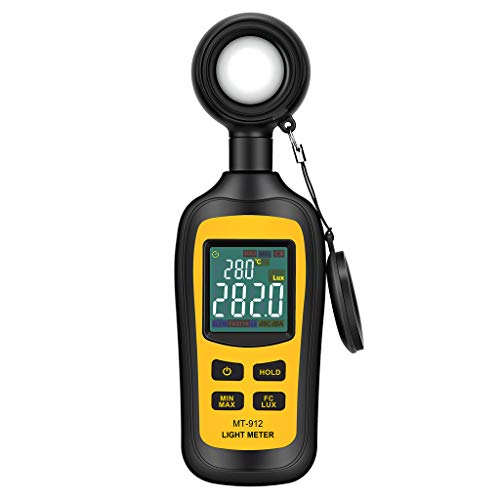
Two numbers decide whether a plant lives in your bathroom: foot-candles and hours. One foot-candle equals 10.764 lux, so a phone app reading in lux converts easily.
What a low-light plant needs. Extension guides put low light at about 75 fc (807 lux) and medium light at 150 fc (1,615 lux). Under roughly 50 fc (538 lux), a plant slowly spends its reserves.
What the bathroom gives. General bathroom light runs 20 to 50 fc (215 to 538 lux), with the vanity at the top of that range. A shelf or tank several feet from the fixture often reads 5 to 15 fc. Measure yours.
The multiplication. Intensity times hours is a rough stand-in for what growers call daily light integral. A vanity at 30 fc for 1.5 hours is 45 fc-hours a day. A low-light plant at its 75 fc floor for 12 hours gets 900. That is a twenty-fold gap.
How to measure. Lay the phone flat at leaf height, screen up, light on. Take three readings and use the middle one. Phone sensors are rough, so compare spots against each other rather than trusting the decimal.
Key Takeaway: A low-light plant wants about 900 fc-hours a day and a bathroom light delivers around 45, so either the hours or the intensity has to come from somewhere else.
Living on the Vanity Bulb: Who Holds On and for How Long
 Save
A dark powder room with a single warm downlight is the hardest test there is, and two plants pass it better than the rest: the ZZ and the snake plant. Neither is thriving; both are coasting. The ZZ stores water and food in thick underground rhizomes, and the snake plant keeps its reserves in stiff, fleshy blades, so both can run down their savings slowly for months while showing very little change.
That is the honest promise of the bulb alone: a slow decline that takes most of a year to show. A light switched on for guests three times a week will not stretch it.
The monstera reaching across the anthracite tile is the opposite case. Built for bright filtered light, it stalls here and pushes out new leaves without splits. Keep it only under a grow light. In dark matte pots 8 to 10 in (20 to 25 cm) across on a 48 in (122 cm) walnut console, the ZZ and snake plant look deliberate, and they are the two that will still be there in spring.
Key Takeaway: On bulb light alone, choose the ZZ or the snake plant and expect them to coast slowly on stored reserves, not to grow.

Bulb Alone or Grow Light: The Sorting Table
 Save
Sort every plant you own or want into one of three columns before it goes into a windowless bathroom.
Column one, bulb alone: ZZ plant and snake plant. They coast for months on stored reserves. Water rarely, accept no new growth, and rotate them to a window if you can.
Column two, a grow light at about 75 fc (807 lux) for 12 hours: pothos, heartleaf philodendron, cast iron plant, Chinese evergreen and parlor palm. University extension lists rate all of them for low light, but low light in a living room still means daylight for twelve hours. Under a grow light they grow normally. Without one they stretch.
Column three, a grow light near 150 fc (1,615 lux) plus humidity: Boston fern, monstera, and peace lily if you want flowers. These want medium light. Put the light closer, 12 in (30 cm) above the leaves, and give them the shower corner.
The count: 2 plants manage without help, 5 need a light, and 3 need a stronger light and steam.
Key Takeaway: Only the ZZ and snake plant work on the bulb alone; every other common bathroom plant needs a grow light at 75 fc, and ferns and monstera want closer to 150.

A Grow Light Above the Mirror That Reads as Part of the Room
 Save
The mirror wall is the best address in a windowless bathroom: the outlet and your attention are already there. A 36 in (91 cm) oak shelf on a black iron rail above a 24 x 30 in (61 x 76 cm) mirror gives you a run long enough for one grow-light strip, mounted flat to the shelf’s underside so nobody sees the fixture.
The trick is to light the shelf from above it, not below. Put the strip under a second, shallow shelf or under the ceiling’s edge, and let the pothos and philodendron trail down past the mirror’s sides. The vines then frame the mirror in soft green, and the strip reads as a cabinet light rather than gear. Choose white housing to match the tile.
Two practical notes. Bathroom outlets are on ground-fault protection, which is what you want under a plug-in light, and a vanity mirror usually sits well outside the tub zone covered later in this guide. Keep the pothos tips trimmed above the faucet so they stay dry and out of the splash.
Key Takeaway: Mount a white grow-light strip above the plant shelf over the mirror, run its cord along the rail, and let the vines frame the glass.
The Grow-Light Spec Card for a Bath With No Daylight
 Save
Five lines cover almost every grow light a bathroom will need.
Spectrum: full-spectrum white LED. It looks like ordinary light to you and covers the blue and red a plant uses. Pink and purple lights work too, but nobody wants a bathroom glowing magenta.
Color temperature: 5000 to 6500K, the cool daylight end. Warmer bulbs work, but cool white matches what most plant lights are tested at.
Hours: 12 to 14 a day, on a timer. Illinois Extension puts the ceiling at 16, because plants need a dark rest.
Distance: 12 to 24 in (30 to 61 cm) above the leaves. Ferns and monstera go to the 12 in (30 cm) end; ZZ and snake plant are fine at 24 in (61 cm).
Wattage by shelf length: linkable T5 strips run about 5 W per foot. A single plant takes one 9 W grow bulb in a clip lamp. A 24 to 30 in (61 to 76 cm) shelf takes one 2 ft strip at 10 W. A 36 to 48 in (91 to 122 cm) shelf takes one 4 ft strip at 20 W, or two 2 ft strips linked.
Key Takeaway: Full-spectrum white LED at 5000 to 6500K, 12 to 14 hours on a timer, 12 to 24 in (30 to 61 cm) above the leaves, about 5 W per foot of shelf.

Shelves Over the Toilet, a Strip of Light Under Each
 Save
The wall above the toilet is the biggest unused surface in most windowless bathrooms, and a stack of shelves turns it into a small greenhouse, provided each shelf lights the one below. Three honey oak shelves about 30 in (76 cm) wide, each with a 2 ft 10 W strip under its front edge, give three lit tiers from one outlet if the strips link end to end. The bottom strip lights the plants on the tank lid, the middle strip lights the bottom shelf, and the top strip lights the middle. The top shelf has no strip above it, so it holds the plant that copes best: the snake plant, upright and slow.
Put the fussiest plant in the brightest slot. The bird’s nest fern goes on the bottom shelf, where it gets the strip above at close range plus the warm, damp air of the room. The pothos and Chinese evergreen take the middle. Wicker cachepots around plain nursery pots let you lift a plant out to water it in the sink, which keeps drips off the shelf below. The hanging corner basket gets the least light of all and suits a faux vine.
Key Takeaway: Fix a strip under each shelf so every tier lights the one below, give the top shelf to the snake plant and the bottom to the fern.

Placement by Zone, With the Inches Each One Allows
 Save
Tank lid: most are 17 to 20 in (43 to 51 cm) wide and 7 to 9 in (18 to 23 cm) deep. A 6 in (15 cm) pot fits on any of them; an 8 in (20 cm) pot only on a 9 in (23 cm) lid. Leave the lid liftable.
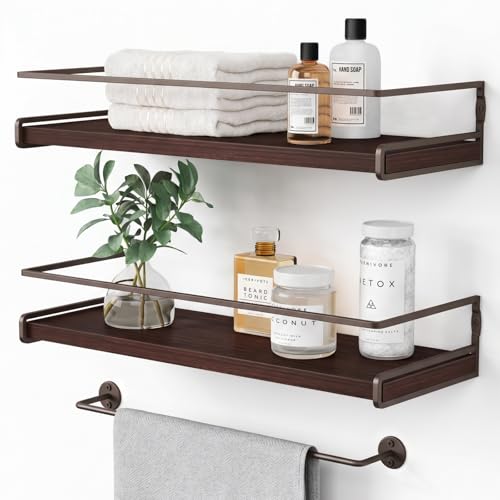
Shelves above the toilet: lowest shelf 10 to 12 in (25 to 30 cm) above the tank, the rest 12 to 16 in (30 to 41 cm) apart, 6 to 8 in (15 to 20 cm) deep. Space lit shelves 16 in (41 cm) apart, so a 4 in (10 cm) trailing pot sits about 10 in (25 cm) below its strip.
Vanity corner: an 18 to 21 in (46 to 53 cm) deep counter takes a pot up to 6 in (15 cm) in the back corner, clear of the faucet.
Over the tub: hang the pot with its base at 6 ft 8 in (203 cm), door height. Under an 8 ft (244 cm) ceiling that leaves 16 in (41 cm) for hook, hanger and pot.
The rule for lights: the electrical code bars cord-connected, chain-hung and pendant fixtures from a zone 3 ft (91 cm) out and 8 ft (2.4 m) up from the tub rim. A plant may hang there; a grow light, clip lamp or plug-in strip may not.
Key Takeaway: Pots up to 6 in (15 cm) on the tank and vanity, shelves 10 to 12 in (25 to 30 cm) above the tank, hanging pots at 6 ft 8 in (203 cm), and no grow light within 3 ft (91 cm) of the tub.

The Shower Corner Where Steam Does Half the Work
 Save
The corner beside the shower is the one spot where a windowless bathroom beats the living room. Light is still short, but every shower sends the humidity up, and the plants nearest the glass get the most of it.
That makes this the corner for the plants that pine in dry heated rooms. Maidenhair ferns crisp at the edges in a dry living room and stay soft beside a shower. Calatheas, whose leaves curl and brown in dry air, uncurl here. A monstera in a 10 in (25 cm) matte black pot gets the humidity it wants, though it still needs a grow light.
Group them. Plants on an 18 in (46 cm) hairpin stool and the floor beside it share their own moisture, which keeps the corner damp between showers. Keep the glazed pots off the shower ledge itself, where hot spray and soap reach them, and leave about 12 in (30 cm) between the leaves and the glass so the glass panel can dry. If only the ceiling light reaches it, add a clip-on light for the ferns.
Key Takeaway: Give the shower corner to ferns, calatheas and monstera, grouped together and kept 12 in (30 cm) off the glass, and still give them a grow light.

The Humidity Curve After a Shower, and Who Wants It
 Save
A shower bath does not hold steady humidity. It swings, and the swing is what your plants experience.
The spike. In one measured bathroom, a 6-minute shower took relative humidity from 44% to over 75%.
The fall. It dropped sharply in the first hour and was back near the starting level after about 3 hours.
The baseline. A New Zealand survey found a median bathroom humidity of 67%, while a heated living room in winter can sit at 10 to 20%. A bathroom used twice a day spends roughly 6 of 24 hours well above the rest of the house.
Who wants it:
- Ferns, calatheas, maidenhair: the more swings the better. Put them nearest the shower.
- Pothos, philodendron, monstera: happy anywhere in the room.
- ZZ, snake plant: indifferent, as long as the soil drains.
- Preserved moss: keep it between 35 and 65%, never above 70%. That means across the room from the shower, or a powder room with no shower at all.
Run the fan for 20 minutes after a shower. The plants still get their spike, and the walls dry.
Key Takeaway: A shower lifts a bathroom from the 40s to over 75% for about 3 hours, so ferns go nearest the steam and preserved moss goes farthest away.

Borrowing a Window: Plants That Commute
 Save
If you would rather not wire a grow light, borrow a window instead. The plants in your bathroom do not have to live there full time. They can commute, spending part of each month in the light elsewhere in the house and part in the bathroom.
Trailing plants commute best. A 48 in (122 cm) plank on yellow chain holding pothos, philodendron and satin pothos is really a display rack: lift two pots down, carry them to a bright room, and swap two rested ones up. The small 3 to 4 in (8 to 10 cm) terracotta pots on the bench below are light enough to carry in one trip.
Choose the window carefully. The aim is medium light, about 150 fc (1,615 lux), which Illinois Extension places directly in front of a north window or a few feet back from an east or west one. A plant that has lived in near darkness and goes straight into hot south sun scorches. Keep the long vines looped up on the plank, not trailing on the bench, so they are easy to lift and do not snap in transit.
Key Takeaway: Rotate trailing plants between the bathroom and a north, east or west window rather than a south one, and pick pots light enough to carry.

The Rotation Calendar: Two Weeks In, Two Weeks Out
 Save
The calendar is simple: two weeks in, two weeks out.
The cycle. Weeks one and two in the bathroom, weeks three and four at a north, east or west window. Each four-week cycle repeats 13 times a year, which gives a plant 26 weeks of window light, half its year.
Two teams. Split your bathroom plants into Team A and Team B. On the first and fifteenth of each month, they swap. The bathroom is never empty, and nobody has to remember which plant went where.
Plants that commute well: pothos, heartleaf philodendron, ZZ, snake plant, cast iron plant, Chinese evergreen. They take the change in stride.
Plants that dislike moving: Boston fern, maidenhair fern, calathea, fiddle-leaf fig. Each move costs them leaves. Give them a grow light and leave them put.
Adjusting the dose. If a commuter still stretches, make it three weeks out and one in. If its leaves pale at the window, move it a few feet back.
Key Takeaway: Swap two teams on the first and fifteenth, giving each plant 26 weeks of window light a year, and leave ferns and calatheas out of the rotation.

Five Signs a Windowless Plant Is Starving for Light
 Save
Light hunger gets mistaken for other problems and treated with fertilizer or water, which makes it worse. These five signs point to light.
From the guides
You've saved it, wanted it. Here's the how: codes, measurements, order. Your choices make it yours.
The Japandi Honest PlaybookThe honest version of the style: what to keep, what to skip, and the order to do it in.See inside →The Room Refresh PlaybookA repeatable four-step method, room by room, in ten minutes, thirty minutes, or one weekend.See inside →Make Any Room Feel Cozy on PurposeWhy some rooms hold people and others empty out, and the moves that change it.See inside →New leaves come in smaller than the last ones. The plant is building with less.
Stems stretch. The gaps between leaves get longer, and the plant looks leggy and sparse.
Variegation fades. A golden pothos turns plain green, because the pale parts of the leaf cannot make food and the plant stops making them.
The plant leans toward the door, the mirror or the light fixture.
The soil stays wet for two weeks or more and the lower leaves yellow. With little light the plant drinks little, and the roots sit in water.
Two signs together mean act now. Ease the plant out of its nursery pot on the vanity, as with this ZZ. White, firm roots mean you caught it in time; give it a grow light or put it on the rotation. Brown, soft roots mean trim them, repot into fresh mix in a 4 in (10 cm) pot with a drainage hole, and set it in a white ceramic cylinder.
Key Takeaway: Smaller leaves, stretched stems, fading variegation, leaning and soil that stays wet all mean too little light, so add light before you add water or fertilizer.

Watering Without Sun: The Half-Rate Chart
 Save
A plant in low light uses less water, so the grower’s tag overstates what it needs. Start at half the label rate and let the soil confirm.
Pothos: label about weekly, windowless about every 2 weeks.
Heartleaf philodendron: label about weekly, windowless about every 2 weeks.
ZZ plant: label every 2 to 3 weeks, windowless every 4 to 6 weeks.
Snake plant: label every 2 to 3 weeks, windowless every 4 to 6 weeks.
Cast iron plant: label every 7 to 10 days, windowless every 2 to 3 weeks.
Boston fern, the exception: never halve it. Ferns want evenly damp soil, so check every 4 to 5 days and water when the surface just dries.
The test before every watering: push a finger into the top 2 in (5 cm). Dry means water; damp means wait.
Under a grow light on for 12 to 14 hours, plants drink closer to their label, so move back toward it. A plant that commutes drinks more in its window weeks.
Key Takeaway: Water at about half the label rate in a windowless bathroom, test the top 2 in (5 cm) first, and treat ferns as the exception.

Preserved Moss, Quality Faux or Cut Stems, Honestly Compared
 Save
Some corners get no light worth growing in, and something not alive looks better there than a plant in slow decline. Three options, each with a catch.
Preserved moss needs no water and no light, which makes it the only true no-light green. Its catch is steam: it wants humidity between 35 and 65% and suffers above 70%, so it belongs across the room from the shower or in a powder room. Small pieces run about $15 to $18 for 8 x 8 in (20 x 20 cm) at current prices, and it keeps its color for several years out of strong sun.
Quality faux is a matter of spending enough. A realistic 48 in (122 cm) trailing pothos costs around $54, while vines under $10 read as plastic from the doorway. Dust it monthly; dust is what gives faux away.
Cut stems are the freshest look and the shortest-lived. Eucalyptus in a 12 in (30 cm) ribbed vase lasts a couple of weeks in water and dries in place after that.
Mix them with live plants, not instead of them: one moss piece, one eucalyptus vase, one living trailing plant under a light.
Key Takeaway: Use preserved moss away from the shower, spend enough on faux that it reads real, and treat cut eucalyptus as a two-week refresh.

The Starter Kit Cost Ladder: $40, $100, $250
 Save
Every kit is a plant, a light and a timer. Three price points, at current prices.
About $40, one plant on the vanity: a 4 in (10 cm) pothos runs about $13 to $25, and a clip-on gooseneck grow light with a built-in 12-hour timer about $10 to $26. Clip it to the shelf edge 12 in (30 cm) above the leaves.
About $100, a shelf: a 6 in (15 cm) ZZ in a decor pot runs about $37 to $44, a pack of 2 ft 10 W T5 strips about $52 (one lights this shelf; save the spares for the toilet tiers), and a mechanical plug-in timer about $6 to $8. Set the timer for 12 to 14 hours.
About $250, a fixture: two 4 in (10 cm) plants at about $13 to $25 each, a mechanical timer, and a design pendant grow light around $200 that reads as a lamp, hung over the vanity outside the 3 ft (91 cm) tub zone, on a timer.
Order: buy the light before the second plant. One plant under a light outlives three on the bulb alone.
Key Takeaway: Start at about $40 with one pothos and a timed clip light, step to about $100 for a lit shelf, and save about $250 for a pendant that doubles as a lamp.

The original ideas from this article continue below.
- Ensure to keep plants that like humidity and have low light requirements in bathrooms with no windows; examples include snake plants, ZZ plants, Boston Ferns, Pothos, Lucky bamboo, and philodendrons.
- You can rotate your plants between the bathroom and an area that receives light or use grow lights.
 Save
Windowless bathrooms can often seem rather dull, dark, and unappealing. One of the easiest ways to liven up a bathroom with no windows is to get some houseplants in there.
Most plants cannot survive and grow optimally without a decent light source, but some will flourish with extra care. Which plants can you keep in a bathroom without windows, and how do you keep them happy?
Before choosing plants to keep in your windowless bathroom, you should research which ones prefer this environment. A few plants thrive in low light conditions with high humidity levels, and it is these that you should keep in bathrooms without windows.
Although, even low-light-loving plants might need a bit of extra light attention every once in a while.
What Plants Will Thrive In A Bathroom Without Windows?
 Save
Bathrooms without a natural light source often appear dark, damp, and dreary, so getting something in them to brighten them up is always a good idea.
Luckily for those with windowless bathrooms, several lovely plants will thrive in humid low light conditions. Plants also provide extra oxygen, purify the air, absorb excess moisture, and eliminate bacteria and are great additions to any room.
The following plants will thrive in windowless bathrooms with their preference for low light conditions and high humidity levels:
Snake Plants (Dracaena trifasciata)
 Save
Prefer partial shade to full shade, soil pH 5.5 – 7, and are excellent air filters.
ZZ Plants (Zamioculcas zamiifolia)
 Save
Prefer partial to low indirect sunlight, soil pH 6 – 7, and prefer to dry out between waterings.
Boston Ferns (Nephrolepis exaltata)
 Save
Prefer indirect light, soil pH 5 – 5.5, and love shady conditions and high humidity levels.
Pothos (Epipremnum aureum)
 Save
Prefer indirect sunlight, soil pH 6.1 – 6.5, and love humidity.
Lucky Bamboo (Dracaena sanderiana)
 Save
Prefer partial shade, low light, and soil pH 6 – 6.5. This plant will happily grow without soil as long as you top up its water regularly, making it an ideal bathroom feature.
Philodendrons (Philodendron spp.)
 Save
Depending on the variant, they prefer partial to low light conditions, soil pH 5 – 6, and love to hang from the ceiling or a shelf.
Tips For Keeping Plants In A Bathroom Without A Window
 Save
Even plants that thrive in low light conditions can get somewhat leggy if left without a decent light source for too long. To combat this problem, you could employ one or more of the following tips and ensure that you keep your plants happy and growing optimally.
Grow Lights
Use a grow light in your bathroom to provide your plants with the right amount of artificial light to ensure that they can photosynthesize properly and develop optimally.
Rotate Your Bathroom Plants
If your bathroom has no windows and little to no natural light, you should consider rotating the plants you keep there approximately every three weeks.
You can do this by taking the plants in your bathroom and swapping them out with plants that have been receiving good indirect sunlight from another area in your home.
By continuously rotating your plants, you will ensure they get enough light to grow optimally and not become stunted.
Conclusion
Plants are the perfect way to get life and beauty into a windowless bathroom. Before selecting your bathroom plants, always make sure that they will be able to survive in low light and high humidity conditions. Several lovely plants will suit these requirements.
One thing to remember is even though some plants will happily survive in low light conditions, to give them a boost, you should place them in an area where they can get some extra light every few weeks.
Follow Quiet Minimal on Pinterest for more home inspiration and ideas.
This post contains affiliate links. If you make a purchase, Quiet Minimal may receive a small commission at no additional cost to you.
From the guides
You've saved it, wanted it. Here's the how: codes, measurements, order. Your choices make it yours.
The Japandi Honest PlaybookThe honest version of the style: what to keep, what to skip, and the order to do it in.See inside →The Room Refresh PlaybookA repeatable four-step method, room by room, in ten minutes, thirty minutes, or one weekend.See inside →Make Any Room Feel Cozy on PurposeWhy some rooms hold people and others empty out, and the moves that change it.See inside → Save


