 Georgia
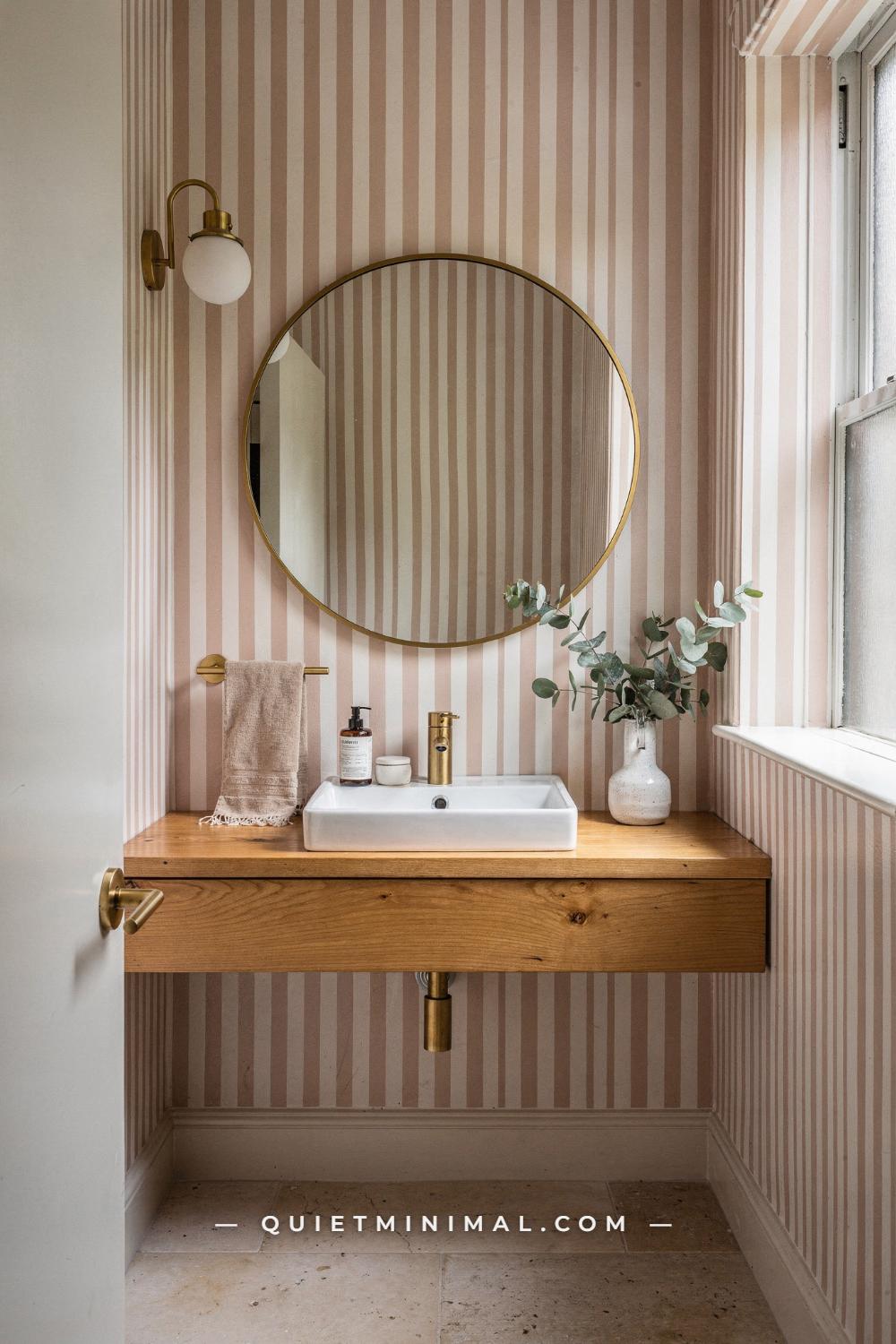
The question is a practical one and it deserves a practical answer: can you put removable wallpaper in a bathroom, and will it still be on the wall in two years? If you rent, or you own a bathroom you cannot afford to gut, you have probably saved a dozen papered powder rooms and then hesitated at the checkout, because the same roll that looks perfect on a pin has a reputation for lifting at the seams the first winter the shower runs hot. The honest answer is yes, removable wallpaper works in a bathroom, but only when three things line up: the paper is a vinyl-faced product rather than plain paper, the wall under it is smooth and clean, and the steam actually leaves the room. Get those right and the ideas below, from a two-zone wall over ribbed tile to a near-black powder room, are yours to copy without a contractor. Get them wrong and no pattern will save the install. This article earns a definite answer by taking the question one facet at a time, with the measurements, the stopping points and the failure modes spelled out. By the end you will know which walls to paper, which to leave alone, and how to choose a pattern that makes a small wet room feel settled rather than busy.
The Short Answer: Yes, If You Split the Wall
 Save
The single most reliable removable wallpaper idea for a bathroom is the one that keeps the paper away from the water entirely: a hard, wipeable material on the lower third of the wall and the pattern above it. The photograph makes the case at full scale. White vertical ribbed ceramic tile runs up to roughly 36 in (91 cm), which is the height where splashes from a vessel sink, a hand towel and a wet toothbrush actually land, and the golden yellow paper with its oversized white cut-paper shapes starts above that line and owns the top two thirds of the room. Nothing wet ever touches the adhesive. That is the whole trick, and it is the reason a two-zone wall survives where a floor-to-ceiling wrap in the same bathroom would lift at the baseboard within a year.
The split also solves a design problem you may not have named yet. A bold pattern on all four walls of a small room has no place to rest the eye, and a bathroom is already crowded with fixed white objects, sink, toilet, tub, that fight it. Giving the pattern a horizontal edge to sit on turns those objects into part of a band rather than interruptions. Here the pill-shaped mirror, about 20 by 40 in (51 by 102 cm) in a thin matte black frame, is centred exactly on the split, so its lower edge reads with the tile and its top reads with the paper. The brass wall-mounted faucet, an 8 in (20 cm) cross-handle spread, comes out of the tile rather than the paper, which matters because faucet penetrations are the first place a paper edge will curl.
If your bathroom has no wainscoting, you have two routes. The cheaper one is a run of peel-and-stick fluted or ribbed tile panels sold in sheets, capped with a slim painted wood chair rail so the transition looks intentional. The more durable one is real ceramic ribbed tile set by a tiler, which is a half-day job in a powder room and worth it if you own the place. Either way, aim for the cap between 34 and 40 in (86 and 102 cm) from the floor: lower and the tile reads like a skirting board, higher and the pattern shrinks to a frieze. Where it fails is a split at exactly counter height, because then the vanity top, the tile cap and the mirror bottom stack into three lines within a few inches of each other, and the wall looks striped by accident. Push the cap 4 to 6 in (10 to 15 cm) above the counter and the lines separate.
Key Takeaway: Put a wipeable surface on the lower third of the wall and the removable wallpaper above it, with the split between 34 and 40 in (86 and 102 cm) so the paper never meets water.
From the guides
You've saved it, wanted it. Here's the how: codes, measurements, order. Your choices make it yours.
 The Japandi Honest PlaybookThe honest version of the style: what to keep, what to skip, and the order to do it in.See inside →
 The Room Refresh PlaybookA repeatable four-step method, room by room, in ten minutes, thirty minutes, or one weekend.See inside →
 Make Any Room Feel Cozy on PurposeWhy some rooms hold people and others empty out, and the moves that change it.See inside →

What Removable Means Once the Shower Is Running
 Save
Removable is a promise about how the paper comes off, not about how it stands up to steam, and confusing the two is the single most common reason a bathroom install fails. Peel-and-stick products fall into two families. The first has a genuine paper or thin woven face on a pressure-sensitive adhesive; it is lovely to look at, takes a soft matte print like the lavender and sage watercolor dabs here, and it will absorb moisture at the edges and swell. The second has a vinyl or polyester face: it wipes clean, sheds water and, according to the retailers and trade blogs selling it, lasts three to five years in a ventilated bathroom and up to seven with care. For any wall in the same room as a shower, you want the second family, and the listing will say vinyl, polyester or moisture-resistant in plain words. If it says none of those, assume it belongs in a bedroom.
Placement then decides the rest. The wall in the photograph sits beside the subway-tiled alcove, not inside it, and that gap is not negotiable. Hot water and direct spray will soften any pressure-sensitive adhesive, and the tile is doing the work of a waterproof surround so the paper does not have to. Keep the first papered panel at least 6 in (15 cm) back from the edge of the shower opening, and if the room has a curtain rather than a glass door, make it 12 in (30 cm), because a wet curtain swings. The brass ceiling-mounted rain head, about 8 in (20 cm) across, throws a wide soft spray that lands well inside the alcove on a proper install, but a handheld on a slide bar can be pointed anywhere, which is exactly why the paper stays out of reach of it.
The renovation-mode moment in this scene is worth copying for another reason: the drop sheet. A bathroom floor is where cut offcuts, a dusty razor blade and a damp sponge all end up, and a vinyl face does not forgive grit trapped under it. Sweep, wipe the floor, then lay the sheet before you unroll anything. Where this fails is the person who papers the wall above a tub-shower combo because the tile only goes to 72 in (183 cm) and the drywall above it is bare. That strip gets the hottest, wettest air in the house. Paint it in a moisture-resistant bathroom paint instead, in the cream from the wallpaper’s ground, and let the pattern start on the wall that faces the shower.
Key Takeaway: Choose a vinyl or polyester-faced product and keep it at least 6 in (15 cm) outside any tiled wet zone, because removable describes how it comes off, not how it takes steam.

Where the Paper Stops and the Hard Surface Begins
 Save
Every removable wallpaper bathroom that lasts has a line on the wall where the paper stops and something harder takes over, and the smartest installs make that line look like a design decision rather than a limit. Here the terrazzo does it. White stone-chip terrazzo with navy, rust, black and beige fragments runs across the floor and turns up the wall, so the wet zone around the matte black oval vessel sink, about 18 by 13 in (46 by 33 cm), is entirely stone. The sage green paper above it is a linen-textured vinyl with a fine woven grain, which is the right choice for a wall this close to a basin: a texture hides the tiny ripple that can form where a smooth vinyl meets a slightly uneven wall, and a mid-tone green shows water spots far less than a pale cream.
The proportions are what to copy. Terrazzo up the wall to around 42 in (107 cm), just above the counter, and paper from there to the ceiling. That puts the transition behind the sink rather than at counter level, so the stone catches every drip from the wall-mounted soap and the brass mirror sits fully on the paper with a clean margin around it. A round mirror of about 24 in (61 cm) in a thin brass frame needs 3 to 4 in (8 to 10 cm) of paper visible on each side to read as framed by the wall rather than crammed onto it. The globe sconce, a 4 in (10 cm) opal ball on a brass stem, is mounted through the paper, and that is fine in a dry position, provided the cutout is made with a fresh blade and the backplate covers it completely.
Three tactile registers in a room this small is the maximum. Terrazzo is smooth and cool, the live-edge oak shelf below the counter, about 24 by 10 in (61 by 25 cm), is raw and warm, and the black ceramic is matte and dense. The wallpaper’s linen grain is the fourth texture, so it stays quiet in colour and does not add a pattern on top. Where this fails is the version where the paper is a glossy smooth vinyl in the same sage: gloss beside terrazzo reads as plastic, and every fingerprint and water mark shows. Where it also fails is the terrazzo stopping at the floor and the paper running down to the baseboard behind a vessel sink, because a vessel sink splashes further than an undermount and the lowest 12 in (30 cm) of paper will be wet twice a day.
Key Takeaway: Run the hard surface up the wall to just above counter height, about 42 in (107 cm), and start a textured mid-tone paper there so the transition lands behind the basin, not beside it.

What a Builder-Grade Bathroom Is Telling You
 Save
Before you choose a pattern, read the room you already have, because a builder-grade bathroom tells you exactly which walls will take removable wallpaper and which will not. The photograph is the standard American rental bath: a 60 in (152 cm) white acrylic alcove tub, a 36 in (91 cm) white three-drawer vanity, a chrome three-bulb light bar about 24 in (61 cm) wide, and flat greige walls close to Sherwin-Williams Agreeable Gray SW 7029. It is not ugly. It is undecided, and that is a better starting point than most, because everything in it is white, chrome or a neutral that will sit under almost any colour you bring in.
The first thing to check is the wall surface, and you check it with a flashlight held flat against the wall in the dark. If the beam shows a fine pebbled shadow, that is orange-peel texture, the most common finish in homes built after about 1990, and peel-and-stick adhesive cannot grip it: the voids under the film leave pockets that lift within weeks. Smooth drywall, which shows only roller stipple, is fine. The second thing is the paint sheen. Bathrooms are usually painted in satin or semi-gloss, and a vinyl film bonds well to both once the wall is washed; a flat or matte paint can chalk and let go of the film along with itself. The third is the layout: the wall opposite the tub and the wall behind the toilet are dry, the wall the vanity sits on is damp at the bottom and dry above the mirror, and the strip above the tub surround is wet.
That map decides your idea. In this room the obvious move is the long wall behind the toilet and the vanity, papered from the ceiling down to a new chair rail at 36 in (91 cm), with the lower wall left in the existing greige, which is warm enough to act as a wainscot colour on its own. The chrome stays. Swapping to brass or black hardware is a second project, and a good pattern makes chrome look considered rather than default. Where this fails is the tenant who papers the wall inside the tub alcove above the acrylic because it is the wall she sees from the door: that strip lives in steam, and the film will bubble and slide within a season. Paper the walls that face the water, never the ones that hold it.
Key Takeaway: Read the surface, the sheen and the wet map before the pattern: smooth satin walls that face the water take paper, textured or steam-side walls do not.

Why the Trim Colour Does Half the Work in a Full Wrap
 Save
A full-wrap powder room is the removable wallpaper idea everyone saves and the one most people get slightly wrong, because they spend all their attention on the roll and none on the trim. Look at what holds this room together. The paper is a cream ground scattered with loose watercolor dabs in sage, olive, soft gold, dusty teal and mauve, five colours that could easily go muddy on four walls. What stops that is the slate blue-green on the door casing and the wainscot panels: one flat, deep, matte colour drawn from the dustiest tone in the print, repeated on every hard edge in the room. The eye reads the trim as the frame and the paper as the picture, and a picture with a frame can afford to be busy.
The rule is to pull the trim colour from the second or third darkest tone in the pattern, not the darkest and not the ground. Match the darkest and the trim disappears into the print; match the ground and there is no frame at all. Take a sample of the paper to the paint store and hold chips against the print itself, then paint the door, the casing, the baseboard and the wainscot in the same colour and sheen, satin in a bathroom. Doing the door too is what makes it look designed. A wainscot at 32 to 36 in (81 to 91 cm) suits a powder room because there is no bathing and the only water is the pedestal sink, so the panels can be painted MDF rather than tile.
Lighting a full wrap needs care. Sconces should sit on the paper at about 60 to 66 in (152 to 168 cm) to centre, and a linen cylinder shade like the brass one here, roughly 12 in (30 cm) tall, throws light down the wall so the print glows rather than glares. A bare-bulb fixture on a busy print makes every colour shout. Where this fails is the room where the trim stays builder white against a five-colour paper: the white edges chop the walls into panels and the print never settles, which is exactly the look people mean when they say wallpaper feels chaotic. Where it also fails is the powder room with no window and a cool white bulb; a five-colour watercolor under 5000K light reads grey-green and tired. Use bulbs at 2700K.
Key Takeaway: In a full wrap, paint every piece of trim, including the door, in one satin colour pulled from the pattern’s second-darkest tone, because the trim is the frame that makes a busy paper read as calm.

Can a Small Powder Room Take a Large-Scale Pattern?
 Save
Yes, and the counterintuitive truth is that a small powder room takes a large pattern better than a small one. A tiny repeat, say a 2 in (5 cm) geometric, on four walls of a 4 by 5 ft (1.2 by 1.5 m) room turns into visual static, because the eye counts dozens of repeats in every glance. An oversized abstract mural like this one, with brushstroke shapes in cobalt, orange-red, teal and white sweeping across a pale mint ground, has perhaps three or four full motifs per wall. The eye reads them as a single composition, the way it would read a painting, and the room feels bigger because the walls stop being surfaces and become one image. This is why designers go bold in the smallest room in the house, not the biggest.
A mural is sold in numbered panels rather than a repeating roll, and that changes the install. Measure the wall height and width before ordering, and add 2 in (5 cm) to each edge for trimming, because a panel that is even slightly short at the ceiling cannot be stretched. Most removable murals come in panels 24 in (61 cm) wide by 96 or 108 in (244 or 274 cm) tall, so a wall 60 in (152 cm) wide needs three panels with one trimmed. Start from the wall with the mirror, because the arch-top oval here, about 24 by 48 in (61 by 122 cm) in a thin brass frame, has to sit where the composition looks intentional around it, and the corners are where any drift in the pattern gets hidden.
The white ribbed tile wainscot at about 18 in (46 cm) is lower than the two-zone rooms earlier in this article, and that is deliberate: a mural needs height to breathe, and 18 in (46 cm) is enough to protect the base of the wall from a mop and a vessel-sink splash without cutting the image in half. The aged bronze cross-handle faucet with its 8 in (20 cm) spread comes out of the tile, so nothing penetrates the mural except the mirror screws. Where this fails is the mural on one wall only, with the other three painted white: the image becomes a poster, and posters in a bathroom look temporary. If a full wrap is beyond the budget, wrap the wall with the mirror and the two side walls, and paint the door wall in the mint ground colour so the image seems to continue.
Key Takeaway: In a room under 25 sq ft (2.3 sq m), go oversized rather than tiny; a large abstract mural reads as one composition and makes the walls feel further away.

The Quiet Pattern That Makes a Guest Bath Feel Finished
 Save
Not every removable wallpaper idea for a bathroom is a statement, and the guest bath is where a quiet pattern earns its keep. A guest bathroom is seen for three minutes at a time by people who do not live with it, so it should feel finished and generous rather than loud. A fine hand-drawn reed stripe in greige on cream does that. From the doorway it reads as a warm textured wall; up close it is a pattern, and that two-distance quality is what makes a small room feel expensive. The vanity is white, close to Benjamin Moore White Dove OC-17, with aged brass bin pulls, and the 30 in (76 cm) round brass mirror is the only strong shape in the room. Everything else, the seagrass basket at about 12 by 8 in (30 by 20 cm), the cream pot, the white soap dispenser, is a soft neutral.
A fine vertical line does something structural, too. It draws the eye up, so an 8 ft (244 cm) ceiling feels taller, and it forgives a wall that is very slightly out of plumb, because the lines are irregular by design and nobody can tell which one is the wall. Match your seams on a pattern like this by overlapping the panels 1/8 in (3 mm) and aligning a line, not the edge of the sheet; on a hand-drawn stripe the repeat is loose enough that the join disappears. On a ruler-straight stripe you have no such forgiveness, which is why the irregular version is the safer buy for a first install.
The staging in this room is precise and worth copying literally: one plant, one dispenser, one basket, and nothing on the mirror wall but the mirror. A patterned wall is already the decoration. Three objects on the counter, in the same cream and brass family, are the limit, and they sit at the edges so the pattern behind the faucet stays clear. Where this fails is the guest bath styled like a shop shelf, six bottles and a tray and a candle, on top of a stripe, so the wall and the counter compete. Where it also fails is a cool grey stripe in a room with warm brass and white; greige works because it holds a little yellow, and a true grey next to aged brass looks like a mistake in the metal rather than the paper.
Key Takeaway: For a guest bath, choose a fine irregular stripe in a warm neutral that reads as texture from the door, and keep the counter to three objects so the wall stays the only pattern.

What to Do to the Wall Before the First Panel Goes Up
 Save
The install is decided the day before it starts, on a wall that looks exactly like this one: white, smooth, and empty above a painted MDF chair rail at 36 in (91 cm). Prep is the unglamorous half of the answer to whether removable wallpaper works in a bathroom, and it is where most failures are actually caused. Start with a wash. Bathroom walls carry a film of hairspray, soap aerosol and skin oil that you cannot see, and pressure-sensitive adhesive will bond to that film rather than the paint. Wipe every wall with a cloth wrung out in warm water and a few drops of dish soap, rinse with clean water, then let it dry for a full day. A bathroom that had a shower running that morning is not dry.
Next, check the paint. If the upper walls were painted within the last month, wait; fresh latex keeps curing for three to four weeks and a film applied over it can pull the paint off on removal, which defeats the entire renter-friendly point. Fill nail holes with lightweight spackle, sand flush, and spot-prime the patches, because a vinyl film telegraphs every bump behind it. Then run a hand over the whole surface with your eyes closed; anything you can feel, the paper will show. The blush-pink trim on the door here is a reminder to tape it off before you start; the razor cuts along the casing are where a fresh blade slips, and a scored trim edge in a rental is a repair you will be paying for.
Have the tools within reach before you peel the first backing: a plastic smoothing tool with a felt edge, a snap-off blade knife with a fresh segment for every cut, a 4 ft (122 cm) level for the first panel, and a clean cloth. The first panel is the only one you plumb, so take five minutes over it. Draw a light pencil line at the panel width from the corner and hang to the line, not to the corner, because corners in a bathroom are rarely square. Where this fails is the person who starts in the most visible spot, above the vanity, and works out; start in the least visible corner, behind the door, so the last panel, which is always the cut one, lands where nobody looks.
Key Takeaway: Wash, rinse and dry the walls a day ahead, wait a month on fresh paint, fill and sand every flaw, and plumb only the first panel from a pencil line rather than the corner.
How Dark Can You Go in a Windowless Powder Room?
 Save
Darker than you think, provided the pattern carries its own light. A windowless powder room is the one bathroom where the usual advice to keep small rooms pale is wrong: there is no daylight to reflect, so a pale wall just looks flat under a bulb, while a near-black green wall with blush, cream and terracotta shapes floating on it turns the room into a jewel box. The pale motifs are the trick. They are the highlights a window would have supplied, spread evenly across every wall, and at roughly 30 percent coverage of the ground they keep the room from becoming a cave. A solid near-black paper with no motif would be too much in a room this size; the pattern is what makes the dark colour work.
Warm metal is not optional here. The thin gold frame on the arched mirror, the brass sconce, the small gold vessel of white ranunculus, and the white marble counter with its grey veining are the four reflective surfaces in the room, and each one bounces the sconce’s amber light back across the paper. Use a single sconce at 2700K on the side wall rather than an overhead, because light raking across a dense pattern makes it read as depth, while a downlight flattens it. Position it at 60 in (152 cm) to centre and about 12 in (30 cm) from the mirror’s edge. A white ceiling is essential: paint it in the cream from the pattern, in flat, and the dark walls stop at a crisp line that makes the ceiling feel higher.
The install detail that matters on a dark paper is the seam. On a cream ground a hairline gap at a seam shows as nothing; on a near-black ground it shows as a white line, because the wall behind it is white. Paint a stripe of the ground colour on the wall wherever a seam will fall, about 2 in (5 cm) wide, before you hang, and butt the panels rather than overlapping them. Where this fails is the dark powder room with a cool white bulb, which turns forest green to grey and blush to beige, and the room reads dingy rather than dramatic. Where it also fails is a busy floor: a dense dark paper needs a plain floor, in stone or a solid tile, so that the walls are the only thing happening.
Key Takeaway: In a windowless powder room a near-black ground works when the pattern carries pale motifs and warm metal reflects a single 2700K sconce; pre-paint the seam lines in the ground colour so joins never flash white.

Wallpaper Above a Dado, With a Tub in the Room
 Save
A full bathroom with a freestanding tub is the hardest room in this article to paper and the most rewarding when it works, and the English dado is how it works. The lower wall, from the floor to about 36 in (91 cm), is painted timber panelling in a dark olive green, wipeable and unbothered by a wet foot or a dropped towel. Above it a small-scale block-print lattice in blush and muted colours on cream covers the walls to the ceiling, and because the tub stands free of the wall with its chrome telephone taps, no spray hits the paper at all. The navy cast-iron tub, 60 in (152 cm) long, is close to Farrow and Ball Hague Blue No. 30, a colour the brand describes as a strong blue with green undertones that sits happily in small dark rooms, and it is the anchor that lets the olive and the blush make sense together.
The dado height is the decision. At 36 in (91 cm) the panelling lines up with the tub rim, so the tub reads as sitting in a dark band rather than in front of a pattern, and the paper above starts at roughly the height of a person sitting in the bath. That is also the height a wet hand reaches when someone steps out. Go lower, to 30 in (76 cm), and the paper is in the splash; go higher, to 48 in (122 cm), and the room feels cut in half with the smaller portion on top. A dado rail in the same olive, 1.5 to 2 in (4 to 5 cm) deep, caps the panelling and gives the paper a clean bottom edge to be trimmed to.
A freestanding tub still steams the room, and this is where ventilation matters more than in any other layout here. Run the extractor for twenty minutes after every bath, and keep the paper at least 12 in (30 cm) from the ceiling above the tub if there is any history of condensation drips there, finishing that strip in the cream ground colour instead. The matte black arched mirror, about 30 in (76 cm) across, and the two 18 in (46 cm) white floating shelves with plain glass bottles are the only things fixed to the paper, and both are on the wall furthest from the tub. Where this fails is the tub pushed against a papered wall with a handheld shower on it; that is a shower enclosure without the enclosure, and the paper will lift at the tub rim within the year.
Key Takeaway: With a freestanding tub, put a wipeable painted dado at tub-rim height, about 36 in (91 cm), and keep everything fixed to the paper on the wall furthest from the water.

How Many Rolls a Bathroom Actually Needs
 Save
Most rolls of removable wallpaper sold in the United States are 20.5 in (52 cm) wide by 16.5 ft (5 m) long, which is about 28 sq ft (2.6 sq m) of coverage, and the arithmetic that follows from that decides whether the project costs $90 or $250. Measure each wall you intend to paper, width times height, and add them up. Do not subtract for the door or the mirror; you cannot use those offcuts, and a 24 in (61 cm) window is smaller than the panel that has to run past it. Then divide by 28 and round up. A powder room with two papered walls of 5 ft (152 cm) and one of 6 ft (183 cm), all 8 ft (244 cm) tall above nothing, is 128 sq ft (11.9 sq m), which is five rolls before waste.
Waste is the number people miss, and the pattern sets it. A pattern with a 24 in (61 cm) vertical repeat means every panel after the first has to be cut so its motif lines up with its neighbour, and on average you lose half a repeat per drop: roughly 12 in (30 cm) of a 96 in (244 cm) drop, or about 12 percent. A stripe or a fine texture has almost no waste. A wide check like the charcoal and cream one in this room falls between, and it is why three rolls covered two walls with a fourth standing in the corner for the third. Buy all your rolls in one order so the dye lot matches; a roll bought three weeks later from a different batch can be a shade off, and on a two-colour geometric that difference shows at every seam.
Panels are cut on the floor, not the wall. Measure the wall height, add 4 in (10 cm), cut the first drop, then lay it face up beside the roll and cut the second so the pattern lines up before either goes on the wall. Number the backs in pencil. On a peel-and-stick vinyl you peel about 12 in (30 cm) of backing, place the top edge to your line, then work down, peeling and smoothing as you go, with a felt-edged tool from the centre out. Where this fails is the person who orders exactly the calculated number of rolls: one torn panel or one mis-cut and the project stalls for a week waiting on a roll that may not match. Order one extra and return it unopened, which most retailers allow.
Key Takeaway: Total the wall area with nothing subtracted, divide by 28 sq ft (2.6 sq m) per roll, add 12 percent for a patterned repeat, and buy one extra roll from the same order so every panel matches.

Should the Ceiling Get Paper Too?
 Save
In a powder room, yes, and it is the one removable wallpaper idea that most reliably makes a small bathroom feel like a considered room rather than a papered box. A ceiling in the same pattern removes the hard white lid that normally sits on top of four patterned walls, and the room reads as a wrapped space you have stepped into. A fine terracotta and cream pinstripe does this especially well: on the ceiling the stripes run across the short dimension of the room, and where they meet the wall stripes at the cornice line they make a subtle mitre that the eye enjoys without quite noticing. In a room under 30 sq ft (2.8 sq m), the effect is of a lined jewellery box.
The conditions are stricter than for a wall. A powder room ceiling is dry, which is why this works there and not in a full bathroom, where the ceiling is the first surface condensation forms on. Check that the ceiling is smooth; many are sprayed with a fine texture even when the walls are not, and a textured ceiling will not take film. Check that it is painted in something with a little sheen, because ceiling paint is usually dead flat and the film may lift it on removal. And hang it with two people: a 60 in (152 cm) drop of vinyl over your head is unwieldy, and every wrinkle you smooth out on a ceiling you will see from below forever. Peel 12 in (30 cm) of backing, start at the wall with the window if there is one so that the seams run away from the light, and have the second person hold the tail.
The fixture is the detail to plan. A flush-mount like the polished nickel drum here, about 12 in (30 cm) across, should be removed before you paper, with the paper cut in an X over the electrical box and the fixture remounted over the cut. A pendant on a long chain in a papered powder room is also lovely, but a big statement fixture competes with the ceiling, so keep it small. Where this fails is a ceiling papered in a directional pattern that runs the wrong way, so the stripes on the ceiling fight the stripes on the walls at two of the four corners; decide the direction on paper first, and accept that two corners will always be the busy ones. Put those two behind the door.
Key Takeaway: Paper a powder room ceiling in the same fine stripe as the walls when it is smooth, sheened and dry; remove the fixture first and hang with a second pair of hands.

One Wall or All Four? The Vanity Wall Case
 Save
In a full bathroom, one wall, and it should be the vanity wall. The logic is about water first and looks second. The vanity wall is the driest tall wall in most full bathrooms: it faces the shower rather than holding it, the sinks are undermount so they splash little, and the mirrors and sconces cover a fair share of its area. Paper it, paint the other three walls in a warm off-white pulled from the paper’s lightest tone, and the bathroom gets a focal wall you see every time you walk in, while the walls that get wet stay in a scrubbable bathroom paint. The tonal teal geometric here, soft-edged rectangles overlapping in two or three teals, is a good choice for a focal wall because it has depth without a second colour, so the brass and the oak do the contrast.
A double vanity wall needs the pattern to survive two mirrors and three sconces, and that means the scale of the motif should be bigger than the gaps between fixtures. Two 24 in (61 cm) round mirrors over a 60 in (152 cm) vanity leave roughly 4 in (10 cm) between them and 4 in (10 cm) at each end. A motif of about 8 to 12 in (20 to 30 cm) reads clearly through those gaps; a 2 in (5 cm) motif turns into stripes of confetti between the mirrors. Hang the paper before the mirrors and sconces go up, cut the paper cleanly around the electrical boxes, and mount the fixtures over the cuts.
The off-white matters as much as the teal. Take the pattern’s palest tone, not builder white, or the three painted walls look unfinished beside the papered one. A single sample roll, usually around $7, is enough to hold up against paint chips in the room’s actual light. Where this fails is the accent wall behind the toilet: it is the wall nobody looks at on purpose and the one that gets the least light, so the paper reads as a leftover. Where it also fails is a focal wall that stops short of the corners, leaving a painted margin; the paper must run into both corners, trimmed along the crease, or it looks like a rug hung on the wall.
Key Takeaway: In a full bathroom, paper the vanity wall corner to corner with a motif larger than the gaps between the mirrors, and paint the other three walls in the pattern’s palest tone.

The Exhaust Fan Question Nobody Wants to Answer
 Save
Here is the part of the answer nobody wants: the roll does not decide whether removable wallpaper survives your bathroom, the fan does. Every trade source on peel-and-stick failure names moisture softening the adhesive as the second cause after textured walls, and moisture is a ventilation problem. If your bathroom has an exhaust fan, find out whether it actually moves air by holding a single square of toilet paper to the grille with the fan running; if it does not hold the square, the fan is either undersized, clogged with lint, or venting into a dead space. Small bathrooms need a fan rated at a minimum of 50 cubic feet per minute, and a full bath with a tub-shower wants 80 or more. A quiet modern fan at that rating costs less than two rolls of wallpaper and is a one-afternoon swap if the ducting already exists.
The habit matters as much as the hardware. Run the fan during every shower and for twenty minutes after, on a timer switch if you can fit one, because the adhesive is softened by the humid twenty minutes after the water stops, when the room is still warm and nobody is in it. If there is a window, as in this room, crack it on its stay for the same twenty minutes. A pale sage tone-on-tone trellis above white square tile is a good pattern for a room like this precisely because it is undemanding: a small, low-contrast geometric in a vinyl face shrugs off a damp day, while a dark saturated ground would show every water mark left by condensation running down the wall.
From the guides
You've saved it, wanted it. Here's the how: codes, measurements, order. Your choices make it yours.
The Japandi Honest PlaybookThe honest version of the style: what to keep, what to skip, and the order to do it in.See inside →The Room Refresh PlaybookA repeatable four-step method, room by room, in ten minutes, thirty minutes, or one weekend.See inside →Make Any Room Feel Cozy on PurposeWhy some rooms hold people and others empty out, and the moves that change it.See inside →The other thing to check is where the condensation forms. Stand in the bathroom after a shower with the door closed and look at the walls; the cold ones, usually the exterior wall and anything behind the toilet cistern, will fog first. Those are the walls that need the fan most and the walls where a paper edge is most likely to lift. If a wall regularly runs with water, it is not a wall for wallpaper of any kind, removable or not. Where this fails is the renter who papers a bathroom with a fan that vents into the ceiling void rather than outdoors: the humidity never leaves, the film lifts within a season, and the paper takes the blame for a building fault. Test the fan before you buy the roll.
Key Takeaway: Test the fan with a square of tissue, upgrade to at least 50 CFM for a small bath or 80 for a full one, and run it twenty minutes after every shower; ventilation, not the roll, is what keeps the paper on.

Orange-Peel Walls and What Happens on Day Ninety
 Save
Orange-peel texture is the wall finish that quietly ends most peel-and-stick bathroom projects, and it deserves a plain explanation because it is on the majority of American walls built since about 1990. It is a fine sprayed stipple that leaves the surface covered in tiny bumps and pits. Pressure-sensitive adhesive only bonds where it touches, so on a textured wall it grips the tops of the bumps and bridges the pits, leaving air under perhaps a third of the film. On day one it looks fine. By day ninety the bathroom’s daily warm-and-humid cycle has softened the adhesive enough that the bridged areas let go, and the panel starts to bubble along its edges and slide at the top. The trade advice is consistent: light texture might be helped with a spray adhesive designed for peel-and-stick, heavy texture needs a skim coat.
A skim coat is the honest fix and it is less frightening than it sounds. A thin layer of joint compound is troweled over the wall, sanded smooth, primed and painted, and the wall in this room is the result: an eggshell white so flat and even that the plaster-look wallpaper above the ledge reads as a real lime-plaster finish. Skim-coating one powder room is a weekend for a confident amateur or a day for a plasterer, and it is the only way to make a textured wall truly ready. If you rent, that is a conversation with the landlord, and many are receptive, because a smooth wall raises the value of the unit and costs them nothing.
If neither is possible, change the idea rather than force it. A textured wall will take paint, so choose a colour-led scheme, a putty lower wall and a warm white upper, with a painted ledge at 36 in (91 cm) to give the room the architecture that a two-zone paper install would have provided, and hang one abstract print on the ledge. Or use the paper only on the one surface in the room that is smooth, which in most textured houses is the door. Where this fails is the person who reads that peel-and-stick is renter-friendly and assumes that means it works on every wall a renter has: it is friendly to the lease, not to the plaster. Where it also fails is a heavy vinyl chosen on the theory that thicker film bridges texture better; it does, briefly, and then it comes down in one sheet.
Key Takeaway: Peel-and-stick cannot hold on orange-peel or knockdown texture past the first humid season; skim-coat the wall, paper only the smooth surfaces, or switch to a colour-and-ledge scheme.

Seams, Corners and the Outlet Cover: Where the Install Shows
 Save
Removable wallpaper looks professional or amateur in three places, the seams, the corners and the outlet covers, and none of them is hard once you know the rule for each. Seams first. On a vinyl face, butt the panels edge to edge rather than overlapping, because an overlap on vinyl leaves a raised ridge that catches light and never lies flat. Line up the pattern at eye level, about 60 in (152 cm), where you will look at it, and let any tiny drift happen at the floor and the ceiling where it is hidden by the baseboard and the cornice. Run a seam roller down the join with light pressure once both panels are on; press hard and you polish the print into a shiny stripe.
Corners are the place people wrap and should not. An inside corner in a bathroom is rarely straight, and a panel wrapped around it will pull away as the vinyl relaxes, leaving a hollow that traps moisture. Instead, cut the panel so that it runs about 1/4 in (6 mm) past the corner onto the next wall, then start the next panel fresh, plumbed from a new pencil line, overlapping that small margin. On a small irregular geometric like the sand and white block print here, the pattern break at the corner is invisible; on a large motif you would match it deliberately, which is why murals are ordered as a set. Outside corners, which are rare in a bathroom but happen at a bulkhead, can be wrapped, but crease the film firmly with the smoothing tool and expect to re-press it after a day.
Outlet and switch covers are simple if you do them in the right order. Turn off the breaker, remove the cover, paper straight over the box, then cut an X from corner to corner inside the box opening with a fresh blade, fold the flaps into the box and trim them, and refit the cover over the paper. The cover then sits flush with the pattern running behind it, as in this corner. Where this fails is the person who cuts the hole before hanging the panel, because the box is never quite where the measurement said and the hole ends up a quarter inch off, showing a white crescent of wall. Where it also fails is a seam placed right beside a towel ring or a hook: the daily tug of a wet towel finds the join and lifts it. Put fixings through the middle of a panel, not near an edge.
Key Takeaway: Butt seams on vinyl and match them at eye level, cut into corners rather than wrapping them, and paper over every outlet before cutting an X inside the box so the cover hides the cut.

The Six Inches Beside the Sink That Get Splashed
 Save
The zone that ends more vanity-wall installs than any shower is the 6 in (15 cm) of wall directly behind the tap. Every hand wash, every rinsed toothbrush, every splash from a dropped bar of soap lands there, and if the bottom edge of the wallpaper is sitting on the counter, that edge is wet several times a day. Water wicks along the cut edge of a vinyl film, works under the adhesive, and the panel starts to curl from the bottom up. The fix is an upstand, a single row of plain glazed tile about 4 to 6 in (10 to 15 cm) tall along the back of the counter, and the paper starts above it. The ochre and cream lattice in this bathroom starts at the tile’s top edge with a clean trimmed line, and the counter zone is glass-hard.
Seal the joint. Where the paper meets the tile, run a fine bead of clear silicone along the paper’s bottom edge, tool it smooth with a wet finger, and let it cure for a day. The trade advice for bathrooms is exactly this: seal the edges with clear caulk and address any lifted edge at once with silicone rather than waiting. The bead is nearly invisible against a glazed tile and it closes the one path water has into the adhesive. If you cannot add tile, a strip of clear acrylic 6 in (15 cm) tall fixed to the wall with mirror adhesive does the same job for a renter, and comes away with a hairdryer at the end of the lease.
Faucet choice matters too. A single-lever faucet like the matte black one here throws less water around than a pair of cross handles, because there is one thing to touch with wet hands rather than two, and a spout that reaches to the centre of the basin keeps the splash inside the bowl. If your faucet is short and the basin shallow, expect more water on the wall and set the upstand at the taller end of the range. Where this fails is the wallpaper that runs to the counter with a bead of silicone as the only protection: silicone bonds to vinyl poorly, and once the film moves the seal opens. Where it also fails is a mirror hung at counter height on the paper as a backsplash; the mirror’s bottom edge holds water against the wall and the paper behind it goes first.
Key Takeaway: Start the paper 4 to 6 in (10 to 15 cm) above the counter on a tiled or acrylic upstand and seal its bottom edge with clear silicone, because the wall behind the tap is wetter than the wall beside the shower.
Choosing a Pattern Against Tile You Cannot Change
 Save
Most rental bathrooms and many owned ones come with tile you cannot change, and the mistake is to pick a wallpaper that pretends the tile is not there. Almond, biscuit, pale pink and mint tile from the 1960s through the 1990s are still on millions of walls, and they are warm, low-contrast colours that make a cool grey or a crisp white paper look as though it was hung in the wrong house. The answer is to choose the paper to flatter the tile, and the way to do that is to find the tile’s undertone and repeat it. Almond tile like this one holds yellow and a little pink; a warm white and caramel wavy stripe picks up both, so the tile reads as the lower band of a deliberate scheme rather than a relic under a new idea.
Do the test with samples, never a screen. Order two or three sample sheets, about $7 each from the mainstream brands, tape them to the wall directly above the tile and look at them at three times of day. Almond tile shifts toward pink in evening light and toward green under some LED bulbs, and a paper that matched at noon can clash at night. Choose the sample that looks like it belongs in both lights, and it is usually the one with the least contrast to the tile rather than the most. A hand-drawn horizontal line, with its slight wobble, also softens the rigid grid of square tile, which is why it is a better choice above old tile than a sharp geometric that repeats the grid.
Then finish the room in the tile’s family. The honey oak mirror frame, the cream cultured marble top and the caramel towels here all hold the tile’s warmth, and the brushed nickel faucet and light bar are the one cool note, kept because they were already there. Painting the vanity a warm white rather than a bright one makes the same point. Where this fails is the person who fights the tile with a paper in the opposite temperature, a cool blue-grey stripe above almond, hoping the paper will win; it never does, because the tile is bigger and closer to the floor. Where it also fails is a busy multicolour print above pink or mint tile: two strong characters in a small room, and the tile is not the one that can be removed.
Key Takeaway: Match the fixed tile’s undertone, warm to warm, with a low-contrast pattern tested in the room at three times of day, and let the tile become the lower band of the scheme.

Grasscloth-Look and Linen Textures: The Tactile Route
 Save
Real grasscloth is the one wallpaper a bathroom should never have: it is woven plant fibre on a paper backing, it drinks moisture, it stains at the first splash and it cannot be wiped. The printed version is another matter entirely, and it is one of the strongest removable wallpaper ideas for a bathroom that wants texture rather than pattern. A vinyl film printed with a high-resolution horizontal fibre in straw and flax, sometimes with a faint embossed sheen, gives a powder room the warm, hotel-lobby depth of the real thing while shedding water like any other vinyl. The current design press keeps returning to tactile weaves, grasscloth and linen looks among them, precisely because they feel human in rooms full of hard surfaces.
Choosing a printed texture is mostly about the light. Grasscloth-look papers depend on a raking light to show their weave, so a single fixture that grazes the wall, the brass picture light above the mirror here, does more for the paper than an overhead ever will. Mount it 6 to 8 in (15 to 20 cm) above the mirror’s top edge and the light runs down the wall, catching every printed fibre. Under a flat overhead the same paper looks like a beige wall. The horizontal direction of the fibre also matters in a small room: it widens the wall visually the way a horizontal stripe does, so a narrow powder room feels less like a corridor.
Then let the real materials do the talking. A rattan mirror frame, a dark walnut floating vanity and a cream honed stone floor are genuine textures next to a printed one, and the trick is that the eye borrows their reality for the paper. Keep the palette within the paper’s range, straw, flax, walnut, cream, and use brass rather than chrome, because chrome reads cold against a fibre texture. Where this fails is a printed grasscloth in a bathroom with a window directly opposite, because flat frontal daylight kills the weave and the wall looks like printed cardboard; that room wants a pattern, not a texture. Where it also fails is matching the seams on a printed fibre without care: real grasscloth is expected to show its panel joins, but a printed one must not, so overlap and double-cut the seams so the fibre runs through unbroken.
Key Takeaway: Use a printed vinyl grasscloth or linen texture rather than the real fibre, light it from the side so the weave shows, and surround it with genuine wood, rattan and stone so the print borrows their depth.

Stripes and Geometrics in a Narrow Bathroom
 Save
A long narrow bathroom, the kind with the tub down one wall and the door at the end, is where the choice between stripes and geometrics stops being taste and becomes geometry. Vertical stripes on the two long walls raise the ceiling, which is what a corridor bathroom needs, but vertical stripes on all four walls make the far wall recede and the room feel even longer. The fix in this room is to switch pattern on the short end wall: a small navy and white chevron in the same two colours pulls the end wall forward, and the corridor reads as a room with a destination rather than a tunnel. The colours stay identical so the switch reads as one scheme; only the geometry changes.
Stripe width is the measurement that decides the mood. A stripe about 1.5 in (4 cm) wide, two fingers, reads as crisp and classic from a distance and does not vibrate up close; a stripe under 1/2 in (13 mm) shimmers in a small room and a stripe over 4 in (10 cm) makes the walls look like a big-top tent. Because a ruler-straight stripe shows every lean in a wall, plumb the first panel with a level and check the last panel before the corner; if the wall is out by more than 1/4 in (6 mm) over its height, choose an irregular hand-drawn stripe instead, as in the guest bath earlier, which forgives the wall.
White beadboard to 36 in (91 cm) does the wet-zone job in this bathroom and is a natural pairing with a stripe, because its own fine vertical grooves are a stripe in relief. Keep the beadboard in a satin white, the stripe’s warm white, and the chrome and checkerboard floor read as period-correct rather than dated. Where this fails is a stripe and a chevron in different colours, say navy stripes and a grey chevron, which chops the room into two schemes at the corner. Where it also fails is a horizontal stripe in a narrow room: it widens the walls but it also drags the eye down the corridor to the toilet at the end, which is rarely the view you want to emphasise. Stripes go up on the long walls, and the geometry changes only on the wall you walk toward.
Key Takeaway: In a narrow bathroom, run a 1.5 in (4 cm) vertical stripe on the long walls and switch to a small geometric in the same two colours on the end wall so the room gains height without gaining length.
A Shared Hall Bath That Gets Wiped Down Weekly
 Save
A hall bathroom shared by several people is the hardest-working room in a house, and removable wallpaper in it has to survive toothpaste flicks, wet towels thrown at hooks and a weekly wipe-down with whatever spray is under the sink. That is a specification, not a mood, and it points to one product: a smooth matte vinyl, labelled washable or scrubbable, in a pattern with no fine detail for grime to settle into. Large soft-cornered colour blocks in butter yellow, dusty blue and warm white are ideal. They are bold enough to make the room cheerful, simple enough to wipe with a damp microfibre cloth in a minute, and their scale hides the small marks that would show on a busy print.
The wet zone in a shared bath is taller than in any other room, because nobody in it is careful. Take the hard surface up to shoulder height, around 48 to 54 in (122 to 137 cm), with a large-format white porcelain tile that has as few grout lines as possible, and start the paper above it. That puts the paper above the reach of the splashing, above the towel hooks, and above the arc of a shower curtain being yanked back. The hooks here are on the tile, in matte black, and the towels never touch the paper. A wide single mirror across a double vanity, rather than two round ones, is also a practical choice: one big flat surface to clean and one continuous run of paper above it.
Cleaning is where the product choice pays off. A washable vinyl takes warm water and a drop of dish soap on a soft cloth; a scrubbable one takes a mild non-abrasive bathroom cleaner and a sponge. Neither takes bleach, an abrasive powder or a magic-eraser block, all of which dull the print in one pass and leave a lighter patch that never comes back. Keep the label from the roll so you know which you bought. Where this fails is a thin paper-faced product chosen because it was cheaper; it stains at the first toothpaste splatter and cannot be wiped. Where it also fails is a dark or saturated colour block in a bath used by several people: hard-water spots and soap splashes show pale on dark, so the deepest colour in the room should be the mid-tone blue, never a navy or a charcoal.
Key Takeaway: For a shared hall bath, choose a washable or scrubbable matte vinyl in a large simple pattern, take the tile to shoulder height, and keep the palette light enough that water spots stay invisible.

What Comes Off With It: The Removal Test
 Save
The other half of removable is removal, and it deserves a test before you commit a whole bathroom, because the thing that decides whether the wall survives is not the paper but the paint underneath it. Peel-and-stick vinyl is designed to release from a properly cured, sheened paint film; it is not designed to release from paint that was not cured, from a flat paint that chalks, or from a wall that was papered without being washed. In those cases the film comes away with the top layer of paint on its back, which is the outcome a renter is trying to avoid. The test is simple: hang a 12 in (30 cm) square offcut on the least visible wall, leave it for two weeks through the room’s normal showers, and peel it off slowly at a low angle. If the paint stays, the wall passes.
Removal itself is a low-drama afternoon on a wall that passed. Warm the paper with a hair dryer on medium, holding it about 6 in (15 cm) from the surface and working across an area the size of a hand towel, then lift a corner and peel down and back at a shallow angle, close to the wall rather than out into the room. Pulling straight out is how paint comes off. Keep the dryer moving just ahead of the peel so the adhesive stays soft, and the panel comes away in one piece, as the strip in this bathroom is doing. Any tacky residue left behind lifts with a cloth dampened in warm soapy water; it is rare on a vinyl that is under five years old and more common on cheap products that have baked under a south window.
Plan the removal on the day you install. Photograph the walls before the first panel goes up, so you and the landlord have the same before picture. Keep one spare offcut for patching a scuff. And do not paper over a wall you have already patched and painted with a different sheen, because the patched area will release differently from the rest and can leave a ghost. Where this fails is the wall that was never washed: skin oil and hairspray under the film mean the adhesive bonded to grime rather than paint, and it releases unevenly, half clean and half stuck. Where it also fails is impatience; peeling cold vinyl fast on a winter morning takes paint with it in a way that the same panel, warmed, would not.
Key Takeaway: Test a 12 in (30 cm) offcut on a hidden wall for two weeks before papering the room, and on removal warm the film with a hair dryer and peel back at a shallow angle so the paint stays where it is.

What It Actually Costs, Room by Room
 Save
The cost of a removable wallpaper bathroom is easy to estimate once you know the roll, and the numbers are gentler than most people expect. Mainstream peel-and-stick sits around $30 to $60 per roll of about 28 sq ft (2.6 sq m); one of the leading brands currently lists a single roll at $44.99 and a double at $95.99, with samples at $6.95. A custom-printed roll of the same coverage runs closer to $99. A single accent wall like the rust and cream stripe behind this pedestal sink, roughly 5 ft (152 cm) wide by 8 ft (244 cm) tall, is 40 sq ft (3.7 sq m): two rolls, or $60 to $120 in materials, which is the figure the trade sites quote for a bathroom feature wall. Two samples first adds $14 and saves a wrong order.
A full powder room scales from there. Four walls averaging 5 ft (152 cm) wide and 8 ft (244 cm) tall, papered above a 36 in (91 cm) wainscot, is about 100 sq ft (9.3 sq m) of paper, which is four rolls before waste and five with a patterned repeat, so $150 to $300 in mainstream paper or around $500 in a custom print. Add $25 to $40 for a smoothing kit, a level and blades if you own none, and $10 for a tube of clear silicone. A powder room in a patterned mid-price paper therefore lands between $200 and $350 all in, and a weekend of your time. A full bathroom with a vanity wall only is closer to the accent-wall number, because the other walls are painted.
Spend the money where it holds. The paper on the wall that faces the door is the one you see; the roll behind the door can be the same product but its pattern matters less, so cut your worst panels for there. Buy a vinyl-faced product over a paper-faced one even at $15 more a roll, because the paper one is the roll you will replace. And put the savings from a single accent wall into one good fixture, a matte black globe sconce or a solid oak shelf, which does more for a powder room than papering the fourth wall would. Where this fails is the cheapest roll on a marketplace with no material listed; it is usually a thin PVC that stretches on the wall and shrinks a week later, opening every seam. Where it also fails is the custom print bought for a rental you will leave in a year: the paper comes off, and $500 of it goes in the bin.
Key Takeaway: Budget $60 to $120 for an accent wall and $200 to $350 for a full powder room in mainstream vinyl, spend the extra on a vinyl face rather than more coverage, and buy samples before rolls.

So, Does Removable Wallpaper Work in a Bathroom?
 Save
Yes: removable wallpaper works in a bathroom when it is a vinyl-faced product hung on a smooth, clean, cured wall, above a hard wipeable surface that takes the water, in a room where the steam actually leaves. Every idea in this article is a variation on that one sentence, and this last room shows the whole answer at once. White ceramic tile to waist height with a slim cap rail takes every splash from the tub and the basin. A soft clay and white hand-drawn grid, a pattern that forgives an old wall, runs from the cap to the ceiling on all four walls. The fan grille is in the ceiling and it works. The arched brass mirror and the sconce are the only things fixed through the paper, and they are on the driest wall. Nothing about it is a compromise; it is a bathroom that was planned in the right order.
That order is the thing to carry away. Wall first: is it smooth, is the paint cured and sheened, does it fog after a shower. Fan second: does it hold a square of tissue, does it run twenty minutes after the water stops. Split third: where does the hard surface end and the paper begin, and is that line at least 4 to 6 in (10 to 15 cm) above any counter and outside any shower. Only then the roll, and it is a vinyl or polyester face, bought as samples first, then all in one order with one spare. Pattern is the last decision, and by then the room has told you most of the answer: a fine irregular stripe or textured print for a wall that is not quite true, a large abstract for a tiny powder room, a dark ground only where there is warm metal and a single warm bulb to light it.
Where the answer is no, it is no for a reason you can name: orange-peel texture, a fan that vents into the attic, a tub-shower with bare drywall above the tile, or a wall that runs with condensation every morning. In those rooms the honest move is paint, a painted ledge, and one good fixture, and the wallpaper waits for the next bathroom. Where the answer is yes, a weekend and two to five rolls get you a room that looks like a decision rather than a default, and that comes off the wall clean when you leave.
Key Takeaway: Removable wallpaper belongs in a bathroom when the wall is smooth, the fan works, the paper starts above a hard wet zone and the product is vinyl-faced; settle those four in that order and the pattern is the easy part.

The bathroom you have is the one that decides this, not the roll in your cart. Check the wall with a flashlight tonight, test the fan with a square of tissue tomorrow morning, and mark with painter’s tape the line where the hard surface will end and the paper will begin. If all three pass, order two samples of a non-figurative pattern in the temperature of the tile you already own, tape them up above the wet line, and live with them for a week at three times of day. The one that still looks right after the seventh shower is the one to buy, in a vinyl face, all in one order, with a spare. Hang it on a washed, dry, cured wall, seal its bottom edge, and it will be there for years and gone in an afternoon whenever you decide otherwise.
From the guides
You've saved it, wanted it. Here's the how: codes, measurements, order. Your choices make it yours.
The Japandi Honest PlaybookThe honest version of the style: what to keep, what to skip, and the order to do it in.See inside →The Room Refresh PlaybookA repeatable four-step method, room by room, in ten minutes, thirty minutes, or one weekend.See inside →Make Any Room Feel Cozy on PurposeWhy some rooms hold people and others empty out, and the moves that change it.See inside → Save


