 Georgia
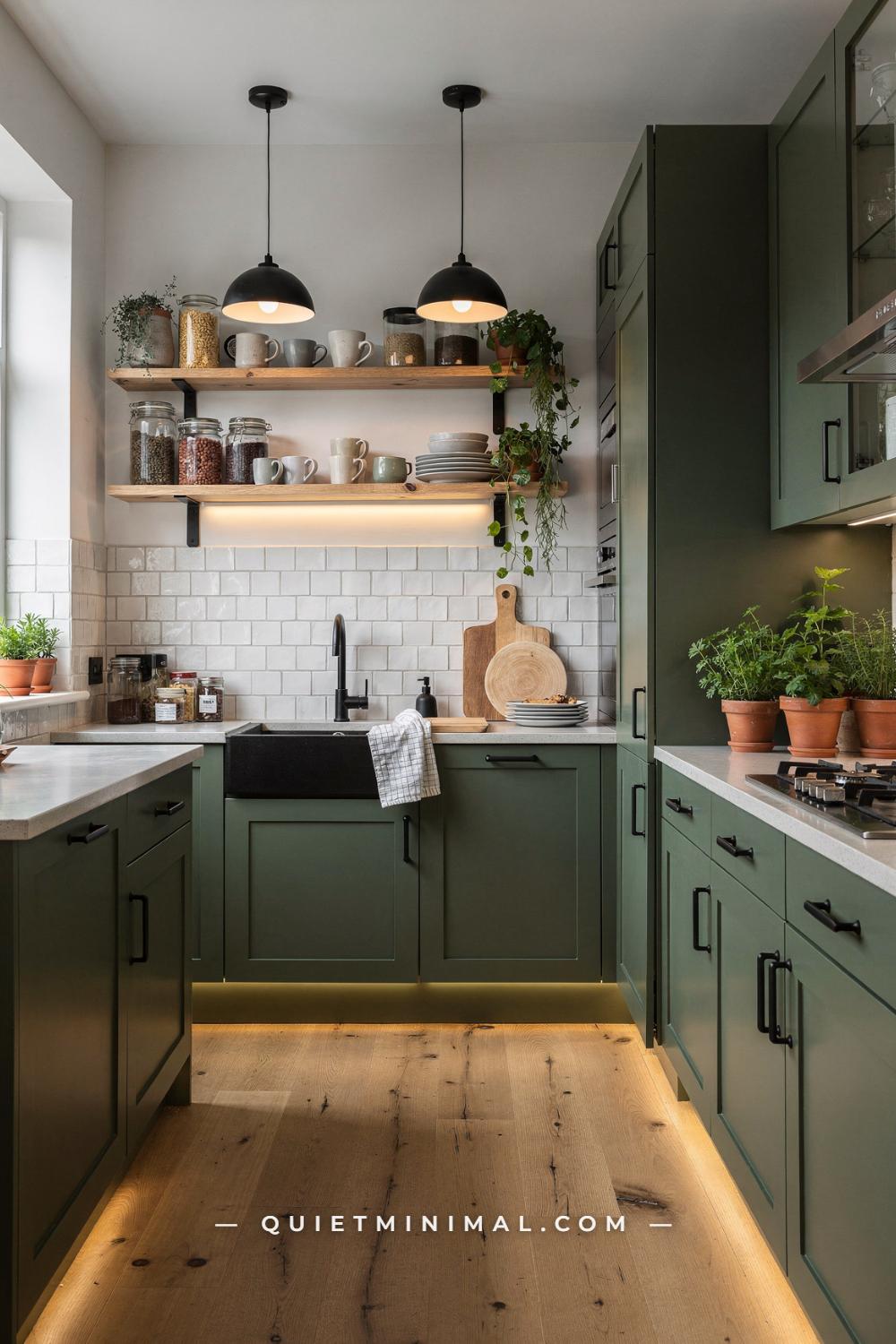
Sage green kitchen ideas are the most saved kitchen on this site, and the eight sections further down this page still hold: the cabinets, the countertops, the backsplash, the appliances, the island, the walls, the decor, the mix. What they never gave you is a number. Sage is the one kitchen color that changes identity with the window, the bulb and the counter beside it, so the soft gray-green you loved on a 2 x 3 in (5 x 8 cm) chip can arrive as putty beside a stainless fridge and as mint under a cool ceiling can. This block sits above the old advice as the decision layer: the sage ladder by paint code and LRV, read under a north window and a south one, the countertop and backsplash matched to the depth of the green with a current cost per square foot, the hardware finish by depth, the two-tone split as a percentage, the wall color chart, the light plan in kelvin, and the order to repaint the cabinets you already own. The photographs are the rooms. The charts are the arithmetic.
Read the Sage on the Cabinet Doors by Its LRV and Your Window, Not the Chip
 Save
A kitchen chip is 2 x 3 in (5 x 8 cm). A full-height run of sage shaker like this one is 150 to 250 sq ft (14 to 23 sq m) of painted door face, all of it vertical and lit by whatever window the room has. Paint on that much surface comes back lighter, grayer and bluer than the card, and the window decides which way. A south or east window, like the corner one throwing those morning shadows across the quartz, carries a warm yellow cast that pushes a sage toward green and, on a light rung, toward mint. A north window carries a cool blue cast that pulls the gray forward, so the same door reads as putty by late afternoon.
The fix is the LRV on every chip, 0 for black and 100 for white, read against the window. Above LRV 55 a sage is a tinted off-white beside white tile. Between 40 and 55 it reads as sage from every angle. Between 25 and 40 it is a mid green that needs daylight or warm under-cabinet light. Under 25 it is a deep gray-green that goes charcoal in a kitchen with one window. Decide the band first, then the undertone for your window, then the name.
Key Takeaway: Choose the LRV band before the name, then match the undertone to the window: yellow-cast sage for a north kitchen, gray-cast sage for a south one.
The Sage Kitchen Ladder by Paint Code, LRV 63 to LRV 14, Under North Light and South Light
 Save
Every code was confirmed on the brand’s own page; Farrow & Ball prints no LRV, so its two rungs carry sample-listing values, marked approximate. Tinted-white band, LRV 55 and up: Sherwin-Williams Sea Salt SW 6204 at 63, pale blue-gray under a north window, soft mint under a south one. True-sage band, 40 to 55: Comfort Gray SW 6205 at 54, weathered gray-blue north and sea-glass green south; Farrow & Ball Mizzle No.266 near 52, chalky gray north and soft gray-green south; Benjamin Moore October Mist 1495 at 46.5, quiet gray-green north and soft olive south; Clary Sage SW 6178 at 41, green under a north window, yellow-green under a south one. Mid band, 25 to 40: Evergreen Fog SW 9130 at 30, smoky greige north, mid gray-green south. Deep band, under 25: Card Room Green No.79 near 27, slate north and dark gray-green south; Rosemary SW 6187 at 14, near-charcoal north, deep muted green south.
The pattern is the undertone. Sea Salt, Comfort Gray, Evergreen Fog and Card Room Green carry a gray or blue base, so a north kitchen turns them gray and a south kitchen keeps them sage. Clary Sage and October Mist carry yellow, so a north kitchen keeps them green and a south kitchen can tip them toward mint or olive.
Key Takeaway: Eight verified rungs from Sea Salt at 63 to Rosemary at 14; north window, take a yellow-cast rung; south window, take a gray-cast rung.
Butcher Block Under a Soft Sage Kitchen: the Counter That Warms a Gray-Green
 Save
The counter is the second-largest color in a sage kitchen and the one that decides whether the green reads warm or cold. Oak butcher block carries the yellow-orange that a gray-green is missing, so it does for a Clary Sage or October Mist door what a south window does: it cancels the putty. On a matte flat-front run like this one, with round brass knobs and a white apron sink, the oak top is what stops the whole wall from reading as one flat gray plane.
Buy it at 1.5 in (4 cm) thick and 25 in (64 cm) deep, the standard base-cabinet overhang, and oil it monthly for the first year, then quarterly. Around an undermount sink the end grain drinks water, so either seal that zone with a waterproof finish or accept a stone insert of about 36 in (91 cm) at the sink and keep the wood everywhere else. Keep the wood count at one species: the floating shelf above in walnut against an oak counter is two woods already, and a third, in a stool or a table, is where the kitchen starts to look assembled rather than chosen. At current prices butcher block installs at $40 to $100 per sq ft, the cheapest counter on the next chart and the warmest.
Key Takeaway: Put oak butcher block under a light or true sage to warm it, 1.5 in (4 cm) thick, oiled monthly the first year, with one wood species in the room.
The Countertop Matrix for a Sage Kitchen: White Quartz, Butcher Block, Marble and Black Honed Stone by Depth, With the Cost per Square Foot
 Save
Read the row for your material and the column for your band. White quartz, $50 to $150 per sq ft installed, most jobs $70 to $100: on light sage it flattens, two pale planes with no edge between them, so choose a warm white with a soft gray vein; on true sage it is the default; on deep sage it is the best contrast in the matrix. Butcher block, $40 to $100: warms every band, ideal on light and true sage, and turns deep sage farmhouse rather than modern. Marble, $75 to $250: a gold-veined Calacatta warms a true or mid sage; a gray-veined Carrara sides with the gray in a light sage and cools it. Black honed granite or soapstone, $40 to $100 with most kitchens $70 to $115: on light sage it drags the lowers toward greige; on true sage it needs brass to stay warm; on deep sage it is the one counter that makes a Rosemary run read as intentional rather than dark.
For a typical 45 sq ft (4.2 sq m) counter run that is $2,250 to $6,750 in quartz, $1,800 to $4,500 in butcher block, $3,375 to $11,250 in marble and $1,800 to $4,500 in granite before cutouts and edge profile.
Key Takeaway: Quartz for true and deep sage, butcher block for light and true, gold-veined marble for mid, black honed stone only under a deep sage with brass.
A Marble Slab Backsplash Against Sage Lowers: Where the Veining Does the Decorating
 Save
A slab puts the pattern on the wall so the cabinets can stay plain. That is the whole trade: flat sage doors, no hardware to speak of, and one uninterrupted piece of stone carrying the movement between the counter and the uppers. The 18 in (46 cm) band between a counter and a 30 in (76 cm) upper across a 12 ft (366 cm) run is about 18 sq ft (1.7 sq m) of slab, small enough that a remnant from the counter fabricator often covers it.
The vein color is the decision. Gold veining sits on the warm side of the wheel with the yellow in sage and with brass, so the two read as one family; a gray vein sides with the gray in the paint and the whole back wall cools. Walnut-veneer uppers, as here, count as the third material, so the kitchen holds at three: sage, walnut, stone. Keep the counter quiet when the splash is loud. At current prices a marble slab backsplash installs at $40 to $100 per sq ft, with fabricator labor at $10 to $30 of that, and it is the only backsplash on the next chart that cannot be a weekend job.
Key Takeaway: Choose a gold-veined slab over a gray-veined one behind sage, keep the counter plain, and hold the kitchen to three materials.
Backsplash Pairings for a Sage Kitchen Costed per Square Foot: White Zellige, Brick, Marble Slab and Beadboard
 Save
Four materials, one 40 sq ft (3.7 sq m) wall, checked at current prices. White zellige, handmade and hand-glazed: $18 to $28 per sq ft for the tile, $20 to $45 installed once labor and shipping land, plus 10 to 15 percent for cuts and breakage, $800 to $1,800 for the wall; it suits every band because the glaze variation forgives the gray in the paint. Thin brick veneer: $4 to $13 material and $12 to $19 per sq ft installed indoors, $480 to $760 for the wall. Warm red brick against a deep sage such as Rosemary is the farmhouse-industrial pair; on a light sage use whitewashed brick or the wall overpowers the doors. Marble slab: $40 to $100 per sq ft installed, $1,600 to $4,000, for a true or deep sage with a gold vein. Beadboard: MDF $0.75 to $2.50, PVC $1.50 to $4, solid wood $2 to $6 per sq ft in material, about $18 to $26 per sq ft installed once the cutting around outlets is counted, $720 to $1,050 for the wall. Paint it the wall color, use tile behind the cooktop, and pair it with a light or true sage for the cottage read.
Most backsplashes land between $15 and $40 per sq ft installed, with labor $5 to $20 of that.
Key Takeaway: For a 40 sq ft wall, brick $480 to $760, beadboard $720 to $1,050, zellige $800 to $1,800, marble slab $1,600 to $4,000; zellige suits every sage, brick the deep ones, beadboard the light ones.
Brass on a Sage Kitchen Is a Depth Decision: Trim, Faucet and Rail in One Finish
 Save
Brass is the finish that warms a sage kitchen for the same reason oak does: it carries the yellow the gray-green lacks. How much of it you can use depends on the depth of the paint. On a light sage, brass in a satin or brushed finish keeps the door face warm without shouting. On a true sage like these lowers, it can run as a line, the toe-kick and edge trim here, and still read as calm, because the green is strong enough to hold it. On a deep sage, brass becomes the brightest thing in the room, so cap it at three touchpoints: the pulls, the faucet and one light.
Count the touchpoints in this kitchen: trim, faucet, rail with its hanging utensils, kettle, tray, pendant. It works because the pendant is a thin tube and the uppers are cream, which gives the eye somewhere to rest. Match every piece within one maker’s brass, because “brass” spans champagne to antique and the mismatch shows within 12 in (30 cm) of each other. Unlacquered brass darkens over 6 to 12 months; brushed lacquered brass holds its color. Pulls at 5 in (13 cm) on doors and 8 to 12 in (20 to 30 cm) on wide drawers keep the proportion.
Key Takeaway: Brass warms sage at any depth, but cap it at three touchpoints on a deep green and buy every piece from one finish line.
Hardware and Faucet Finish by Sage Depth: Brass, Black and Nickel on Light, Mid and Deep Green
 Save
Read your column. Light sage, LRV 55 and up: brushed brass warms it and is the first choice; matte black sharpens it, high contrast on a pale door, so use it on the pulls only and keep the faucet lighter; brushed nickel is the safe neutral; polished chrome reads cold and pushes the paint toward mint. True and mid sage, 25 to 55: brass is ideal, black is equally ideal for the modern read, nickel is fine and slightly flat, chrome is flat. Deep sage, under 25: unlacquered or brushed brass is the finish the paint was made for; matte black disappears into the door, which is only right if you want the hardware to vanish; nickel gives a cool, quiet modern kitchen; chrome shines too hard against a matte deep green.
The fixture-trend reports at the time of writing say warm metals are rising and matte black is now paired with a warm accent rather than used alone, which is what the middle column already tells you. The rule that keeps the set from looking bought in pieces: one finish for every pull and the faucet, a second finish allowed on the pendants and nowhere else.
Key Takeaway: Brass on any depth, black on true and mid sage, nickel as the neutral, chrome never; one finish for pulls and faucet, a second only on lighting.
The Two-Tone Sage Kitchen: Green Lowers, Cream Uppers and Where the Line Falls
 Save
The two-tone kitchen is the version most people can live with longest, because the green sits below eye level where it grounds the room, and the uppers stay light where the eye travels. The line falls at the counter, and the proportion that follows is set by the height of the uppers. A base cabinet shows about 30 in (76 cm) of door and drawer face above the toe kick. With 30 in (76 cm) uppers, sage carries roughly 53 percent of the visible cabinet face; with 36 in (91 cm) uppers, 49 percent; with 42 in (107 cm) uppers, 45 percent. Below 45 the kitchen starts to read as a white kitchen with a green base, which is fine if that is the plan.
Cream, not bright white, on the uppers is what keeps this split soft. A bright white makes the sage look grayer by contrast; a cream with a yellow base sits on the same side as the yellow in the paint. The same gold bar pull on both tones is what ties the two halves into one kitchen, and a vertical metro tile with an LED strip above the counter carries light down into the darker band.
Key Takeaway: Keep sage at 45 to 55 percent of the visible cabinet face with 30 to 36 in (76 to 91 cm) uppers in cream, and use one pull on both tones.
Two-Tone Proportions Measured: Sage Lowers Under White Uppers Against a Sage Island Inside a White Perimeter
 Save
Three ways to split a sage kitchen, measured as the share of visible cabinet face the green carries. Split one, sage lowers under white uppers: 53 percent with 30 in (76 cm) uppers, 49 percent with 36 in (91 cm), 45 percent with 42 in (107 cm). Split two, a white perimeter with the green on the island: a 36 x 72 in (91 x 183 cm) island shows about 30 sq ft (2.8 sq m) of paneled face against roughly 120 sq ft (11 sq m) of perimeter doors in a 10 x 12 ft (305 x 366 cm) kitchen, so sage carries about 20 percent. Split three, one full-height sage wall, usually the pantry and appliance wall, beside a white run: about 40 percent.
Read those against the scale. Under 15 percent, sage is an accent and the wall color should ignore it. Between 40 and 60 percent it is a two-tone kitchen, and the wall takes the lighter tone’s family, cream or warm white. Above 70 percent it is a sage kitchen with white trim, and the wall can go tonal. The island split is the easiest to repaint later and the hardest to light, because 20 percent of the color sits in the middle of the floor under the pendants alone.
Key Takeaway: Lowers-and-uppers gives 45 to 53 percent sage, an island about 20, a full-height wall about 40; under 15 is an accent, 40 to 60 is two-tone, over 70 is a sage kitchen.
Wall Color Around Sage Cabinets: Warm Sand Plaster Instead of Bright White
 Save
The wall is the 60 in the 60-30-10, and it is the surface most people never think about once the cabinets are chosen. A bright white wall, LRV 85 and up, is the default and it is the wrong default beside a gray-green: the white is so much lighter that the eye reads the sage as its shadow, and the gray comes forward. A warm sand or cream in the LRV 70 to 80 range, with a yellow base, sits on the same side of the wheel as the yellow in the paint, and the sage reads greener for it. The texture of a plaster finish, as behind these lowers, does a second job, breaking the wall into small shadows so the flat matte door face reads as the calm surface in the room.
Name the colors in plain words when you shop: warm cream, sand, mushroom, soft clay. Avoid a cool gray wall, which turns the whole kitchen into gray on gray-green. Keep the wall in a flat or matte sheen and the cabinets in satin, so the two surfaces separate by texture rather than by contrast, and let brushed gold on the faucet and the ceiling spots be the 10.
Key Takeaway: Paint the walls a warm sand or cream at LRV 70 to 80 rather than bright white, matte on the wall and satin on the doors.
The 60-30-10 Wall Chart for a Sage Kitchen: Five Wall Colors and What Each Does to the Green
 Save
The split is walls, ceiling and floor at 60 percent, cabinets at 30, hardware and accents at 10, and the 60 decides how the 30 reads. Five wall choices. Warm white, LRV about 85: crisp, the sage reads truest but a touch grayer; best on a deep sage, Rosemary or Card Room Green, which needs the contrast. Cream or sand, LRV 75 to 80: the sage warms and reads greener; best on light and true sage, Sea Salt through Clary Sage. Greige or mushroom, LRV 55 to 65: tonal, the sage sinks into the wall and the room goes quiet; needs brass and a white counter to stay awake; best on true sage. Tone-on-tone, the cabinet code on the walls in matte: a full sage room, very calm, only for a kitchen with a south window and 3000 K light, because a north window turns it into one gray box; best on October Mist or Clary Sage. Terracotta or clay, LRV 30 to 40: the warm complement to a gray-green, and it belongs in the 10, one wall or the dining nook, never all four.
Ceiling and trim stay in the wall’s family, a shade or two lighter, and the floor counts inside the 60, which is why an oak floor warms every row on this chart.
Key Takeaway: Cream or sand for a light or true sage, warm white for a deep one, greige for tonal, the cabinet code itself only with a south window, terracotta on one wall at most.
The Small Kitchen and the Dark Kitchen Compromise: Where Sage Goes When There Is Little Room or Little Light
 Save
A small kitchen and a dark kitchen want opposite things from sage, and most kitchens under 100 sq ft (9.3 sq m) are both. Small wants the color low and the upper wall open: sage on the base cabinets only, the uppers replaced by one 36 in (91 cm) floating shelf, and a rung from the true band, LRV 40 to 55, so the doors read as color without closing the walls in. Dark, meaning one window or a north one, wants the opposite of the instinct. A light sage in a dim room does not brighten it; it goes putty, because there is not enough light for the green to show. A deeper rung, Evergreen Fog at 30 or Rosemary at 14, reads as the color you chose in any light, as long as you light it.
The compromise for a kitchen that is both, like this galley with one high window: true-sage shakers on the lowers, a single wood shelf instead of uppers, butcher block for the warmth the window cannot supply, a white tile floor to bounce what light there is, and a warm 2700 K pendant plus an under-shelf strip so the doors are never lit by the window alone. Jute and wood carry the rest.
Key Takeaway: Small kitchen, sage low and one shelf instead of uppers; dark kitchen, a deeper rung lit on purpose; both, true sage lowers with butcher block and a warm strip under the shelf.
The Light Plan That Keeps a Sage Kitchen Green: 2700 to 3000 K by Layer, Lumens per Foot
 Save
Sage is a gray-green, and gray is what a cool bulb finds. Every guide at the time of writing says to pick one color temperature and keep it through the room; for sage the temperature to pick is 2700 to 3000 K, warm white, on every layer. Some task-lighting guides push the counter strips to 3500 or 4000 K for cutting and reading labels, and on a white kitchen that is harmless; on a sage one it turns the doors under the strip a different color from the doors beside it, mint under the cool strip and gray beside it. Hold the strips at 3000 K and buy brightness instead.
The numbers by layer. Ambient ceiling, recessed or a pendant run, 2700 to 3000 K, dimmable. Under-cabinet task strips, 3000 K, 250 to 450 lumens per foot, dot-free linear so the quartz does not show a row of reflections. Inside glass-front cabinets, 150 to 250 lumens per foot, dimmable, or the display cabinet outshines the room. Every fixture at CRI 80 minimum and 90 or above where it lights the cabinets, because a low-CRI LED drops the green out of the paint before it drops anything else. Over a dining table in the same room, 2700 K, so the two zones agree.
Key Takeaway: 2700 to 3000 K on every layer, task strips at 3000 K and 250 to 450 lumens per foot, glass cabinets at 150 to 250, CRI 90 or above.
Painting the Cabinets You Already Own Sage: the Sample-Door Test Before the First Coat
 Save
Most sage kitchens on Pinterest are repaints, and the ones that went wrong went wrong before the first coat. Test on a door, never on a chip. Take the one door you see least, the inside of a pantry or the end of a run, or buy an unfinished door blank for about the price of a sample quart, and give it the real sequence: bonding primer, two coats of the sage in the cabinet enamel you will actually use. Rehang it for three days and read it at 8 am, 1 pm and 8 pm under the kitchen’s own lights, held beside the counter, the floor and the appliances.
You've saved it, wanted it. Here's the how: codes, measurements, order. Your choices make it yours.

The appliances are the reading most people skip. A stainless French-door fridge, as here, is a cool gray, and it pulls the blue out of a blue-cast sage until the lowers beside it read as gray-blue; with stainless, choose a yellow-cast rung, Clary Sage or October Mist, so the two stay different colors. Black bar handles and a black sink hold up against a matte sage because they match each other, not the paint. Only when the door passes all three readings beside the fridge do you buy the gallon.
Key Takeaway: Prime and paint one real door, rehang it for three days, read it at three times beside the fridge and the floor, then buy.
The Repaint Sequence With the Cost per Linear Foot: From Sample Door to Cured Finish, in Order
 Save
The order, nothing skipped. One, the sample door, three days, as above. Two, every door and drawer front off, each labeled on tape inside the hinge cup, hardware bagged by cabinet. Three, degrease with a TSP substitute, sand at 220 grit, fill the old pull holes if the new spread differs. Four, one coat of bonding primer, or a sage over an old glossy finish peels at the edges within a year. Five, the first coat of cabinet enamel, sprayed for a flat-front door, brushed and rolled for a shaker where the frame hides the strokes. Six, the second coat after four to six hours, or the recoat time on the can if it is longer. Seven, cure before heavy use for the time on the can, counted in days, not hours, doors rehung and drawers left slightly open.
The cost at current prices. A professional charges $30 to $70 per linear foot, $30 to $60 brushed and $40 to $100 sprayed, with up to 10 percent more for cabinets above 8 ft (244 cm), and $2,000 to $6,500 for a whole kitchen. A 40 linear foot kitchen, uppers and lowers measured separately, is $1,200 to $2,800 brushed or $1,600 to $4,000 sprayed. Doing it yourself, paint and supplies run $200 to $600 and the weekends run to three.
Key Takeaway: Sample door, doors off and labeled, degrease and sand, bonding primer, two coats, cure for days; $30 to $70 per linear foot professionally, $200 to $600 in supplies yourself.
 Save
The original ideas from this article continue below.
A sage green kitchen is a perfect blend of elegance and comfort, offering a fresh and inviting atmosphere for cooking and entertaining. You can achieve this timeless look by incorporating sage green elements throughout your kitchen, such as countertops and backsplashes that offer both style and serenity. Picture a sage green island serving as a functional workspace and a striking visual focal point. Whether your taste leans towards modern, farmhouse, or eclectic, you’ll find that sage green is versatile enough to enhance any design style. Ready to transform your cooking space with these inspirations?
- Opt for sage green cabinets with brass or matte black hardware to create a stylish and inviting kitchen.
- Use sage green countertops to provide a calming, earthy feel that pairs well with natural wood and stainless steel.
- Incorporate sage green backsplashes like subway or patterned tiles to add an eye-catching feature and break up neutral tones.
- Choose sage green appliances to elevate the kitchen’s aesthetic and infuse a sense of calm and sophistication.
- Install a sage green kitchen island to serve as a functional workspace and visual centerpiece, adding a pop of color and sophistication.
Imagine entering a kitchen where sage green cabinets with matte black hardware greet you, creating a calm and elegant ambiance.
Sage Green Cabinets
 Save
Transform your kitchen with sage green cabinets that offer a refreshing and timeless look. You’ll find that this color brings a sense of calm and tranquility and adds a touch of elegance to your space.
Start by selecting cabinets with clean lines and a matte finish for a sophisticated appearance. Sage green works well with various styles, from modern to farmhouse, making it versatile.
Pair your cabinets with brass or matte black hardware to elevate the overall aesthetic. Add some open shelving to break up the monotony and display your favorite dishes or plants.
With sage green cabinets, your kitchen will feel both inviting and stylish.
Countertops in Sage Green
 Save
When it comes to countertops in sage green, you’ll find they add both a unique touch and a cohesive flow to your kitchen design. Sage green countertops provide a calming, earthy feel that complements various kitchen styles, from rustic to modern. They pair beautifully with natural wood elements and stainless steel appliances, creating a balanced and inviting atmosphere.
Consider materials like quartz or granite in sage green, as they offer durability and easy maintenance. These countertops can be the focal point of your kitchen, tying together other sage green accents and creating a harmonious look.
Whether you choose a smooth, polished finish or a more textured surface, sage green countertops will undoubtedly enhance your cooking space’s overall aesthetic and functionality.
Sage Green Backsplashes
 Save
A sage green backsplash can be an eye-catching feature that adds color and character to your kitchen. It breaks up the monotony of neutral tones and can make a subtle yet impactful statement.
You could opt for classic subway tiles in sage green for a timeless look or go for patterned tiles to introduce more visual interest. Whichever style you choose, a sage green backsplash can create a cohesive feel when paired with white or wooden cabinetry.
It’s also a versatile choice that complements various kitchen styles, from modern to rustic. Don’t forget that a backsplash is easy to clean, making it a practical choice for a busy cooking space.
Sage Green Appliances
 Save
Incorporating sage green appliances into your kitchen can instantly elevate its aesthetic while adding a unique touch of color. Imagine a sage green refrigerator or oven becoming the focal point of your kitchen, seamlessly blending with other elements.
These appliances provide functionality and infuse a sense of calm and sophistication. You can opt for a sage green toaster, coffee maker, or even a mixer to create subtle yet impactful accents.
The beauty of sage green lies in its versatility, allowing it to complement various styles, whether modern, rustic, or traditional. By choosing sage green appliances, you make a bold yet tasteful statement that transforms your kitchen into a welcoming and stylish space.
Sage Green Kitchen Islands
 Save
Consider enhancing your kitchen’s charm by introducing a sage green kitchen island that serves as both a functional workspace and a stunning visual centerpiece. This versatile piece can transform your cooking area, adding a pop of color and sophistication. Imagine preparing meals in a space that feels both modern and timeless.
Here are some ideas to inspire you:
- Contrast Colors: Pair your sage green island with white or dark cabinets.
- Natural Elements: Add wooden stools or butcher block countertops.
- Storage Solutions: Include drawers and shelves for extra storage.
- Lighting: Install pendant lights above the island for a cozy ambiance.
- Decorative Touches: Place a vase of fresh flowers or a fruit bowl on the island.
Embrace the calming influence of sage green to elevate your kitchen space.
Sage Green Walls
 Save
Transform your kitchen into a serene and inviting space by painting the walls in a soothing shade of sage green. This calming color provides a perfect backdrop, allowing other elements in your kitchen to shine. Sage green walls can make your kitchen feel more spacious and airy, creating a welcoming atmosphere for both cooking and socializing. Pair this with natural light to enhance the room’s brightness and bring out the warm undertones of the green.
You can also mix and match different textures and finishes to add depth to your walls. Matte finishes offer a modern, understated look, while semi-gloss paints can make your walls easier to clean. The versatility of sage green ensures it complements various kitchen styles, from rustic to contemporary.
Sage Green Decor
 Save
To further enhance your serene kitchen space, sage green decor elements can seamlessly tie the room together. Incorporating these accents will create a cohesive touch that elevates the overall aesthetic. Small yet impactful additions can make all the difference.
- Sage green dishware: Display elegant plates and bowls to create a coordinated look.
- Textiles: Add sage green dish towels, napkins, or a table runner.
- Wall art: Framed prints or canvases in shades of sage can add personality without overwhelming the space.
- Potted herbs: Fresh, green plants in sage-colored pots serve as both decor and functional kitchen items.
- Light fixtures: Swap out old fixtures with ones featuring sage green accents for a modern touch.
These elements will ensure your kitchen feels cohesive and stylish.
Mixing Sage Green Elements
 Save
Blending various sage green elements throughout your kitchen creates a harmonious and inviting space. Start by painting your cabinets in a soft sage green. This creates a calm backdrop for the rest of your kitchen.
Next, add sage green tiles for the backsplash to tie the room together. You can also incorporate sage green dishware or small appliances for subtle pops of color.
Don’t forget textiles like dish towels, rugs, and seat cushions. These small touches make a big difference.
Mix in natural materials like wood and stone for a cohesive look, which complement sage green beautifully. By thoughtfully integrating these elements, you’ll create a cohesive, stylish kitchen that feels both modern and timeless.
 Save
 Save
 Save
 Save
 Save
 Save
 Save
 Save
 Save
 Save
 Save
 Save
 Save
 Save
 Save
 Save
 Save
 Save
 Save
 Save
 Save
 Save
 Save
 Save
 Save
 Save
 Save
 Save
 Save
 Save
 Save
 Save
 Save
 Save
 Save
 Save
 Save
 Save
 Save
 Save
 Save
 Save
 Save
 Save
 Save
 Save
 Save
 Save
 Save
 Save
 Save
 Save
 Save
 Save
 Save
 Save
 Save
 Save
 Save
 Save
 Save
 Save
 Save
 Save
 Save
 Save
 Save
 Save
 Save
 Save
Follow Quiet Minimal on Pinterest for more home design tips and inspiration.
You've saved it, wanted it. Here's the how: codes, measurements, order. Your choices make it yours.


