 Georgia
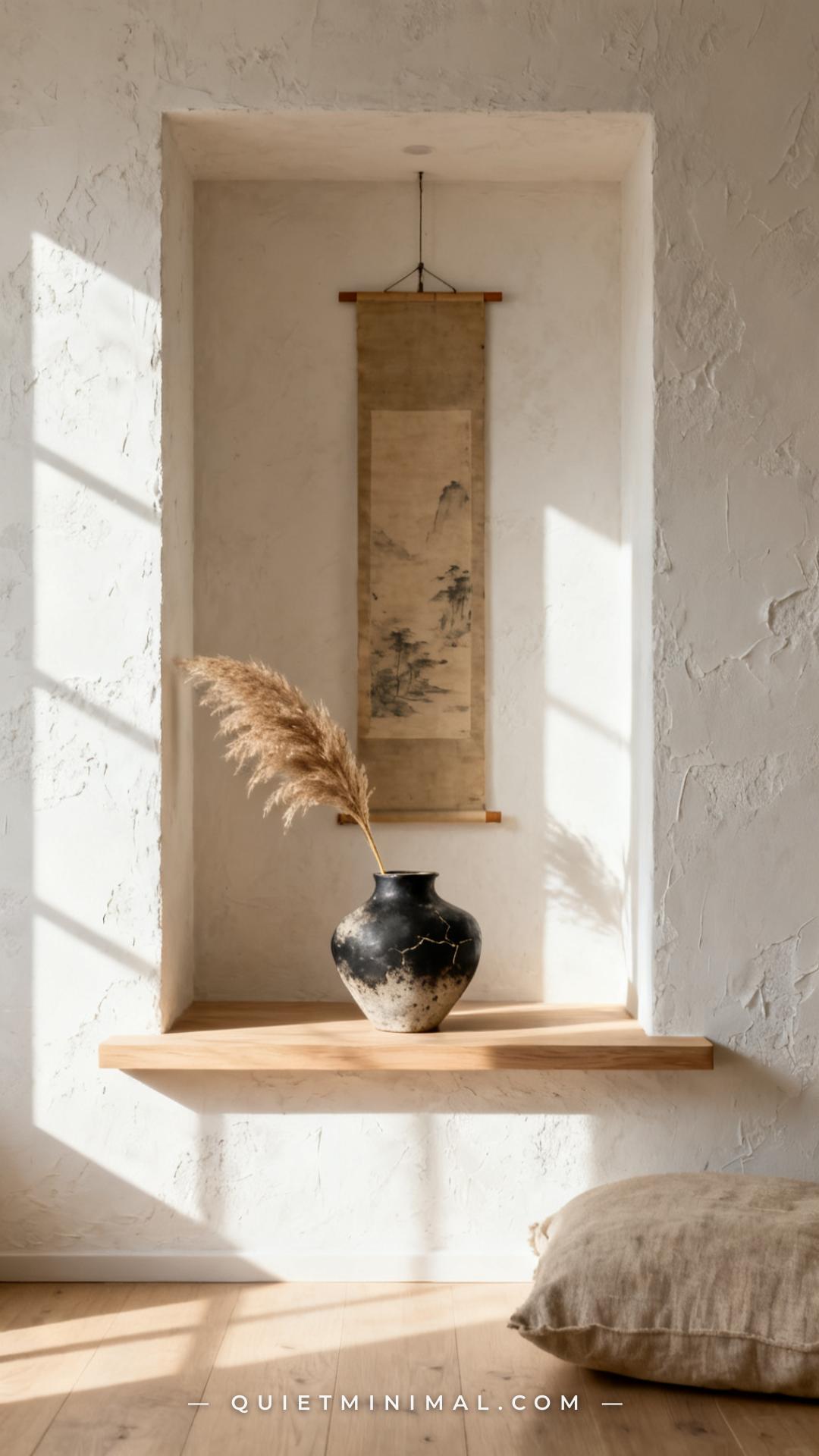
There is a particular kind of stillness that a well-composed shelf can create — one that stops you in the doorway, makes you exhale, and then pulls you in for a closer look. That is the entire point of a tokonoma. Originating in Japanese domestic architecture as a recessed alcove designed for a single, rotating display, the tokonoma has nothing to do with filling space and everything to do with editing it. In 2026, as Western interiors get louder and more cluttered, the logic of the tokonoma — one focal object, seasonal rotation, no visual noise — feels less like a cultural curiosity and more like the sanest approach to decorating a home. This guide shows you exactly how to build a wabi-sabi tokonoma display in any Western home, from a purpose-built niche to a single wall shelf, using real objects: ikebana arrangements, aged hanging scrolls, cracked raku pottery, and raw organic materials that age beautifully rather than dating fast.
1. Start With a Single Low Platform — Not a Floating Shelf
 Save
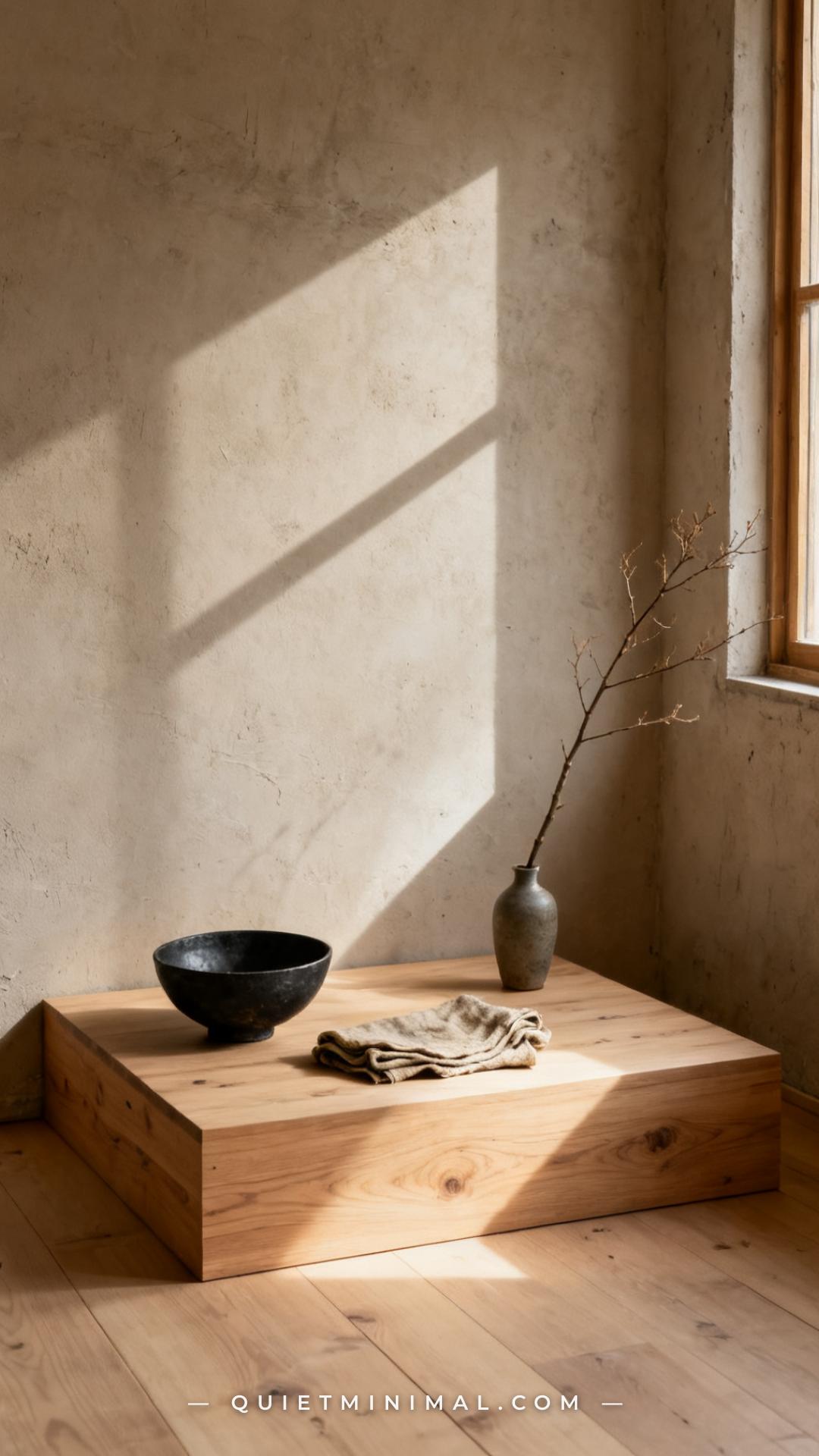
The structural foundation of any tokonoma is a low display platform called a tokonoma-no-ma — traditionally built into the floor recess, but for modern Western homes, a solid wood riser block or a low credenza shelf replicates the visual intention perfectly. The critical rule: the platform must sit lower than eye level when you’re seated. This grounds the entire display and signals to your eye that this is a place of quiet contemplation, not a mantelpiece that competes with conversation.
Choose a platform in pale oak, raw walnut, or a solid plywood slab finished with a matte tung oil — anything that shows the natural character of the wood without a high-gloss lacquer that would undercut the wabi-sabi aesthetic. Depth matters more than width: a platform that is at least 14 inches deep gives you enough room to layer a foreground object (the pottery) and a background element (the scroll or branch) without crowding.
From the guides
You've saved it, wanted it. Here's the how: codes, measurements, order. Your choices make it yours.
 The Japandi Honest PlaybookThe honest version of the style: what to keep, what to skip, and the order to do it in.See inside →
 The Room Refresh PlaybookA repeatable four-step method, room by room, in ten minutes, thirty minutes, or one weekend.See inside →
 Make Any Room Feel Cozy on PurposeWhy some rooms hold people and others empty out, and the moves that change it.See inside →
Key Takeaway: The platform sets the entire emotional register — choose raw wood, keep it low, and resist the urge to fill every inch of its surface.

2. Hang a Single Aged Scroll — and Leave Everything Else Off the Wall
 Save
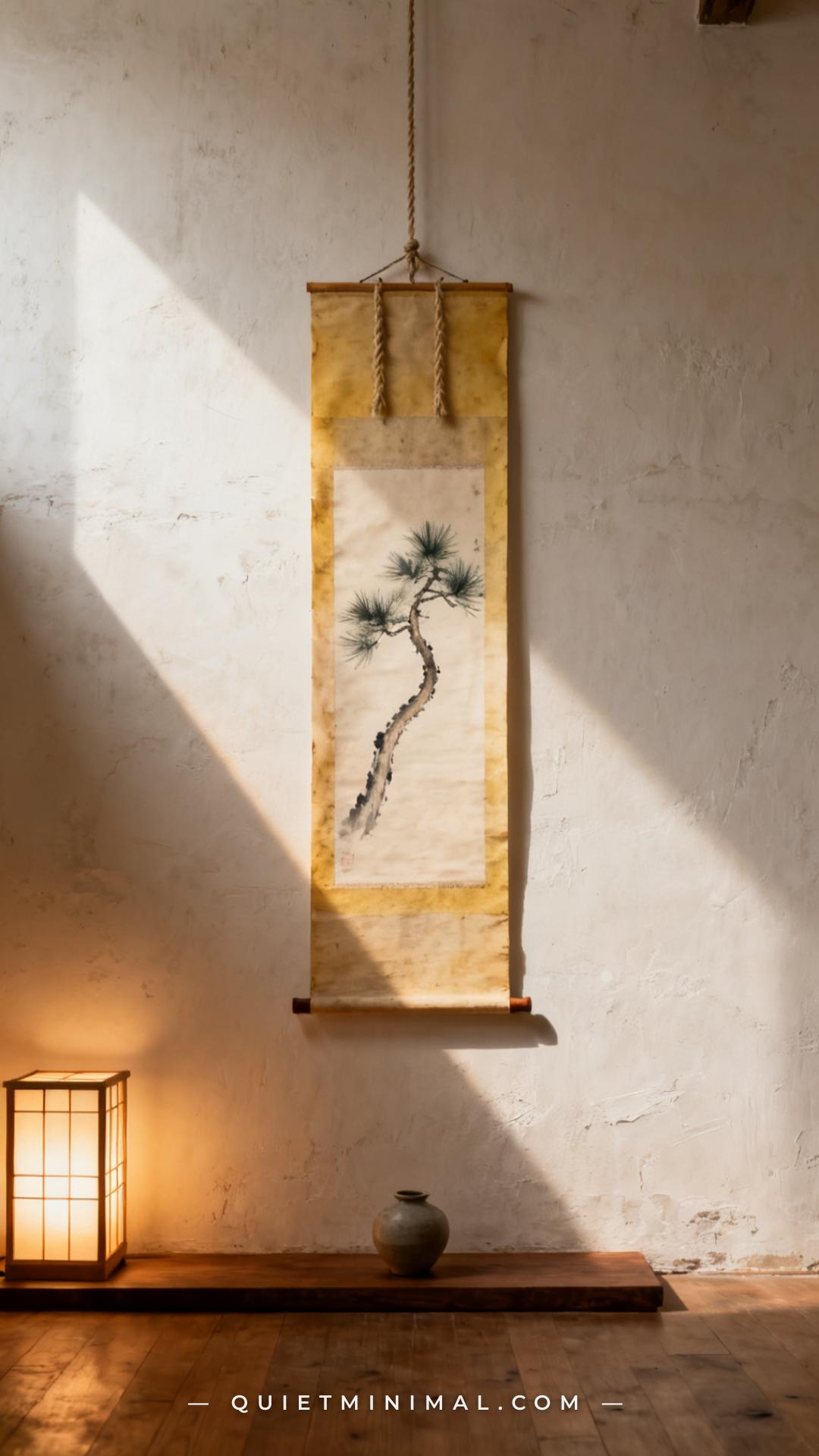
In traditional Japanese tokonoma design, the kakejiku (hanging scroll) occupies the vertical axis of the display and anchors the seasonal or emotional mood of the whole alcove. For a Western wabi-sabi display, the equivalent is any narrow vertical hanging — an antique ink-wash scroll painting, a hand-written sutra reproduction, or a simple dried botanical pressed under thin Japanese washi paper. The key principle is that the wall remains empty on all other sides.
Source aged reproduction scrolls from Japanese antique dealers, Etsy shops specializing in East Asian art, or small auction houses. Avoid mass-produced wall hangings printed on synthetic fabric — the texture of real mulberry paper or silk is what gives the scroll its visual weight and natural aging quality. A scroll that measures 12 inches wide by 36 inches tall works for most residential walls without overwhelming a small alcove.
Key Takeaway: One scroll, centered, with breathing room on all sides — the empty wall around it is as important as the scroll itself.

3. Place a Cracked Raku Pottery Piece as the Focal Object
 Save
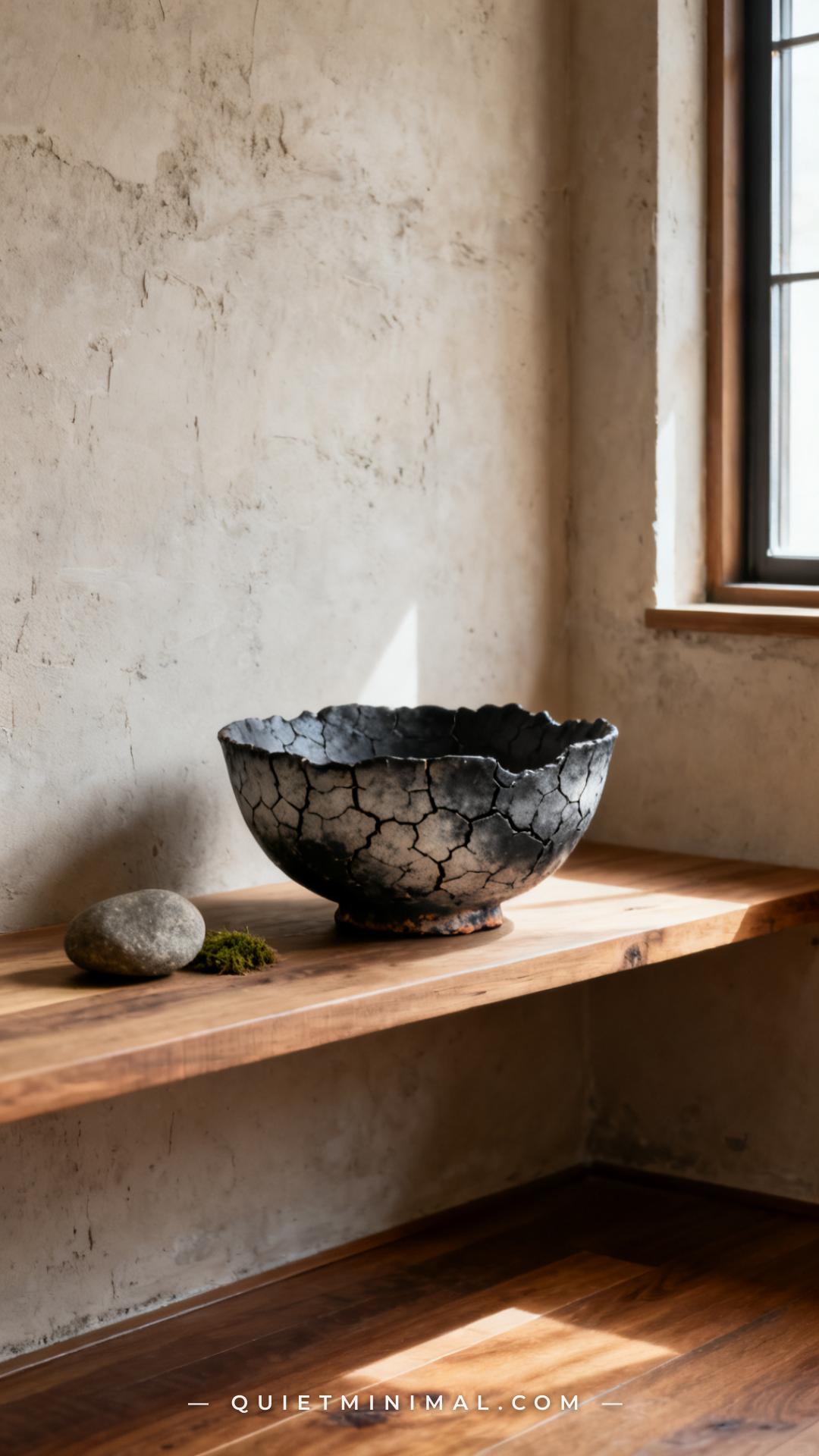
Raku pottery is the ideal wabi-sabi object because imperfection is not incidental to its making — it is the entire point. The crackle network across the glaze surface, the smoke blackening in the kiln, the irregular shape of a hand-pulled clay form: these are the visual records of a process that cannot be controlled or replicated. That is exactly what wabi-sabi celebrates.
For a tokonoma display, choose one raku piece that has strong silhouette contrast against your wall color — a dark smoke-blackened bowl against a pale plaster wall, or a white crackle-glazed cylinder against a warm gray. Size matters: the pottery should be substantial enough to hold visual attention from across the room (at least 4–6 inches in height or diameter) but not so large that it crowds the platform. Etsy’s handmade ceramic sellers and Amazon Handmade both carry authentic raku-fired pieces from studio potters in the US and UK.
Key Takeaway: Choose one raku piece with a strong silhouette and crackle texture — the imperfections are the design feature, not a flaw to work around.

4. Compose an Ikebana Arrangement in a Narrow-Necked Vessel
 Save
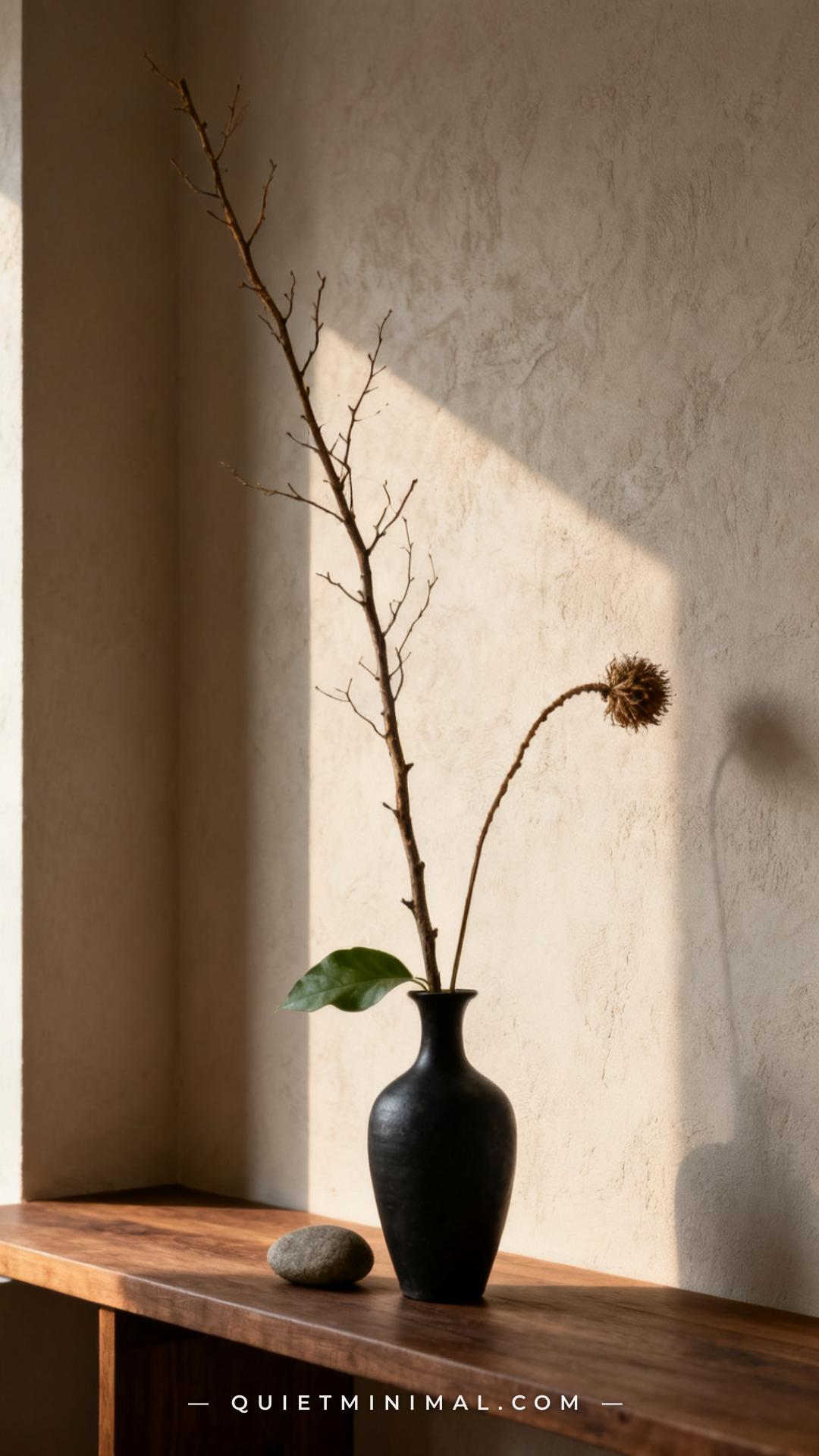
Ikebana is not flower arranging in the Western sense — it is a sculptural practice where the empty space between stems carries as much meaning as the stems themselves. For a tokonoma display, you don’t need to study ikebana formally to apply its core principle: use three to five stems maximum, choose an odd number, angle the tallest element to one side rather than centering it, and let the negative space speak.
The vessel matters as much as the arrangement. A narrow-necked ceramic bud vase in matte black, dark clay, or a subtle celadon glaze gives the stems structural support while keeping the base visually quiet. For materials, prioritize dried over fresh where possible — dried pampas, bleached thistle, dried seed pods, bare branches, and dried lunaria silver dollar — because they age gracefully on display and align with wabi-sabi’s acceptance of natural decay. When you do use fresh elements, a single stem of something seasonal (a bare quince branch in February, a single calla lily in spring) keeps the arrangement temporally honest.
Key Takeaway: Aim for three to five stems, odd numbers, and let the empty space between them be a design element — a crowded ikebana arrangement defeats its own purpose.

5. Use a River Stone or Moss-Covered Rock as a Grounding Element
 Save
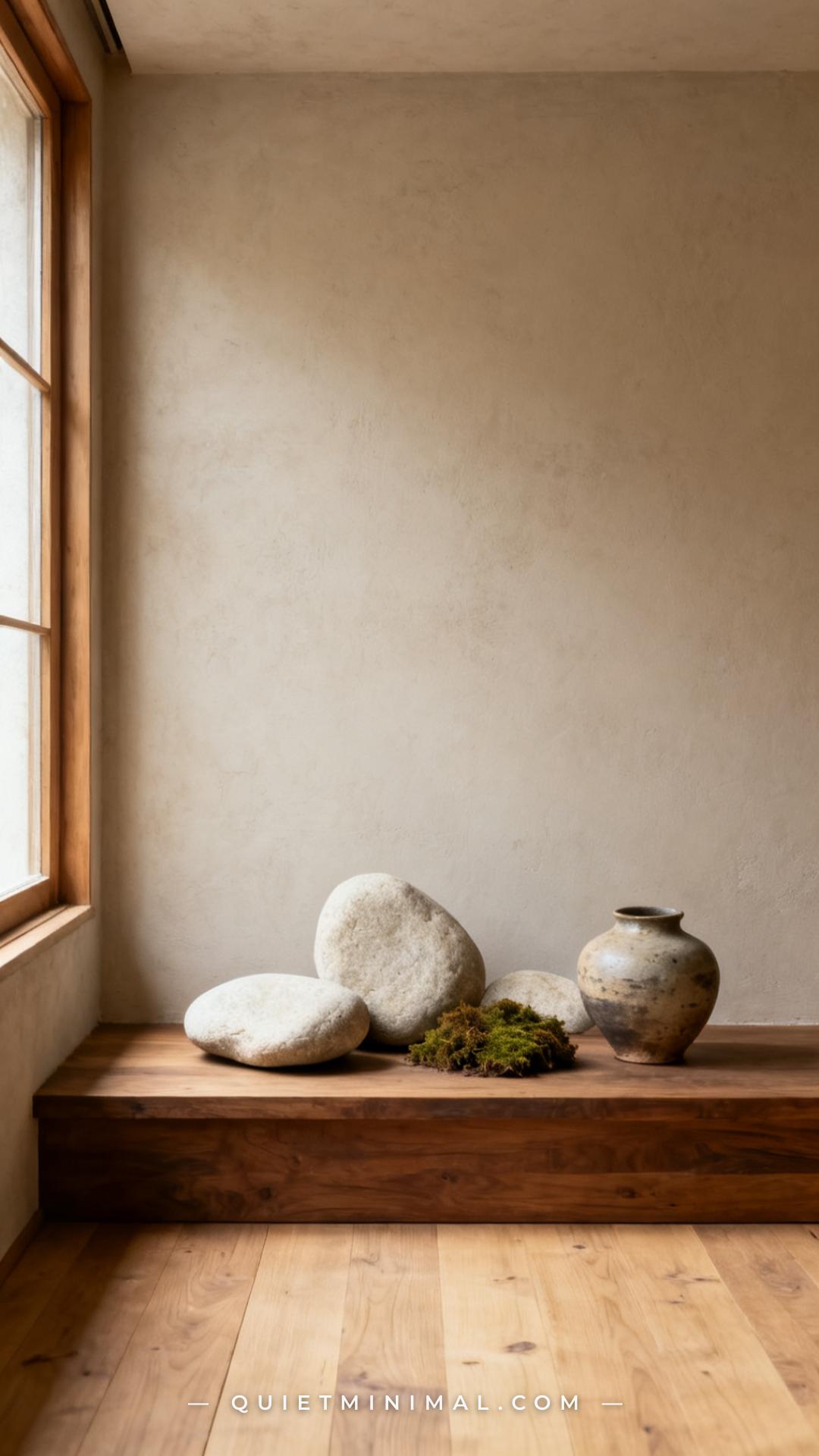
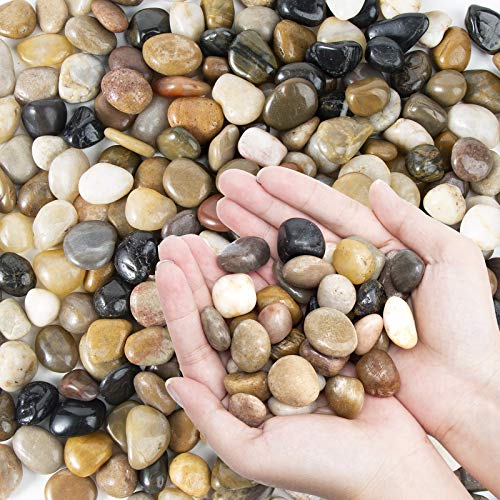
Every strong wabi-sabi composition needs at least one object that connects the display to the natural world in its most raw, unprocessed form. River stones and moss-covered rocks fulfill this role perfectly: they carry no cultural context that needs decoding, they age without degrading, and their weight — both literal and visual — anchors the other elements on the platform.
Source river stones from craft stores, garden centers, or literally a riverbed if you have access to one. For preserved moss, look for sheet moss or cushion moss sold for terrarium applications — it maintains its color and texture for months without water. Arrange the stones in a group of three rather than a single stone, and vary the scale slightly so the grouping reads as natural rather than staged. The stones should sit in the foreground of the platform, with the pottery and ikebana vessel behind them at a slightly higher visual level, creating the layered depth that makes a tokonoma display feel three-dimensional.
Key Takeaway: Three stones of varying sizes arranged in the foreground create natural asymmetry and visual depth — the composition breathes better when the eye has something to rest on at ground level.
6. Incorporate a Piece of Weathered Driftwood for Organic Line
 Save
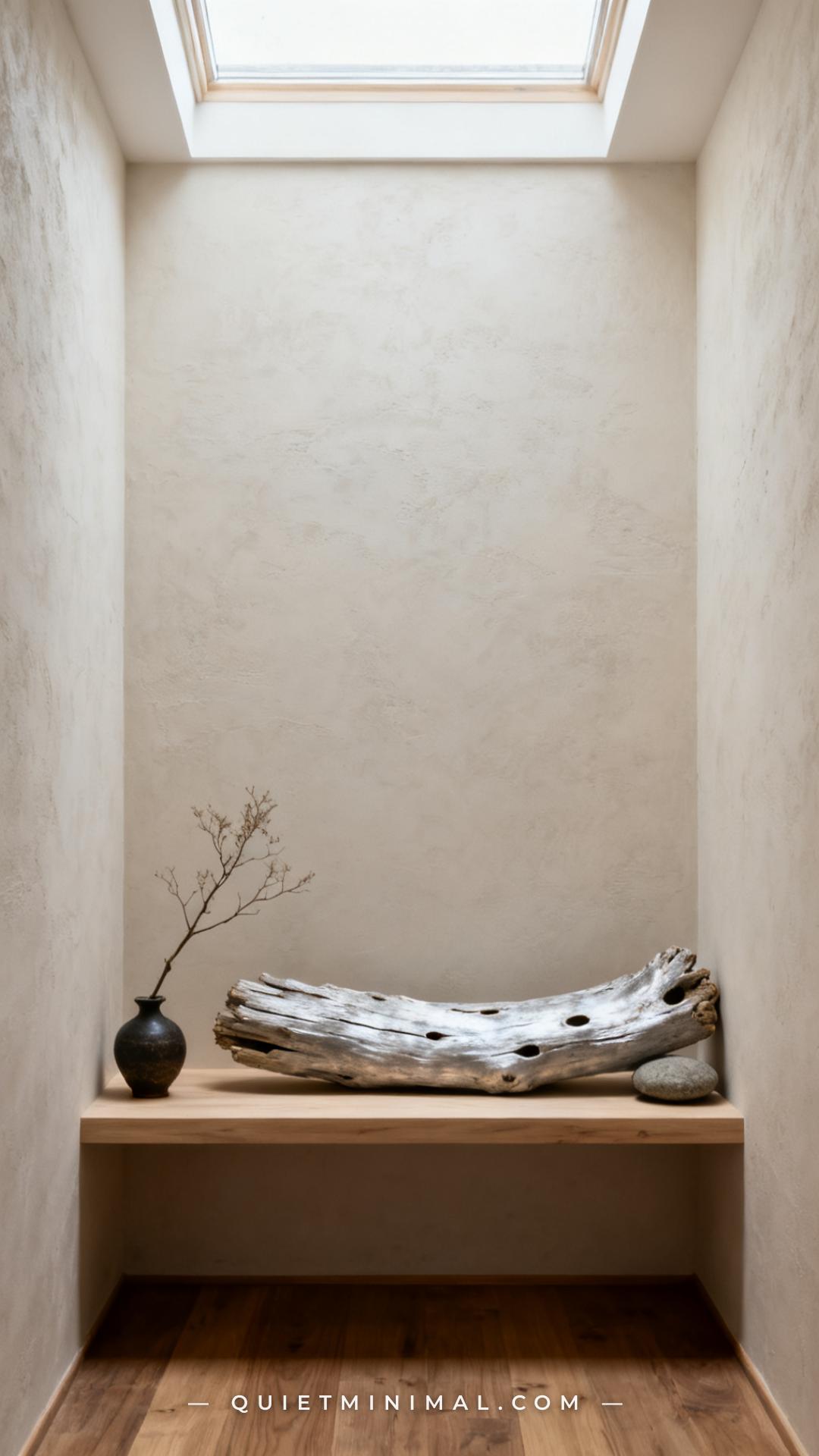
Driftwood introduces something no ceramic or stone object can: the evidence of time spent moving through water, wind, and exposure. The silver-gray bleaching, the smooth worn grain, the occasional hollow cavity — these are the physical records of years of natural transformation, which is the most honest wabi-sabi material a display can contain.
In a tokonoma context, use driftwood as a horizontal element laid across the platform or a low shelf bracket, rather than standing it upright (which reads more as boho-coastal than contemplative Japanese). A piece that runs slightly wider than the display platform’s depth creates a natural leading line that guides the eye across the composition and then out into negative space. Coastal craft markets, driftwood sellers on Etsy, and some garden centers carry properly dried and cleaned pieces.
Key Takeaway: Lay driftwood horizontally to create a visual leading line across the platform — it anchors the composition and gives the eye a path to follow without rushing it toward any single object.

7. Apply Wabi-Sabi Plaster or Limewash to the Alcove Wall
 Save
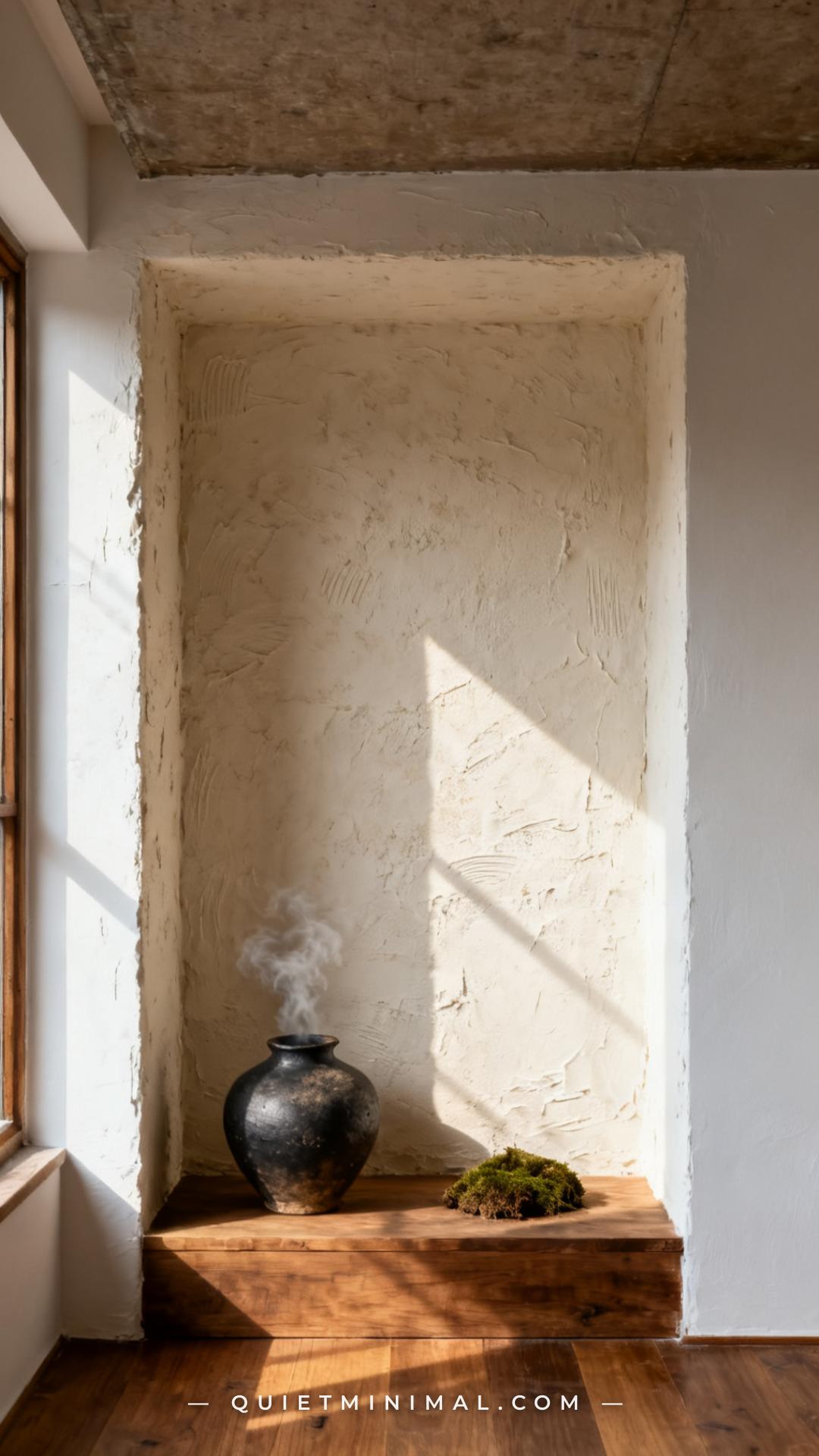
The wall surface inside your tokonoma alcove is not neutral — it is part of the display. A flat white drywall finish reads as construction-complete rather than intentional; it gives your raku pottery and ikebana arrangement nothing to react against visually. A hand-applied plaster finish or a limewash coat changes the entire atmosphere by introducing tonal variation, texture, and light absorption that shifts throughout the day.
For a DIY approach, Portola Paints’ Roman Clay and Behr’s Venetian Plaster are both available at major home improvement retailers and can be applied by hand with a curved trowel in a weekend. The technique is forgiving — mistakes become texture. Choose a warm off-white, a pale warm gray, or a very muted mushroom tone that will let dark ceramics and pale wood read clearly against the surface. Avoid cool grays and bright whites, which fight the warmth that wabi-sabi objects carry.
Key Takeaway: The alcove wall is an active part of the composition — a limewash or plaster texture finish transforms a blank surface into something that holds light and gives your display objects something to respond to.

8. Add a Washi Paper or Rice Paper Lantern for Ambient Light
 Save
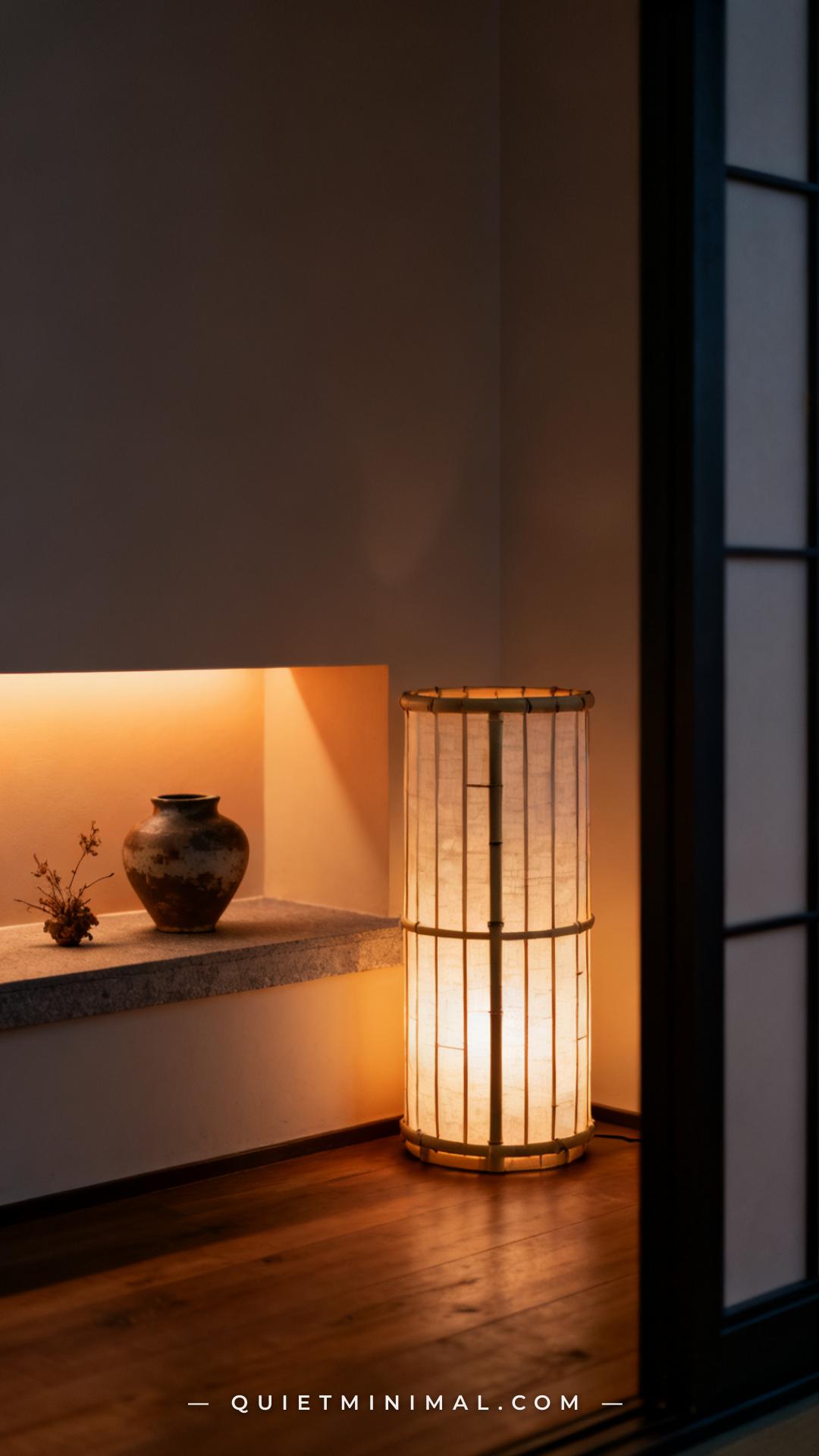
Overhead lighting is the single fastest way to kill the mood of a tokonoma display. The flat, even illumination of a ceiling fixture reveals everything simultaneously and flattens the shadows that make textured objects — raku crackle, driftwood grain, plaster wall texture — visually interesting. Wabi-sabi displays live in the soft, directional glow of low, warm light sources placed at or below the display level.
A traditional Japanese washi paper lantern on the floor beside the platform creates the right quality of light: warm (2700K or lower), diffused through the paper, and positioned to cast raking shadows across the pottery and stones. It also becomes a display element in its own right — the bamboo frame, natural paper, and organic form are entirely consistent with the wabi-sabi material palette. Battery-operated LED versions allow placement anywhere without cord management compromising the clean floor line.
From the guides
You've saved it, wanted it. Here's the how: codes, measurements, order. Your choices make it yours.
The Japandi Honest PlaybookThe honest version of the style: what to keep, what to skip, and the order to do it in.See inside →The Room Refresh PlaybookA repeatable four-step method, room by room, in ten minutes, thirty minutes, or one weekend.See inside →Make Any Room Feel Cozy on PurposeWhy some rooms hold people and others empty out, and the moves that change it.See inside →Key Takeaway: Place the light source beside or below the display — not above it — so shadows do the work of making textured objects look three-dimensional and alive rather than flatly lit.

9. Rotate the Display Seasonally — and Remove More Than You Add
 Save
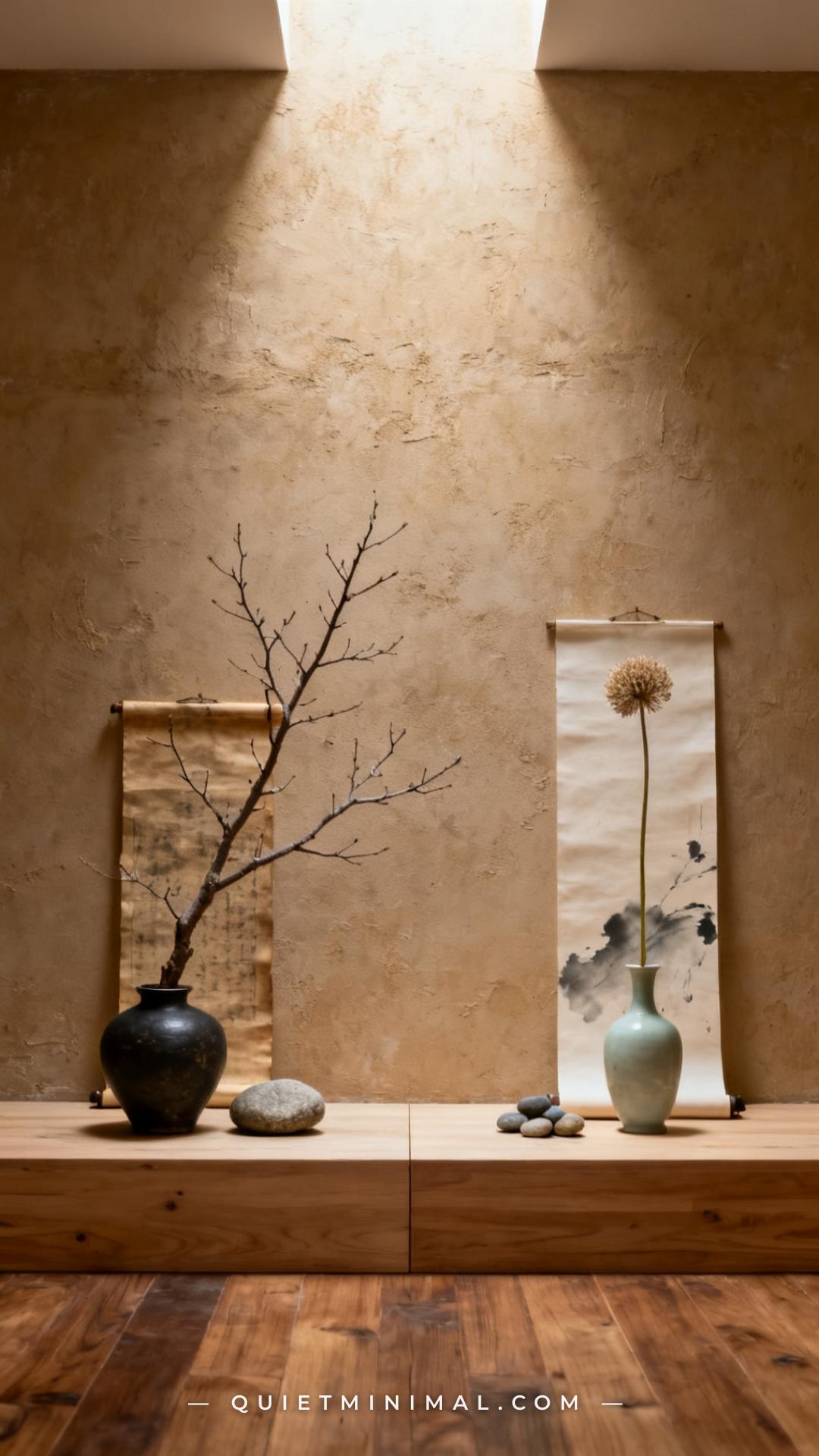
The tokonoma is not a permanent installation — it is a practice of paying attention to seasonal change. Traditional Japanese households rotated the entire display with each season: a different scroll for spring and autumn, a fresh organic element, a different ceramic form. This is not interior design busywork; it is the deliberate act of making time visible inside your home.
For a Western home, a quarterly rotation is a realistic rhythm. Keep a small box of seasonal objects — dried autumn leaves pressed flat, spring branches in a forcing vase, a piece of birch bark for winter, dried sunflower heads for late summer — and swap one or two elements each season rather than replacing everything at once. The critical discipline is removal: for every new element you add, something must leave the platform entirely. The display degrades in direct proportion to how many objects accumulate on it.
Key Takeaway: Rotation is the maintenance practice of a tokonoma — and the discipline is always in what you take away, not what you add.

10. Introduce a Piece of Aged Linen or Undyed Fabric as a Platform Layer
 Save
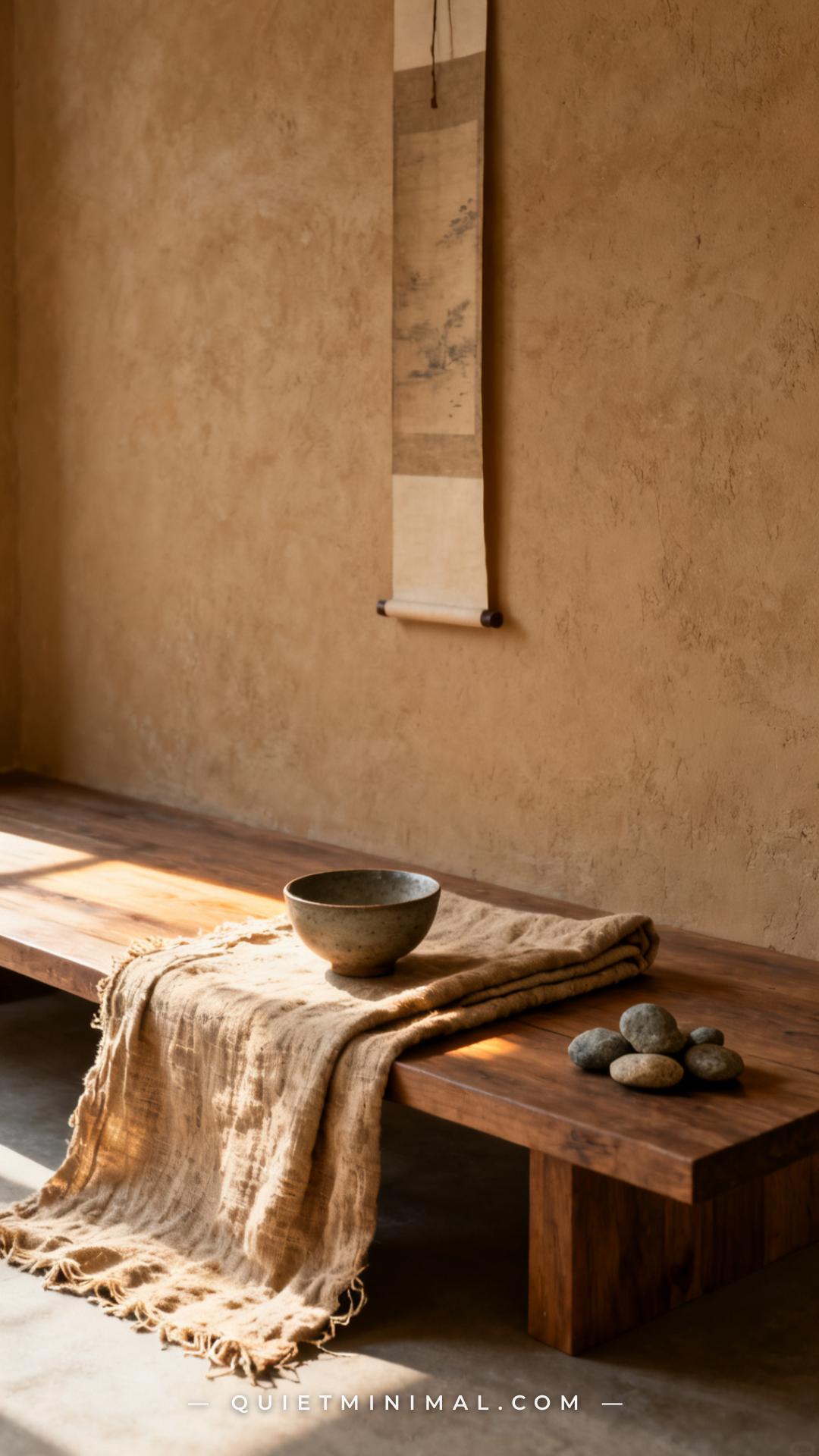
A single piece of undyed linen, aged cotton gauze, or natural hemp fabric laid beneath the ceramics does several things simultaneously: it softens the hard reflective surface of the wood or stone platform, it adds a second natural material to the palette, and it introduces a gentle sense of domestic care — the suggestion that this display was arranged with intention, not just placed.
The key is restraint in how the fabric is handled. Fold it once or twice into a loose rectangle and lay it flat under one object only — the primary ceramic piece or the ikebana vessel. Do not drape it across the full platform surface, which reads as a tablecloth rather than a considered element. Natural linen, undyed muslin, or a piece of aged cotton canvas are ideal. Avoid synthetic fabrics, which have a sheen that fights the matte, organic material palette that wabi-sabi requires.
Key Takeaway: One small piece of undyed linen folded flat under the primary ceramic creates a material layer that softens the platform and signals careful arrangement without overwhelming the composition.

11. Edit the Entire Display Down to Three Objects Maximum
Every element in this guide builds toward a display that is, in the end, ruthlessly edited. The final and most important principle of any tokonoma composition — and of wabi-sabi design broadly — is that nothing is added once the arrangement feels right. The temptation to add one more stone, one more sprig, one more object “just to fill the corner” is the exact impulse that erodes the entire effect.
Apply the three-object rule as a ceiling: the platform holds a maximum of three distinct objects at any one time, not counting the wall scroll and the light source. Three is enough to create spatial relationship and visual interest; four begins to compete; five becomes a collection. When you’re standing back from the finished display and something feels slightly sparse or incomplete, resist the urge to add anything for at least 24 hours. What feels like emptiness on day one usually resolves into calm on day two — and that calm is the entire point.
Key Takeaway: Three objects maximum on the platform is not a limitation — it is the design rule that makes everything else work, because negative space is not empty space in a wabi-sabi composition.

A tokonoma display doesn’t ask for more objects — it asks for more attention. The most common mistake is approaching this kind of alcove with the same instinct you’d bring to styling a bookcase: filling, layering, varying, adding. The tokonoma runs on the opposite logic entirely. You begin with a bare platform, a bare wall, and then you introduce one object at a time until the composition feels complete — which is usually sooner than you expect. Start with the scroll on the wall and the raku vessel on the platform. Live with it for a day. Then decide whether the ikebana branch adds to the silence or interrupts it. That act of deciding, repeated with each seasonal rotation, is itself the practice — and what Maya is really building here isn’t a decor moment, it’s a habit of looking.
Styling Ideas
 Save
Edit Your Tokonoma Alcove Ideas Down to Three Objects Only
 Save
Cracked Raku Pottery as the Soul of a Tokonoma Alcove Display
 Save
One Aged Scroll, Nothing Else — A Tokonoma Alcove Idea Worth Saving
 Save
Ikebana in a Narrow Vessel Lifts Any Tokonoma Alcove Arrangement
 Save
Weathered Driftwood Brings Organic Line to a Tokonoma Alcove Style
 Save
A Washi Paper Lantern Adds Glow to a Tokonoma Alcove Wabi-Sabi Vignette
From the guides
You've saved it, wanted it. Here's the how: codes, measurements, order. Your choices make it yours.
The Japandi Honest PlaybookThe honest version of the style: what to keep, what to skip, and the order to do it in.See inside →The Room Refresh PlaybookA repeatable four-step method, room by room, in ten minutes, thirty minutes, or one weekend.See inside →Make Any Room Feel Cozy on PurposeWhy some rooms hold people and others empty out, and the moves that change it.See inside →


