 Georgia
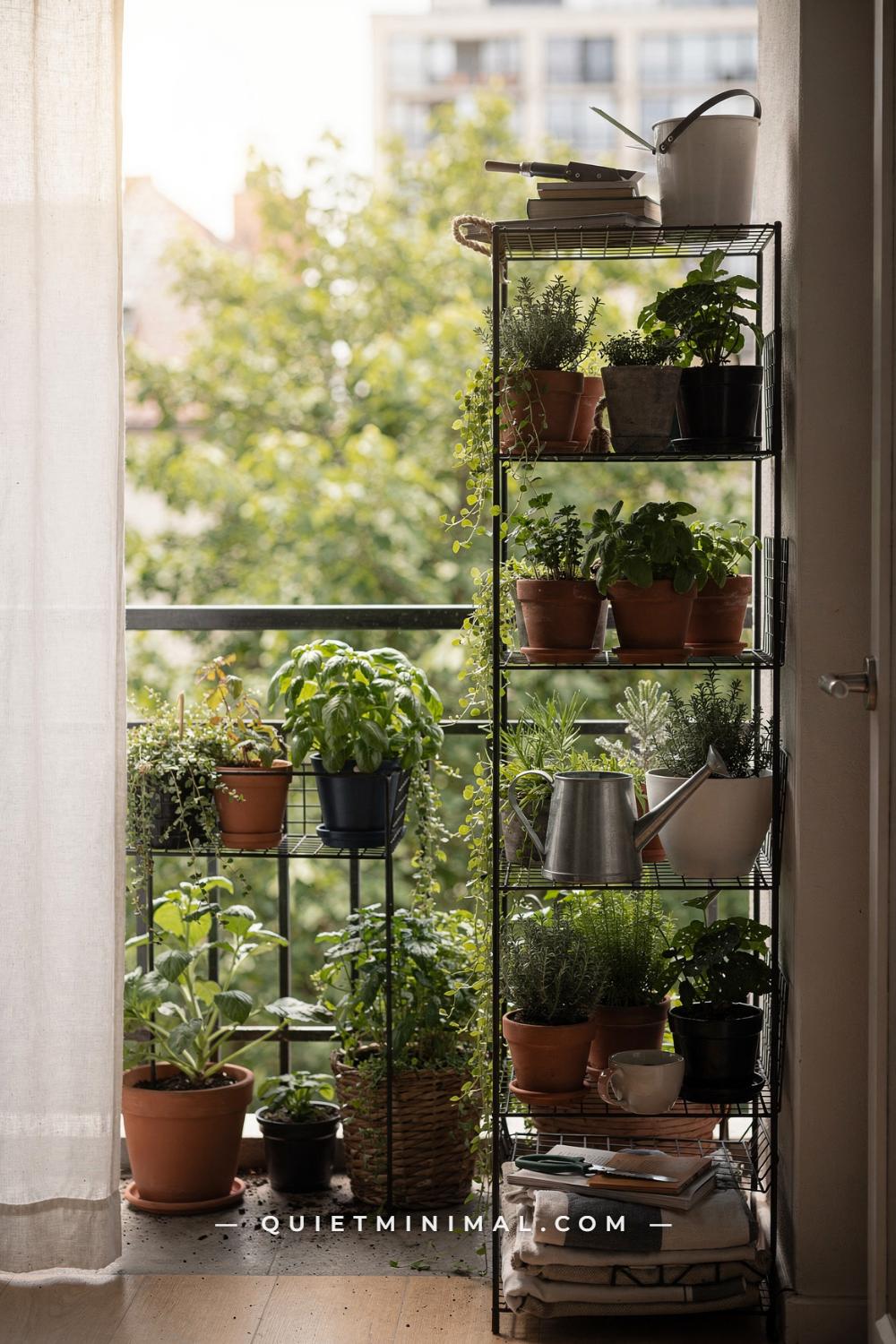
A balcony that is 4 ft (122 cm) deep can hold a garden you would happily eat breakfast in, or it can hold thirty pots you step around, and the difference is almost never the plants. It is the decisions a decorator would make in any small room: how many containers, in what material, at what spacing, with what to sit on and what to look at after dark. Urban gardening is usually taught as a growing problem, and the light and water advice matters, but the reason most balcony gardens look like a nursery clearance rack is a styling problem. This is the version of urban gardening for renters, for people who cannot drill, for one balcony or one window or a shared plot two blocks away. Each section below names one habit that makes a green space read as storage, why the eye reads it that way, and the correction that makes the same square footage read as a room. The photographs show the corrected version every time, because that is the one worth saving.
Buying One Pot at a Time Until the Balcony Reads as Storage
 Save
The most common urban gardening habit is the one nobody notices themselves doing: a pot from the supermarket in March, a glazed one from a market stall in May, two black nursery tubs that came free with the tomatoes, a hanging basket from a relative. By July there are fifteen containers in nine finishes, and the balcony reads the way a bookshelf reads when every book is a different height and colour. The plants are healthy, the picture is noise.
The mechanism is simple. The eye sorts a scene into figure and ground within a second, and it needs a repeating element to do that. Fifteen unrelated pots offer no repeat, so everything becomes figure and nothing becomes background. The plants, which are the whole point, lose to the containers.
The fix is not to throw the pots out. It is to give them a frame and a family. A wall-hung or freestanding black powder-coated metal shelf about 6 ft (183 cm) high and 3 ft (91 cm) wide with four or five tiers is the frame, and once the pots sit inside a black grid, the grid becomes the repeat and the pots read as contents. If you cannot mount to the wall, the same shelf in a freestanding leaning or tension-pole version does the job with no drill. Then edit the pot family down to three materials: rough terracotta, one glazed ceramic in a single colour, and matte black plastic. Terracotta gives warmth, the glaze gives one accent, the black disappears into the frame. Sizes can vary from 3 to 8 in (8 to 20 cm) across, and should, because varied sizes inside a consistent material read as abundance rather than chaos.
Plant it for texture, not variety. Rosemary and thyme give fine grey-green needles, trailing ivy and pothos give the cascade that softens the metal edge and links the tiers. Keep the overflow pots on the floor below the shelf, clustered against the wall in a group of three or five, not scattered along the railing. Against a plain white wall the whole arrangement reads as one deliberate object, slightly wild, clearly lived-in, and unmistakably chosen.
From the guides
You've saved it, wanted it. Here's the how: codes, measurements, order. Your choices make it yours.
 The Japandi Honest PlaybookThe honest version of the style: what to keep, what to skip, and the order to do it in.See inside →
 The Room Refresh PlaybookA repeatable four-step method, room by room, in ten minutes, thirty minutes, or one weekend.See inside →
 Make Any Room Feel Cozy on PurposeWhy some rooms hold people and others empty out, and the moves that change it.See inside →
Key Takeaway: Put your existing pots inside one black metal frame and limit the family to terracotta, one glaze colour and matte black, so the containers become background and the plants become the picture.

Packing the Shelf So Tight Nothing Has Room to Trail
 Save
Once people own a shelf, the next mistake is to treat every inch of it as a slot to fill. Eight pots on a shelf built for five, leaves pressed against the tier above, basil growing sideways into the mint. It looks generous for a fortnight and then it looks like a plant hospital, because the plants shade each other, the air stops moving and the lower leaves yellow from the inside out.
Visually the problem is the same one that makes a crowded gallery wall tiring. Spacing is what tells the eye that each object was placed. A 4-tier black wire shelving unit around 72 in (183 cm) tall, 18 in (46 cm) wide and 12 in (30 cm) deep holds four to five pots per tier comfortably if the pots are 4 to 8 in (10 to 20 cm) in diameter, which is the size range that actually suits herbs. That leaves about a hand’s width between rims, and that hand’s width is the whole design.
The correction is to plant for the space each plant will occupy in six weeks, not the day it goes in. Basil doubles in a month in warm weather, mint would fill the tier if you let it, thyme creeps outward slowly. Give each a pot with 1 to 2 in (2.5 to 5 cm) of clear soil around the root ball, then leave a gap between pots wide enough that a trailing stem can drop over the edge without touching its neighbour. Put the trailing plants, creeping thyme and the like, on the upper tiers so they hang into the gap below, and the mounding herbs on the lower tiers where they can grow up into it. That pairing is what produces the soft, cascading mass in a well-done vertical garden, and it only happens when there is somewhere for the cascade to go.
Materials stay quiet. Off-white ceramic, muted terracotta and charcoal plastic against black wire, on a plain concrete floor, is a four-tone palette. The forest green does the rest. If a tier looks empty, resist the urge to fill it; put a single larger pot in the centre and let the empty wire either side of it read as intentional.
Key Takeaway: Space pots on a wire shelf a hand’s width apart and plant for the size they will be in six weeks, because the gap is what makes the arrangement look placed instead of stored.

Building One Big Bed Instead of a Grid You Can Reach Across
 Save
If you do have a small yard behind the city house, the tempting move is one large raised bed, because one bed is cheaper than four and looks like more garden. The trouble shows up in week three. A bed wider than 4 ft (122 cm) cannot be reached from the sides, so you step into it, the soil compacts where you stood, and the middle of the bed becomes the place things are planted and then forgotten. From the kitchen window it reads as a single dark rectangle with a green fringe.
The reason a grid looks better is the reason a rug looks better than wall-to-wall carpet in a small room: edges. A grid of dark-stained cedar beds, each about 8 ft (244 cm) by 4 ft (122 cm) and 12 in (30 cm) high, gives the eye a rhythm of wood, soil, path, wood. The paths between beds want to be at least 18 in (46 cm) wide so a watering can and a person pass without brushing the tomatoes, and 24 in (61 cm) if you want a kneeling pad down. Four beds in a 2 by 2 grid with a cross of paths covers roughly 20 by 11 ft (6.1 by 3.4 m) including the walkways, which is a normal city backyard.
Plant each bed by height so the grid reads from the house. Cherry tomatoes on 48 in (122 cm) bamboo and steel cages go in the beds furthest from the window, peppers and butter lettuce in the middle distance, and the feathery carrot tops and low leaf crops nearest, so nothing tall hides anything short. A dark stain on the cedar matters more than it seems: it turns the beds into a frame the way a dark picture frame does, and makes the greens look more saturated by contrast. Untreated cedar goes silver in a year, which is a different, softer look and a fair choice, but decide, do not let it happen by default.
One sage-green metal watering can, 2 gal (7.5 L), left standing by the nearest bed is the only prop the scene needs. It is the right colour, it is the right scale, and it says someone tends this every evening.
Key Takeaway: Build several 4 ft (122 cm) wide beds with 18 to 24 in (46 to 61 cm) paths instead of one wide bed, because the edges and rhythm of a grid are what make a kitchen garden look designed from the house.

Treating a Shared Plot as Rows of Leftovers Instead of a Shape
 Save
Community and rooftop gardens fail as spaces for a reason that has nothing to do with growing. They get laid out as rows, because rows are how farms work, and rows on a roof read as an allotment: functional, a little bleak, nowhere to stand. The plants are fine. The place has no shape, so nobody lingers, and a garden nobody lingers in gets neglected by September.
What makes the best rooftop gardens feel civic is that they were laid out as a floor plan first. Irregular interlocking beds, in corten steel or hardwood, at 10 to 24 in (25 to 61 cm) heights, arranged like puzzle pieces around a central clearing, do two things at once. From above, and rooftops are always seen from above by the floors around them, the beds make a pattern rather than a strip. At ground level the varying heights make walls, and the central clearing becomes a room with those walls around it. A hedgerow along the exposed edge is the back wall of that room and the windbreak that stops the lettuces drying out in an afternoon.
The clearing is where the decorating happens. A white cloth over a plain folding table, a glass pitcher of lemonade and a stack of tall glasses at the harvest hour, and the whole roof reads as somewhere people gather rather than somewhere they work. Keep the tabletop to that: one pitcher, glasses, a bowl of whatever came out of the beds. Stone-grey paving or plain concrete underfoot is the right floor for it; anything patterned fights the bed pattern.
For your own share of a plot like this, the same logic applies at 4 by 8 ft (122 by 244 cm). Plant the outer edge of your bed with red-leaf lettuces and the centre with tall greens, so your piece contributes a border to the overall pattern. Corten weathers to a rust that flatters every green in the garden and needs no maintenance, which on a shared roof is worth more than any other quality.
Key Takeaway: Lay out a shared or rooftop garden as interlocking beds around a central clearing with a table in it, because a garden with a room in the middle gets used and a garden of rows gets abandoned.

Growing Everything at Knee Height and Forgetting the Ceiling
 Save
Most container and courtyard gardens live entirely between the ground and your knees. Beds, pots, more pots, and then bare wall and open sky. It grows food perfectly well, and it never feels like a place, because a room needs a ceiling and this one has none. The same courtyard with something overhead reads twice as large and ten times as private.
The fix is a structure you walk under. A bamboo pergola lashed from poles 8 to 10 ft (244 to 305 cm) long, spanning a path about 3 ft (91 cm) wide, makes a corridor with a green roof once a vine covers it. Grapes are the classic choice because they leaf out fast, hang fruit at eye level, and go bare in winter to let light back in. In a warm climate passion fruit does the same job faster. The point is not the crop, it is the canopy: dappled light on the path, a roofline the eye can rest on, and the sense of walking into something rather than past it. If lashing a pergola is beyond your lease, a freestanding steel arch 7 ft (213 cm) tall over the path is the no-drill version and holds a vine just as well.
Underneath, low brick raised beds about 12 in (30 cm) high on either side of the path do the work of a hallway’s side tables. Fill them with the dense, glossy, coloured crops: red peppers, cabbage, cauliflower, lettuce in rows, so the corridor is lined with texture. Stone stepping stones of 12 in (30 cm) square set into gravel or ground cover give the path a rhythm and keep feet out of the mud.
Water is the last layer and the one people skip. A small pond about 6 ft by 3 ft (183 by 91 cm) with a quiet bubbler, even a preformed liner sunk into a corner bed, reflects the canopy and adds the one sound that makes a courtyard feel enclosed from the street. Terracotta brick, turquoise water, purple fruit and vivid green is a palette that already exists in every tropical kitchen garden, and it works because every colour in it is a material, not a paint.
Key Takeaway: Give a courtyard garden a ceiling with a vine on a bamboo pergola or a freestanding arch, line the path with low brick beds and add one small pond, because a green roof and a reflection are what turn a productive strip into a place.

Loading a Rooftop With Garden Soil the Structure Was Never Asked to Carry
 Save
The rooftop mistake is invisible until it is expensive. Bags of garden soil go up the stairs one at a time, a bed gets filled, then another, and nobody adds it up. Wet soil weighs 100 to 130 lb (45 to 59 kg) per cubic foot. An 8 ft by 4 ft bed 10 in (25 cm) deep holds about 27 cu ft (0.76 cu m), which saturated after a storm is around 3,000 lb (1,360 kg) sitting on a rectangle of roof. Residential balconies are commonly designed for a live load of 60 psf (293 kg per sq m), and that bed alone is putting roughly 94 psf on its footprint. The structure may well take it, but you should know the number before the landlord does.
The correction is to build lighter and to spread the load, and it happens to look better. Warm cedar beds at 8 by 4 ft (244 by 122 cm) and 10 in (25 cm) high, filled with a container mix built on coir, perlite and compost rather than bagged topsoil, weigh less than half of a soil-filled bed and drain faster, which lettuce and kale prefer anyway. Set the beds over the roof’s beams or along the perimeter where the structure is stiffest, never clustered in the centre of a span, and leave paths of white or grey coarse gravel between them. Gravel is light, it reflects light up into the lower leaves, and against warm cedar it makes the greens look almost lit from within.
Along the exposed back edge, a run of tall ornamental grasses in the last bed is the windbreak. Rooftop wind is the thing that kills roof gardens, not sun; it dries a 10 in bed in a day in July. A 4 to 5 ft (122 to 152 cm) grass screen slows it without blocking the skyline, and the movement of the grass is what makes the space feel alive when nothing is fruiting.
Keep the metal safety railing plain and unplanted. Hanging pots on a parapet railing add point loads where you least want them, and they clutter the one clean line in the picture. The skyline is the wall art. Let it be.
Key Takeaway: Fill rooftop beds with a light coir-and-perlite mix rather than garden soil, set them over beams with gravel paths between and a grass screen at the windward edge, because a roof garden that is light and spaced is both safer and better looking.

Leaving the Side Yard as a Path You Walk Down Once a Week
 Save
Most row houses have a strip between the wall and the fence about 3 to 5 ft (91 to 152 cm) wide that holds the bins, a hose and nothing else. It gets walked once a week. The mistake is to see it as a corridor rather than as a long, narrow room, and long narrow rooms are the ones designers love, because the proportion does half the work of making a space feel deliberate.
Treat it like a hallway with three layers. The ceiling layer is a bamboo trellis arch about 7 ft (213 cm) high and 4 ft (122 cm) wide, set two-thirds of the way down the strip so there is something to walk toward. Cucumbers trained up and over it hang their fruit at head height, which is the single most satisfying thing a small garden can do and the one reason to grow them here rather than on the ground. The wall layer, along the fence side, is a three-tier rough-sawn wood planting stand about 48 in (122 cm) tall for lettuce and dark leafy greens, so the crops that need picking most often are at hand height by the kitchen end. The floor layer is a pea-gravel path with irregular 12 in (30 cm) stepping stones set at a natural stride, which keeps the strip dry and gives it a rhythm.
Along the house side, where the wall reflects heat, put the tomatoes. Recycled tyre planters painted a single leaf green, 18 in (46 cm) across, are the resourceful version and they disappear against the foliage once they are planted; the tidier version is a row of matching 18 in fabric grow bags in one colour. Either way, repeat the same container down the strip. Repetition is what turns a collection into a border.
Edge the border with a single flower in a single colour. Orange marigolds along the gravel line do it here, and they earn their place twice: they draw the eye down the length of the strip toward the arch, and they are the classic companion for tomatoes. One colour, not four. The brick wall, the wood fence, the warm bamboo and the pea-stone beige already give you a four-material palette, and the marigold is the accent.
Key Takeaway: Run a bamboo arch overhead, a tiered stand along the fence, repeated planters along the wall and one flower colour at the edge, because a side yard laid out as a hallway with a ceiling, walls and a floor becomes the best room outside.

Hanging a Living Wall and Planting It Like a Flower Bed
 Save
Vertical pocket gardens are the most saved and most abandoned idea in urban gardening, and the reason is that people plant them like a border. A pocket about 6 in (15 cm) wide and 5 in (13 cm) deep holds a cup or two of soil. Put a tomato, a pepper or a rosemary bush in that and it will sulk, dry out by lunchtime and be dead by August, and the wall will read as a grid of failure.
Planted for what it is, the same wall is the most productive square yard on the property. A natural pine slat panel around 8 ft (244 cm) high and 6 ft (183 cm) wide, leaned or hung on a fence or wall, carries black plastic pockets in a tight grid. The plants that live in a cup of soil are the shallow-rooted, fast leaf crops: butter lettuce, loose-leaf lettuce, spinach, bok choy, arugula, and every cut-and-come-again green. They finish in five to seven weeks, they are picked from the outside in, and they never need the depth they do not have.
The design move is to plant it in waves, not all at once. Sow or plant the top rows first and the lower rows two or three weeks later, so at any moment the wall shows full ruffled heads above and small establishing seedlings below. That staggered picture, dense lime green over darker young growth, is what makes a living wall look tended rather than just installed, and it means there is always something to cut. Water from the top and let it trickle down; a low wood raised bed about 8 in (20 cm) deep along the base catches the run-off and grows a row of chard or herbs on it.
Keep the panel plain. Natural pine, matte black pockets, nothing painted, no labels. The frilled lettuce against pale wood is the whole composition, and it looks the same from a kitchen window as it does from 2 ft away. Indoors, in a bright window or under a light bar, the identical setup at half the size works on a wall of the kitchen.
Key Takeaway: Plant a pocket wall only with shallow-rooted leaf crops, in staggered waves so full heads sit above new seedlings, because a living wall planted for its depth stays green and one planted like a border dies by August.

Assuming Urban Gardening Needs Land You Own
 Save
The quiet mistake is the one that stops people starting: the belief that a real garden needs a yard, and a yard needs a mortgage. So the balcony gets a basil plant and the idea gets shelved. Meanwhile most cities run community gardens on vacant lots between apartment buildings, allocated by plot, with waiting lists that move faster than people assume, and a 4 by 8 ft (122 by 244 cm) bed in one of them grows more than a whole balcony.
What these gardens look like is worth understanding, because it is a style in itself and it is a style you can borrow. Two parallel rows of weathered, untreated pine or cedar beds, in sizes from 4 by 4 ft (122 by 122 cm) to 4 by 8 ft, run the length of a narrow lot between brick walls, with plain soil or gravel paths between. Nothing is stained, nothing is matched, and yet it reads as a place with a strong identity because every bed is the same weathered grey-brown, every path is the same width, and the brick facades and water towers frame it like a courtyard.
If you take a plot, the way to make it look cared for from the first week is to hold to that discipline. Use the same bamboo and metal cages as your neighbours rather than a novelty support. Mulch the surface of your bed with a single material so it reads as one dark rectangle. Plant the edge with a low crop and the centre with a tall one so your bed has a silhouette from the path. Leave a 2 ft (61 cm) clear path on all sides and keep it swept, because the paths belong to everyone and a tidy path is what makes a garden look organised from the street.
For a renter this is also the answer to weight limits, drilling, light and lease clauses all at once. The balcony grows the herbs you cut daily and the plot grows the tomatoes and squash. The two together are an urban garden. Neither is one on its own.
Key Takeaway: Take a community plot for the crops that need depth and keep the balcony for the herbs you cut daily, and match your bed to the shared garden’s weathered wood, cage and path discipline so it looks tended from the first week.

Spreading Pots Across the Floor When the Garden Should Lean
 Save
On a balcony 4 ft (122 cm) deep, every pot on the floor is a square foot you cannot stand on. People start with three, add six, and end the summer with a floor they cross sideways and a chair pushed into the corner. The garden has taken the room. That is the moment most balcony gardens get reduced to two pots in October and never come back.
The correction is the A-frame ladder planter, and the reason it works is that it borrows the wall without touching it. A rough-sawn, weathered-wood A-frame about 6 ft (183 cm) high and 3 ft (91 cm) wide with three or four stepped tiers leans against a fence or wall at a shallow angle, its own weight holding it. No drilling, no anchors, nothing a lease can object to, and it can go to the next apartment in the back of a car. Its footprint is roughly 3 by 2 ft (91 by 61 cm), and in that footprint it holds what would otherwise be twelve floor pots.
Plant it by tier, the way you would style a bookcase. The top tier gets trailing plants, nasturtium or a trailing squash or sweet potato vine, so the greenery falls down the front of the frame and links the shelves. The middle tiers are the crops with height and colour: kale, compact cabbage, a cherry tomato staked to the frame with its orange-red fruit at eye level. The bottom tier, widest and closest to the ground, gets the heavy, spreading things, big butter lettuce heads that spill over the edge and hide the base. Top light, middle dense, bottom heavy, and the frame reads as a single cascade rather than a rack.
Weathered silver-grey wood against a dark stained fence is the palette here, and it is the one to keep. Do not paint the ladder, and do not add a coloured pot to it. The vivid greens and the glossy tomato do the colour work, and the silver wood is what lets them.
Key Takeaway: Move the floor garden onto a leaning A-frame ladder planter, planted trailing on top, tall and colourful in the middle and heavy at the base, because it holds a dozen pots in 6 sq ft (0.56 sq m), needs no drill and gives the balcony floor back.
Leaving the Tools Out So the Plot Looks Like a Job Site
 Save
A garden bed looks two ways at once: like the thing that is growing and like the work that grew it. Most plots fail on the second one. A blue plastic trowel in the soil, a coiled orange hose, a torn bag of compost against the bed, a bucket, a plastic chair. The photograph nobody takes is the one with all of it in shot, and yet that is the plot as it is seen every day.
The fix is to choose a small, permanent kit that looks right left out, and to store everything else out of sight. Three things earn their place on a bed edge: a metal hand fork or cultivator, a pair of plain grey gloves and a folded brown leather or waxed canvas apron. They are the right materials, steel, leather and cotton, in the right colours, and they read as care rather than clutter. Everything plastic, bright or bagged goes into a lidded bin at the plot edge or back to the shed.
The untreated pine or cedar beds, about 8 by 4 ft (244 by 122 cm) and 10 in (25 cm) high, do the rest of the work if you let them weather and keep their tops clear. A bed edge is a shelf, and like any shelf it looks best with one thing on it, not five. Dark moist soil, freshly cultivated, is itself a finish; a bed with an even, forked, dark surface and nothing standing in it looks tended in a way that no ornament can fake.
There is a rhythm to this that keeps it looking that way. Water in the early morning or evening, when the low light comes across the beds and the wet soil reads darkest. Fork the surface lightly once a week so it never crusts pale. Harvest from the outside of the bed inward so the silhouette stays full. Cut, do not pull, so the row stays even. None of it takes ten minutes, and it is the difference between a plot that looks like a project and one that looks like a garden with a person behind it.
Key Takeaway: Keep one steel hand fork, plain gloves and a leather or canvas apron as the only things left on a bed edge, put everything plastic in a lidded bin, and fork and water on a rhythm, because a plot reads as a garden only when the work is invisible.

Keeping Tomatoes in Black Nursery Tubs When a Grow Bag Is the Renter’s Raised Bed
 Save
The tomatoes came in a black plastic tub, so they stay in the black plastic tub. It is the default that makes more balconies look temporary than any other, because nursery pots are designed to be thrown away and they look it: thin, shiny, dented, and every one a slightly different black. A row of them along a railing says the garden has not moved in yet.
Fabric grow bags are the renter’s answer to a raised bed, and they are also the better-looking object. A 10 gal (38 L) bag is about 16 in (41 cm) across and 12 in (30 cm) deep, enough for one indeterminate cherry tomato with a cage, or a bush zucchini, or two peppers. A 15 to 20 gal (57 to 76 L) bag at 18 to 20 in (46 to 51 cm) across takes a dwarf blueberry or a full stand of chard. The fabric lets roots air-prune at the edge instead of circling, so plants stay healthier in less soil than they would need in a hard pot, and a wet 10 gal bag weighs around 60 lb (27 kg), well under the point-load worry of a ceramic pot the same size. At the end of the lease they fold flat.
The decorating rule is the one that runs through this whole article: repeat the container. Four bags of the same size in the same tan canvas along the railing, two larger ones in charcoal at the corner, and the balcony reads as a planted border instead of a collection. Tan against black steel is a clean pairing; charcoal against a dark fence is the other. Avoid the bags printed with brand names or handles in a contrast colour, and avoid mixing three colours of bag, which brings the nursery-tub problem back in fabric.
Set them straight on the concrete or on a slatted mat so they drain, with a saucer only under the ones near the neighbour’s balcony below. A small teak stool beside the row, holding a stoneware bowl of what you picked, is the finishing touch and the argument for the whole thing.
Key Takeaway: Move tomatoes, peppers and zucchini into matching 10 to 20 gal (38 to 76 L) fabric grow bags in one colour along the railing, because a repeated soft container in one weave is the renter’s raised bed and looks like a border instead of a nursery.

Planting Every Flower Colour at Once and Losing the Green
 Save
Flower colour is the one place urban gardeners let go completely. A tray of mixed annuals from the garden centre, red and yellow and purple and orange in one flat, goes into one balcony, and by June it looks like a party supply aisle. Every colour is competing, none of them is winning, and the green, which is the material that makes a garden restful, disappears behind the noise.
Think of flowers the way you think of throw pillows. The room is the green. The flowers are the accent, and one accent colour reads as a decision while five read as leftovers. The most forgiving palette for a small space is white on green: white cosmos, white geraniums, white bacopa trailing, with a silvery lavender for a second note, and boxwood or rosemary as the plain green that holds it together. White flowers glow at dusk, which matters on a balcony you mostly use after work, and they flatter every pot colour.
Then repeat the pot. Five glazed ceramic pots in one colour, sage green here, in graduated sizes from about 8 to 18 in (20 to 46 cm) across, grouped in a triangle rather than a line. A triangle has a front pot, a back pot and a tall pot, which gives the group depth from any angle; a line has none. Set them against a plain wall, whitewashed brick or a rendered surface, so the sage glaze and the silver-green foliage read against something quiet.
If white is too restrained, pick one warm colour and hold it: all orange (marigold, calendula, nasturtium), or all deep purple (salvia, verbena, heliotrope). The plants change with the season and the colour rule stays. Add a plain teak bench with one cushion in the same white as the flowers, and the corner is a room.
Key Takeaway: Choose one flower colour, white on green being the most forgiving, and repeat one glazed pot colour in graduated sizes grouped in a triangle, because the green is the room and a single accent is what makes a small garden look composed.

Hooking Planters Over the Outside of the Railing
 Save
Railing planters look like the answer to a small balcony and they usually go on wrong. Hooked over the outside of the rail, they hang above the neighbour below, they drip on that neighbour, they are the first thing a gust takes, and in most buildings they break a clause in the lease. From the street they look like a hazard, because they are one.
From the guides
You've saved it, wanted it. Here's the how: codes, measurements, order. Your choices make it yours.
The Japandi Honest PlaybookThe honest version of the style: what to keep, what to skip, and the order to do it in.See inside →The Room Refresh PlaybookA repeatable four-step method, room by room, in ten minutes, thirty minutes, or one weekend.See inside →Make Any Room Feel Cozy on PurposeWhy some rooms hold people and others empty out, and the moves that change it.See inside →The version that works is the saddle planter mounted on the inside. A powder-coated steel saddle or trough with a bracket that sits over the top rail and rests against the inside face carries about 24 in (61 cm) of planting at hand height, drains onto your own floor, and needs no screws, so it goes on and comes off in a minute. Three of them in a row, in the same colour as the railing, and the railing turns into a planted edge rather than a fence with things attached. Matching the rail colour is the whole trick. Charcoal on black disappears; white on black reads as a row of boxes.
Plant them for the view from the chair, not from the street. Alpine strawberries, trailing thyme and compact basil sit at the height you reach for them, and they are low enough that the view stays. Anything taller than 12 in (30 cm) on a railing blocks the one thing the balcony has. Put the height on the floor instead: two rectangular charcoal fibre-clay troughs holding a dwarf pepper and a lemon verbena, standing below the saddles, so the planting steps down from the rail to the floor and the corner reads as a bank of green.
Leave the floor in front of them clear for a round folding bistro table and a pitcher of iced mint tea. The rail garden is for mornings. It should look like somewhere a morning happens.
Key Takeaway: Use inside-mounted saddle planters in the same colour as the railing, planted low with strawberries and herbs, with the taller plants in troughs on the floor beneath, because the railing becomes a planted edge and the view, the neighbour and the lease all stay intact.

Leaving Supermarket Basil in Its Pot to Die on the Sill
 Save
The pot of basil from the grocery store is not one plant. It is thirty seedlings sown dense in a peat plug to look full on the shelf, and it is designed to last a week. Left on the windowsill in its plastic sleeve it collapses, yellows, and becomes the reason people decide they cannot keep herbs alive. Three of them in a row on a sill, in three different plastic pots, is the most common kitchen garden in the country and the saddest.
The correction takes ten minutes. Slide the plug out, tease it into three or four clumps, and pot each into a 6 in (15 cm) pot of fresh container mix with a drainage hole. Water once, then let the top inch dry between waterings. The same goes for parsley, chives and thyme, which arrive the same way. Within three weeks you have a sill of plants that behave like plants.
Then style the sill the way you would style a shelf. Four matching pots, white matte ceramic or plain terracotta, on one long tray of dark wood or slate, so water has somewhere to go and the group reads as one object. The tray is what makes four pots look composed; without it they look like four errands. Keep them to the same size, and keep the tray to the length of the sill with an inch to spare at each end.
Light is the part that decides whether this lasts past October. A north or shaded window in a city apartment gives herbs a fraction of what they need. A slim full-spectrum LED bar fixed under the cabinet above the sill, on a timer for twelve to fourteen hours, keeps basil bushy through winter, and the newer bars in warm white light look like task lighting rather than a laboratory. It is the only wired thing in this article, and it plugs into the counter outlet.
Key Takeaway: Split supermarket herbs into 6 in (15 cm) matching pots on one dark tray and add a warm-white LED bar under the cabinet on a timer, because a repotted, lit sill garden lasts through winter and reads as a styled shelf rather than three errands.

Hiding Indoor Plants in the Dark Corner Because the Light Looks Clinical
 Save
Indoor edibles fail in one of two ways. Either they are put in the brightest window, which is the place a chair or a desk wants to be, or they are put where there is room, which is the dark corner, and they die. The second happens because the fix, a grow light, is imagined as a purple glowing panel that would ruin the room, so nobody buys one.
The panels of ten years ago did look like that. The current generation is a slim bar of full-spectrum LEDs in warm white, the same colour as a good reading lamp, and the way to use one is as a lamp: fixed under a shelf, lighting the shelf below it. Two bars under two shelves of an open ash unit give you 3 to 4 ft (91 to 122 cm) of growing space at chest height in a living room, and the light spills a warm glow on the wall that reads as under-shelf lighting, which is exactly what it is. On a timer for fourteen hours the bars cost pennies a day and the plants behave as if it were May.
What to grow under it is the decorating decision. Dwarf chilli plants for the red fruit, compact lettuces for the ruffle, and a tray of microgreens for the dense green mat, in matching white cylinders so the shelf reads as a planted row rather than a science project. Keep the rest of the unit sparse: a run of ordinary books, one stoneware vase, one small abstract sculpture in plaster. The greenery is the collection.
The rule is that the grow shelf should look like it belongs in a room, and that means the same materials as the room. Pale ash, white ceramic, a linen sofa, an abstract canvas in soft greens, and the black light bars vanishing under the shelf edge. Nobody who walks in will know the lettuce is under a grow light, which is the whole point.
Key Takeaway: Fix warm-white LED grow bars under open shelves and treat them as under-shelf lighting for a row of matching white pots, because a grow shelf built from the room’s own materials lets you garden anywhere in the apartment, not just at the window.

Watering Every Pot by Hand and Then Going Away for the Weekend
 Save
Container gardens die in threes: one weekend away in July, and the basil, the tomato and the lettuce are all past saving by Monday night. A pot has no reserve. On a bright, windy balcony a 10 in (25 cm) pot can lose all its water in a day, and hand-watering twice a day is not a routine anyone keeps through August. The garden is then rebuilt in spring and abandoned again, and the balcony looks like a place where things die.
The fix is to stop watering by hand and to build the water into the containers. Three systems, in order of effort. Self-watering planters carry a reservoir in the base and a wick, so a tall 28 in (71 cm) planter can go a week between fills; used for the permanent, woody plants, a bay, a dwarf fig, a rosemary, they are the anchor pieces of the terrace and the ones that must not be lost. A drip line on a battery timer from the outdoor tap, a slim black tube run along the base of the wall with an emitter into each pot, handles everything else and costs about an afternoon to lay. And ollas, unglazed terracotta jars buried to the neck, seep water into the soil around them for days and are the oldest trick in the book for a bed of herbs.
The decorating side is that the watering system decides the containers, and matching self-watering planters in one finish are a better-looking row than any mix of pots. Four tall matte white planters in one design along a pale grey wall read as architecture. The drip line disappears against the wall base. The olla tops showing in a gravel bed look like what they are, which is old and right.
Group plants by thirst so each system serves the right ones: the woody Mediterranean plants together on the reservoirs, the salad and annual crops together on the drip, the herbs in the olla bed. Then go away for the weekend.
Key Takeaway: Put the woody anchor plants in matching self-watering planters, the annual crops on a drip line with a timer and the herbs around buried ollas, because a garden that waters itself survives August and matching reservoirs are the best-looking row on the terrace.

Filling the Balcony With Plants and Leaving Nowhere to Sit
 Save
The balcony that finally has enough plants often has no room for the person who planted them. This is the mistake that turns an urban garden back into storage: the chair is folded against the wall, the door only opens halfway, and the garden is tended standing up and then looked at through the glass. A space you cannot sit in is not a room, no matter how green it is.
Start with the seat, not the plants. On a balcony 4 ft (122 cm) deep and 8 ft (244 cm) long, one folding slatted acacia chair and a round table about 20 in (51 cm) across take up a footprint of roughly 3 by 3 ft (91 by 91 cm). Place them first, at the end nearest the door where you will actually use them, and turn the chair to the best view, not toward the wall. Then plant the two ends and the railing, and leave the middle open. The plants become the walls of a tiny room and the chair sits inside it.
The ends are where the height goes. A tall charcoal planter with a dwarf olive or a bay in one corner, a three-tier metal stand of terracotta herb pots in the other, and one low saddle planter of trailing thyme on the inside of the rail. That is enough green to feel enclosed; more than that and the walls close in. A flatweave outdoor rug in sand and charcoal under the chair does more than anything else to make the concrete read as a floor rather than a landing.
Then the table. A clear glass pitcher of iced mint tea, made from the mint on the stand, and one tall glass. That is the picture, and it is the picture that gets you to sit out there on a Tuesday, which is the only measure of a balcony garden that matters.
Key Takeaway: Place one chair and a small table first, push the planting to the two ends and the rail, and put a rug under the chair, because a balcony garden is only a room if there is somewhere in it to sit with a glass of something.

Screening the Neighbours With Plastic Instead of Something That Climbs
 Save
The neighbour’s balcony is 6 ft (183 cm) away, and the usual answer is a roll of green plastic screening zip-tied to the railing. It works for one summer, fades to a chalky lime, sags in the wind, and from both sides says exactly what it is. A balcony can be private without looking like it is hiding, and the way to do that is to grow the screen.
A freestanding bamboo trellis panel about 6 ft tall and 4 ft (122 cm) wide, set in a long, heavy trough of fibre-clay or a wide planter box so its own base holds it up, needs no fixing to anything. Plant the trough with climbers and by midsummer the lattice is a green wall. Scarlet runner beans are the fastest and the best-looking, with red flowers and a crop; sweet peas in white give scent at seated height; a climbing nasturtium fills the low gaps in orange. For a permanent screen, a star jasmine or an ivy on the same frame stays green through winter in a mild climate.
The design point is that a living screen filters rather than blocks. Light comes through the lattice, the neighbour’s balcony goes soft rather than vanishing, and your side gets a wall of leaf with flowers in it. That is a better wall than any solid panel. It also reads as intentional from the street, which a plastic roll never does.
Use the same bamboo weave for anything else that needs screening, so the balcony has one lattice language. A second, shorter panel leaning in the far corner behind a bench of weathered teak hides the air-conditioner unit or the neighbour’s bins and carries a second climber. Two terracotta pots of chives on the bench and the corner is finished. Honey bamboo, charcoal trough, grey teak and terracotta: four materials, one accent flower colour, and privacy that gets better every week.
Key Takeaway: Stand a bamboo trellis in a heavy trough and plant it with runner beans or sweet peas instead of tying plastic screening to the rail, because a living lattice filters light and looks intentional from both sides.

Twenty Small Pots When Three Large Ones Would Make the Room
 Save
Small pots are cheap and easy to carry home, so a courtyard or terrace ends up with twenty of them, each 6 to 8 in (15 to 20 cm) across, each drying out by noon, each holding one plant that never gets big enough to matter. From the doorway it reads as a collection of samples. The eye counts them, and counting is the opposite of resting.
Every container-design source this year says the same thing, and it is worth believing: fewer, larger planters. Three pots of 18 to 24 in (46 to 61 cm) across hold more soil than twenty small ones, dry out at a fraction of the rate, and give plants room to reach the size that makes an impression. Visually three objects in graduated sizes in a triangle read as a composition; twenty read as inventory. This is the same reason one large sofa beats three small chairs in a small living room.
Plant each large pot as a complete arrangement using the thriller, filler, spiller rule. The thriller is the tall centre, a multi-stem olive, a feather grass, a dwarf tree. The filler is the mound around its base, lavender, thyme, a compact salvia. The spiller trails over the rim, silver dichondra, white alyssum, creeping thyme. One pot planted this way is a whole border in 3 sq ft (0.28 sq m). Three of them in one material and colour, charcoal fibre-clay against an off-white wall, are the courtyard.
Fibre-clay and fibreglass are the materials to choose at this size, because a 24 in glazed ceramic pot full of wet soil is a two-person lift and a point load, while a fibre-clay one is half the weight and looks identical from 3 ft away. Set the group off-centre against the longest wall, leave the paving in front of it open, and put one bench along the wall so the pots have something to belong to.
Key Takeaway: Replace twenty small pots with three large fibre-clay planters in graduated sizes, each planted thriller, filler and spiller, because three big pots in a triangle read as a composed garden and twenty small ones read as inventory.

Growing on Bare Concrete That Reads as a Landing, Not a Floor
 Save
Nearly every rented balcony has the same floor: grey concrete, sometimes painted, sometimes stained where a pot stood for a year. Plants placed straight onto it look like they are waiting to be moved. The reason is that concrete is the material of landings and car parks, and the eye files the balcony under those until the floor says otherwise. No amount of planting fixes a floor that reads as outside the home.
The correction is a floor you lay in an afternoon and lift in an hour. Interlocking acacia or teak wood tiles, about 12 in (30 cm) square, snap together over the concrete on plastic grids, need no glue or fixing, and can be lifted and taken to the next apartment. A 4 by 8 ft (122 by 244 cm) balcony takes 32 tiles. Lay them with the grain alternating in a checkerboard, which hides the joins and looks like it was always there. Warm acacia under a black railing is the most flattering pairing for foliage; the pots stop looking parked and start looking placed.
Once the floor is wood, the rest of the balcony falls into line with less. A row of matching charcoal grow bags along the rail, one tall terracotta rosemary in the far corner, a teak stool with a stoneware jug, a seagrass basket by the door for gloves and twine. Wood, terracotta, canvas, seagrass: the tiles set the material language and everything else follows it. It is the same effect as putting a rug down in a room with nothing else changed.
Two practical notes. The grids lift the tiles about 1 in (2.5 cm), so water drains under them and pots do not sit in puddles, which also means the grow bags stay drier at the base. And oil the tiles once a year with a plain wood oil, or let them silver, but decide, as with cedar beds, rather than let it happen.
Key Takeaway: Lay interlocking acacia floor tiles over the concrete before adding another plant, because a wood floor is what makes a balcony read as part of the home, and every pot on it looks placed instead of parked.

Letting the Garden Vanish From October to April
 Save
The balcony garden that looked full in July is, by November, a row of empty pots with a dead tomato cage in one of them, and it stays that way for six months. Half the year the room outside the window reads as abandoned. That is not a growing failure, it is a planning one: everything chosen was an annual, and nothing was chosen for structure.
Gardens that hold through winter are built on evergreens first and crops second, in the same way a room is built on the furniture that stays and dressed with things that change. Three tall planters holding a clipped bay, a dense rosemary and a dwarf conifer are the furniture. They are the same three pots all year; in summer the annuals are grouped around them and in winter they stand alone and look intended. A low trough at their base with a winter heather in white and a variegated ivy gives a second line of colour at the coldest time of year, and both are cheap and hardy.
For the crops, a small cedar cold frame with a glass or polycarbonate lid, about 3 ft (91 cm) wide and 18 in (46 cm) deep, sits against the wall and grows lamb’s lettuce, winter spinach and mizuna through the cold months in most temperate cities. It looks like a piece of furniture, which is the point: warm cedar and glass against a charcoal planter is a good pairing in any light, and the rows of green under the lid are the winter version of the summer harvest.
Keep the chair out. A thick wool blanket over its back, the table beside it, and the balcony says it is used in January too. Clear the dead annuals promptly, top the empty summer pots with a mulch of bark or gravel so they read as resting rather than dead, and stack the cages out of sight. A winter garden is mostly an edited one.
Key Takeaway: Build the balcony around three evergreen anchor planters, add a cedar cold frame for winter greens and leave the chair out with a blanket, because a garden planned for structure looks intended in January and a garden of annuals looks abandoned.

Storing the Soil Bags and Tools Where Everyone Can See Them
 Save
A balcony garden comes with a half bag of potting mix, a bag of perlite, a bottle of feed, a hose, twine, labels, a trowel and a bag of the plastic pots the plants arrived in. On a balcony there is nowhere for any of it, so it lives in the corner in a plastic tub, or on the floor, and the garden looks like a project in progress from the first day to the last. Nothing kills the sense of a room faster than visible supplies.
The fix is a piece of furniture. A lidded teak storage bench about 4 ft (122 cm) long, sealed against rain, holds every bag and bottle inside and gives you a second seat on top with one cushion. It goes against the wall, it needs no fixing, and it turns the ugliest square yard of the balcony into the most useful one. Beside it, two plain galvanised steel bins with tight lids, one for potting mix and one for the hose, look like they belong outside and keep the mix dry and the mice out. Galvanised steel, teak and terracotta share a palette; plastic tubs share one with nothing.
Tools want a place that is both hidden and at hand, and the answer is a short black metal rail with hooks, fixed to the wall if you can, or hung from a hook over the bench if you cannot, holding the three tools you actually use: hand fork, trowel, secateurs. Three tools in a row on a rail look like a display. Ten in a bucket look like a job.
The compost question is the one people avoid on a balcony, and it is answered by a lidded bokashi bucket inside under the sink, or a small stackable worm bin in the same galvanised finish beside the bench. Both are sealed and neither smells if used as directed, and the result feeds the pots. Once the supplies have a home, the corner gets its finishing pieces, terracotta herbs along the bench end and a bay in a tall matte black planter to close it.
Key Takeaway: Put every bag and bottle inside a lidded teak storage bench, the potting mix and hose in galvanised bins and three tools on a rail, because a garden looks like a room only when its supplies are furniture rather than clutter.

Letting the Whole Garden Disappear the Moment the Sun Goes Down
 Save
Most urban gardens are used between seven and ten in the evening, which for eight months of the year means after dark, and most of them have no light at all. The balcony that looked composed at noon is a black void at eight. The chair is out there somewhere. The garden might as well not exist for the hours it is actually wanted.
Lighting a balcony garden is easier than lighting a room, because there are only three jobs. The first is a line of light overhead, and a single string of warm-white festoon bulbs run along the top of the trellis or the rail, on a plug timer or a solar pack, gives the space a ceiling after dark the way the pergola gave the courtyard one in daylight. Warm white, 2700 K or lower, and one string, not three; a balcony lit like a bar terrace looks like one. The second job is light low among the plants, and three short black solar stake lights pushed into the herb pots on the stand glow at leaf level and make the foliage the thing you see. The third is light on the table, which is a candle in a glass hurricane and nothing else.
Everything about this is renter-safe. Solar stakes charge on the rail in the day, festoon strings hang from the trellis with soft ties, the lantern sits on the table. Nothing is wired, nothing is fixed. The colour rule holds too: warm amber light only, no colour-changing anything, because amber against the blue of dusk is the whole picture and a green bulb undoes it.
Then put the drink on the table. A glass of sparkling water with a wedge of lime, or the pitcher of mint tea from the afternoon, and the balcony at eight on a Wednesday is the room in the apartment you most want to be in. That is the finished urban garden: small, planted with restraint, floored, seated, watered on its own, and lit so it exists after the sun goes.
Key Takeaway: Light a balcony garden with one string of warm festoon bulbs overhead, three solar stakes among the pots and a candle on the table, because a garden used after work only exists if it can be seen after dark.

The urban garden that works as a room was decided by three rules that have nothing to do with growing. Repeat the container, so the pots become background and the plants become the picture. Build the structure first, a frame, a ladder, a trellis, a floor, a seat, and let the planting fill it, because a balcony with a chair and three pots is a room and a balcony with thirty pots and no chair is storage. And plan for the hours you actually use it, which means water that runs on its own and light that comes on when the sun goes. If you do one thing this weekend, lay the floor tiles, put the chair out and pull the pots into a single material along the railing. Then sit in it, and let that evening decide what you plant next.
From the guides
You've saved it, wanted it. Here's the how: codes, measurements, order. Your choices make it yours.
The Japandi Honest PlaybookThe honest version of the style: what to keep, what to skip, and the order to do it in.See inside →The Room Refresh PlaybookA repeatable four-step method, room by room, in ten minutes, thirty minutes, or one weekend.See inside →Make Any Room Feel Cozy on PurposeWhy some rooms hold people and others empty out, and the moves that change it.See inside → Save


