 Georgia
You’ve spent countless hours curating a home that feels like a true sanctuary—a space that reflects your creative spirit and provides a calming retreat from the outside world. But let’s be honest: the reality of life can feel at odds with a pristine aesthetic. A glossy tabletop that was perfect a moment ago now showcases a collection of fingerprints. A sleek, dark cabinet reveals every single smudge. It can feel like a constant battle to maintain that minimalist calm you crave.
What if there was a design philosophy that not only embraced life’s beautiful imperfections but was inherently designed to conceal them? Enter the modern wabi sabi interior. This style isn’t about chasing an impossible standard of perfection; it’s about finding beauty in the authentic, the handmade, and the gently worn. Here’s why this thoughtful approach is the secret to a stunning home that’s also incredibly forgiving to live in.
1. Embrace Matte and Unfinished Surfaces
 Save
The number one enemy of a fingerprint-free home is a high-gloss finish. Light reflects off shiny surfaces, highlighting every smudge, streak, and speck of dust. Modern wabi sabi design circumvents this issue entirely by prioritizing matte, flat, and unfinished surfaces. Think of a honed marble countertop instead of a polished one, or a matte black faucet instead of chrome. These surfaces absorb and diffuse light rather than reflecting it, causing minor imperfections like fingerprints to blend into the texture and simply disappear from view.
Key Takeaway: Swap high-gloss finishes for matte alternatives on countertops, hardware, and paint to diffuse light and make smudges virtually invisible.
2. Opt for Natural, Unsealed Wood
 Save
Perfectly stained and sealed wood can be beautiful, but it can also act like a mirror for oily marks. Modern wabi sabi interiors often feature raw, reclaimed, or lightly sealed wood with a prominent grain. The natural texture, knots, and color variations in a piece of oak, ash, or walnut create a complex visual pattern. A stray fingerprint or a small water ring doesn’t stand out as a flaw; it simply gets lost in the wood’s inherent, organic character. This is especially true for items you touch often, like dining tables, coffee tables, and console tops.
From the guides
You've saved it, wanted it. Here's the how: codes, measurements, order. Your choices make it yours.
 The Japandi Honest PlaybookThe honest version of the style: what to keep, what to skip, and the order to do it in.See inside →
 The Room Refresh PlaybookA repeatable four-step method, room by room, in ten minutes, thirty minutes, or one weekend.See inside →
 Make Any Room Feel Cozy on PurposeWhy some rooms hold people and others empty out, and the moves that change it.See inside →
Key Takeaway: Choose wooden furniture with a visible grain and a low-sheen or natural finish. The organic patterns are experts at camouflaging everyday signs of use.
3. Use Textured Walls Like Plaster or Limewash
 Save
A flat, painted wall is a blank canvas—and unfortunately, it’s a blank canvas for smudges, especially in high-traffic areas like hallways or near light switches. Wabi sabi design champions textured wall treatments like Venetian plaster, tadelakt, or a simple DIY limewash. These finishes are applied by hand, creating subtle, cloud-like variations in color and texture. This inherent movement means there is no uniform surface to disrupt. A scuff or a fingerprint won’t register to the eye because it blends seamlessly into the wall’s artistic, imperfect landscape.
Key Takeaway: Textured wall finishes like limewash not only add depth and character but also hide fingerprints and scuffs far more effectively than standard flat paint.
4. Decorate with Organic, Irregular Ceramics
 Save
Your decor choices can also contribute to a low-maintenance home. Instead of mass-produced, perfectly smooth vases and bowls, curate a collection of handmade or artisan-inspired ceramics. The subtle throwing rings from the potter’s wheel, the uneven glaze, and the slightly asymmetrical forms are central to their charm. These pieces celebrate the touch of the human hand, and their tactile nature means any fingerprint left behind from moving them feels like a natural part of their story, not a blemish.
Key Takeaway: Choose handmade or wabi sabi-inspired ceramics. Their inherent texture and irregularity make them immune to looking “smudged.”
5. Layer with Forgiving Natural Textiles
 Save
Think about the difference between a sleek microfiber sofa and a casual linen one. The former shows every pet hair and water spot, while the latter’s natural slubs and relaxed weave make it look effortlessly chic, even when slightly rumpled. Wabi sabi interiors lean heavily on natural, textured fabrics like linen, raw cotton, hemp, and jute. Their open weaves and organic textures are not only beautiful but are also brilliant at concealing small spills, lint, or marks from everyday living. This applies to everything from sofa upholstery and throw blankets to curtains and bedding.
Key Takeaway: Incorporate textiles made from natural fibers like linen, jute, and raw cotton. Their innate texture and relaxed look are perfect for a lived-in, worry-free home.
6. Curate a Muted, Earthy Color Palette
 Save
Stark, high-contrast colors—like jet black or pure white—are notorious for showing imperfections. The modern wabi sabi palette is rooted in nature and is far more forgiving. Shades of mushroom, taupe, terracotta, olive green, and warm grey have a soft, muted quality. Oily fingerprints, which often appear slightly darker than the surface they are on, are much less noticeable against these complex, mid-tone colors than they are against a pristine, solid background. The colors absorb light and shadow in a way that creates depth and conceals minor flaws.
Key Takeaway: Use a color palette inspired by nature—earthy beiges, soft greys, and muted greens—to minimize the contrast and visibility of fingerprints.
7. Select Hardware with a Living Finish or Patina
 Save
Polished chrome and nickel are beautiful, but they require constant wiping to look their best. A core principle of wabi sabi is appreciating how objects age over time. Opt for hardware with a “living finish,” like unlacquered brass or bronze. These metals are designed to develop a unique patina over time based on where they are touched. Instead of fighting against fingerprints, this approach embraces them as part of the material’s evolving story. Brushed metals offer a similar, lower-maintenance benefit, as their textured surface hides marks well from day one.
Key Takeaway: Choose cabinet pulls, faucets, and lighting with brushed or living finishes (like unlacquered brass) that develop a natural patina, turning touch-points into features.
8. Ground the Space with Natural Fiber Rugs
 Save
Floors take a lot of abuse, from footprints to spills. While a solid, dark hardwood floor can show every speck of dust, a natural fiber rug can be a true lifesaver. Rugs made from jute, sisal, or wool have incredible texture and natural color variation. The woven patterns and multi-tonal fibers are masters of disguise, hiding crumbs, pet hair, and daily foot traffic with ease. They add warmth and texture while drastically reducing the time you spend worrying about a pristine floor.
Key Takeaway: Anchor your rooms with jute, sisal, or wool rugs. Their rich texture and variegated colors are exceptionally effective at hiding everyday dirt and footprints.
From the guides
You've saved it, wanted it. Here's the how: codes, measurements, order. Your choices make it yours.
The Japandi Honest PlaybookThe honest version of the style: what to keep, what to skip, and the order to do it in.See inside →The Room Refresh PlaybookA repeatable four-step method, room by room, in ten minutes, thirty minutes, or one weekend.See inside →Make Any Room Feel Cozy on PurposeWhy some rooms hold people and others empty out, and the moves that change it.See inside →9. Focus on Asymmetrical and Hand-Carved Forms
 Save
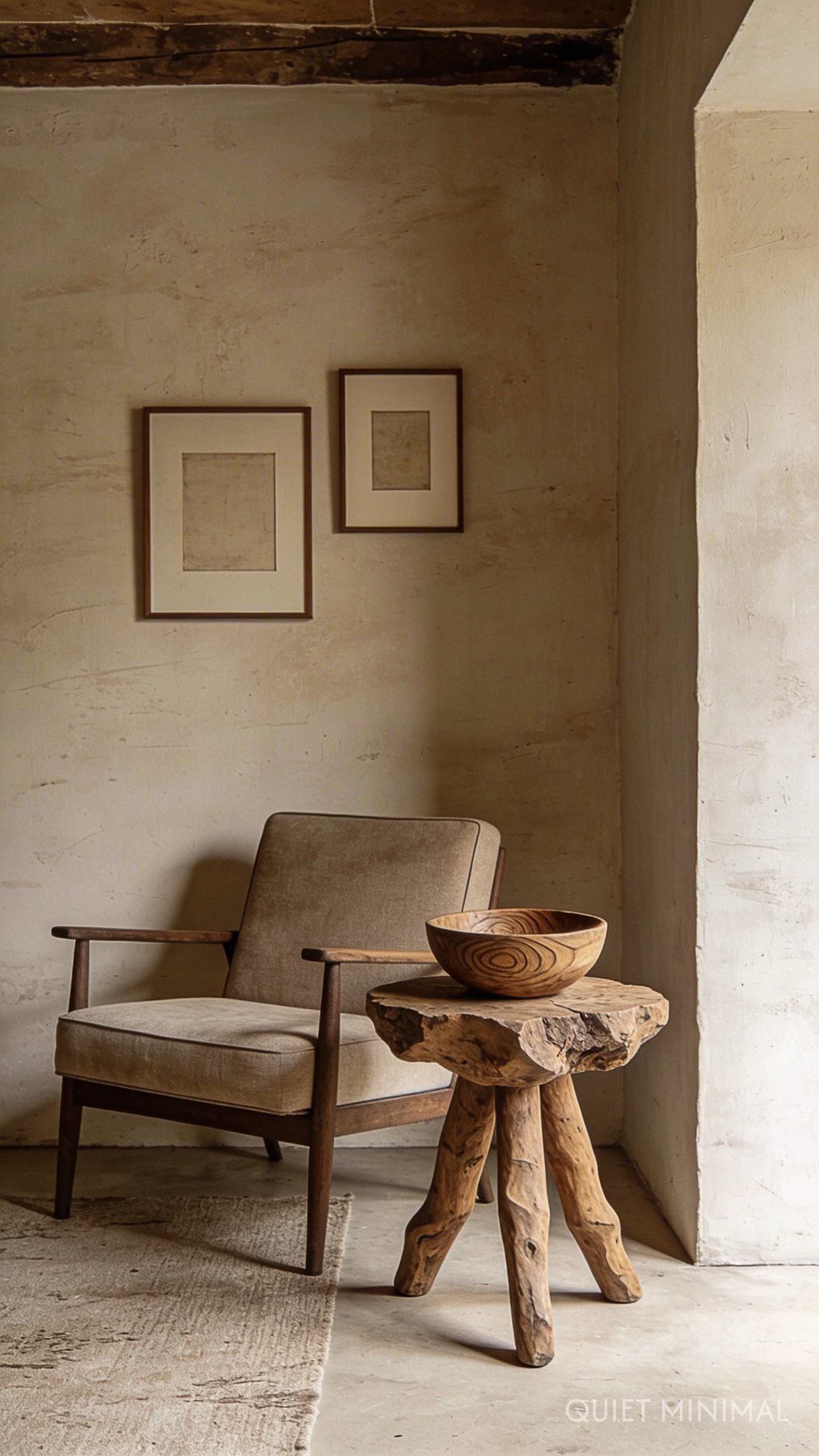
Perfectionism breeds anxiety. When a room is based on perfect symmetry and machine-made precision, any little thing out of place feels jarring. Modern wabi sabi design frees you from this by celebrating asymmetry and the mark of the maker. A hand-carved wooden bowl, a slightly irregular side table, or a gallery wall arranged organically draws the eye to its overall form and feeling, not its flawless surface. Your focus shifts from “is it clean?” to “how does this make me feel?” The soul of the object takes precedence over its superficial perfection.
Key Takeaway: Embrace asymmetry and handmade objects. When the overall aesthetic isn’t about rigid perfection, small imperfections like fingerprints become completely irrelevant.
10. Adopt the Philosophy of “Perfectly Imperfect”
 Save
Ultimately, the reason wabi sabi interiors hide fingerprints so well is philosophical. The entire style is a celebration of a home that is truly lived in. It finds beauty in the signs of use—the worn path on a rug, the patina on a brass knob, the gentle weathering of a wooden table. A fingerprint isn’t an error to be erased; it’s a quiet, fleeting reminder of life happening within your walls. By adopting this mindset, you not only create a home that is easier to maintain, but you also give yourself permission to relax and simply enjoy the beautiful, imperfect sanctuary you’ve built.
Key Takeaway: Shift your mindset to see signs of use not as flaws, but as evidence of a well-loved home, which is the core principle of the wabi sabi philosophy.
 Save
Follow Quiet Minimal on Pinterest for more curated aesthetic inspiration.
The images featured in this article have been generated or modified using AI to help visualize these design concepts.
From the guides
You've saved it, wanted it. Here's the how: codes, measurements, order. Your choices make it yours.
The Japandi Honest PlaybookThe honest version of the style: what to keep, what to skip, and the order to do it in.See inside →The Room Refresh PlaybookA repeatable four-step method, room by room, in ten minutes, thirty minutes, or one weekend.See inside →Make Any Room Feel Cozy on PurposeWhy some rooms hold people and others empty out, and the moves that change it.See inside →


