 Georgia
There is a specific moment in the design process when a room transitions from merely “furnished” to truly “curated.” For the creative soul, that moment usually happens when you decide to break the rules. We are often sold the idea that a cohesive home requires purchasing a matching three-piece suite from a showroom floor. But for those of us who view our home as a sanctuary—a canvas for self-expression—the “catalog look” can feel flat, impersonal, and surprisingly expensive for such a generic result.
Enter the art of the mismatch. Utilizing mismatched sofas in living rooms is not about chaos; it is about conversation. It is the sophisticated interplay of texture, era, and silhouette that tells a story about the person who lives there. Whether you are refurbishing a mid-century gem you found at an estate sale or sewing your own slipcovers to refresh a tired piece, mixing your seating creates a layered, high-end aesthetic that money alone cannot buy. Here is why breaking up the set is the ultimate design flex, and how to master the look.
1. It Breaks the “Showroom” Spell
 Save
The quickest way to make a living room feel uninspired is to fill it with furniture that looks like it was delivered all at once on a shrink-wrapped pallet. Matching sofa sets tend to dominate a room, dictating the style so heavily that your art and accessories struggle to compete. By intentionally choosing mismatched sofas, you disrupt that uniformity. This approach signals confidence. It suggests that your home was assembled over time, piece by piece, rather than ordered from a page. This separation allows each piece to breathe and stand as an individual element of design.
Key Takeaway: Avoid buying the full suite. Treat each sofa as a standalone investment to avoid the flat, impersonal look of a furniture catalog.
2. It Creates Texture and Depth
 Save
One of the secrets to an expensive-looking home is tactile variety. When you have two identical sofas, you are doubling down on a single fabric—be it gray tweed or beige linen. However, mismatched sofas in living rooms offer a prime opportunity to layer textures. Imagine the richness of a buttery, cognac leather sofa sitting across from a deep emerald velvet settee. The leather reflects light and adds warmth, while the velvet absorbs light and adds depth. This tension between materials creates a sensory experience that makes the room feel cozy, finished, and incredibly sophisticated.
From the guides
You've saved it, wanted it. Here's the how: codes, measurements, order. Your choices make it yours.
 The Japandi Honest PlaybookThe honest version of the style: what to keep, what to skip, and the order to do it in.See inside →
 The Room Refresh PlaybookA repeatable four-step method, room by room, in ten minutes, thirty minutes, or one weekend.See inside →
 Make Any Room Feel Cozy on PurposeWhy some rooms hold people and others empty out, and the moves that change it.See inside →
Key Takeaway: Contrast your materials. If one sofa is a matte fabric (linen, cotton, wool), ensure the second sofa introduces a sheen or distinct texture (leather, velvet, boucle).
3. It Allows You to Mix Eras
 Save
For the curator who loves a weekend antique hunt, mismatched seating is the perfect vehicle for blending history with modernity. A sleek, contemporary Italian sofa can look striking when paired with a refurbished Victorian settee or a Danish mid-century modern loveseat. This juxtaposition creates a dynamic energy in the room. It stops the space from feeling like a time capsule of a specific decade and instead makes it feel timeless. It validates your love for that vintage find without forcing you to commit your entire aesthetic to a “retro” theme.
Key Takeaway: Bridge the gap between time periods. Pair a clean-lined, modern architectural piece with something vintage or ornamental to create a curated narrative.
4. It Enhances Color Blocking Opportunities
 Save
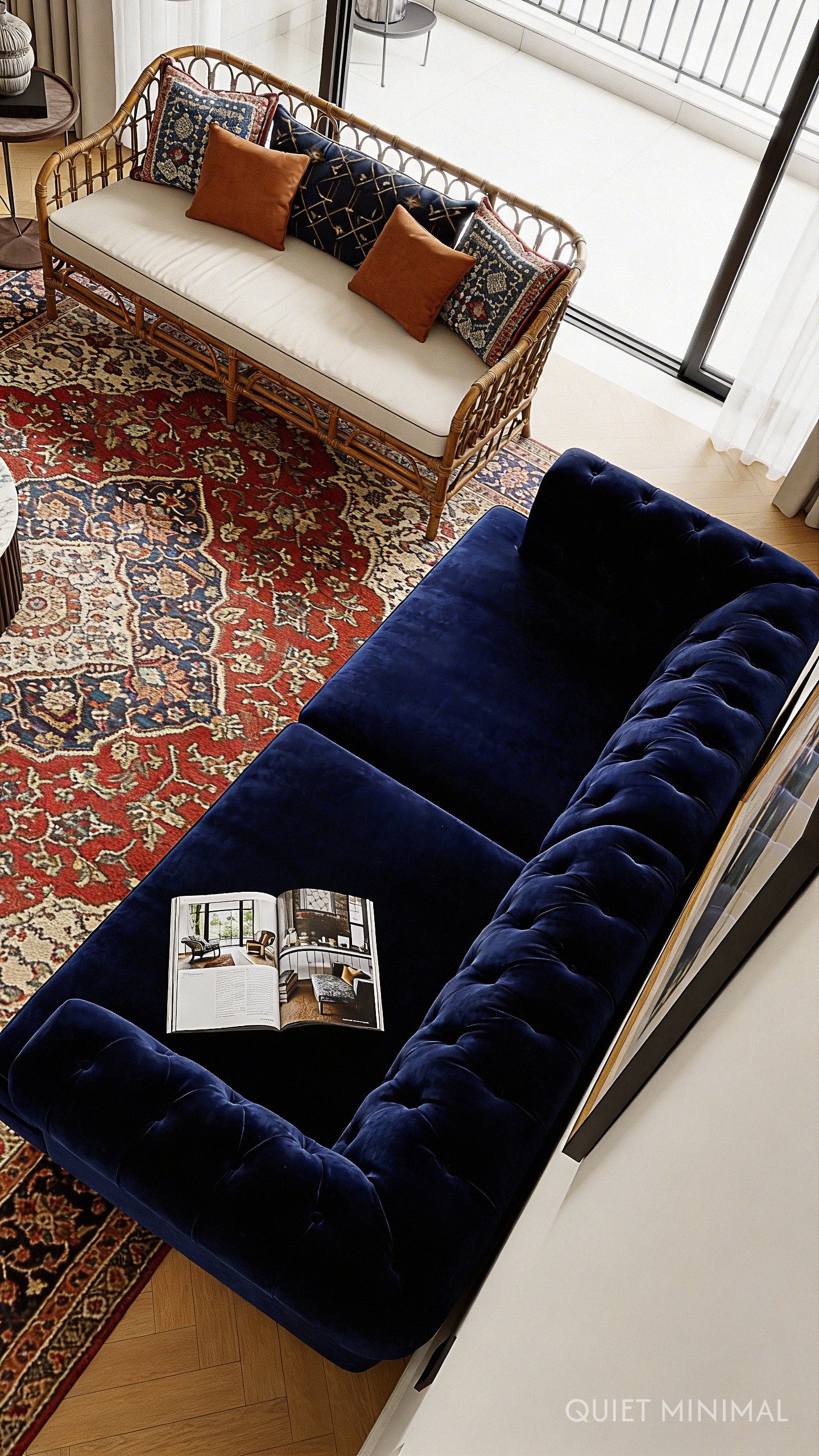
Color theory is a painter’s best friend, and your living room is the canvas. Mismatched sofas allow you to play with color in a way that matching sets simply cannot. You can utilize a neutral, grounding sofa—perhaps in oatmeal or charcoal—as your foundation, and then introduce a “jewel box” piece in terracotta, sage, or navy. This technique anchors the room while providing a specific focal point. It draws the eye and allows you to pull specific hues from your gallery wall or rug, tying the room together through color echoes rather than matching furniture frames.
Key Takeaway: Use an 80/20 rule for color. Let one sofa be your neutral anchor, and let the second mismatched piece serve as your bold accent color.
5. It Solves Visual Weight Issues
 Save
Not all sofas take up the same amount of visual space. A heavy, skirted sofa can feel like a solid block, while a sofa on high, tapered legs feels airy and light. In an awkward living room layout, two heavy sofas can make the room feel claustrophobic, while two light ones might make it feel cluttered. Mixing the silhouettes allows you to balance the visual weight. You might pair a substantial Chesterfield with a lighter, leggy daybed. This balance prevents the room from feeling bottom-heavy and keeps the energy flowing freely through the space.
Key Takeaway: Balance the mass. If one sofa sits heavy on the floor, choose a companion piece with visible legs to maintain airiness and flow.
6. It Supports the “Slow Decorating” Philosophy
 Save
There is a distinct joy in the “Maker Mindset”—the idea that good things take time and effort. The mismatched aesthetic inherently supports a slow decorating approach. You don’t need the budget to buy everything at once. You can invest in one high-quality piece now, and thrift or DIY the second piece later. This takes the pressure off immediate perfection and allows you to hunt for the right piece that speaks to you. It creates a home that grows with you, rather than one you simply inhabit.
Key Takeaway: Embrace the process. Use the mismatched style to curate your home slowly, waiting for the right piece rather than rushing to fill the space.
7. It Defines Conversation Zones
 Save
Psychologically, identical seating can sometimes feel like a waiting room. It implies a rigid structure. Mismatched sofas, however, inherently suggest a more casual, lounge-like atmosphere. They invite different types of sitting—one might be deep and slouchy for movie nights, while the other is firmer and upright for coffee and embroidery. By orienting different styles of seating toward each other, you create a dynamic tension that encourages interaction. It breaks down the formality of the living room and turns it into a true social hub.
Key Takeaway: Use form to dictate function. Choose one sofa for lounging and one for conversation to maximize the utility of your living space.
8. It Highlights Sculptural Shapes
 Save
High-end design is often about geometry and sculpture. When you look at mismatched sofas living rooms in design magazines, you will notice that the furniture often acts as art. By mixing styles, you can play with contrasting shapes. A boxy, track-arm sofa looks incredibly expensive when juxtaposed with a curved, kidney-bean-shaped settee. The contrast between the straight lines and the organic curves highlights the silhouette of both pieces, turning your furniture into sculptural elements rather than just functional objects.
Key Takeaway: Contrast lines with curves. Pair a structured, rectangular sofa with a piece that features organic curves or rounded edges.
From the guides
You've saved it, wanted it. Here's the how: codes, measurements, order. Your choices make it yours.
The Japandi Honest PlaybookThe honest version of the style: what to keep, what to skip, and the order to do it in.See inside →The Room Refresh PlaybookA repeatable four-step method, room by room, in ten minutes, thirty minutes, or one weekend.See inside →Make Any Room Feel Cozy on PurposeWhy some rooms hold people and others empty out, and the moves that change it.See inside →9. It Offers High-Low Budget Flexibility
 Save
Designing a curated home is often a balancing act of budget. The mismatched look is the ultimate financial hack for the stylish homeowner. You can splurge on a timeless, high-quality main sofa that will last for decades, and pair it with a budget-friendly vintage find that you recover yourself. Because they aren’t supposed to match, no one will compare the quality of the two directly. The expensive piece elevates the budget piece, making the entire room feel high-end. It allows you to channel your budget where it matters most without sacrificing the overall look.
Key Takeaway: Leverage the “high-low” mix. Let your investment piece elevate a budget-friendly or DIY second piece.
10. It Makes Accessories Shine
 Save
When your sofas don’t match, you need a unifying element to tie the room together, and this is where your accessories get to be the heroes. A vintage rug, a cohesive collection of throw pillows, or a consistent wood tone on the coffee table becomes the glue that holds the look together. This forces you to be more intentional with your styling. Instead of the furniture doing all the work, your curated accessories—the art prints, the ceramics, the textiles—bridge the gap between the two sofas. This results in a room that feels deeply layered and intentionally designed.
Key Takeaway: Unify through accessories. Use a shared color palette in throw pillows or a large area rug to visually connect your mismatched sofas.
 Save
Follow Quiet Minimal on Pinterest for more curated aesthetic inspiration.
The images featured in this article have been generated or modified using AI to help visualize these design concepts.
From the guides
You've saved it, wanted it. Here's the how: codes, measurements, order. Your choices make it yours.
The Japandi Honest PlaybookThe honest version of the style: what to keep, what to skip, and the order to do it in.See inside →The Room Refresh PlaybookA repeatable four-step method, room by room, in ten minutes, thirty minutes, or one weekend.See inside →Make Any Room Feel Cozy on PurposeWhy some rooms hold people and others empty out, and the moves that change it.See inside →


