 Georgia
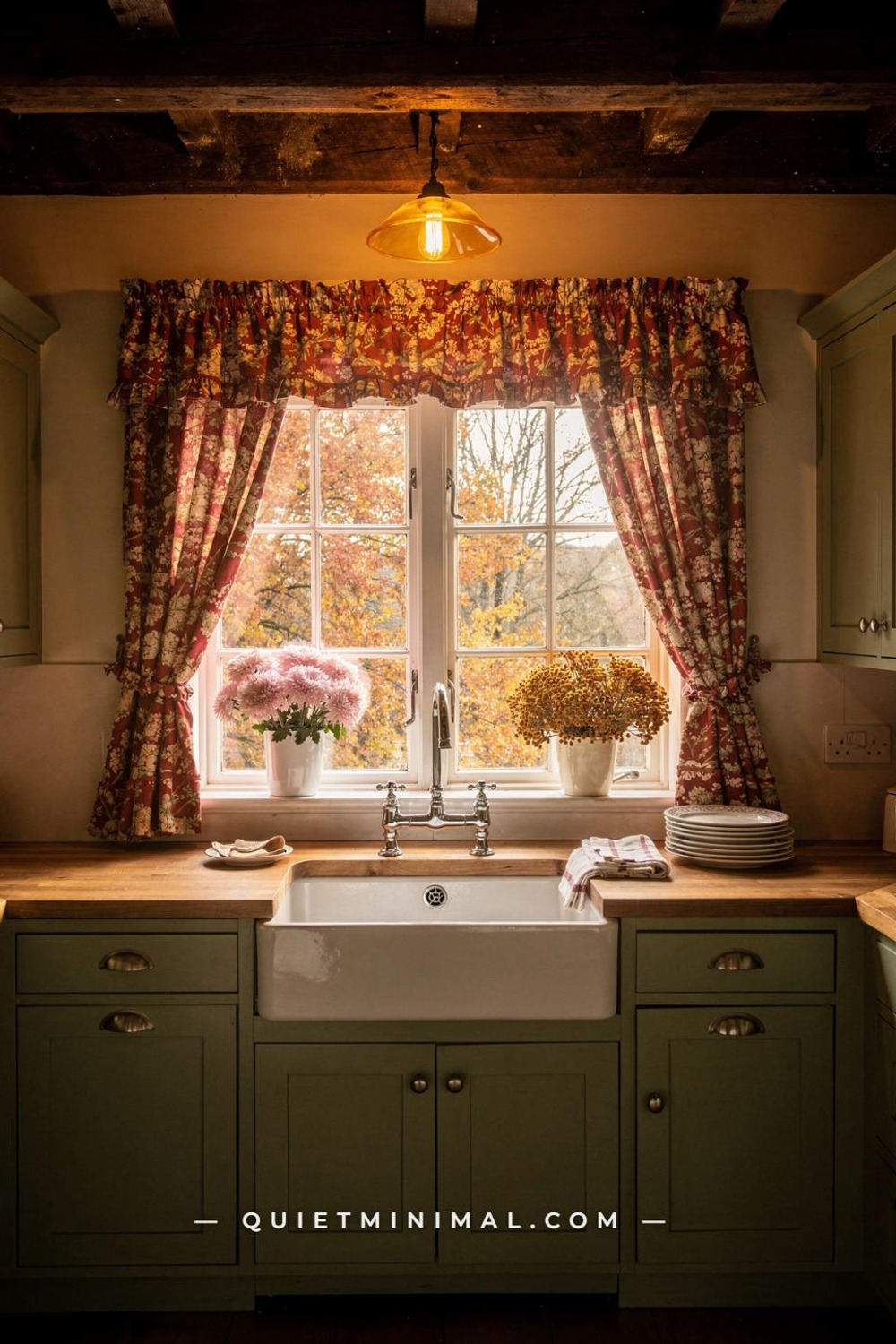
What makes farmhouse kitchen curtains look right over a working sink? The answer is less about the print than about five decisions made in order: the curtain type, the rod height, the fullness, the fabric and the hardware. The fabric, pattern, layering and care ideas further down this page still hold. What they leave out are the numbers, and the numbers are why one gingham cafe curtain looks hand-finished while the same print, hung 3 in too low and half as full, looks like a dish towel on a string. This block sits above the ideas as the measuring layer: the five types and where each mounts, the sink-window rules, yardage for a real window, the fabric that copes with steam and grease, how far fabric stays from the cooktop, and what one window costs three ways.
What a Farmhouse Kitchen Window Asks a Curtain to Do
 Save
A kitchen window has four jobs where a living room window has two. It lights the counter where you chop, gives privacy at face height when you stand at the sink, takes splash from the faucet, and collects the film of grease every pan throws into the air. Each curtain type trades those four differently, which is why the choice comes before the print.
Stand at the sink and look out. A neighbor’s window or the sidewalk at eye level means fabric across the lower half; a yard means you can leave the glass bare and frame it. Then sit at the table: beside a 30 in (76 cm) round pine bistro table, the seated eye sits about 18 in (46 cm) lower, and a sage gingham valance with tied-back panels reads as a frame from both heights.
Write five numbers down before you shop: inside width, sill-to-head height, sill depth, what sits below, and the distance to the cooktop.
Key Takeaway: Decide whether the window needs privacy, light or only a frame, then measure width, height, sill depth, what sits below and the distance to the cooktop before choosing any fabric.
The Five Kitchen Curtain Types, and Where Each One Mounts
 Save
Five curtain types suit a farmhouse kitchen, and each has its own place on the window.
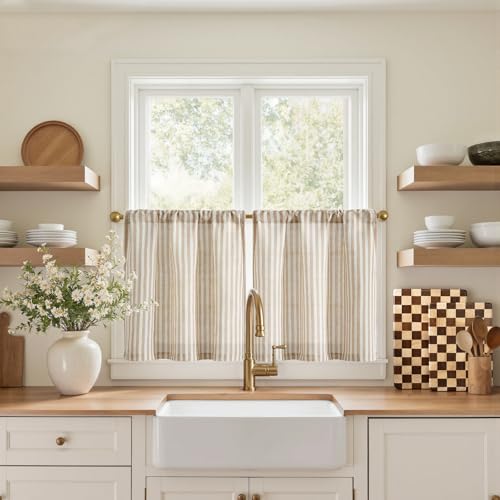
The cafe curtain covers the lower half. Its rod sits at the sash midpoint, 24 in (61 cm) above the sill on a 48 in (122 cm) window, moved 2 in (5 cm) up for privacy or down for light. The hem stops 1/2 in (1.3 cm) above the sill.
Tier and valance adds a short valance above the cafe: upper rod 4 to 6 in (10 to 15 cm) above the frame, drop one seventh to one fifth of the window height, 7 to 10 in (18 to 25 cm) on that window.
Short panels hang from a rod 4 to 6 in above the frame, brackets 3 to 6 in (8 to 15 cm) past each side, hemmed 1/2 in above the sill.
Apron length uses the same rod with the hem 4 in (10 cm) below the sill, so it suits a window over a bench or table, never over the sink.
The fabric Roman shade mounts on the casing and lifts into folds at the head.
Key Takeaway: Match the type to the window first, then mount it where that type belongs, and keep apron length away from the sink.

The Cafe Curtain: Privacy at Sink Height, Sky Above It
 Save
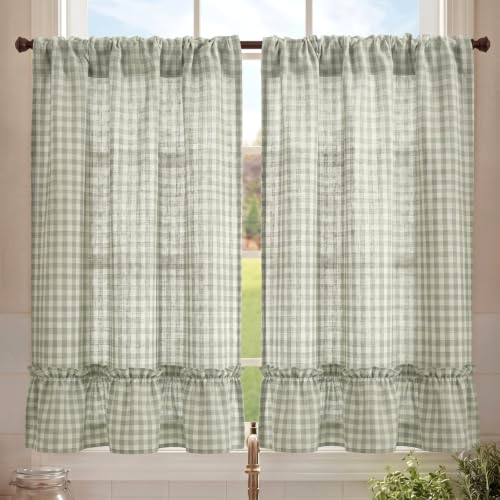
The cafe curtain suits most sink windows because it covers exactly the glass that faces the street and leaves the sky for the counter. Over a 33 in (84 cm) double apron sink, the window is often 36 to 42 in (91 to 107 cm) wide, and a cafe at the midpoint hides whoever stands at the sink while the upper half keeps the room bright.
On a ring rod, measure differently. Clip rings hang the fabric below the rod, so take the length from the rod top to the sill and subtract 2 in (5 cm); a rod-pocket cafe takes the same measurement plus 1/2 in (1.3 cm). Mix them up and the hem either sits in the splash or floats short.
Banded linen needs one more check: the dark bands read as a hem, so keep the lowest within 4 to 6 in (10 to 15 cm) of the bottom edge, with the black pom-pom trim right at it. Iron rings then slide the panels to the jambs on a gray morning.
Key Takeaway: Hang the cafe at the sash midpoint, measure clip-ring panels from the rod top minus 2 in (5 cm), and keep any dark band within 4 to 6 in (10 to 15 cm) of the hem.

Sink-Window Rules, Measured From the Faucet Up
 Save
The sink window has seven rules, each measured from something you can touch.
One: the cafe rod sits at the sash midpoint, 24 in (61 cm) above the sill on a 48 in (122 cm) window, shifted up to 2 in (5 cm) either way.
Two: a panel or valance rod sits 4 to 6 in (10 to 15 cm) above the frame, so the casing still reads as part of the window.
Three: brackets go 3 to 6 in (8 to 15 cm) past each side, so open panels stack on the wall, not the glass. A 36 in (91 cm) window takes a 42 to 48 in (107 to 122 cm) rod.
Four: every hem stops 1/2 in (1.3 cm) above the sill, out of standing water.
Five: where a tall bridge or gooseneck faucet rises above the sill, the hem clears its top by at least 2 in (5 cm), or the fabric wicks water with every rinse.
Six: on a casement, an inside-mount tension rod sits 1 in (2.5 cm) above the crank, or the rod moves outside the frame.
Seven: clip rings hang the panel low, so subtract 2 in (5 cm) from the rod-top measurement.
Key Takeaway: Measure every rod and hem from the sash, the frame, the sill and the faucet, never by eye.
Tier and Valance Sets: Two Rods, One Window
 Save
The tier and valance set is the farmhouse look most people picture: a short gathered top, a band of clear glass, then the tiers. That band decides whether it reads as a set or as one curtain that slipped.
Keep the band at least as tall as the valance. On a 48 in (122 cm) window with a 9 in (23 cm) valance and tiers from the midpoint, it runs about 15 in (38 cm), enough to see sky between two fabrics. Any shorter and the top of the window looks crowded.
Two rods means two decisions. The valance rod goes 4 to 6 in (10 to 15 cm) above the frame; the tier rod can be a slim cafe rod inside the casing at the midpoint. Semi-sheer linen tiers suit a 30 in (76 cm) sink, keeping privacy while the counter still gets soft light, and a gathered sage and cream floral repeated on both pieces ties the two rods into one treatment.
Key Takeaway: Leave a band of clear glass at least as tall as the valance between valance and tiers, and repeat the same fabric on both rods.

Fullness and Yardage, Worked Through for a 36 in Window
 Save
Fullness makes a cafe curtain look generous rather than stretched. Rod-pocket panels need 1.5 to 2 times the rod width in finished fabric; ring-top or clip panels need 2 times. Here is the sum for a 36 in (91 cm) by 48 in (122 cm) sink window at 2x.
Width: 36 in times 2 is 72 in (183 cm), split into two 36 in panels. Add 1 in (2.5 cm) per side for double side hems and each panel is cut 38 in (97 cm) wide.
Length: a 24 in (61 cm) drop, plus 4 in (10 cm) for casing and header, plus 3 in (8 cm) for a double hem, plus 2 in (5 cm) for shrinkage, is 33 in (84 cm).
Yardage: on 54 in (137 cm) fabric, one panel fits per length, so two 33 in lengths make 66 in, or 1.83 yards. Buy 2 yd (1.8 m).
Valance: a 42 in (107 cm) rod at 2x is 84 in (213 cm) plus 4 in (10 cm) of hems, so two widths seamed, each 16 in (41 cm) long for a 9 in drop. Buy 1 yd (0.9 m), 3 yd (2.7 m) for the whole set.
Key Takeaway: Buy 2 yd for a 2x cafe pair on a 36 in (91 cm) window and 3 yd with a valance.

The Fabric Roman Shade for a Sink Set Tight to the Glass
 Save
Some sinks sit so close to the window that no hem has room to hang. A deep 30 x 20 in (76 x 51 cm) cast-iron farmhouse sink with a bridge faucet rising 10 in (25 cm) can put the spout against the glass, and a cafe curtain there stays damp. That is the window for a fabric Roman shade: it lifts away in folds instead of hanging into the splash.
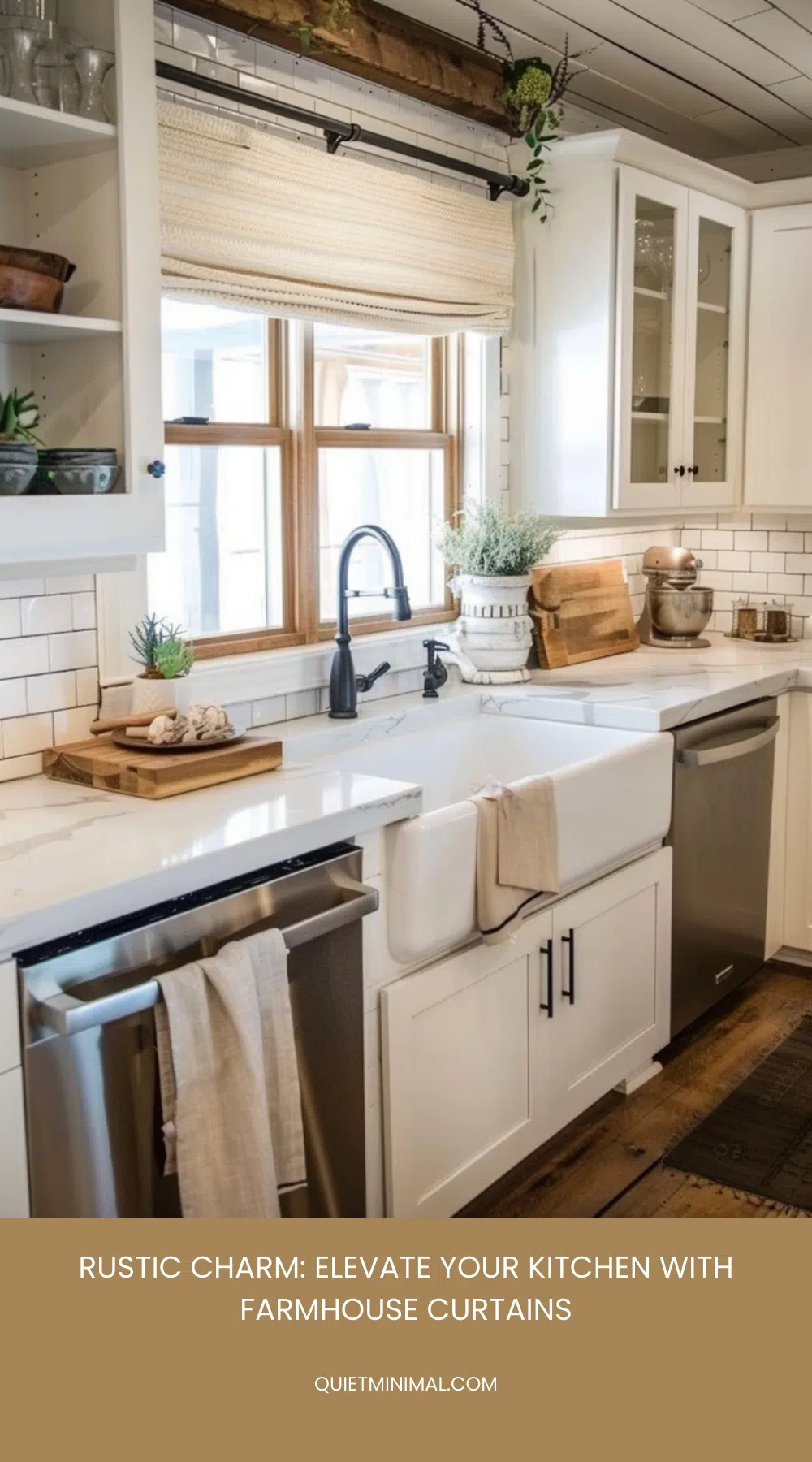
It is still fabric, so the fabric rules apply. Choose unlined linen or a cotton-linen blend for soft light, and run the stripes vertical: a slate blue grain-sack stripe centered on the window lines up with the faucet and makes a narrow alcove look taller.
Mount it on the casing so the raised stack sits on the trim, not the glass. A tied-up version, two fabric bows holding the folds, stays at one height all day and suits a window you rarely cover. Choose a cordless lift, since children reach kitchen windows.
Key Takeaway: When the faucet stands against the glass, use a fabric Roman shade mounted on the casing, with vertical stripes centered on the faucet and a cordless lift.

Fabric by Kitchen Conditions: Wash, Shrink, Fade and Grease
 Save
A kitchen curtain lives through steam, splash, sun and grease, so pick the fiber by the window’s conditions rather than by the swatch.
Cotton washes cool to warm on a gentle cycle and pretreats well with dish soap for grease. It fades low to moderate in direct sun, most visibly on saturated reds and blues, so prewash it and keep it to a shaded window.
Linen shrinks 3 to 10 percent overall: 1 to 3 percent washed cold and line dried, 7 to 10 percent washed hot and machine dried, mostly in length. Wash it cold, hang it, and it holds color better than cotton.
A cotton-linen blend sits between the two: softer creases than linen, more give than cotton. Prewash it the way you will wash the finished curtain.
A polyester blend, like the 90 percent polyester tiers in most stores, shrinks least, holds color in sun and washes cold with a low dryer. Blot oily splashes, then pretreat.
Outdoor fabric in solution-dyed acrylic is the one for a window directly over a sink that splashes: it resists fading, sheds water, machine washes and must air dry.
Key Takeaway: Choose cotton or linen for a shaded window, a polyester blend for a sunny one, and solution-dyed outdoor fabric where the sink splashes the hem.
Short Panels Tied Back at a Window That Opens
 Save
Short panels tied back suit a window you open every day: the fabric lives at the sides and the sash moves freely between them. The rod goes 4 to 6 in (10 to 15 cm) above the frame and 3 to 6 in (8 to 15 cm) past each side, so a 30 in (76 cm) window over a 30 in apron sink takes a 36 to 42 in (91 to 107 cm) rod.
Tie at the sill line or a third of the way up from the hem. Lower and the swag drops onto the counter; higher and the panel looks pinned. Jute ties suit ivory lace because both are matte, and they wash with the panel.
On a double-hung window, keep the tied fabric fully outside the casing, or it catches when the lower sash rises. Lace is the right weight here: it filters light when untied at night and dries fast after a wash.
Key Takeaway: Hang tied-back panels on a rod 3 to 6 in (8 to 15 cm) past each side, tie at the sill line or a third up from the hem, and keep the fabric clear of the moving sash.

Keep Fabric Away From the Cooktop: the Clearance Checklist
 Save
This is the one section with no style choice in it. Fire-safety guidance relayed from NFPA keeps anything that can burn at least 3 ft (91 cm) from the stovetop, and appliance makers say to keep curtains away from hot surfaces. A kitchen curtain is a fabric hanging in moving air, which is exactly what that rule is written about.
Work through six checks.
One: measure from the nearest burner to the window edge. Inside 3 ft, no fabric hangs within reach of the cooktop.
Two: a window inside that ring gets either no curtain or a short valance mounted high and well clear, and nothing that hangs down beside the range.
Three: tiebacks on any nearby panel are fixed hardware, so a draft from an open window cannot swing the fabric toward a burner.
Four: the toaster and toaster oven never sit under a curtain or a valance. Both throw heat straight up.
Five: read the range and hood manuals for the maker’s side clearance to combustible materials, and use whichever number is larger.
Six: towels hang on a cabinet pull, not the oven handle.
Key Takeaway: Keep every curtain at least 3 ft (91 cm) from the stovetop, keep toasters out from under fabric, and check the range maker’s clearance before hanging anything beside it.

Barn Red Check on a Full-Height Panel
 Save
A large barn red check needs room to show its pattern. On a big double-hung window, two panels about 54 in (137 cm) wide each, hemmed 1/2 in (1.3 cm) above the counter, carry several full repeats, and the check reads as a deliberate graphic. On a 24 in (61 cm) window the same check shows one and a half squares and looks like a cut-off tablecloth.
Match the repeat across the pair: cut both panels so a full red square starts at the same height, and buy one extra repeat to allow for it. Set the hem on a full line of the check, never mid-square.
Mix through the rest of the kitchen, not the curtain. One large check at the window and one narrow stripe in the same red on a towel or cushion is enough; two similar checks in one sightline compete. White shaker cabinets and warm butcher block give a strong check somewhere quiet to sit, and polished nickel keeps the red from feeling heavy.
Key Takeaway: Save a large check for a big window with full-width panels, match the repeat across both panels, and pair it with one narrow stripe rather than a second check.

Check Scale by Window Size: 1/8 in, 1/4 in and 1 in
 Save
Check scale is a ratio between the square and the glass it covers, and three sizes handle almost every farmhouse kitchen.
A 1/8 in (3 mm) micro check suits windows under 30 in (76 cm) wide. From across the room it reads as a soft tint, adding texture without busying a narrow wall.
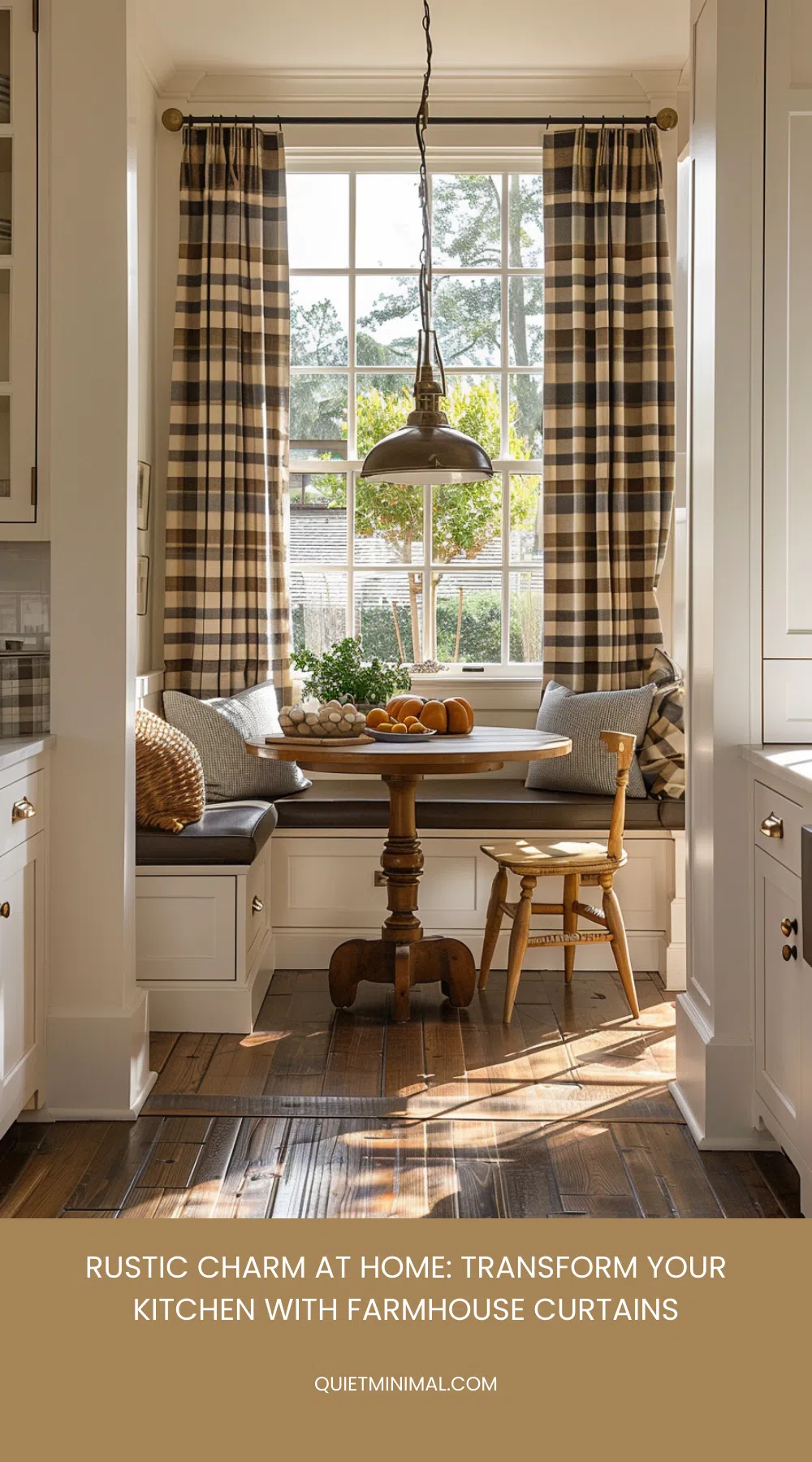
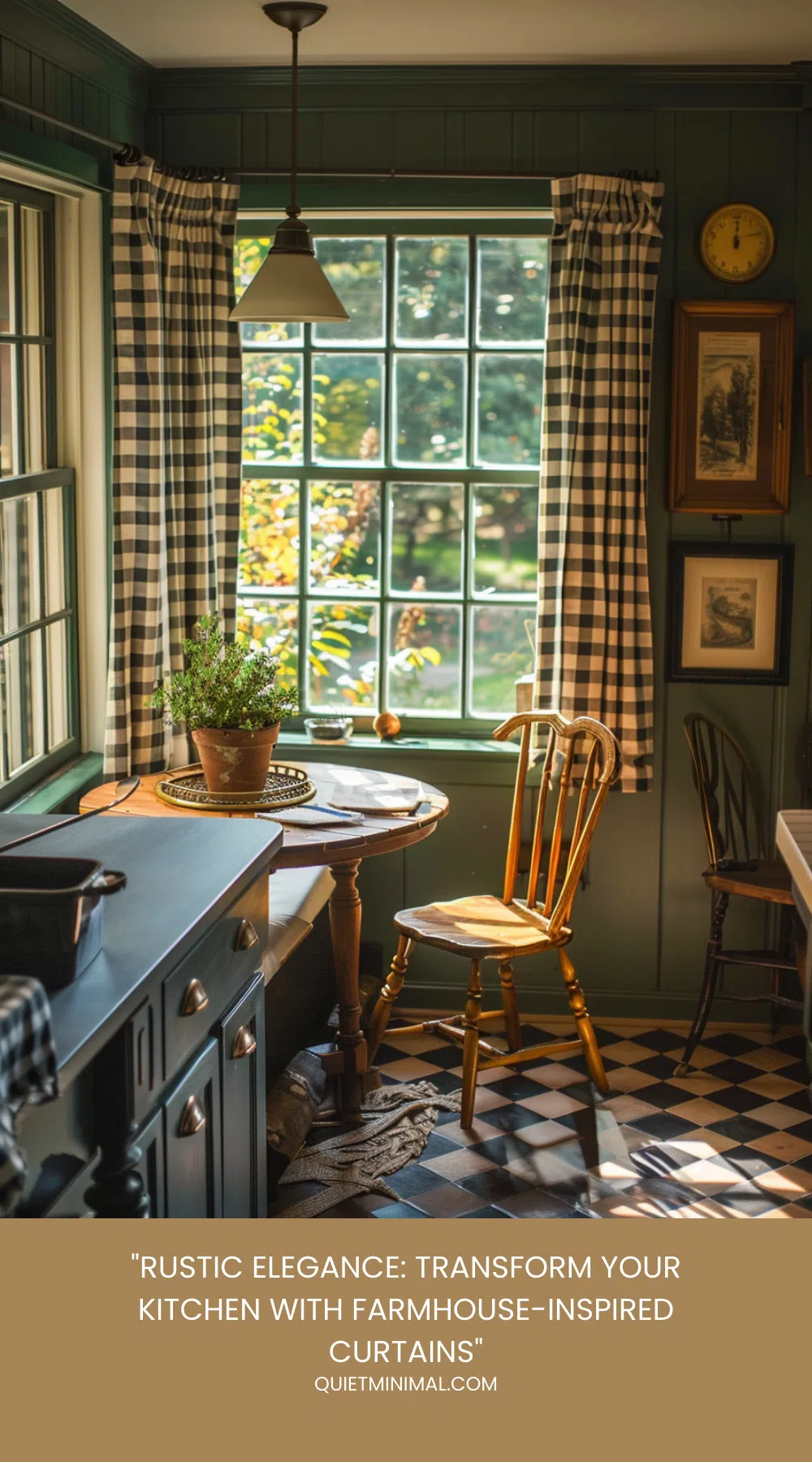
A 1/4 in (6 mm) check is the classic sink-window scale for windows 30 to 48 in (76 to 122 cm) wide: gingham from the doorway, color from the table.
A 1 in (2.5 cm) check suits windows over 48 in (122 cm) and kitchens open to a living area, where it must hold its own from 15 ft (4.6 m). Larger buffalo checks belong only on full-width panels.
You've saved it, wanted it. Here's the how: codes, measurements, order. Your choices make it yours.


To mix, step the scale by at least 3 to 1 and share one color. A 1/4 in check at the window with a 1 in stripe on the chair cushions works; a 1/4 in check beside a 3/8 in check does not. Keep to two patterns in one sightline.
Key Takeaway: Use a 1/8 in (3 mm) check under 30 in (76 cm), 1/4 in (6 mm) at 30 to 48 in (76 to 122 cm) and 1 in (2.5 cm) above that, and mix patterns only at a 3 to 1 step.

Valance Only: A Brow for the Window and Nothing Below
 Save
A valance alone is the answer when the window faces a yard, the sill holds herbs that need every hour of sun, and nobody looks in. It frames the glass like a brow and leaves the whole sash clear.
Size it to the window: the drop runs one seventh to one fifth of the height, so a 40 in (102 cm) window takes 6 to 8 in (15 to 20 cm) and a 60 in (152 cm) window 9 to 12 in (23 to 30 cm). Mount the rod 4 to 6 in (10 to 15 cm) above the frame, with the valance covering the top 2 in (5 cm) of the casing so it reads as part of the window, not a strip floating on the wall.
Run the rod 3 in (8 cm) past each side; with no panels to stack, a valance needs less overhang. Over a 30 in (76 cm) apron sink in white shiplap, an ecru crochet valance on a black iron rod throws lace shadows onto the counter all afternoon.
Key Takeaway: Choose a valance alone for a private, sunny sink window, drop it one seventh to one fifth of the window height, and let it cover the top 2 in (5 cm) of the casing.

Five Farmhouse Curtain Colors and What Each One Pairs With
 Save
Five colors carry almost every farmhouse kitchen curtain, and each has cabinets and metals it suits.
Buttermilk, a pale warm yellow, sits with white shaker cabinets, butcher block and brass, and warms a north-facing window. Use it as a 1/4 in (6 mm) check or a solid.
Sage, a soft gray green, pairs with cream cabinets, oak and aged bronze. It is the safest color for a first curtain because it reads as neutral beside wood and as color beside white.
Barn red pairs with white or cream cabinets and black iron. Keep it to a large check on a big window, and choose a polyester blend or outdoor fabric on a sunny window, since saturated reds fade first.
Blue and white suits white cabinets with chrome or nickel, as a 1/4 in check or a ticking stripe. Navy holds up longer in sun than mid blue.
Black and white works with any wood tone and matte black hardware, as a 1/8 in (3 mm) check or a narrow stripe. It is the most graphic of the five, so use it on one window only.
Key Takeaway: Pick buttermilk for brass and butcher block, sage for oak and cream, barn red for black iron, blue and white for nickel, and black and white for matte black hardware.

Hardware That Slides, Lifts Off and Goes in the Wash
 Save
A kitchen curtain goes in the wash every few weeks, so choose the heading by how it slides and how fast it comes off the rod.
A rod pocket is the cheapest heading and holds its gathers, but it drags on the rod, so it suits a curtain that stays put. The rod comes down for every wash.
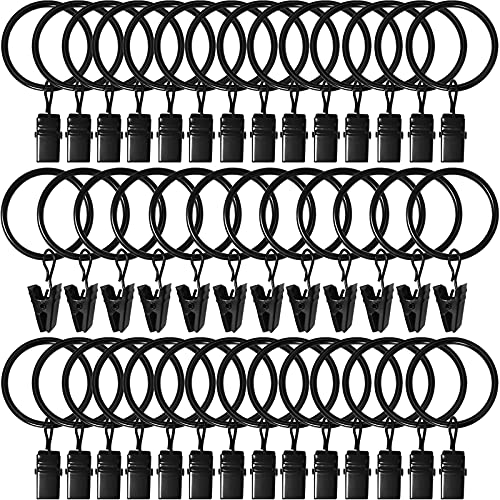
Clip rings slide easily and unclip in seconds, the best heading for a cafe you open daily and wash often. The fabric hangs about 0.8 in (2 cm) below the rod, so measure from the rod top and subtract 2 in (5 cm). Over a 33 in (84 cm) double sink, cream linen panels on a black iron ring rod push to the jambs while you wash up.
Tab tops slide better than a pocket and worse than rings, and show the rod between tabs.
For renters, a tension rod inside the frame needs no drilling. Standard spring rods are commonly rated around 3 to 5 lb (1.4 to 2.3 kg), plenty for an unlined cafe or valance; weigh a lined panel first. Rubber end caps protect the paint.
Key Takeaway: Use clip rings for a cafe you open and wash often, a rod pocket for one that stays put, and a tension rod rated for the panel’s weight in a rental.

What One Window Costs: Ready-Made, Sewn From Yardage, Custom
 Save
At current prices, one 36 in (91 cm) sink window can be dressed at three levels, and the difference is fiber and fit, not style.
Ready-made: big-box kitchen tier pairs run about $10 to $23, tier and valance sets about $18 to $24. Most are polyester or polyester-linen blends in fixed 24 or 36 in (61 or 91 cm) lengths, so the midpoint rule decides which you buy.
Sewn from yardage: 2 yd for a cafe pair, 3 yd with a valance. Cotton gingham at about $11 a yard comes to $22 to $33; mid-weight linen at about $28 a yard, $56 to $84, plus thread and an evening at the machine.
Custom: made-to-measure cafe panels start around $120 a panel, more for printed linen, so roughly $150 to $380 a window for exact length and a finish no shelf offers.
So the answer to the opening question: farmhouse kitchen curtains look right when the type suits the window, the rod sits at the midpoint or 4 to 6 in above the frame, the fabric runs twice the rod width, and nothing hangs within 3 ft of the cooktop.
Key Takeaway: A 36 in (91 cm) window costs about $10 to $24 ready-made, $22 to $84 sewn from 2 to 3 yd, and $150 or more custom.

The original ideas from this article continue below.
You might think farmhouse kitchen curtains are purely decorative, but they do more than just look charming. You can combine practicality with a rustic aesthetic by choosing the right fabric, such as durable cotton or textured linen.
Don’t overlook the impact of patterns and designs like gingham or ticking stripes, which add a quaint, country feel. Layering curtains can further enhance depth and visual interest, transforming your kitchen into a warm, inviting space. Curious about how to perfectly coordinate colors and hang these curtains for maximum effect? There’s much more to explore.
- Opt for durable and aesthetically appealing cotton, linen, or canvas fabrics to enhance texture and style.
- Introduce patterns such as gingham, ticking stripes, and floral designs to add a rustic or vibrant element.
- Layer sheer or lace curtains with heavier depth, warmth, and visual interest options.
- Coordinate curtain colors with the existing kitchen palette, adjusting for lighting and seasonal decor.
- Use rustic rods and position them higher than the window frame to create a spacious look.
 Save
 Save
 Save
 Save
 Save
 Save
 Save
 Save
 Save
 Save
 Save
 Save
 Save
 Save
 Save
 Save
 Save
 Save
 Save
 Save
 Save
 Save
 Save
 Save
 Save
 Save
 Save
 Save
 Save
 Save
 Save
 Save
 Save
 Save
 Save
 Save
 Save
 Save
 Save
 Save
 Save
 Save
 Save
 Save
 Save
 Save
 Save
 Save
 Save
 Save
 Save
 Save
 Save
 Save
 Save
 Save
 Save
 Save
 Save
 Save
Choosing the Right Fabric
When choosing the right fabric for farmhouse kitchen curtains, consider both durability and aesthetic appeal. You want a material that can handle your kitchen’s everyday hustle and bustle while still looking charming. Cotton is an excellent choice because it’s durable, easy to clean, and offers a soft, natural look that fits well in farmhouse decor. Linen is another great option, giving you a slightly more textured and rustic feel. It’s also breathable, which is perfect if your kitchen gets a lot of sunlight.
You should also think about how much light you want to let in. Sheer fabrics like voile or lightweight cotton can provide a soft, diffused light, making your kitchen feel airy and bright. If you prefer more privacy or need to block out harsh sunlight, a heavier fabric like canvas or denim might be better. These materials add a cozy feel and offer more protection from the sun’s rays.
Don’t forget about maintenance. Machine-washable fabrics save you time and effort, especially in a kitchen setting where spills and splatters are common. Choosing the right fabric ensures your farmhouse kitchen curtains are both functional and beautiful.
Popular Patterns and Designs
Once you’ve chosen the right fabric, it’s time to explore popular patterns and designs that will elevate your farmhouse kitchen curtains.
One timeless option is gingham. This checkered pattern adds a quaint, country feel to your space, and its simplicity complements a variety of color schemes.
For a more rustic look, consider ticking stripes. These narrow, evenly-spaced stripes often come in muted colors like navy or gray, providing a subtle yet stylish touch.
Floral patterns can also bring a fresh, vibrant element to your kitchen. Opt for smaller prints for a delicate, vintage vibe or larger, bolder florals if you want to make a statement.
Another classic choice is the toile pattern, featuring intricate, pastoral scenes that evoke a sense of history and charm.
If you prefer something more understated, solid colors with textured fabrics like linen or burlap can add depth without overwhelming the space.
For a touch of whimsy, consider patterns like polka dots or checks, which can infuse your kitchen with personality and warmth.
Layering for Depth
Layering your farmhouse kitchen curtains can add depth and dimension, transforming your space into a cozy, inviting haven. Start by choosing a base layer, like a simple sheer or lace curtain, which allows natural light to filter through while providing a soft backdrop.
Next, add a heavier, more textured curtain, such as linen or burlap, to introduce warmth and contrast. This combination not only provides visual interest but also offers practical benefits like privacy and light control.
You can also play with lengths and patterns. For instance, pair floor-length curtains with shorter café curtains. The café curtains can cover the lower half of your windows, offering privacy, while the longer ones frame the entire window and draw the eye upward, creating an illusion of height.
Mixing patterns, like pairing a neutral base with a patterned overlay, can add a unique flair without overwhelming the space.
Color Coordination
Choosing the right colors for your farmhouse kitchen curtains can significantly enhance your space’s overall aesthetic and harmony. Start by considering the existing color palette in your kitchen. If you have neutral walls and cabinetry, you can introduce curtains with bold patterns or vibrant hues to create a focal point. On the other hand, if your kitchen features colorful elements, opt for curtains in soft, complementary shades to maintain balance.
Don’t forget to consider the textures and materials of your curtains. Linen and cotton fabrics often come in various colors that work well in a farmhouse setting. You can also mix and match patterns, but make sure they share a common color to tie everything together seamlessly.
Moreover, think about the lighting in your kitchen. Natural light can brighten darker colors, while artificial lighting may require lighter, more reflective shades to keep the space open and airy.
Lastly, consider the seasonality of your decor. Warm colors like deep reds and earthy browns can create a cozy atmosphere in the colder months, while light blues and greens can evoke a fresh, breezy feel during spring and summer.
Hanging Techniques
After selecting the perfect color and fabric, the way you hang your farmhouse kitchen curtains can significantly impact their overall effect. Start by choosing the right hardware. Rustic rods with distressed finishes often complement the farmhouse look. Position the rod at the correct height – mounting it higher than the window frame can make your kitchen appear taller and more spacious.
Consider the fullness of the curtains. Curtains that are one and a half to two times the window’s width create a fuller, more luxurious appearance. For a more tailored look, opt for a single panel or a pair that just covers the window.
Here’s a quick guide to help you decide:
| Hanging Style | Description | Best For |
|---|---|---|
| Rod Pocket | Curtains slide onto the rod | Casual, relaxed look |
| Grommet | Metal rings slide on the rod | Modern farmhouse style |
| Clip Rings | Clips attach to curtain tops | Easy adjustability |
| Tab Top | Fabric loops slide on the rod | Decorative, rustic charm |
| Pleated | Fabric gathered into pleats | Formal, elegant appearance |
Don’t forget to consider the length. Floor-length curtains can add drama, while café curtains covering only the lower half of the window offer a charming, airy feel. You’ll enhance both function and style by thoughtfully hanging your farmhouse kitchen curtains.
Maintenance Tips
Maintaining your farmhouse kitchen curtains is crucial to keeping them looking fresh and prolonging their lifespan.
First, always check the care label before washing. Some fabrics may require delicate handling or dry cleaning. If they’re machine washable, use a gentle cycle with cold water to prevent shrinking or fading. Avoid using bleach, as it can damage the fabric and cause discoloration.
Regular dusting is essential. Use a vacuum with a brush attachment or a lint roller to remove dust and debris that can accumulate over time. A mild detergent and a damp cloth should do the trick for spot cleaning. Gently blot the stain—don’t rub, as this can push it deeper into the fabric.
Ironing your curtains can help maintain their crisp look. Iron them on a low setting, and keep a pressing cloth between the iron and the fabric to prevent any potential damage.
Lastly, rotate your curtains occasionally. This can help distribute sunlight exposure evenly, reducing the risk of fading in one area.
Follow Quiet Minimal on Pinterest for more home design tips and inspiration.
You've saved it, wanted it. Here's the how: codes, measurements, order. Your choices make it yours.


