 Georgia
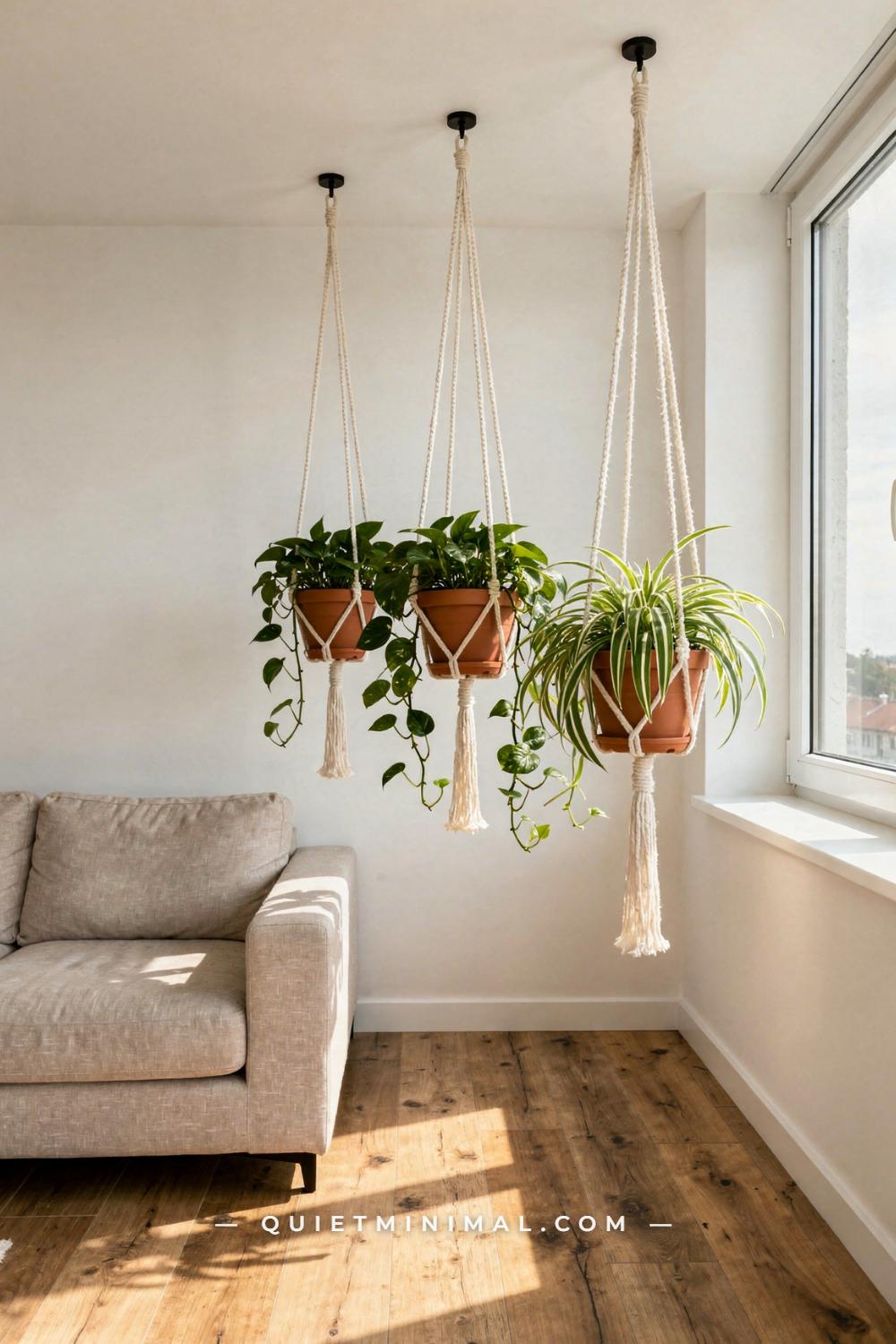
You want the trailing green curtain at the window, the pothos spilling from a hook over the reading chair, the cluster of macrame hangers in the corner that makes the room look finished. What stops most people is not the plant. It is the ceiling: what it is made of, what it can hold, and what happens to the deposit if the answer turns out to be “not that”. Most of the advice about hanging plants from the ceiling skips straight past that question to the pretty part, and the pretty part is why so many hung plants end up on the floor, either because the hook let go or because the plant quietly died up there where nobody could reach it. This is the other half of the advice: what each ceiling type actually carries in lb (kg), how far down a plant should hang for your ceiling height, how far from which window, and how to water something hanging at 7 ft (213 cm) without a ladder. Every section takes one piece of received wisdom and checks it against what holds.
Adhesive Hooks Are Not the Renter’s Answer, the Curtain Rod Already Is
 Save
The advice every renter hears first is to use a heavy-duty adhesive hook and skip the drill. It sounds harmless, and it is the single most common reason a hanging plant ends up on the floor. Adhesive hooks are rated in shear, hanging flat against a wall with the load pulling down along the surface. On a ceiling the same hook is loaded in tension, straight away from the surface, and the adhesive is holding on to a layer of ceiling paint rather than the ceiling itself. Paint is the weak link. A hook that carries 5 lb (2.3 kg) on a wall will let go of a ceiling under a watered 6 in (15 cm) pot, usually at night, usually onto something you like.
The renter-safe anchor is already installed above the window. A curtain rod bracket is screwed into the wall framing or into proper wall anchors, and a wall anchor keeps its full rating, because the load runs down the wall rather than pulling out of it. A standard 1 in (2.5 cm) black metal rod on two brackets, the kind that spans a 48 in (120 cm) window, will happily carry three hangers as long as you keep each one under 5 lb (2.3 kg) watered and hang them between the brackets rather than on the overhang. Use S-hooks, not knots, so each plant lifts off in seconds for watering. If the rod already carries curtains, a second rod on the same brackets or a double bracket set gives the plants their own rail.
Weight is the whole decision here. A Boston fern in a 10 in (25 cm) pot weighs 6 to 8 lb (2.7 to 3.6 kg) after watering, which is one fern per rod, hung at a bracket end where the screw takes the load, not at mid-span. A small pothos in a 4 in (10 cm) pot is about 1 lb (0.5 kg) wet and can go anywhere. An English ivy in a 6 in (15 cm) pot lands around 2 to 3 lb (0.9 to 1.4 kg). Three plants, one rod, no new holes, and the light is exactly where the plants want it, since the rod sits within 12 in (30 cm) of the glass.
Keep the floor plants doing the heavy visual work. Snake plants and a peace lily in white pots at floor level give the corner its base without asking anything of the ceiling, and the cream boucle chair and oak sideboard stay clear of drips because the rod hangs over the sill line, not over the furniture.
From the guides
You've saved it, wanted it. Here's the how: codes, measurements, order. Your choices make it yours.
 The Japandi Honest PlaybookThe honest version of the style: what to keep, what to skip, and the order to do it in.See inside →
 The Room Refresh PlaybookA repeatable four-step method, room by room, in ten minutes, thirty minutes, or one weekend.See inside →
 Make Any Room Feel Cozy on PurposeWhy some rooms hold people and others empty out, and the moves that change it.See inside →
Key Takeaway: Skip adhesive hooks on ceilings entirely and hang up to three plants under 5 lb (2.3 kg) each from the existing curtain rod on S-hooks, with the heaviest at a bracket end.

One Hook Per Plant Is the Slow Way, a Grid on Four Joists Is the Strong Way
 Save
The received rule is one hook per plant, which means six plants become six holes, six anchors and six chances to miss the joist. A suspended grid reverses the arithmetic. One 48 x 48 in (120 x 120 cm) powder-coated wire panel hung from four points carries the whole collection, and because you choose the four points, every one of them can go into framing rather than into drywall.
Start with the load, always watered. Six galvanized pots at 4 in (10 cm) weigh about 1 to 1.5 lb (0.5 to 0.7 kg) each when wet, so 9 lb (4 kg) for the plants. A wire panel of that size is 6 to 10 lb (2.7 to 4.5 kg). Add pendant cords and bulbs at 1 lb (0.5 kg) each and the whole installation sits under 25 lb (11 kg). A screw eye driven 3 in (7.6 cm) into a spruce-pine-fir ceiling joist has a safe working load of 40 to 50 lb (18 to 23 kg) with the 4:1 safety factor already applied, so four of them give you a margin you will never use, even when someone hangs a seventh pot on the corner.
Finding the joists is the only real work. Ceiling joists in most homes run 16 in (41 cm) on centre, occasionally 24 in (61 cm). A stud finder set to deep scan reads them through 1/2 in (13 mm) drywall; on a textured ceiling, a small rare-earth magnet dragged across the surface will stop on the drywall screws, which are always in a joist. Mark two joists 32 or 48 in (81 or 122 cm) apart, then drill a pilot hole 1/8 in (3 mm) smaller than the screw eye shank and wind it in until the eye seats against the ceiling. If the pilot hole hits nothing solid after 3/4 in (19 mm), you have missed, and the fix is to move 3/4 in (19 mm) sideways and try again, never to fill the hole with a toggle and hope.
Hang the panel on four short lengths of jack chain or black cord so it sits 10 to 14 in (25 to 36 cm) below the ceiling, enough for the ivy to breathe in cooler air. The bulbs are decoration, not plant lighting; plug-in pendant cords rated for the bulb wattage are the only version to use here, since a hardwired fixture is an electrician’s job and a rental’s headache.
Key Takeaway: Hang a cluster from one grid on four screw eyes set 3 in (7.6 cm) into joists, rated 40 to 50 lb (18 to 23 kg) each, rather than drilling a separate anchor for every pot.

The Rope Is Not the Weak Point, the Knot and the Hook Are
 Save
People look at a plant hung on rope and worry about the rope. A 1 in (2.5 cm) jute rope has a breaking strength measured in hundreds of pounds; a 6 in (15 cm) nursery pot of pothos on a pine platform weighs perhaps 5 lb (2.3 kg) watered. The rope is never what fails. What fails is the knot, which can slip on smooth jute when it is tied without a stopper, and the hook above it, which was chosen for the look rather than for the ceiling.
Take the platform first. An 18 in (46 cm) equilateral triangle cut from 3/4 in (19 mm) pine weighs about 3 lb (1.4 kg). Drill a 1 1/8 in (29 mm) hole 1 1/2 in (38 mm) in from each corner, feed the rope down through each and tie a figure-eight stopper knot underneath, since a figure-eight does not slip under a steady load the way an overhand knot can. Bring the three legs together above the platform and tie them into one loop with the same knot, then hang that single loop from one swivel hook. The swivel matters more than it looks: it lets you turn the plant a quarter turn each week so the pothos grows evenly toward the window instead of leaning.
The hook is the decision. A three-point platform puts its entire load, platform, pot and wet soil, on one anchor, so that anchor must be in a joist. A 5 lb (2.3 kg) load on a screw eye rated 40 to 50 lb (18 to 23 kg) is an easy margin; the same load on a plastic sleeve anchor rated 3 to 8 lb (1.4 to 3.6 kg) and never intended for overhead use is a coin toss. If the joist is not where you want the platform, a short length of 1 x 3 in (25 x 75 mm) cleat screwed across two joists lets you place the hook anywhere along it.
Drips are the last thing to solve, and a nursery pot solves them badly on its own. Set the brown plastic pot inside a glazed cachepot with a 1/2 in (13 mm) layer of pebbles at the bottom so the roots never sit in run-off, and water sparingly, in two passes, ten minutes apart. The pendant bulbs below should hang at least 12 in (30 cm) clear of the platform’s edge so nothing drips onto a socket.
Key Takeaway: Tie figure-eight stopper knots, gather three legs to one loop, and put that single loop on a swivel hook in a joist, because the anchor, not the 1 in (2.5 cm) jute, is what carries the plant.

A Concrete Ceiling Is the Strongest One You Can Hang From, With One Exception
 Save
Apartment dwellers with a concrete ceiling usually assume it rules out hanging anything. The opposite is true. A 1/4 in (6 mm) masonry screw anchor set 1 1/4 in (32 mm) into sound concrete has a safe working load of 150 to 250 lb (68 to 113 kg) with the 4:1 factor applied, which is five times what the best wood joist gives you. It is the only ceiling type where a heavy trough over a dining table is a routine job rather than an engineering question.
Weigh the trough honestly before you buy the hardware. An oak trough at 36 x 12 in (90 x 30 cm) with 6 in (15 cm) of moist potting mix comes in at 40 to 60 lb (18 to 27 kg) once it is planted and watered, more with a liner and pebble layer. Hang it from two points, one at each end, so each anchor sees about 30 lb (14 kg) of a 150 lb (68 kg) rating. Use 3/16 in (5 mm) welded chain with a rated working load, not decorative jack chain, and a threaded eye anchor rather than a hook so the chain cannot bounce off when someone brushes the trough clearing plates.
The exception is the one that matters. Many post-2000 apartment slabs are post-tensioned, with steel cables running inside the concrete under enormous load. Drilling into one is dangerous and expensive. Post-tensioned slabs are normally marked with a stamp or a sticker near the floor edge or in the parking level, and the building manager will know; ask, and if the answer is post-tension, hang from a ceiling-mounted track or the wall instead. Where the slab is ordinary reinforced concrete, use a hammer drill with a carbide bit of the exact size the anchor specifies, blow the dust out of the hole, and drive the anchor by hand for the last two turns so you feel it seat.
Height over the table decides whether the piece is a canopy or a nuisance. Hang the trough so its underside is 30 to 36 in (76 to 91 cm) above the table top, which puts the bottom edge at roughly 60 to 66 in (152 to 168 cm) from the floor and leaves the trailing pothos and heartleaf philodendron ending a hand’s width above the plates. The steel-frame window supplies the light; a trough 6 to 8 ft (183 to 244 cm) from a big window like that is in the bright-indirect zone these two plants want.
Key Takeaway: In sound concrete, two 1/4 in (6 mm) masonry anchors rated 150 to 250 lb (68 to 113 kg) each carry a 60 lb (27 kg) trough with ease, but check for post-tension marking before the drill touches the slab.

Outdoor Hooks Need a Bigger Margin Than Indoor Ones, Not the Same Hardware
 Save
The received wisdom is that a hook is a hook, and the one that held the fern in the living room will hold a basket of petunias on the balcony. Outdoors changes three things at once: the load moves, the water never stops, and the hardware rusts. Engineering practice that accepts a 4:1 safety factor for a static indoor load asks for 5:1 or 6:1 outside, because a 12 in (30 cm) basket swinging in a gust puts a shock load on the anchor that a still room never does.
Start again with the wet weight. A 12 in (30 cm) plastic basket of impatiens and petunias in moist mix is 10 to 15 lb (4.5 to 7 kg), and after a rain it is at the top of that range. Five baskets in a row is 75 lb (34 kg) of live, moving load. On a balcony soffit that is usually concrete or cement render over a slab, so the masonry anchor from the dining room applies and the margin is generous: a 1/4 in (6 mm) masonry anchor rated 150 lb (68 kg) is carrying 15 lb (7 kg). On a stucco soffit over wood framing you are back to finding the joists, and the 40 to 50 lb (18 to 23 kg) screw-eye figure now needs the outdoor factor, so keep each hook under 10 lb (4.5 kg) and use two hooks for any basket heavier than that.
Bracket projection is what keeps the baskets healthy. A forged U-bracket that stands the basket 8 in (20 cm) off the soffit lets air move across the top of the soil and keeps the flowers out of the dead, hot pocket right under the ceiling. Space the hooks 24 in (61 cm) apart so a 12 in (30 cm) basket has a full basket-width of air on each side; petunias crowded against each other stay wet on the shaded side and rot from there. Choose stainless or properly powder-coated hooks and check them each spring; a rusted hook loses section at the throat, which is exactly where the basket wire sits.
Drips are a neighbourly matter three floors up. Either fit a clip-on saucer under each basket or choose self-watering baskets with an internal reservoir, and water in the morning so the excess is gone before evening. The floor pots of roses along the railing catch what little falls, which is one more reason to line the balcony edge with pots rather than leaving it bare.
Key Takeaway: Outdoors, size every hook for a 5:1 margin on the wet weight, keep 12 in (30 cm) baskets to one per hook at 24 in (61 cm) spacing on 8 in (20 cm) brackets, and use stainless or powder-coated hardware.

Far From a Window, Faux Is Not the Cheat, It Is the Only Thing That Lives
 Save
Plant people treat artificial foliage as an admission of defeat. The honest version is that light decides, and a ceiling more than 8 ft (244 cm) from the nearest window is in semi-shade at best, whatever the room feels like to you. Most trailing tropicals need a minimum of 500 to 1,000 lux to hold their leaves, and a ceiling corner in the middle of a room, or a windowless café ceiling, delivers a fraction of that. A live canopy there will drop leaves for six weeks and then be a canopy of stems. The choice is not live versus faux. It is faux versus dead.
So the first decision is a tape measure. Stand under the spot you want to hang from and measure to the glass of the nearest window. Inside 5 ft (152 cm) of a decent window, go live. Between 5 and 8 ft (152 and 244 cm), go live with the tough ones only, pothos and heartleaf philodendron, and accept slower growth. Past 8 ft (244 cm), or in any room whose window faces a light well, hang artificial foliage and put your live plants where they can see the sky.
Faux reads as real when it follows the same rules as a real canopy. Mix at least three leaf sizes, a fine fern, a mid-size ivy and a long trailing strand, so the eye finds the same variety it expects in a living cluster. Choose matte finishes; the glossy plastic sheen is what gives cheap foliage away at a distance. Vary the drop lengths so the strands end at three different heights, and hang the whole thing from a 48 x 48 in (120 x 120 cm) iron grid on four joist anchors exactly as you would a live one, since a grid dressed this densely weighs 15 to 20 lb (7 to 9 kg) even with no soil at all.
The maintenance is different but not zero. Faux foliage collects dust on the upper faces of every leaf, and dust is what makes it look fake after six months. A soft brush attachment on a vacuum, run along the strands every couple of months, keeps it convincing. Two wicker pendant baskets in the mass, at 14 in (35 cm), break up the green with a warm honey texture and give the bulb below something to glow against.
Key Takeaway: Measure to the glass first: inside 5 ft (152 cm) hang live plants, past 8 ft (244 cm) hang matte artificial foliage in three leaf sizes, and give your living plants the window.

A High Ceiling Does Not Mean Hang It High, It Means a Longer Drop
 Save
The instinct in a tall room is to hang the plant close to the ceiling so it “uses the height”. What that actually does is push the plant into the warmest, driest air in the room and out of everyone’s eye line, so it neither thrives nor gets looked at. The plant’s position should be set from the floor, not from the ceiling, and the ceiling height then tells you how long the drop needs to be.
Two floor-based heights cover nearly every case. Where people walk under it, the lowest leaf should clear 80 in (203 cm), the height of a standard door opening, so the tallest guest never ducks. Where it hangs in a corner or over furniture nobody walks through, the visual centre of the plant sits at 60 to 66 in (152 to 168 cm), standing eye level, which is where a trailing plant reads as a piece in the room rather than a thing on the ceiling.
Now subtract from your ceiling. Under an 8 ft (244 cm) ceiling a walk-under plant gets a drop of only 6 to 12 in (15 to 30 cm) from ceiling to hook-to-pot, with the foliage doing the rest; a corner plant gets 18 to 24 in (46 to 61 cm). At 9 ft (274 cm), the drops become 12 to 24 in (30 to 61 cm) and 24 to 36 in (61 to 91 cm). At 10 ft (305 cm) and above, 24 to 48 in (61 to 122 cm) for a walk-under and up to 60 in (152 cm) for a corner piece, and this is where a hoop earns its place, because a 36 in (90 cm) rattan ring on a long drop fills the vertical space a single pot never could.
The hoop is a load lesson as well. A rattan ring that size draped densely with artificial creeping fig is 10 to 15 lb (4.5 to 7 kg), hung from three cords gathered to one point, which means one anchor carrying everything. In a tall commercial space that anchor goes into the structure above the ceiling; at home it goes into a joist, with the long drop on a rated cord so the ring can be lowered for dusting. Keep the ring’s underside at 84 in (213 cm) and the macrame wall hanging beside it becomes the vertical line that ties the ceiling piece back to the wall.
Key Takeaway: Set the plant from the floor, 80 in (203 cm) clearance under a walkway or 60 to 66 in (152 to 168 cm) eye level in a corner, then let the ceiling height decide the drop: 6 to 12 in (15 to 30 cm) at 8 ft (244 cm), up to 48 in (122 cm) at 10 ft (305 cm).

Hanging Everything at One Height Reads as a Shelf, Three Tiers Read as a Garden
 Save
Tidy-minded people hang their plants in a neat row at one height, and the result always looks like a shop display. A cluster reads as a garden when the eye has to move up and down through it, and that takes deliberate tiers with a fixed gap between them. The gap is the rule: 8 to 12 in (20 to 30 cm) between the underside of one tier and the top of the pot rim on the next, which is enough for the upper plant’s trail to pass the lower plant without tangling and enough for light to reach the lower tier’s soil.
A two-tier wood chandelier does this on one anchor. The top tier is a 20 in (50 cm) round disk, sanded, at about 24 in (61 cm) below the ceiling; the second is a 12 x 6 in (30 x 15 cm) plank 10 in (25 cm) lower, offset so it sits under the disk’s edge rather than its centre. Both hang on 1 1/2 in (4 cm) twisted jute run through drilled holes with stopper knots underneath, and all the legs gather to one loop. The disk carries the heavier pots, two terracotta at 5 in (13 cm), about 3 lb (1.4 kg) each wet; the plank carries one copper pot at 4 in (10 cm), under 1 lb (0.5 kg). The whole piece with wood, rope and wet plants is roughly 15 lb (7 kg), so it goes on a single screw eye in a joist and nothing else.
Put the longest trailer on the top tier, not the bottom. String of pearls hung high reaches past the lower plank and gives the cluster its full height; ivy on the lower tier fills the middle; creeping jenny at the edge of the disk makes the short, bright drop that stops the top from looking bare. The reverse arrangement, long trailer at the bottom, leaves the top tier looking like a plate of pots and the bottom dragging on whatever is beneath.
Light from full-height steel windows is what makes this cluster work at all, and the tiers are placed 3 to 4 ft (91 to 122 cm) back from the glass so both levels get the bright, even light of an overcast day without the top tier baking in direct sun. Rotate the whole chandelier a quarter turn weekly by hand, since a plant on a fixed hook will lean toward the window inside a month.
Key Takeaway: Stagger a cluster in tiers 8 to 12 in (20 to 30 cm) apart, longest trailer on top, and hang the whole 15 lb (7 kg) piece from one joist anchor 3 to 4 ft (91 to 122 cm) back from the window.

Old Plaster Will Not Hold a Toggle, So Go Straight to the Framing
 Save
The drywall advice gets passed to owners of older homes as if the ceilings were the same, and they are not. Lime plaster over wood lath is brittle, it is often 3/4 to 1 in (19 to 25 mm) thick, and under a sustained pull it can let go of the lath in a plate-sized piece rather than around the hole. Toggles do not seat reliably in it because the wings open into a cavity full of lath strips and old plaster keys. The safe rule for plaster is simple: nothing hangs from the plaster itself. Everything hangs from the framing behind it.
Finding that framing takes a magnet rather than a stud finder, which reads plaster badly. A small rare-earth magnet swept slowly across the ceiling will stop on the nails that fix the lath to the joists, and where you find two or three nails in a line 16 in (41 cm) from another line, you have the joist. Drill a 1/8 in (3 mm) pilot at that point and feel for solid wood past 1 in (25 mm); then drill the pilot to the screw-eye size, cut a shallow countersink in the plaster so the eye seats against wood rather than crushing the surface, and wind the eye in at least 2 1/2 in (64 mm) into the joist. That gives you the same 40 to 50 lb (18 to 23 kg) working load as a modern ceiling.
A bamboo ladder chandelier at 36 x 18 in (90 x 45 cm), lashed and wrapped with artificial ivy, is a good match for a plaster vault precisely because it is light, 8 to 12 lb (3.6 to 5.4 kg) including three globe bulbs on copper sockets, and because two chains into two joists spread that load into the strongest part of an old ceiling. Keep the artificial ivy on this one; a vault is the warmest air in the house and a live ivy up there would crisp within a fortnight.
If the piece is also a light, one more rule applies. A standard ceiling electrical box is only required to support 50 lb (23 kg) of fixture; anything over that, or anything that swings, has to be supported independently of the box, which in practice means the chains go to joist anchors and the box carries only the cord. Plug-in pendant sockets on a rated cord keep it simple and keep it reversible.
Key Takeaway: On lath and plaster, find the joists with a magnet and drive screw eyes 2 1/2 in (64 mm) into the wood, since the plaster itself holds nothing and a toggle cannot seat in it.

A Hallway Is Not Too Narrow to Hang Plants, It Is Too Low to Hang Them Wrong
 Save
The usual verdict on a hallway is that it is too narrow for hanging plants, and the usual result of ignoring that verdict is a pot in the face at 7 am. Width is not the problem. A 36 to 42 in (91 to 107 cm) hallway has plenty of room across; what it lacks is height to spare, and the only rule that matters is the headroom rule from the walk-under section: the lowest leaf clears 80 in (203 cm) along the full length of the path.
Under a standard 8 ft (244 cm) hallway ceiling that leaves 16 in (41 cm) for the whole assembly, grid, hanger, pot and trail. A 24 x 36 in (60 x 90 cm) wire trellis grid hung 4 in (10 cm) below the ceiling on four short chains uses a quarter of that. Pots then hang directly against the grid on S-hooks with the shortest possible hangers, 4 in (10 cm) pots at most, and the trailers are trimmed so they end at the 80 in (203 cm) line. It is a tighter, denser look than a living-room cluster, and it is the right look for a corridor: a green ceiling you pass under, not a curtain you push through.
The load is easy, six or seven small pots at 1 lb (0.5 kg) wet each and a grid of 5 lb (2.3 kg), but the anchors in a hallway are not. Corridor ceilings often carry ducting and wiring just above the drywall, and joists may run across the hallway rather than along it. Scan carefully, mark every joist you find, and keep the four anchors in the two joists closest to the hallway walls; four screw eyes at 40 to 50 lb (18 to 23 kg) each are carrying 12 lb (5.4 kg) between them.
Light is the thing to be honest about. A hallway with no window is past the 8 ft (244 cm) line from any glass, and two globe bulbs at 2700K add atmosphere, not photosynthesis. Hang live pothos and ivy only in the 5 ft (152 cm) nearest a window or a glazed door, and use artificial trailers along the dark middle. If the hallway has a window at one end, the plants nearest it will grow toward it, so the mismatched containers, macrame, jute-wrapped pots and one plain galvanized planter, are the honest way to make a mixed live-and-faux tunnel look like one collection.
Key Takeaway: In a hallway the only rule is 80 in (203 cm) of clear headroom along the path, which under an 8 ft (244 cm) ceiling means a grid 4 in (10 cm) off the ceiling, 4 in (10 cm) pots on short S-hooks and trimmed trailers.

The Warm Air Near the Ceiling Is the First Thing That Kills a Hung Plant
 Save
The received wisdom says plants like warmth, so the warm air that collects at the ceiling should suit them. It is the first of the two mistakes that kill hung plants. Warm air holds more moisture than cool air, so the layer under the ceiling is both warmer and drier than the air at chest height, and in winter with the heating on it is also the layer the supply vents blow into. A Boston fern, which wants humid air and evenly moist soil, hung with its pot 6 in (15 cm) below the ceiling will lose the fine inner fronds within two weeks and go bald from the top down.
The fix is to hang the fern lower than instinct says and to give the pot air above it. Keep a minimum of 12 in (30 cm) between the ceiling and the pot rim, and for ferns aim for the crown of the plant at 60 in (152 cm) from the floor rather than 80 in (203 cm). At that height it sits in ordinary room air, it is at eye level where the fronds are actually seen, and it is within reach of a watering can without a step. A big fern is a corner plant, never a walk-under, so the headroom rule does not apply.
The other half of the fix is the bracket. Ceiling brackets that stand the plant out from the wall keep the fronds off the plaster and let air circulate all the way around the pot. Two mature Boston ferns in 14 in (36 cm) pots are 15 to 20 lb (7 to 9 kg) each after watering, which is far beyond a ceiling toggle and a comfortable load for a screw eye in a joist rated 40 to 50 lb (18 to 23 kg), one anchor per fern in separate joists 16 in (41 cm) apart. A bracket screwed to the wall framing 8 in (20 cm) below the ceiling does the same job with a wall anchor’s full rating and puts the fern exactly where you want it.
Humidity is the last piece. Position the pair at least 6 ft (183 cm) from any heating vent, and in a heated room set a shallow tray of pebbles and water on the cart below them so the evaporating water rises past the fronds. A fern that is misted every day and hung in hot dry air still dies; a fern hung low, away from the vent, with a tray beneath, mostly does not.
Key Takeaway: Hang ferns with the crown at 60 in (152 cm), never within 12 in (30 cm) of the ceiling and never within 6 ft (183 cm) of a heating vent, because the ceiling layer is the driest air in the room.

If the Ceiling Is Off Limits, the Wall Holds More Than the Ceiling Ever Did
 Save
Renters whose lease forbids ceiling holes assume the whole cascading look is out of reach. The numbers say the reverse. The same 1/4 in (6 mm) toggle that carries about 10 lb (4.5 kg) in a drywall ceiling carries roughly twice that in a drywall wall, because a wall loads the anchor in shear rather than pulling it straight out, and packaging ratings are wall ratings to begin with. A wall high enough is a ceiling for every purpose that matters, and a ledge mounted at 78 in (198 cm) gives a 30 in (76 cm) cascade from a plant nobody had to drill the ceiling for.
The ledge is a slim wood shelf, 24 x 4 in (60 x 10 cm), with a 1/2 in (13 mm) front lip so a pot cannot walk off the edge as its trailer thickens. Mount it on two brackets into wall studs where you can, which in a hallway is usually possible because studs run 16 in (41 cm) on centre and a 24 in (61 cm) shelf spans two; where a stud is not available, one strap toggle per bracket in 1/2 in (13 mm) drywall carries the 8 to 10 lb (3.6 to 4.5 kg) of a shelf plus three 6 in (15 cm) pots with room to spare. In a rental, two screw holes in a wall are a putty-and-touch-up job at move-out; ceiling holes are noticed.
The pots stay in nursery plastic set inside a cachepot with a saucer, because the ledge is the one place where a drip lands on the wall and stains it. Water each pot in the sink, let it drain for ten minutes, and put it back; three pots at 6 in (15 cm) lift down in a minute. Heartleaf philodendron and golden pothos tolerate the diffused side light of a corridor without complaint, and a small Boston fern manages if the hallway opens onto a window within 5 ft (152 cm).
The columns of vine are the design, so give them somewhere clean to fall. Against smooth white plaster on one side and a textured three-dimensional panel on the other, the trailing stems become the only curved line in a room of flat planes, and the light grey porcelain floor keeps the eye moving down the length of them. Trim the trailers at 40 in (102 cm) so they end above the reach of a passing shoulder.
Key Takeaway: A 24 x 4 in (60 x 10 cm) ledge at 78 in (198 cm) on studs or strap toggles gives the ceiling cascade with two puttyable wall holes, since a wall anchor keeps double the rating a ceiling anchor loses.

A Warm Bulb Beside a Plant Is Mood Lighting, Not Plant Lighting
 Save
The plant-and-pendant grid is everywhere, and half the people who build one believe the bulbs are helping the plants. They are not. A warm amber filament bulb at 2700K puts out a few hundred lumens of light in a colour range plants barely use, and a plant 12 in (30 cm) from it receives less usable light than it would from a north window 6 ft (183 cm) away. The bulbs are for you. The window is for the pothos.
That said, the two can share a grid if you keep them apart in the right ways. Distance first: keep foliage at least 8 in (20 cm) from an LED filament bulb and 12 in (30 cm) from an incandescent one, since incandescent filaments run hot enough to scorch a leaf resting against the glass, and a pothos vine grows toward the light and will find the bulb. Cord length second: hang the bulbs on the grid’s outer edge at varying drops, 12, 18 and 24 in (30, 46 and 61 cm), and hang the pots toward the centre so the trailers fall between the bulbs rather than onto them. Water third: pots on the same grid as electrical cords get watered in the sink, not in place, without exception.
If you actually want the light to feed the plants, the bulb changes. A full-spectrum LED grow bulb with a standard screw base fits the same pendant socket, and at 12 to 18 in (30 to 46 cm) from the foliage for 10 to 12 hours a day it will keep a pothos growing in a room that would otherwise be past the 8 ft (244 cm) line. Its light is whiter and flatter than an amber filament, so mix one grow bulb among the decorative ones rather than replacing them all; the plants get their light and the room keeps its evening warmth.
The structural rule is unchanged. A 36 x 24 in (90 x 60 cm) black mesh grid with four pendants and three or four pots is 15 to 20 lb (7 to 9 kg), hung from four screw eyes into two joists, and the pendant cords plug into a wall socket through a rated inline switch so the whole piece can be lifted down in ten minutes when you move. Against a cobalt blue accent wall the amber glow reads warm and the pothos reads very green, which is the whole reason to build it.
Key Takeaway: Keep leaves 8 in (20 cm) from LED bulbs and 12 in (30 cm) from incandescent ones, water the pots off the grid, and add a screw-base full-spectrum LED only if the plants are more than 8 ft (244 cm) from a window.

Heavy Pieces Do Not Need More Anchors, They Need the Right Two
 Save
When a piece gets heavy, people add anchors: six toggles across the ceiling in the belief that six small ratings add up to one big one. They do not, or at least not safely. Six 10 lb (4.5 kg) ceiling toggles holding a 60 lb (27 kg) beam means every one of them is at its limit all the time, and the first one to creep out of its hole passes its share to the other five. Heavy pieces are a joist job, full stop, and a joist job is usually two anchors, not six.
Do the weight properly. A live-edge reclaimed beam 60 x 8 in (150 x 20 cm) and 2 to 3 in (5 to 7.6 cm) thick is 25 to 40 lb (11 to 18 kg) depending on the species and how dry it is. Ivy along its length adds little, a couple of pounds; eight globe bulbs on cords add about 8 lb (3.6 kg); heavy iron chain adds 4 to 6 lb (1.8 to 2.7 kg). Call it 50 to 60 lb (23 to 27 kg). Two screw eyes 3 in (7.6 cm) into separate joists at 40 to 50 lb (18 to 23 kg) working load each give 80 to 100 lb (36 to 45 kg) of capacity with the safety factor already inside those numbers. That is a proper margin, and it comes from two holes.
The two holes need to be in different joists, 16 or 32 in (41 or 81 cm) apart, and the beam hung so the chains rise vertically from it; chains that splay out to reach anchors put a sideways pull on the eye that the rating does not cover. Use a threaded eye bolt through a hole drilled in the beam with a washer and nut underneath rather than a screw hook into the top of old wood, since reclaimed timber can be soft or split along the grain right where a hook would bite. Rated welded chain at 3/16 in (5 mm) carries far more than this and looks right against the bark edge.
Height and light follow the earlier rules. Over a table the underside of the beam sits 30 to 36 in (76 to 91 cm) above the top; in an open room the lowest bulb clears 80 in (203 cm). The ivy along the beam is the one live plant in this section that can cope, since a beam at that height is well below the ceiling air layer, but it still wants the window within 6 ft (183 cm) or it will want to be artificial.
Key Takeaway: Weigh the piece watered, then put it on two screw eyes in two separate joists, 80 to 100 lb (36 to 45 kg) of rated capacity for a 60 lb (27 kg) beam, and never on a row of ceiling toggles.

More Plants Do Not Make the Corner, the Right Count at the Right Spacing Does
 Save
The collector’s instinct is that a corner gets better with every hanger added. It gets better up to a number and then it gets worse, because past that number the hangers touch, the trailers tangle, and the plants at the back lose their light to the plants at the front. The number is set by the hooks, and the hooks are set by spacing: one hook per 12 to 16 in (30 to 41 cm) along the ceiling, no more than three hangers on any one hook, and no hanger sharing a hook with another of the same length.
A corner 4 ft (122 cm) along each wall gives you a run of roughly 8 ft (244 cm) of ceiling edge, which is six hooks at 16 in (41 cm), and six hangers of one plant each is the right count for the space. Vary the lengths: two hangers at 24 in (61 cm), two at 32 in (81 cm), two at 40 in (102 cm), so the pots sit at three heights with the 8 to 12 in (20 to 30 cm) gap between tiers that stops trailers tangling. Put the longest hangers closest to the corner where the two walls meet and the shortest at the outer ends, and the group reads as a curve rather than a row.
Weight is easy here and that is the point of small pots. Matte white ceramic at 4 to 7 in (10 to 18 cm) holds 1 to 4 lb (0.5 to 1.8 kg) wet, so six hangers total 15 lb (7 kg) at most, and even a ceiling toggle at 10 lb (4.5 kg) carries any single one of them; joists are still better, and in a corner the wall plates make them easy to find. Cotton macrame at 24 in (60 cm) is rated well beyond these loads, and the S-hook on each lets the whole corner come down for watering in five minutes.
The sheer curtain is a light decision, not just a colour one. A blush sheer cuts window light by roughly a third to a half, which turns a bright south window into the diffused light that a string of pearls, a variegated pothos and a spider plant all prefer, and takes the sting out of afternoon sun for the string of hearts. A Calathea is the one that would rather be lower and further back; hang it on the shortest hook at the outer end where the monstera on the floor shades it a little.
Key Takeaway: One hook per 12 to 16 in (30 to 41 cm), three hangers per hook at most, six hangers in three lengths across a 4 ft (122 cm) corner, and pots kept to 4 to 7 in (10 to 18 cm) so the whole cluster stays under 15 lb (7 kg).

The Installation Above Reach Is Only as Good as the Way You Water It
 Save
The big restaurant canopy over a communal table is the picture everyone saves and the one nobody should copy directly, not because it is commercial but because it survives on a maintenance schedule. Someone on a ladder waters and trims that grid twice a week. At home, anything hung above 72 in (183 cm) that needs a ladder to water gets watered late, then drowned to make up for it, and that pattern kills more hung plants than any anchor ever has.
Scale first, then solve reach. A 24 x 24 in (61 x 61 cm) grid over a home dining table holds three or four pots of pothos and creeping fig at 6 in (15 cm), 10 to 15 lb (4.5 to 7 kg) all in with the grid, on four joist anchors as before, with the underside 30 to 36 in (76 to 91 cm) above the table top. Now decide how the water gets there, and there are three answers that do not involve a ladder.
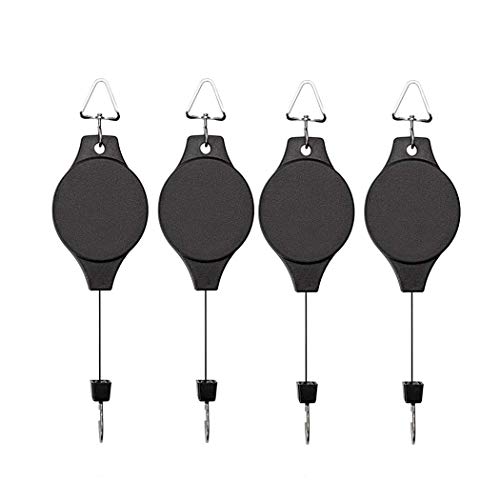
The first is the pulley hanger. A retractable plant pulley sits between the hook and the hanger and lets the pot drop 24 to 36 in (61 to 91 cm) with a gentle tug, so a pot hung with its rim at 78 in (198 cm) comes down to 48 in (122 cm), waist height, for watering and goes back up with a second tug. Each pulley is rated for a stated load, typically 15 to 30 lb (7 to 14 kg), well beyond a single pot. The second is the long-spout can: a 20 to 24 in (51 to 61 cm) spout on a 1 qt (1 L) can reaches a pot rim at 78 in (198 cm) from the floor for anyone of average height, and the small capacity stops you giving each pot too much. The third is the self-watering insert, a reservoir pot with a wick that holds a week’s water so the plant draws what it needs, which halves how often the pot has to be reached at all.
Trimming is the other half of the schedule. Creeping fig and pothos over a table grow toward the tall windows on the right, so the side nearest the glass thickens and the far side thins; rotate the grid a half turn monthly, which is a two-minute job with the pots lowered on pulleys, and cut the trailers back to a hand’s width above the plates so no one is eating under a vine.
Key Takeaway: Anything hung above 72 in (183 cm) gets a pulley hanger, a 20 to 24 in (51 to 61 cm) long-spout can or a self-watering insert before it gets a plant, because the watering routine, not the anchor, is what keeps it alive.
Over the Bed, the Honest Answer Is a Wall Beam and a Faux Garland
 Save
The bedroom canopy of live plants over the pillow is a picture that circulates every spring, and the received wisdom is that it is the ultimate version of the hanging-plant look. Think about what is above your head. Soil, which dries and sheds; water, which drips exactly once, at 2 am; fungus gnats, which live in moist potting mix and fly at night; and a pot on an anchor that you will never get around to re-checking. Add the fact that a bed is usually on the wall furthest from the window and the live version fails on light as well.
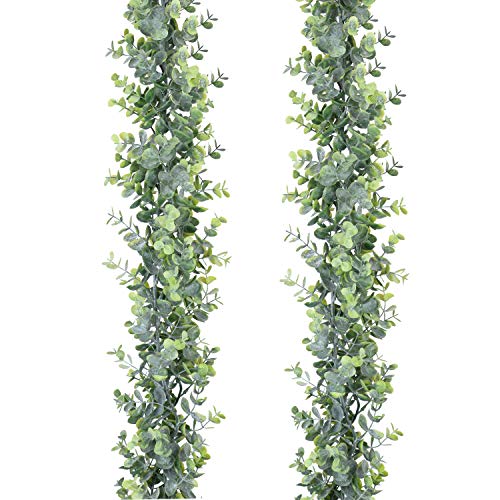
The version that holds up puts a beam on the wall above the headboard, not on the ceiling above the pillow, and dresses it with a faux boxwood garland. A reclaimed beam 48 x 6 in (120 x 15 cm) and 2 in (5 cm) thick is 12 to 18 lb (5.4 to 8 kg); mounted flat to the wall on two heavy L-brackets or a pair of 3/8 in (10 mm) lag screws into studs 16 in (41 cm) on centre, it is a wall load, in shear, with a margin measured in hundreds of pounds. Set the underside of the beam at 72 to 78 in (183 to 198 cm), well above a sitting head, and let the garland strands hang 18 to 24 in (46 to 61 cm) so they end above the headboard, never on the pillows.
Five globe bulbs on staggered black cords, plugged into a bedside socket through a dimmer, give the vignette its warm evening light and give you a reading light that switches off at the wall. Keep bulbs LED so nothing near a faux vine gets warm. The dark wood ledge below carries the things that would otherwise be in a nightstand drawer: dried pampas in a terracotta vase, a short stack of books, a glass candle holder, and two leaning framed abstract prints in soft earth tones that pick up the stone-textured plaster behind.
If you cannot give up live plants in the bedroom, put them where the bed is not. A single hanger beside the window at eye level, on the S-hook and rod method from the first section, gives you a live plant in the room without one over your sleeping head, and it gets the light the bed corner never will.
Key Takeaway: Mount a 48 x 6 in (120 x 15 cm) beam on studs at 72 to 78 in (183 to 198 cm) with a faux garland and LED bulbs above the bed, and keep the live plants beside the window where nothing drips on a pillow.
If Live Plants Are Going Above the Bed Anyway, Seal the Trough and Pull the Pots
 Save
Some people will do the boutique-hotel canopy regardless, and the received version, a wooden trough of soil with a drainage hole hung over white linen, is the one to refuse. The hotel version works because housekeeping changes the linen daily and a contractor services the troughs. The home version works only if the trough cannot drip and the plants can be lifted out for watering, and that is a construction detail rather than a plant choice.
Build the trough sealed. A 24 x 8 in (60 x 20 cm) natural wood trough gets a rigid plastic liner with no holes, a 1 in (2.5 cm) layer of pebbles in the bottom, and the ferns stay in their own 6 in (15 cm) nursery pots standing on the pebbles rather than planted into the trough. Nothing in the trough can drain, so nothing can drip; any water that runs through a pot collects in the pebble layer below the pot’s base, where it evaporates and humidifies the ferns from beneath. To water, lift the three pots out, water them in the sink, drain for ten minutes and put them back. A liner also stops the wood staining and swelling.
Offset the troughs. Hang them so no part of either trough is over the mattress: at least 12 in (30 cm) outboard of the mattress edge on each side, with the underside at 84 in (213 cm), which puts the fern tips around 72 in (183 cm) and above any sitting head. Two troughs with wet pots, liner and pebbles come to 18 to 25 lb (8 to 11 kg) each, so each hangs from two black metal pendant rods into two joists, four anchors total, each carrying 12 lb (5.4 kg) against a 40 to 50 lb (18 to 23 kg) rating. The black cage pendant lights between them are on their own ceiling boxes and carry no trough load.
Light is the honest limit. A bed wall is usually 8 ft (244 cm) or more from the window, so the ferns in these troughs are living on the edge of their light and will need the pots swapped with a second set kept by the window every few weeks, or a screw-base full-spectrum bulb in one of the cage pendants for 10 hours a day. The areca palm in the corner by the window is the plant that is actually thriving in this room, and it is on the floor.
Key Takeaway: Over a bed, a trough is a sealed liner with pebbles and removable nursery pots, hung 12 in (30 cm) outboard of the mattress at 84 in (213 cm) on four joist anchors, and watered in the sink.

One Plant at the Right Distance From the Right Window Beats Twelve at the Wrong One
 Save
The received idea is that the look takes a lot of plants. A single 12 in (30 cm) wicker basket of pothos hung where the light is right will outgrow and outlast a dozen hung where it is wrong, and choosing where is a question with a clear answer for each window direction.
An east-facing window, which is what tall French doors like these face when the morning sun pours in, gives two or three hours of gentle direct sun and then bright indirect light for the rest of the day. Hang the basket 2 to 3 ft (61 to 91 cm) back from the glass and pothos, philodendron and ferns are all content. A south window is stronger: direct sun within 2 to 3 ft (61 to 91 cm), bright indirect to about 5 ft (152 cm), semi-shade to 8 ft (244 cm). Trailing tropicals hang 3 to 5 ft (91 to 152 cm) back from a south window, or right at the glass behind a sheer. A west window is the south window’s afternoon-only cousin and its light is hot; give it 4 to 5 ft (122 to 152 cm) or a sheer. A north window delivers indirect light only, so the basket hangs within 2 ft (61 cm) of the glass and the plant is a low-light one, pothos or heartleaf philodendron, never a fern that wants brightness.
The radiator is the other half of the placement. A cast-iron radiator on the wall beside the doors means a column of hot, dry air rising exactly where a window plant would like to hang, and a basket in that column dries out in a day in winter. Hang at least 3 ft (91 cm) to the side of any radiator or supply vent, which in this room means the basket sits centred on the doors rather than beside them.
From the guides
You've saved it, wanted it. Here's the how: codes, measurements, order. Your choices make it yours.
The Japandi Honest PlaybookThe honest version of the style: what to keep, what to skip, and the order to do it in.See inside →The Room Refresh PlaybookA repeatable four-step method, room by room, in ten minutes, thirty minutes, or one weekend.See inside →Make Any Room Feel Cozy on PurposeWhy some rooms hold people and others empty out, and the moves that change it.See inside →The anchor in a room with ornate plaster molding is a plaster-ceiling job: find the joist with a magnet, screw eye 2 1/2 in (64 mm) into the wood, and place it where the molding is flat rather than through a decorative run. A wicker basket of pothos in a 10 in (25 cm) pot is 6 to 8 lb (2.7 to 3.6 kg) watered, an easy load, hung with its base at 66 in (168 cm) so the long trailers reach the armchair’s shoulder line and the eye moves down from the basket to the chair to the floor plants.
Key Takeaway: Place by window direction: 2 to 3 ft (61 to 91 cm) back from east, 3 to 5 ft (91 to 152 cm) from south or west or on the sill behind a sheer, within 2 ft (61 cm) of north with a low-light plant, and 3 ft (91 cm) clear of any radiator.
A Dry-Looking Top Is the Second Thing That Kills a Hung Plant
 Save
The rule everyone repeats is to water when the top of the soil looks dry. In a hung pot that rule is the second killer, after the ceiling heat. A pot in warm moving air crusts over on top within a day of watering while the root ball underneath is still saturated, so the top says “water me” and the roots say “please stop”, and the plant that looked thirsty rots from the bottom. Spider plants and string of pearls, two of the most common hanging plants, are exactly the two that die this way most often.
The test that works is weight, and a hanger makes it easy. Water the pot thoroughly once, let it drain, then lift it on its hanger and notice the heft. Lift it again every couple of days; when it feels distinctly light, perhaps two-thirds of the watered weight, it is time. A 5 in (13 cm) stone-glazed ceramic pot of spider plant goes from about 3 lb (1.4 kg) wet to under 2 lb (0.9 kg) dry, and the difference is obvious in the hand after a week of practice. If you would rather have a number, a finger pushed 2 in (5 cm) into the mix, not 1/2 in (13 mm) into the crust, tells the truth the surface hides.
Each plant has its own point on that scale. A spider plant wants the top 2 in (5 cm) dry and the pot noticeably light. A string of pearls wants drier still, the pot almost feather-light and the beads just beginning to lose their sheen, since its pearls store water and its roots rot in a damp week. An English ivy on the shelf above sits between the two. Water each in the sink, a slow pass until it runs from the base, ten minutes to drain, and back on the S-hook; the brass can on the floor is for the philodendron in the pot beside it, not for pouring into a hung basket over a walnut shelf.
Mounting is a wall job here, and a kind one. A 36 x 6 in (90 x 15 cm) walnut shelf on two black iron brackets into studs carries the ivy plus three macrame hangers hooked to eyes screwed into its underside, 12 in (30 cm) apart, each pot under 3 lb (1.4 kg) wet. The whole corner, shelf and plants, is under 20 lb (9 kg) on two stud fixings rated far above that, and not one hole touches the ceiling.
Key Takeaway: Judge a hung pot by lifting it, water when it feels two-thirds of its watered weight or dry 2 in (5 cm) down, and let string of pearls go lighter still, because the crusted top of a hanging pot lies.

Macrame Is One Hanging System of Four, and the Plant’s Weight Picks Between Them
 Save
Macrame has become shorthand for hanging plants, as if the knotted hanger were the only way up. It is one of four systems, and the honest way to choose between them is to weigh the plant, look at the lease, and decide how often you will move things.
Macrame and cord hangers are the light-load, permanent-anchor option. A cotton or linen cord hanger holds a pot from 4 to 10 in (10 to 25 cm) with ease, and it hangs from a screw eye in a joist, one hole per hanger. It is the prettiest system and the least flexible; the pot lives where the hook is. Three matte ceramic spheres at 6 to 8 in (15 to 20 cm) on linen cord, staggered 8 to 12 in (20 to 30 cm) apart, are 2 to 4 lb (0.9 to 1.8 kg) each wet, and three screw eyes within a 12 in (30 cm) run of one joist carry them with nothing to spare a thought about.
A ceiling track is the heavy-load, moveable option. A length of aluminium curtain track screwed along a joist, or across two, carries sliding hooks that can be repositioned any time, which is what you want when a cluster of pots keeps changing size. Rated tracks carry 10 to 20 lb (4.5 to 9 kg) per hook depending on the profile, the fixings go into framing at 16 in (41 cm) centres, and a 6 ft (183 cm) run in a bright room holds a whole collection that can be shuffled toward the window in winter.
A tension rod is the no-hole, tiny-load option. Wedged inside a window recess, a spring-loaded rod holds the smallest pots, 4 in (10 cm), one or two of them, never a wet 10 in (25 cm) basket; every rod has a stated limit and a rod that lets go takes the plants and a strip of paint with it. It is the right system for a renter with a deep window reveal and a couple of small trailers, and wrong for anything else.
A wall bracket is the mid-weight, single-plant option and the renter’s strongest friend. A forged bracket screwed into a stud beside the window carries a 10 in (25 cm) fern at 6 to 8 lb (2.7 to 3.6 kg) on a wall anchor’s full rating, projects the plant 8 to 12 in (20 to 30 cm) into the light, and leaves two puttyable holes. In strong side light like this, all four systems cast the same latticed shadows on a cream wall; the plant does not care which one holds it up, only that the number behind it was right.
Key Takeaway: Pick the system by the wet weight: cord hangers on joist eyes for pots to 10 in (25 cm), a ceiling track when the cluster will move, a tension rod for 4 in (10 cm) pots only, and a wall bracket for one heavier plant beside the window with no ceiling holes.

Start with the ceiling, not the plant. Find out what it is made of, find the joists, and match the anchor to the wet weight of what you want to hang: about 10 lb (4.5 kg) for a drywall toggle, 40 to 50 lb (18 to 23 kg) for a screw eye in a joist, well over 100 lb (45 kg) for a masonry anchor in sound concrete, and nothing at all for an adhesive hook or an old plaster surface. Then set the height from the floor, 80 in (203 cm) under a walkway or eye level in a corner, and keep every pot 12 in (30 cm) below the ceiling air layer and 3 ft (91 cm) from any heat. Place it by window direction, and before it goes up, decide how it comes down for watering, then water it by weight rather than by the look of the top. If you have one hook and one plant to start with, put a curtain rod or a wall bracket beside the brightest window, hang a pothos at eye level, and let it show you whether the spot is right before you drill anything at all.
 Save
More Plants To Hang From The Ceiling
The original ideas from this article continue below.
Hanging plants from the ceiling can transform any interior space, adding a sense of life, greenery, and tranquility. However, not all plants are suitable for ceiling hanging. As an interior plantscape designer, it’s important to carefully consider factors like plant size, weight, light exposure, and growth habits when selecting species.
 Save
In this comprehensive guide, we will explore 20 top options for ceiling-hanging houseplants, along with care tips and considerations for each. Whether you want trailing vines, ropy strands, lush leaves, or cascading tendrils, there is a wonderful world of plants perfect for suspending from above. Let’s get started!
The images featured in this article have been modified using AI to help visualize these design concepts.
Spider Plant (Chlorophytum comosum)
The spider plant is a trailing houseplant classic, with arching ribbon-like foliage that can grow quite long. Native to tropical regions of Africa, spider plants are very adaptable and easy to care for. They can tolerate low to bright indirect light. Allow soil to dry out some between waterings. Spider plants also produce babies that can be clipped and propagated. Their lightweight trailing nature makes these excellent ceiling-hanging plants.
 Save
 Save
- Sun Exposure: Bright, indirect to low light
- Soil Type: Well-draining potting mix
- Soil pH: 6.1-7.5
Key Details:
- Trailing nature is great for hanging baskets
- Very adaptable to various light levels
- Produces baby plants for propagation
- Lightweight foliage good for ceiling mounts
- Easy care for beginner gardeners
Takeaways:
- Trailing nature is great for hanging baskets
- Very adaptable to various light levels
- Produces baby plants for propagation
- Lightweight foliage good for ceiling mounts
- Easy care for beginner gardeners
Wandering Jew (Tradescantia zebrina)
Known for its striking purple and silver striped leaves, the wandering Jew plant is a trailing vine that can grow quite lengthy. Give it bright, indirect light to encourage fast growth. These trailing plants require more frequent watering and high humidity. Allow soil to dry out slightly between waterings. The wandering Jew makes a beautiful hanging plant with its cascading purple foliage.
 Save
- Sun Exposure: Bright indirect light
- Soil Type: Rich, well-draining potting mix
- Soil pH: 5.6-7.5
Key Details:
- Cascading purple foliage creates drama
- Appreciates bright light for the best color
- Provides movement and flow
- Requires more moisture than some plants
- Trailing nature is perfect for hanging
Takeaways:
- Cascading purple foliage creates drama
- Appreciates bright light for the best color
- Provides movement and flow
- Requires more moisture than some plants
- Trailing nature is perfect for hanging
String of Pearls (Senecio rowleyanus)
The string of pearls plant gets its name from the unique round, pea-like foliage that trails in bead-like strands. Native to South Africa, it thrives in bright light positions, tolerating some direct sun. Allow the soil to dry out completely between waterings. Their lightweight dangling strands make a string of pearl plants ideal for ceiling mounts or hanging containers. Keep away from pets, as they are toxic.
 Save
- Sun Exposure: Bright indirect light to full sun.
- Soil Type: Sharp drainage required.
- Soil pH: 6.1-7.5
Key Details:
- Trailing strands create lush drapery
- Requires very well-draining soil
- Tolerates bright light and some direct sun
- Toxic to pets, so hang away from reach
- Unique pearl-like foliage
Takeaways:
- Trailing strands create lush drapery
- Requires very well-draining soil
- Tolerates bright light and some direct sun
- Toxic to pets, so hang away from reach
- Unique pearl-like foliage
Philodendrons
Philodendrons are classic houseplants, valued for their heart-shaped leaves and vining growth habit. Varieties like Brasil, Micans, and Green Heartleaf Philodendron are fantastic choices for ceiling hanging containers. Allow soil to dry out some between waterings. Most philodendrons thrive in moderate to bright indirect light. Water when the top inch of soil is dry. Mist occasionally increases humidity around the foliage.
 Save
- Sun Exposure: Bright indirect light to low light
- Soil Type: Well-draining potting mix
- Soil pH: 5.5-6.5
Key Details:
- Heart-shaped leaves add warmth and style
- Trailing vines create depth and movement
- Many varieties to choose from for varied looks
- Generally easy care and hard to kill
- Allow soil to dry out between waterings
Takeaways:
- Heart-shaped leaves add warmth and style
- Trailing vines create depth and movement
- Many varieties to choose from for varied looks
- Generally easy care and hard to kill
- Allow soil to dry out between waterings
Hoya Hindu Ropes (Hoya carnosa compacta)
The Hindu rope hoya is aptly named for its twisted, ropy foliage. This slow but steady-growing trailing succulent appreciates bright indirect light. Allow soil to dry out before rewatering. Hoyas tend to bloom more when slightly rootbound. Mist occasionally to provide added humidity. Hindu rope hoya is a uniquely shaped trailing plant perfect for ceiling mounts or hanging containers.
 Save
- Sun Exposure: Bright indirect light
- Soil Type: Loose, well-draining mix
- Soil pH: 6.1-7.5
Key Details:
- Ropy, twisted foliage for texture
- Slow growing but worth the wait
- Allows soil to dry out between waterings
- Blooms more when slightly rootbound
- Perfectly suited for hanging positions
Takeaways:
- Ropy, twisted foliage for texture
- Slow growing but worth the wait
- Allows soil to dry out between waterings
- Blooms more when slightly rootbound
- Perfectly suited for hanging positions
Fuchsia (Fuchsia hybrida)
Few plants can match the vibrant colors of the hanging fuchsia. This popular basket plant produces delicate teardrop blossoms in shades of red, purple, white, pink, and more. Native to South America, fuchsias grow best in cool climates with mild summers. They require consistent moisture and bright indirect sunlight. Pinch back tips to encourage bushiness. Hummingbirds love fuchsia flowers!
 Save
- Sun Exposure: Cool, bright indirect light
- Soil Type: Rich, humus potting mix
- Soil pH: 5.5-6.5
Key Details:
- Beautiful drooping flower clusters
- Loves cool climates and indirect sun
- Consistent moisture helps flowers thrive
- Attracts hummingbirds
- Pinchback for fullness
Takeaways:
- Beautiful drooping flower clusters
- Loves cool climates and indirect sun
- Consistent moisture helps flowers thrive
- Attracts hummingbirds
- Pinchback for fullness
Chain of Hearts (Ceropegia woodii)
The chain of hearts vine is a trailing succulent perfect for hanging containers. Originally from South Africa, a chain of hearts has unique heart-shaped foliage on vining stems. It flourishes in bright, indirect sunlight. Allow the soil to dry out between waterings. Mist occasionally for added humidity. Propagate in water or sphagnum moss for lush hanging displays.
 Save
- Sun Exposure: Bright indirect light
- Soil Type: Well-draining cactus mix
- Soil pH: 6.1-7.5
Key Details:
- Unique trailing foliage with heart shapes
- Requires well-draining soil
- Allow soil to dry out before rewatering
- Propagate easily in water or moss
- Thrives in bright, warm conditions
Takeaways:
- Unique trailing foliage with heart shapes
- Requires well-draining soil
- Allow soil to dry out before rewatering
- Propagate easily in water or moss
- Thrives in bright, warm conditions
Peperomia tetragona
With its lush oval succulent-like leaves, the peperomia tetragona makes a lush addition to hanging collections. It flourishes best in bright, indirect light. Allow soil to dry before watering again. Native to South America, peperomias are generally easy care plants, making them great for beginner gardeners. Mist occasionally for added humidity around the leaves.
 Save
- Sun Exposure: Bright indirect sunlight
- Soil Type: Loose, well-draining mix
- Soil pH: 5.5-6.5
Key Details:
- Succulent-like foliage adds texture
- Best growth in moderate to bright light
- Allow soil to dry out before rewatering
- Beginner-friendly and easy care
- Benefits from occasional misting
Takeaways:
- Succulent-like foliage adds texture
- Best growth in moderate to bright light
- Allow soil to dry out before rewatering
- Beginner-friendly and easy care
- Benefits from occasional misting
Burro’s Tail (Sedum morganianum)
With trailing blue-green leaves tightly packed on wiry stems, the burro’s tail is a unique succulent perfect for hanging displays. Native to southern Mexico and Honduras, it flourishes best in full sun. Allow soil to dry thoroughly between waterings. It can struggle with excess moisture. Mist occasionally for humidity. Show off its gorgeous trailing foliage by ceiling mounting or hanging the burro’s tail.
 Save
- Sun Exposure: Bright indirect light to full sun
- Soil Type: Very well-draining mix
- Soil pH: 6.1-7.5
Key Details:
- Unique, tightly packed foliage
- Requires very well-draining soil
- Thrives best in full sun conditions
- Struggles if overwatered
- Gorgeous trailing nature
Takeaways:
- Unique, tightly packed foliage
- Requires very well-draining soil
- Thrives best in full sun conditions
- Struggles if overwatered
- Gorgeous trailing nature
Air Plants (Tillandsia species)
Air plants are unique tropical epiphytes that cling to trees and rocks. They absorb moisture and nutrients through their leaves and roots, requiring no soil. There are over 650 Tillandsia air plant species. Most prefer bright, humid environments. Air plants make fantastic hanging plants since they attach easily to seagrass or coco liners, shells, driftwood, glass, and more. Mist 1-2 times per week and soak monthly.
 Save
- Sun Exposure: Bright indirect to full sun
- Soil Type: Epiphytic so no soil is needed
- Soil pH: N/A
Key Details:
- No soil needed to grow these epiphytes
- Attach easily to seashells, wood, glass
- Prefer bright, humid tropical environments
- Mist 1-2 times weekly and soak monthly
- Over 650 unique species to collect
Takeaways:
- No soil needed to grow these epiphytes
- Attach easily to seashells, wood, glass
- Prefer bright, humid tropical environments
- Mist 1-2 times weekly and soak monthly
- Over 650 unique species to collect
Staghorn Fern (Platycerium spp)
The staghorn fern is a unique epiphytic plant perfect for adding an architectural element to hanging displays. They form gorgeous two-tiered fronds that resemble antlers. Staghorns thrive mounted on wood or wireframes where their fuzzy rhizomes cling. Mist several times per week and water when fronds appear dry. Thrive best in indirect sunlight with 60-70% humidity.
 Save
- Sun Exposure: Bright indirect sunlight.
- Soil Type: Usually grown on mounts without soil
- Soil pH: N/A
Key Details:
- Unique antler-shaped fronds
- Grown mounted without soil
- Require consistent moisture and humidity
- Attach to wood or wireframes
- Architectural appeal for ceilings
Takeaways:
- Unique antler-shaped fronds
- Grown mounted without soil
- Require consistent moisture and humidity
- Attach to wood or wireframes
- Architectural appeal for ceilings
Rosary Vine (Ceropegia linearis)
The rosary vine is a flowering succulent perfect for suspended containers. Silver-grey foliage is topped by unique tube-shaped blooms. Native to South Africa, rosary vines flourish best in bright, indirect sun. Allow the soil to dry out before watering again. Introduce a trellis for optimal display of the trailing vines and unusual flowers.
 Save
- Sun Exposure: Bright indirect light
- Soil Type: Well-draining cactus mix
- Soil pH: 6.1-7.5
Key Details:
- Trailing silver-grey succulent foliage
- Topped by delicate tubular flowers
- Allow soil to dry out between waterings
- Add a trellis for optimal effect
- Flourish in warm, bright conditions
Takeaways:
- Trailing silver-grey succulent foliage
- Topped by delicate tubular flowers
- Allow soil to dry out between waterings
- Add a trellis for optimal effect
- Flourish in warm, bright conditions
Boston Fern (Nephrolepis exaltata Bostoniensis)
Boston ferns are herbaceous plants known for long, graceful fronds. They flourish best in warm, humid conditions with indirect sunlight and consistent soil moisture. Mist regularly to provide needed humidity. Ceiling hanging these beauties helps meet their moisture and humidity preferences. Their lush fronds will drape beautifully. Keep away from cold drafts.
 Save
- Sun Exposure: Bright indirect light
- Soil Type: Rich, organic potting mix
- Soil pH: 6.1-7.5
Key Details:
- Long, graceful arching fronds
- Thrive best in humidity and warmth
- Requires consistently moist soil
- Mist regularly to increase humidity
- Makes a beautiful ceiling-mounted plant
Takeaways:
- Long, graceful arching fronds
- Thrive best in humidity and warmth
- Requires consistently moist soil
- Mist regularly to increase humidity
- Makes a beautiful ceiling-mounted plant
Rabbit’s Foot Fern (Davallia fejeensis)
The rabbit’s foot fern is named for its furry rhizomes. These tropical ferns love warm, humid environments with indirect sunlight. Allow the soil to dry slightly between waterings without fully drying out. Rhizome tips can be snipped for propagation or to encourage bushiness. The lush fronds drape nicely in hanging pots. Keep soil moist. Mist occasionally for added humidity.
 Save
- Sun Exposure: Bright indirect sunlight
- Soil Type: Humus-rich potting mix
- Soil pH: 6.5-7.5
Key Details:
- Furry rhizomes give it a distinctive look
- Keep soil consistently moist but not soggy
- Loves warm temperatures and high humidity
- Mist regularly to provide humidity
- Rhizome tips used for propagation
Takeaways:
- Furry rhizomes give it a distinctive look
- Keep soil consistently moist but not soggy
- Loves warm temperatures and high humidity
- Mist regularly to provide humidity
- Rhizome tips used for propagation
Nerve Plant (Fittonia albivenis)
This tropical houseplant is a real showstopper with striking veined foliage in shades of deep green, red, pink, white, and more. Nerve plants hail from the rainforests of South America. They flourish best in high-humidity environments with bright indirect light. Keep soil consistently moist and mist 1-2 times per week. Allow soil to dry slightly between waterings. Ceiling hanging helps increase humidity exposure.
 Save
- Sun Exposure: Bright indirect sunlight
- Soil Type: Rich, organic potting mix
- Soil pH: 6.0-6.5
Key Details:
- Gorgeous colored veined foliage
- Native to warm, humid rainforests
- Keep soil consistently moist
- Thrives best in high humidity
- Trailing nature is perfect for hanging
Takeaways:
- Gorgeous colored veined foliage
- Native to warm, humid rainforests
- Keep soil consistently moist
- Thrives best in high humidity
- Trailing nature is perfect for hanging
Flowering Maple (Abutilon hybrida)
Flowering maples are long-blooming flowering shrubs that make gorgeous hanging plants. Hybrid varieties offer a range of blossom colors like red, orange, pink, white, and more. Flowering maples hail from subtropical regions and flourish best with indirect sunlight and consistent moisture. Ceiling hanging encourages the long arching stems to drape beautifully. Bring plants indoors before the first frost.
 Save
- Sun Exposure: Cool, bright indirect light
- Soil Type: Evenly moist, organic mix
- Soil pH: 6.0-6.5
Key Details:
- Prolific flowers in shades of red, orange, pink
- Long arching stems drape gracefully
- Keep soil consistently evenly moist
- Appreciate cool daytime temperatures
- Bring indoors before frosts
Takeaways:
- Prolific flowers in shades of red, orange, pink
- Long arching stems drape gracefully
- Keep soil consistently evenly moist
- Appreciate cool daytime temperatures
- Bring indoors before frosts
Goldfish Plant (Columnea gloriosa)
This Central American native is named for its unique flower shape, said to resemble a swimming goldfish. Glossy bright foliage drapes from long vines, with orange and red blooms that add a pop of color. Goldfish plants flourish best in humid environments with indirect light. Keep soil evenly moist but not saturated. Trailing vines make this a stunning ceiling plant for adding movement and visual interest.
 Save
- Sun Exposure: Bright indirect light
- Soil Type: Evenly moist potting mix
- Soil pH: 5.5-6.5
Key Details:
- Vining foliage and vivid goldfish-shaped flowers
- Prefers warm and humid conditions
- Keep soil consistently evenly moist
- Allows soil to almost dry before rewatering
- Trailing nature is perfect for hanging
Takeaways:
- Vining foliage and vivid goldfish-shaped flowers
- Prefers warm and humid conditions
- Keep soil consistently evenly moist
- Allows soil to almost dry before rewatering
- Trailing nature is perfect for hanging
Lady Slippers (Paphiopedilum spp)
Lady slipper orchids are prized for their pouch-shaped flowers resembling elegant shoes. Most lady slippers are terrestrial, flourishing in well-draining orchid bark mixes. Their trailing spike-like foliage also lends itself well to ceiling-hanging containers and displays. Lady slippers flourish best in bright, indirect sunlight and average room temperatures. Water when the top inch of the mix is dry.
 Save
- Sun Exposure: Bright indirect light
- Soil Type: Well-draining orchid mix
- Soil pH: 6.0-6.5
Key Details:
- Unique pouch-shaped lady slipper flowers
- Trailing foliage is great for hanging
- A well-draining orchid mix is needed
- Allow orchid mix to nearly dry before watering
- Prefers average household temperatures
Takeaways:
- Unique pouch-shaped lady slipper flowers
- Trailing foliage is great for hanging
- A well-draining orchid mix is needed
- Allow orchid mix to nearly dry before watering
- Prefers average household temperatures
Arrowhead Vine (Syngonium podophyllum)
The arrowhead vine houseplant is an easy-to-grow trailing beauty originally from tropical rainforests. Juvenile leaves have unique arrow shapes before maturing to lobed leaves. Provide bright indirect light to encourage fast growth. Water when the top inch of soil is partly dry. Propagate stem cuttings in water. Allow long vines to gracefully drape when ceiling hung for tropical style.
 Save
- Sun Exposure: Bright indirect light
- Soil Type: Evenly moist potting mix
- Soil pH: 6.0-6.5
Key Details:
- Unique arrow-shaped young leaves
- Fast growing in warm, bright conditions
- Keep soil evenly moist but not soaked
- Easy to propagate stem cuttings in water
- Trailing vines perfect for ceiling mounts
Takeaways:
- Unique arrow-shaped young leaves
- Fast growing in warm, bright conditions
- Keep soil evenly moist but not soaked
- Easy to propagate stem cuttings in water
- Trailing vines perfect for ceiling mounts
Grape Ivy (Cissus rhombifolia)
Grape ivy is a popular indoor vine known for its glossy, oval-shaped foliage. It flourishes best in average room temperatures with moderate sunlight. Keep soil evenly moist but not soaked. Mist occasionally to boost humidity. Grape ivy can withstand short, dry spells. Long trailing vines give gorgeous movement and texture when the ceiling hangs. Pinch back over stems to encourage bushiness if needed.
 Save
- Sun Exposure: Medium to bright indirect light
- Soil Type: Well-draining potting mix
- Soil pH: 6.1-7.5
Key Details:
- Glossy oval-shaped trailing foliage
- Withstands brief dry periods
- Keep soil evenly moist but not soaked
- Makes beautiful ceiling hanging plant
- Pinchback to maintain the desired length
Takeaways:
- Glossy oval-shaped trailing foliage
- Withstands brief dry periods
- Keep soil evenly moist but not soaked
- Makes beautiful ceiling hanging plant
- Pinchback to maintain the desired length
Conclusion
When selecting plants for ceiling hanging displays, consider important factors like sunlight needs, humidity preferences, mature size, growth rate, and trailing habits. Choose plants whose needs best match your growing environment. This helps ensure healthy, thriving plants. Properly caring for ceiling hanging plants encourages lush growth that enhances the decor. With the right selections, you can create beautiful living artwork from above!
Follow Quiet Minimal on Pinterest for more home design tips and inspiration.
This post contains affiliate links. If you make a purchase, Quiet Minimal may receive a small commission at no additional cost to you.
From the guides
You've saved it, wanted it. Here's the how: codes, measurements, order. Your choices make it yours.
The Japandi Honest PlaybookThe honest version of the style: what to keep, what to skip, and the order to do it in.See inside →The Room Refresh PlaybookA repeatable four-step method, room by room, in ten minutes, thirty minutes, or one weekend.See inside →Make Any Room Feel Cozy on PurposeWhy some rooms hold people and others empty out, and the moves that change it.See inside →


