 Georgia
An eclectic moody bedroom is the room Pinterest keeps saving and the one most people stall on at the paint counter. The six sections further down this page still hold: the dark palette, the textures and fabrics, the vintage pieces, the modern counterweights, the lighting and the personal layer. What they never gave you is the method. Which eggplant purple, by code. How much of the room one era may own before the mix turns into a showroom. What order the linen, the velvet and the wool go onto the bed, and how many pillows that makes. How far apart the gold frames and the black frames hang above the headboard. This block sits above the old advice as the mix method: five dark palette cards with verified codes, the ceiling and trim decision, the 60/30/10 era ratio, the bedding order with counts, the gallery grid in inches, three light sources at 2700 K, rug size by bed, vintage sourcing by category and price, the pattern scale rule, the small dark room compromise, the shopping order and a budget ladder. The photographs are the rooms. The charts are the arithmetic.
Pick the Dark Wall First, Then Let the Eclectic Layers Argue With It
 Save
Every eclectic moody bedroom that reads as collected rather than random starts with one decision made alone: the wall color. A kilim throw, a copper lamp and a gilt frame have nothing in common until a bottle-green wall stands behind all three; then they are three notes in one chord. Buy the paint before the textiles, because the textiles are easy to change and the wall is what they will be judged against.
Sample the way a decorator does. Benjamin Moore 8 oz samples cost $5.99 each and cover a 2 x 2 ft (61 x 61 cm) board with two coats; paint five boards, not the wall, and move them. Read them at 8 in the morning beside the window, at noon in the center of the room, and at 9 at night under the lamp you will actually use. A color with a light reflectance value under 10 gives back less than a tenth of the light that hits it, so the board that looked green at noon will look black at night, and the night reading is the one you sleep with.
The room here shows why the wall earns its place: rumpled gray linen, a jewel-red kilim, embroidered velvet bolsters, a copper dome lamp about 14 in (36 cm) across and a brass pendant about 12 in (30 cm) tall all sit on green, and none of them fights. The wall is the referee.
Key Takeaway: Choose the dark wall on five sample boards read at three times of day, and let every textile and lamp arrive afterward to argue with it.
From the guides
You've saved it, wanted it. Here's the how: codes, measurements, order. Your choices make it yours.
 The Japandi Honest PlaybookThe honest version of the style: what to keep, what to skip, and the order to do it in.See inside →
 The Room Refresh PlaybookA repeatable four-step method, room by room, in ten minutes, thirty minutes, or one weekend.See inside →
 Make Any Room Feel Cozy on PurposeWhy some rooms hold people and others empty out, and the moves that change it.See inside →
Five Dark Palette Cards by Verified Paint Code: Eggplant, Forest, Oxblood, Charcoal and Navy
 Save
Every code on these cards was confirmed on the brand’s own page at the time of writing. Card one, eggplant: Farrow & Ball Brinjal No. 222, the brand’s deep eggplant purple, with brass hardware, blush velvet and walnut. Card two, forest: Farrow & Ball Studio Green No. 93, a deep, dark green that reads close to black indoors unless the room has strong daylight, or Benjamin Moore Hunter Green 2041-10, LRV 6.39, which holds its green under lamplight; pair either with mustard, walnut and gilt. Card three, oxblood: Sherwin-Williams Rookwood Dark Red SW 2801, with hunter-green velvet, cream linen and walnut. Card four, charcoal: Benjamin Moore Wrought Iron 2124-10, LRV 8.17, a soft, malleable black, or Farrow & Ball Railings No. 31, a soft black with blue undertones; both take white linen, antique gold frames and mustard. Card five, navy: Benjamin Moore Hale Navy HC-154, LRV 8.36, a use-anywhere navy, or Farrow & Ball Hague Blue No. 30, a deep dark blue with green undertones, with rust, camel and brass.
The cost is the same on every card. Benjamin Moore Regal Select Interior Matte is $84.99 per gallon and covers 400 to 450 sq ft; a 12 x 12 ft (366 x 366 cm) bedroom with 8 ft (244 cm) ceilings has about 340 sq ft of wall once a door and a window come off, and a dark color needs two coats, so budget two gallons at $169.98. Five 8 oz samples at $5.99 come to $29.95.
Key Takeaway: Five verified cards, Brinjal, Studio Green or Hunter Green, Rookwood Dark Red, Wrought Iron or Railings, Hale Navy or Hague Blue; two gallons at $169.98 covers a 12 x 12 ft room twice.
Drench the Ceiling and Trim or Draw the Line: the One Decision an Eclectic Moody Room Makes Once
 Save
A dark wall stopped at the ceiling line draws a horizon, and in a bedroom under 9 ft (274 cm) that horizon is the first thing the eye measures. Two honest options; the room here takes the first. Drench: walls, ceiling, trim, doors and any built-in cabinetry in the same wine, with the walls in matte and the cabinetry and trim in satin of the same color, so the sheen does the outlining instead of a second color. The room loses its edges, the ceiling stops being a lid, and the ivory ruffled pendant, about 30 in (76 cm) across, and the camel check headboard become the only pale shapes, which is exactly why they read. Livingetc’s latest bedroom trend report puts dramatic drenching first on its list, on the grounds that one hue wrapped around a room reads as calm rather than loud.
Contrast: ceiling and trim in a warm white, walls dark, a crisp line at the crown. Choose it when the room has molding worth reading or a ceiling above 9 ft (274 cm) that can afford to be seen.
The cost of drenching is one extra gallon. A 12 x 12 ft (366 x 366 cm) ceiling is 144 sq ft, two coats is 288 sq ft, and about 60 linear ft (18 m) of baseboard and casing adds little, so one gallon at $84.99 covers the whole decision. Ceiling first, then walls, then trim.
Key Takeaway: Under 9 ft, drench walls, ceiling and trim in one color with matte walls and satin trim; above 9 ft or with real molding, draw the line in warm white.
The Eclectic Era Ratio: One Era at 60 Percent, a Second at 30, and Wildcards at 10
 Save
Eclectic fails in two directions: a room where every piece is from a different decade reads as a resale shop, and a room where every piece matches reads as a catalog page. The ratio that holds the middle is 60/30/10, counted in pieces, not in dollars. Count everything the eye lands on: bed frame, two nightstands, dresser, bench or chair, rug, two lamps, pendant, mirror. That is 10 pieces in an ordinary bedroom.
Sixty percent, six pieces, belong to one anchor era and carry the furniture with mass: the bed frame, the dresser, both nightstands, the bench and the lamp bases. Mid-century walnut is the easiest anchor because it is still plentiful secondhand and sits under dark paint without competing. Thirty percent, three pieces, come from a second era that argues with the first: a carved Victorian mirror, ornate gilt frames, one velvet chair with turned legs. Ten percent, one piece, is the wildcard neither era explains: a glossy red dome lamp, a rice-paper globe, a lacquer panel. The wildcard is never the bed, because the bed is the largest surface and the eye needs it to belong somewhere.
For 12 pieces the split is 7, 4 and 1. For 15 pieces it is 9, 4 and 2, with the second wildcard on the opposite side of the room from the first. If you cannot say which era a piece belongs to, it counts as a wildcard, and once the wildcards pass two, the room has slipped.
Key Takeaway: Count the pieces and split them 60/30/10, six, three and one in a 10 piece room; the anchor era takes the bed and the storage, and the wildcard never takes the bed.
How a Mid-Century Dresser Sits Beside a Tufted Velvet Headboard Without a Fight
 Save
This is the 60/30 pairing on one wall. The anchor era is mid-century: a walnut five-drawer dresser about 42 in wide, 18 in deep and 34 in tall (107 x 46 x 86 cm) with recessed tab pulls, a drum-shade lamp with a 16 in (41 cm) shade, walnut nightstands out of frame. The second era is traditional: a dark green tufted velvet headboard about 64 in wide and 48 in tall (163 x 122 cm), a Persian rug in amber and navy. The wildcard is the carved relief panel in a black frame, 24 x 36 in (61 x 91 cm), which belongs to no decade at all.
Three things stop the pairing from fighting. Height: the top of the dresser at 34 in (86 cm) sits below the top of the headboard at 48 in (122 cm), so the two silhouettes step rather than compete. A bridge color: mustard on the lamp shade and again on the fringed throw appears in both eras, and one repeated color is what makes two styles read as one decision. Wood tone: the walnut of the dresser and the walnut of the headboard’s frame are within a shade of each other, so the wood is one family even where the shapes are not.
If your dresser is oak and your bed is walnut, stain one or paint the dresser in the wall color; two wood tones plus two eras plus a dark wall is one variable too many.
Key Takeaway: Pair eras by stepping their heights, repeating one bridge color across both, and keeping the wood tones within one family.
The Layered-Bedding Order: Linen, Then Velvet, Then Wool, With the Counts
 Save
The order is linen, velvet, wool, from the mattress up, and the counts are fixed. Layer one is the sheet set in washed linen, one fitted and one flat, in the wall color one or two steps lighter so the bed and the wall are the same conversation. Layer two is the linen duvet: the Casaluna 100 percent European flax set at Target is $139.00 in full/queen and measures 96 x 92 in (244 x 234 cm), which drops about 16 in (41 cm) past the mattress edge on each side of a 60 in (152 cm) queen. Layer three is velvet, the fabric that catches lamplight: a velvet quilt or coverlet folded in thirds across the foot, covering the bottom 30 in (76 cm) of the bed. A box-stitched heavyweight linen-blend quilt at $119.00, 94 x 90 in (239 x 229 cm), does the same job in a matte finish if velvet reads too formal. Layer four is wool, one throw about 50 x 60 in (127 x 152 cm) folded once and dropped over a corner, the one layer allowed to look careless.
Pillows: two linen sleeping pillows against the headboard, two velvet shams in the accent color in front, one lumbar in a kilim or block print in front of those. Five pillows, three fabrics, four layers. The budget version swaps the linen duvet cover for waffle cotton, IKEA’s LUKTVICKER in dark green at $49.99 for full/queen, and keeps every other count.
Key Takeaway: Linen sheets and duvet, a velvet layer folded in thirds at the foot, one wool throw over a corner, and exactly five pillows in three fabrics.
The Mixed-Frame Salon Hang Above the Bed: Gold Frames Beside Black Ones
 Save
A salon hang above the bed is the eclectic move with the highest failure rate, because the frames are the pattern and most people mix them by accident. Set the mix on purpose. The wall here is near-black and carries eight to ten frames, from 10 x 12 in (25 x 30 cm) up to 24 x 30 in (61 x 76 cm), split between ornate antique gold and plain black. Keep the split near 60 percent plain and 40 percent ornate; flip it and the wall turns into a gilt shop. Every piece inside the frames is abstract, ink studies, soft color fields, gestural brushwork, so the frames carry the eras and the art carries the mood. A cream mat 2 to 3 in (5 to 8 cm) wide on every piece, ornate or plain, is the thread that makes a thrift frame and an antique one read as one family.
Anchor the hang on the bed’s own furniture. The antique walnut bed here is about 62 in wide (157 cm), the mustard velvet bench at the foot about 48 in (122 cm), and the gallery spans roughly the headboard’s width and no more, so the bed, the bench and the frames stack as three centered blocks. The brass drop pendant, only 6 in (15 cm) across, hangs dead center above them and gives the eye its vertical axis.
Nothing in the frames is a face, a landscape or a caption. On a dark wall, lettering becomes the loudest thing in the room.
Key Takeaway: Mix plain black and antique gold frames near 60/40, mat every piece in cream, keep the art abstract, and hold the hang to the headboard’s width.
The Gallery Grid Above the Bed by the Numbers: 2 to 3 in Gaps, 57 in Center and 6 in Over the Headboard
 Save
The measurements are the same on every wall; only the frame count changes with the bed. Gaps: 2 to 3 in (5 to 8 cm) between every frame, and the same gap on all four sides, not 2 in on one side and 4 in on the other. Height: on a bare wall the center of the whole group sits at 57 to 60 in (145 to 152 cm) from the floor, eye level for the average adult. Over a bed the headboard sets the height instead: the bottom edge of the lowest frame sits 6 to 10 in (15 to 25 cm) above the headboard’s top, or 4 to 6 in (10 to 15 cm) if you want the group to read as part of the bed rather than above it. Width: the group spans about two thirds of the headboard, so 40 in (102 cm) over a 60 in (152 cm) queen and 50 in (127 cm) over a 76 in (193 cm) king.
Count by bed: six to seven frames over a full, seven to nine over a queen, nine to twelve over a king, with one piece at 24 x 30 in (61 x 76 cm) as the largest and nothing smaller than 8 x 10 in (20 x 25 cm). The largest frame sits just off center, never dead center, and the smallest pieces go to the outer corners.
Cut kraft-paper templates at the frame sizes, tape them up with the gaps measured, and live with the paper for two days before a single nail goes into a dark wall, where every hole shows.
Key Takeaway: Gaps of 2 to 3 in, the bottom edge 6 to 10 in above the headboard, the group at two thirds of the headboard’s width, seven to nine frames over a queen.
Three Light Sources in a Dark Eclectic Bedroom, Every One at 2700 K and on a Dimmer
 Save
A dark wall with an LRV under 10 swallows most of the light that reaches it, so the lamp plan that worked in a white room delivers about half the brightness here. Plan three sources minimum and make every one dimmable. Source one is ambient: a pendant or ceiling fixture on a wall dimmer. The guideline is 10 to 20 lumens per sq ft, which is 1,500 to 3,000 lumens for a 150 sq ft (14 sq m) bedroom, and with dark walls aim for the top of that range and dim down rather than the bottom and wish. The hunter-green fringe pendant here, about 18 in (46 cm) across, throws light down onto the bed instead of into the ceiling.
Source two is task: a lamp on each nightstand at 400 to 800 lumens apiece, one 60 W-equivalent bulb under a fabric shade. Fabric, not metal, because a fabric shade glows and a metal shade only points. The spiral-base brass lamps here with cream shades do that job on two walnut fluted nightstands about 18 in (46 cm) square.
Source three is accent, 150 to 400 lumens: a picture light over the gallery, a sconce beside the chair, an LED strip inside a shelf. Every bulb at 2700 K, no exceptions, because one 4000 K bulb in a 2700 K room turns burgundy walls gray. Three sources, three heights, one color temperature.
Key Takeaway: Ambient at 1,500 to 3,000 lumens on a dimmer, two bedside lamps at 400 to 800 lumens under fabric shades, one accent at 150 to 400, all at 2700 K.
Rug Size by Bed: 8 x 10 ft Under a Queen, 9 x 12 ft Under a King, and the 18 in Rule
 Save
The rule is the overhang, and the size follows from it. A bedroom rug shows 18 to 24 in (46 to 61 cm) of rug beyond each side of the mattress and at least 24 in (61 cm) past the foot, so the first step out of bed lands on wool, not floor. A queen mattress is 60 x 80 in (152 x 203 cm). An 8 x 10 ft rug (244 x 305 cm) laid with its 8 ft side across the bed gives 96 minus 60, which is 18 in (46 cm) per side, exactly the minimum, with the nightstands standing just off the rug’s edge and the rug’s top edge tucked under the bed at the line of the nightstand fronts. A 9 x 12 ft rug (274 x 366 cm) gives 24 in (61 cm) per side under a queen and brings both nightstands onto the rug, the better answer in any room over 11 x 13 ft (335 x 396 cm). Under a 76 in (193 cm) king the 9 x 12 ft is the floor, not the upgrade: it leaves 16 in (41 cm) per side, and an 8 x 10 ft leaves 10 in (25 cm), which reads as a bath mat.
In a room too small for either, run a 5 x 7 ft rug (152 x 213 cm) across the foot of the bed, long side parallel to the footboard. At current prices Target’s Threshold washable Persian-style rug is $200.00 at 7 x 10 ft and $100.00 at 5 x 7 ft, medium pile at 0.5 to 1 in (1.3 to 2.5 cm), and a dense Persian pattern hides what a plain rug shows.
Key Takeaway: 18 to 24 in beyond each side and 24 in past the foot: 8 x 10 ft under a queen with nightstands off the rug, 9 x 12 ft to bring them on or under any king.
The Pattern-Mixing Scale Rule: One Large Print, One Medium, One Small, and One Shared Color
 Save
Three patterns is the ceiling in a bedroom, and they only coexist when they sit at three different scales. Large: a repeat over 12 in (30 cm), on the biggest textile in the room, the quilt or the rug. Medium: a repeat of 4 to 12 in (10 to 30 cm), on the curtains or the duvet. Small: a repeat under 4 in (10 cm), on the pillows and nothing else. The room here does it in order. The retro floral quilt is the large print, with blooms the size of a dinner plate in citrus, jade and cream. The Persian rug is the medium, its medallion and border reading as texture from standing height. The block-print pillow is the small.
The rule that makes it work is the shared color: every pattern in the room carries at least one color the others carry. Here it is the citrus yellow, in the quilt, in the rug’s ground and in the orange paper lanterns clustered above the headboard. Without the shared color, three scales are still three arguments.
Solids are not patterns and do not count against the three, which is why the dusty-pink velvet headboard, about 62 in wide and 48 in tall (157 x 122 cm), and the dark teal walls can be as loud as they like. Stripes count. A second floral at a second scale counts. A Persian rug and a kilim in the same room is two mediums, and two mediums is the most common way an eclectic moody bedroom loses.
Key Takeaway: Three patterns at three scales, large on the quilt or rug, medium on curtains or duvet, small on pillows, all sharing one color; solids are free.
Vintage Sourcing by Category and Price: Where the Dresser, the Lamps, the Rug and the Frames Come From
 Save
Buy the 60 percent era secondhand and the mix is affordable; buy it new and the mix costs a sofa. By category, at the typical listing bands on resale platforms at the time of writing. Dresser: estate sales and local marketplace listings, where a mid-century walnut dresser generally lists in the low hundreds, and the ceiling is the dealer market, $4,500 for a brass-clad nine-drawer on a design-dealer site. Nightstands: thrift and marketplace, usually tens of dollars each, and a mismatched pair in the same wood is more eclectic than a matched one. Bed frame: estate sales for antique carved walnut, marketplace for mid-century platform frames; check the rails against a modern mattress size before you drive. Lamps: eBay and estate sales for brass; a matched pair of solid brass table lamps sold for $99.00 on eBay, and single brass bases at thrift stores often cost less than a new shade. Mirror: thrift for ornate gilt, the one category where the ornate version secondhand is cheaper than the plain one new. Frames: thrift stores by the armful for a few dollars each; buy for the frame and replace the art. Armchair: marketplace, and budget the velvet reupholstery as the real cost. Rug: hand-knotted wool secondhand from estate sales, or machine-made new, the $200.00 Target 7 x 10 ft above, when the budget says so.
Buy new, always: the mattress, the sheets, the bulbs, the dimmers and the rug pad. Nothing that touches skin or wiring is worth the hunt.
Key Takeaway: Hunt the dresser, nightstands, bed, lamps, mirror, frames, chair and rug secondhand; buy the mattress, sheets, bulbs, dimmers and rug pad new.
The Small Dark Bedroom Compromise: Keep the Color, Change Everything Else
 Save
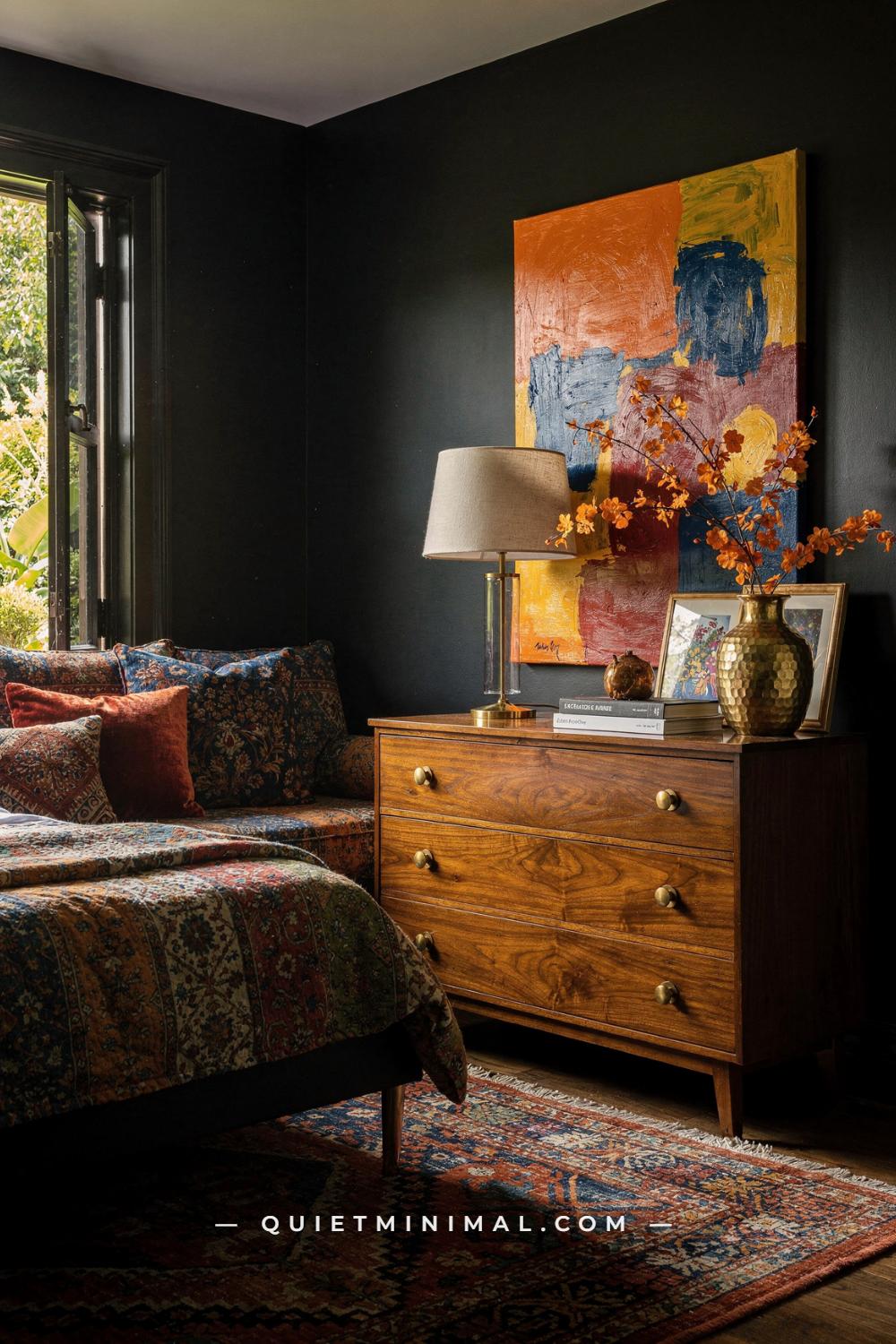
The standard advice for a bedroom under 11 x 12 ft (335 x 366 cm) is to paint it pale, and the standard advice is why small bedrooms look like waiting rooms. Dark walls in a small room remove the corners; the eye stops reading where the wall ends and the room reads deeper than it measures. The compromise is not a lighter color. It is a set of rules about everything except the color.
From the guides
You've saved it, wanted it. Here's the how: codes, measurements, order. Your choices make it yours.
The Japandi Honest PlaybookThe honest version of the style: what to keep, what to skip, and the order to do it in.See inside →The Room Refresh PlaybookA repeatable four-step method, room by room, in ten minutes, thirty minutes, or one weekend.See inside →Make Any Room Feel Cozy on PurposeWhy some rooms hold people and others empty out, and the moves that change it.See inside →The window wall works for its living. Hang the curtains 4 to 6 in (10 to 15 cm) above the frame and 8 to 12 in (20 to 30 cm) past each side so the glass is fully open by day, and leave the sill bare. Hang one mirror of at least 24 x 36 in (61 x 91 cm) on the wall opposite the window, so the daylight lands twice. Keep the furniture low: a platform bed with the mattress top under 24 in (61 cm), nightstands no deeper than 16 in (41 cm), a dresser about 30 in (76 cm) tall rather than a highboy. Hold a 24 in (61 cm) walkway on at least one side of the bed. Hang one large abstract piece, 36 x 48 in (91 x 122 cm), instead of a gallery, because one big shape calms a small dark wall and twelve small ones make it busy. Keep the finish matte; sheen on a dark wall in a small room shows every roller line.
The charcoal room here breaks none of these: the dresser is about 36 in wide and 30 in tall (91 x 76 cm), the painting is one big tangerine-and-cobalt shape, and the window at left is bare to the glass.
Key Takeaway: In a small dark bedroom keep the color and change everything else: bare window, a 24 x 36 in mirror opposite it, furniture under 30 in tall, one large abstract piece, matte walls.
The Collected-Look Shopping Order: Wall, Rug, Bed, Storage, Lamps, Bedding, Frames, Wildcards
 Save
A collected look is bought in a fixed order because each purchase constrains the next, and buying out of order is how a room ends up with a rug that argues with the wall. Wall color first: it fixes the ground tone the rug must carry, and everything else is judged against it. Rug second: it is the largest pattern in the room and it fixes the wood tone, warm walnut against amber and navy, cool oak against slate. Bed frame third: it sets the anchor era, the 60 percent, and it is the single hardest piece to find secondhand, so the hunt starts here. Dresser and nightstands fourth: they follow the bed’s era or deliberately set the 30 percent against it. Lamps and dimmers fifth: two bedside bases in the same metal, fabric shades in a color pulled from the rug, dimmers on the ceiling circuit before the lamps go in. Bedding sixth: the linen in the wall’s family, the velvet in the accent, the wool neutral, in the counts from the bedding section. Frames and art seventh: only once the headboard is in place can the grid be measured. Wildcards last: the glossy dome lamp, the lacquer stool, the one thing no era explains, bought only when the room is otherwise finished and you can see the hole it fills.
On the calendar: weeks one and two for paint, weeks three to eight hunting secondhand for the bed and the storage, week nine to dress the bed and hang the wall.
Key Takeaway: Wall, rug, bed, storage, lamps, bedding, frames, wildcards; each purchase fixes a variable for the next, and the wildcard is the last thing you buy.
Where Layered Tips Into Cluttered: the Surface Count in an Eclectic Moody Bedroom
 Save
The room here is close to the line and stays on the right side of it, and the difference is a count, not a feeling. Every surface has a limit. Nightstand, about 22 x 16 in (56 x 41 cm): a lamp plus two objects, and one of the two can be the book you are actually reading, closed. Dresser, 36 to 42 in (91 to 107 cm) wide: a lamp plus three to four objects, the tallest under 20 in (51 cm). Foot of the bed: one piece, a bench or a trunk, never both. Walls: one gallery wall and one solo piece per room, and the gallery holds the frame count from the grid section. Textiles on the bed: the four layers and five pillows, and a sixth pillow is the first thing to go. Plants: two large or three small, with the trailing ones on the highest surface so they read as one green line. Floor: at least 60 percent of it visible past the rug, which is why the rattan armchair here sits in a corner and not at the foot of the bed.
Collections are the exception and the trap. Display one collection, here the stained-glass panels in soft color fields, and store the others; the eclectic room that displays three collections is the resale shop again. When every surface hits its limit at once, take one object off each, and the room will read as more, not less.
Key Takeaway: Lamp plus two on a nightstand, lamp plus four on a dresser, one piece at the foot, one gallery and one solo piece per room, one collection on show, 60 percent of the floor visible.
The Budget Ladder: Four Rungs From a Sample Pot to a Dressed Bed
 Save
Four rungs, each at current prices, and you climb only as far as the room needs. Rung one, the test, $29.95: five Benjamin Moore 8 oz samples at $5.99, one per palette card, painted on five 2 x 2 ft (61 x 61 cm) boards. Rung two, one dark room, $199.93: the samples plus two gallons of Regal Select Interior Matte at $84.99, enough for two coats on a 12 x 12 ft (366 x 366 cm) bedroom; add a third gallon at $84.99 if you drench the ceiling and trim. Rung three, the floor and the light, $498.93: rung two plus Target’s Threshold washable Persian-style rug at $200.00 in 7 x 10 ft (213 x 305 cm) and a matched pair of secondhand solid brass table lamps at the $99.00 an eBay pair sold for. Rung four, the dressed bed, $756.93: rung three plus the Casaluna 100 percent linen duvet set at $139.00 and the heavyweight linen-blend quilt at $119.00 for the folded layer at the foot.
What the ladder leaves out on purpose is the furniture, because the bed, the dresser and the nightstands come from the sourcing table above at whatever your city’s estate sales are asking this month. The order holds regardless of the total: paint before rug, rug before lamps, lamps before bedding, and the wildcard after all of it. If the budget stops at rung two, a dark room with the old furniture and one good lamp is already an eclectic moody bedroom; the rest is arithmetic you can finish later.
Key Takeaway: $29.95 to test, $199.93 for the dark room, $498.93 with the rug and lamps, $756.93 with the bed dressed; paint first, wildcards last.
 Save
The original ideas from this article continue below.
Imagine walking into a bedroom where vintage charm meets modern sophistication, and you’re surrounded by rich, deep hues like dark blues and charcoal grays. Eclectic elegance in moody bedrooms isn’t just about colors; it’s about layered textures with velvet headboards, linen sheets, and silk throw pillows that create a luxurious feel. Vintage pieces like antique dressers bring character, while sleek, modern furniture and metallic accents add a contemporary edge. The ambiance is perfected with layered lighting, from chandeliers to industrial sconces. Have you ever wondered how to achieve such a stunning fusion in your own space?
- Combine rich, deep hues with matte finishes and muted tones to create a cozy, elegant atmosphere.
- Mix textures like velvet, linen, silk, and chunky knits for depth and luxury.
- Incorporate vintage pieces like antique dressers and embroidered throws for character and warmth.
- Blend sleek, minimalist modern furniture with metallic accents and smart technology for a contemporary touch.
- Use layered lighting with warm, dimmable bulbs, chandeliers, and industrial sconces for the perfect ambiance.
Choosing a Color Palette
When choosing a color palette for a moody bedroom, focus on rich, deep hues that create a cozy and intimate atmosphere. Think dark blues, deep greens, or even charcoal grays. These colors envelop the room, making it feel like a safe, inviting retreat.
You can also add a touch of warmth with burgundy or plum accents. Don’t be afraid to experiment with matte finishes or muted tones to enhance the moody vibe. Avoid overly bright or pastel colors, as they can disrupt the serene ambiance you aim for. Instead, stick to darker shades that blend seamlessly together.
Mixing Textures and Fabrics
 Save
To elevate your bedroom’s moody atmosphere, mix various textures and fabrics to add depth and interest. Start with a velvet headboard, which brings a luxurious feel.
Add linen sheets for a relaxed vibe, and top them with a chunky knit blanket for warmth and contrast. Introduce silk or satin throw pillows to add a touch of elegance.
Don’t forget to layer a plush rug on the floor; it’ll make the space cozy and inviting. Curtains of rich fabrics like brocade or jacquard can enhance the room’s texture.
Incorporating Vintage Pieces
 Save
Infuse your moody bedroom with character by incorporating vintage pieces that tell a story. Start with a statement piece like an antique dresser or a weathered armchair. These items add depth and a sense of history to your space.
Hunt for unique finds at flea markets or estate sales. A retro lamp or a classic mirror can serve as charming focal points.
Consider vintage textiles like an embroidered throw or a faded rug to bring warmth and texture. Don’t forget smaller accents—think old books, framed vintage posters, or a collection of antique trinkets.
Each piece you choose should evoke a sense of nostalgia and blend seamlessly with your room’s moody ambiance, creating a harmonious and inviting retreat.
Adding Modern Elements
 Save
Blend modern elements into your moody bedroom to create a dynamic and contemporary space. Start by choosing sleek, minimalist furniture like a platform bed with clean lines or a geometric dresser.
Incorporate modern artwork with abstract designs or bold colors to make a statement. Opt for metallic accents in your decor, such as a chrome bedside table or a brass wall sculpture, to add a touch of sophistication.
Use modern textiles like a luxurious velvet duvet or a faux fur throw for added texture and comfort. Consider integrating smart home technology, like automated blinds or a wireless sound system, to enhance the modern vibe.
Lighting for Ambiance
 Save
Lighting plays a crucial role in setting the ambiance of your moody bedroom. It’s not just about brightness; it’s about creating a vibe that complements your eclectic style. Think of layered lighting: a mix of ambient, task, and accent lights. Use warm, dimmable bulbs to add intimacy and drama. Try a chandelier for elegance or industrial sconces for an edgy touch. Balance these with soft, diffused floor lamps.
Here’s a quick guide to lighting options:
| Type | Purpose | Example |
|---|---|---|
| Ambient | General Illumination | Overhead chandelier |
| Task | Focused Lighting | Bedside reading lamp |
| Accent | Highlight Features | Wall-mounted sconces |
Experiment with these combinations to achieve the perfect moody atmosphere.
Personalizing With Decor
 Save
Adding personal touches to your decor transforms your moody bedroom into a unique sanctuary that reflects your individual style. Start with artwork that speaks to you; whether it’s a bold abstract painting or a series of black-and-white photographs, these pieces set the tone.
Incorporate textiles like throw pillows, blankets, and rugs in rich, dark hues or intricate patterns to add depth and texture. Don’t forget about your personal collections—displaying cherished items like vintage books, travel souvenirs, or heirloom pieces can make the space truly yours.
Even small details like custom drawer pulls, unique light fixtures, or handmade ceramics can make a big impact. By carefully selecting and placing these elements, you’ll create a cohesive yet eclectic space that’s distinctly you.
Whether mixing vintage finds with modern accents or combining bold patterns with sleek furnishings, the possibilities are endless. So let your creativity run wild, and transform your bedroom into a space that reflects your unique personality and style.
 Save
 Save
 Save
 Save
 Save
 Save
 Save
 Save
 Save
 Save
 Save
 Save
 Save
 Save
Follow Quiet Minimal on Pinterest for more home design tips and inspiration.
From the guides
You've saved it, wanted it. Here's the how: codes, measurements, order. Your choices make it yours.
The Japandi Honest PlaybookThe honest version of the style: what to keep, what to skip, and the order to do it in.See inside →The Room Refresh PlaybookA repeatable four-step method, room by room, in ten minutes, thirty minutes, or one weekend.See inside →Make Any Room Feel Cozy on PurposeWhy some rooms hold people and others empty out, and the moves that change it.See inside →


