 Georgia
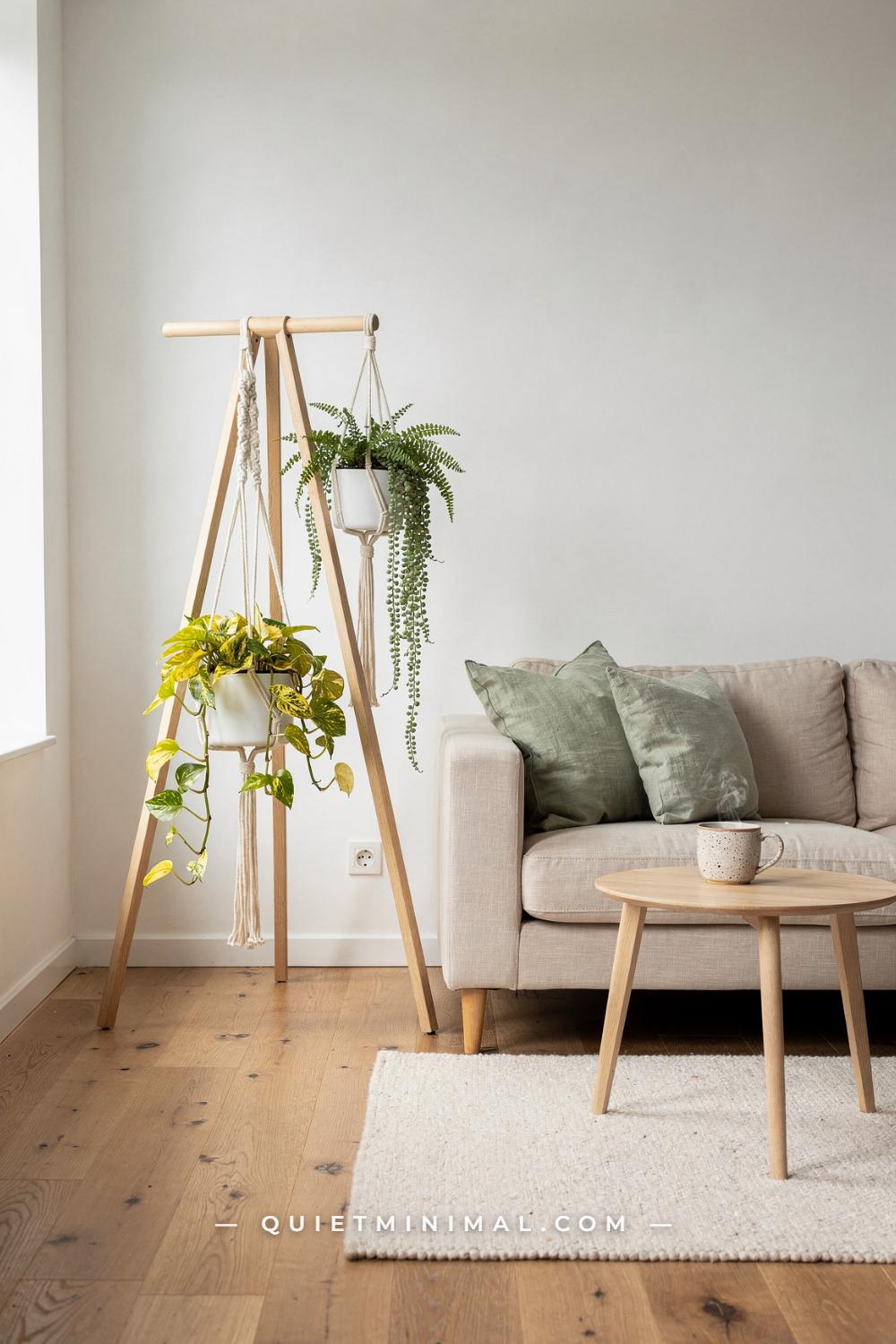
How to hang plants from the ceiling without drilling is really a question about weight. A tension rod, a curtain rod, a magnetic hook, an adhesive hook and a freestanding stand will all hold a plant, and each one has a number past which it lets go. The ten tips further down this page still work. What they never gave you is that number. This block sits above them as the renter’s load sheet: every no-drill method with what it is rated to hold, set against what a pot weighs once it is watered, then the light-fixture rule, the drop that clears a doorway and a deposit-safe checklist. One rule runs through all of it: plan on half the printed rating, and a third for magnets.
A Tension Rod Across a Window Alcove Is the Renter’s First Hanger
 Save
A window alcove is the easiest no-drill ceiling in a rental, because it hands you two solid side walls facing each other. Wedge a tension rod between them just under the top of the window and you have a hanging rail that leaves nothing behind but two faint pad marks.
The catch is the rating. A standard spring rod that spans 28 to 48 in (71 to 122 cm) is commonly rated about 5 lb (2.3 kg), so at half its rating it carries 2.5 lb (1.1 kg). That is one hanger with a 4 in (10 cm) pot or a mounted air plant, not the 6 in (15 cm) pot of pothos most people reach for, which weighs about 4 lb (1.8 kg) once watered. For two small pots, as in this alcove, step up to a heavy-duty short-span rod rated 25 lb (11.3 kg) and keep the pair under its 12.5 lb (5.7 kg) planning load.
Hang each pot 2 to 3 in (5 to 8 cm) in from the wall, where the rod is stiffest, and leave the middle open. Light trailers suit a rod best: string of pearls, pothos and hoya in terracotta or plastic, never glazed ceramic.
Key Takeaway: Use a heavy-duty rod for anything past one small pot, hang near the ends, and keep the total under half the printed rating.
From the guides
You've saved it, wanted it. Here's the how: codes, measurements, order. Your choices make it yours.
 The Japandi Honest PlaybookThe honest version of the style: what to keep, what to skip, and the order to do it in.See inside →
 The Room Refresh PlaybookA repeatable four-step method, room by room, in ten minutes, thirty minutes, or one weekend.See inside →
 Make Any Room Feel Cozy on PurposeWhy some rooms hold people and others empty out, and the moves that change it.See inside →

Every No-Drill Method by What It Holds, in Pounds
 Save
Every method below lists the printed rating first, then the planning load at half of it. Magnets get a third, because their rating is measured on thick bare steel. These are common listings at the time of writing; read the number on yours.
Adhesive ceiling hook: 0.5 lb (225 g). Plan on 0.25 lb (0.1 kg): an air plant, no soil.
Standard tension rod, 28 to 48 in: 5 lb (2.3 kg). Plan on 2.5 lb (1.1 kg).
Long tension rod, 54 to 90 in: 12 lb (5.4 kg). Plan on 6 lb (2.7 kg).
Heavy-duty tension rod, 24 to 40 in: 25 lb (11.3 kg). Plan on 12.5 lb (5.7 kg).
Ceiling curtain track already installed: about 11 lb (5 kg) per track. Plan on 5.5 lb (2.5 kg).
No-drill curtain brackets: up to 20 lb (9.1 kg). Plan on 10 lb (4.5 kg), curtains included.
Magnetic hook on a steel beam: 18 lb (8.2 kg) pull. Plan on 6 lb (2.7 kg).
Tension-pole tray: 3.3 to 15 lb (1.5 to 6.8 kg). Plan on 1.6 to 7.5 lb (0.7 to 3.4 kg).
Freestanding hanger stand: 22 lb (10 kg). Plan on 11 lb (5 kg).
Leaning ladder, per step: 11 to 44 lb (5 to 20 kg). Plan on 5.5 to 22 lb (2.5 to 10 kg).
Light fixture: 0 lb.
Key Takeaway: Halve every printed rating, take a third for magnets, and treat a light fixture as zero.
Floor-to-Ceiling Tension Poles Turn a Kitchen Into a Hanging Garden
 Save
A tension pole braces between floor and ceiling with a spring or a screw jack in its top section, so it stands where a rod cannot: in the open, away from any wall. In a kitchen that means the end of a run of counters or the strip of floor beside a window, with pots hung from its arms at two or three heights.
The rating that matters is per arm or tray, and it varies more than the poles look. Listings run from 3.3 lb (1.5 kg) a tray on light four-tier poles to 15 lb (6.8 kg) on a sturdier tray, with three-arm planter poles around 5 lb (2.3 kg) a tier. Halved, that is 1.6 to 7.5 lb (0.7 to 3.4 kg) per arm, enough for a 6 in (15 cm) glazed pot at 6 to 7 lb (2.7 to 3.2 kg) only on the strongest tray.
Stand the pole plumb on its rubber foot, set the top pad on flat drywall clear of the light fixture, and tighten until a firm twist will not turn it. Check it again after a week, once the pads settle. Load the heaviest pot lowest and keep cotton hangers away from the steam above the range.
Key Takeaway: Read the per-arm rating, halve it, and put the heaviest pot on the lowest arm.

What a Watered Pot Weighs at 6, 8 and 10 Inches, and What Holds It
 Save
A pot roughly doubles its dry weight when watered, so plan on the watered figure. Each line names the methods whose planning load clears it.
6 in (15 cm) plastic, 4 lb (1.8 kg): a heavy-duty tension rod, a ceiling track (5.5 lb), a magnetic hook (6 lb), a freestanding stand, the strongest pole tray (7.5 lb). Not a standard tension rod at 2.5 lb, and never an adhesive hook.
6 in glazed ceramic, 6 to 7 lb (2.7 to 3.2 kg): a heavy-duty tension rod, a freestanding stand, the strongest pole tray. It is too heavy for the magnet and the ceiling track.
8 in (20 cm) plastic, 8 lb (3.6 kg): a heavy-duty tension rod with nothing else on it (12.5 lb), a freestanding stand (11 lb), a ladder step on a solid pine ladder.
8 in glazed ceramic, 12 to 14 lb (5.4 to 6.4 kg): past every rod. A strap over a solid beam, a beam clamp, a sturdy ladder’s bottom step (22 lb).
10 in (25 cm) plastic, 13 lb (5.9 kg), up to 20 lb (9.1 kg) waterlogged, and 10 in glazed, about 18 lb (8.2 kg): a beam strap, a beam clamp, the ladder’s bottom step or the floor.
Key Takeaway: A 6 in plastic pot has the most no-drill homes, a long rod among them; a 10 in glazed pot has fewer, and none of them is a rod.

An Exposed Wood Beam Carries Plants on a Strap, Not a Screw
 Save
An exposed beam is the strongest no-drill point a rental can offer, as long as it is a real beam and there is a gap above it. Check both before you buy a single chain.
Many decorative beams are hollow: three-sided boxes of pine or molded polyurethane glued or nailed to the ceiling. Knock along it. A solid wood beam sounds dull and dense; a hollow one sounds like a drum. A hollow beam carries nothing. Then look at the top edge: if the beam sits tight to the ceiling, no strap can pass over it and this method is out.
On a solid beam with a gap, loop a wide canvas or webbing strap over the top and hang the chain from it. The strap spreads the load and keeps chain off the wood finish. Now the limit is the strap and chain, so read their ratings. A 48 x 8 in (122 x 20 cm) plank with four small watered terracotta pots comes to about 25 lb (11.3 kg). Split across two straps, each carries about 12.5 lb (5.7 kg), so each strap and chain needs a printed rating of at least 25 lb (11.3 kg).
Key Takeaway: Knock-test the beam, confirm the gap above it, and buy straps and chain rated at twice their share.

Why Adhesive Hooks Let Go on a Ceiling: Shear, Peel, Heat and Damp
 Save
Adhesive hooks are the first thing renters try overhead and the method that fails most.
Direction: on a wall the load slides along the strip, which is how wall hooks are rated. On a ceiling the load pulls straight off it, so a wall rating does not carry over.
Peel: every time you water, the pot swings and lifts one edge of the strip. A peel starts at an edge and runs.
Heat: warm air collects at the ceiling, and the strips are only meant to be applied between 50 and 104 F (10 and 40 C).
Damp: kitchen and bathroom steam softens the foam from the edges in.
Texture and paint: the maker says not for popcorn or heavily textured ceilings, and fresh paint needs weeks to cure first.
The rating: the best-known brand’s own ceiling hook is rated 0.5 lb (225 g), for paper lanterns. At half, that is 0.25 lb (0.1 kg).
The honest limit: an air plant in a wire cradle or a dried arrangement. Nothing with soil, and nothing you water in place.
Key Takeaway: Keep adhesive overhead for air plants under 0.25 lb (0.1 kg) and never hang a watered pot from a strip.

The Hook Already in the Ceiling: Test It Before You Trust It
 Save
Plenty of rentals come with a hook already in the ceiling, left by a previous tenant’s plant or an old swag lamp. It costs you no hole, but you have no idea what it is screwed into: a joist, a toggle in drywall, or plaster alone.
So test it before a plant goes anywhere near it. Hang twice the watered weight of the pot you plan to use and leave it overnight. A gallon of water weighs about 8.3 lb (3.8 kg), so two full gallon jugs in a tote come to about 16.6 lb (7.5 kg), the test for an 8 in (20 cm) plastic pot at 8 lb (3.6 kg). In the morning the hook should sit exactly where it was: no tilt, no gap at its base, no hairline crack in the paint around it.
Even a hook that passes stays at that 8 in plastic pot unless you know it is in a joist. Use a closed S hook or one with a latch so a swing cannot lift the hanger off, and never unscrew or replace the hook yourself: that turns it into a drilling job.
Key Takeaway: Load an existing hook with twice the watered weight overnight, and cap it at an 8 in (20 cm) plastic pot even when it passes.

Tension Rod Sizing: Span, Tube and Pounds per Hanger
 Save
A tension rod holds by friction at its two end pads, so the span you buy for decides most of what it can carry. Three common ranges, with listed ratings at the time of writing:
Heavy-duty, 24 to 40 in (61 to 102 cm): rated 25 lb (11.3 kg). Plan on 12.5 lb (5.7 kg): up to three 6 in (15 cm) plastic pots at 4 lb (1.8 kg) each.
Standard, 28 to 48 in (71 to 122 cm): rated 5 lb (2.3 kg). Plan on 2.5 lb (1.1 kg): one hanger. This is where the familiar 2 to 3 lb (1 to 1.4 kg) per hanger comes from.
Long, 54 to 90 in (137 to 229 cm): rated 12 lb (5.4 kg). Plan on 6 lb (2.7 kg): one 6 in plastic pot, near an end.
Four rules move a rod to the top of its rating. Buy the range that puts your span in its shorter half, so the spring is pressed harder. Choose rubber end pads 1.5 in (3.8 cm) across or wider. Pick the thicker tube when a range comes in two weights, since a thin tube bows at the center long before the pads slip. Space hangers at least 8 in (20 cm) apart.
Key Takeaway: Measure the span, buy the rod whose range it sits low in, and plan on half the rating.

Hanging Plants From a Curtain Rod Without Bowing It
 Save
The curtain rod is a rental’s widest ready-made hanging rail, and it is the one renters overload most, because it already looks sturdy.
Start with what is already on it. Two unlined linen panels like these weigh roughly 2 to 4 lb (0.9 to 1.8 kg) together; lined blackout panels weigh far more. The plants come second, and they go where the rod is stiffest, a few inches inside each bracket, never in the middle of a span. A rod bows at the center of its longest unsupported stretch, and a center bracket like the one here halves that stretch.
On brackets the landlord screwed in, with a center support, two 6 in (15 cm) plastic pots at 4 lb (1.8 kg) each, 8 lb (3.6 kg) together, is the sensible ceiling over light curtains. On no-drill brackets tapped into the window frame, rated about 20 lb (9.1 kg), the 10 lb (4.5 kg) planning load covers the curtains and one pot.
In a bedroom, keep plants at the window and never over the bed: a dripping saucer or a slipped hanger lands where you sleep.
Key Takeaway: Count the curtains first, hang pots beside the brackets, and keep a no-drill rod to one pot.
Curtain Rod Load Rules: Spans, Brackets and Pots per Foot
 Save
Seven rules keep a curtain rod straight with plants on it. Check them in this order.
Span: no more than 30 to 36 in (76 to 91 cm) of rod between supports.
Center supports: a window wider than 60 in (152 cm) needs two.
Density: one pot per 12 in (30 cm) of rod at most, and no more than two pots in any one span.
Position: every pot within 6 in (15 cm) of a bracket, never at mid-span and never on a finial, which unscrews.
Total load: curtains plus watered plants under half the bracket rating. On no-drill brackets rated 20 lb (9.1 kg), that is 10 lb (4.5 kg) all in.
Fabric clearance: each pot hangs at least 2 in (5 cm) clear of the curtain, so drips miss the linen. Take pots to the sink to water.
Bow check: after the first watering, sight along the rod. If its center has dropped 1/4 in (6 mm) or more, take a pot off.
On a 72 in (183 cm) window with two center supports, that is three 24 in (61 cm) spans and four pots at most, if the brackets allow the weight.
Key Takeaway: Keep spans to 36 in (91 cm), pots beside brackets, one per foot, and the total under half the rating.

Magnetic Hooks and Beam Clamps on an Exposed Steel Beam
 Save
A painted steel beam in a loft or a basement is the one ceiling where a magnet is the right tool, because a hook stuck to its underside pulls straight down, the direction magnets hold best.
The rating still needs reading down. A common swivel hook magnet is listed at 18 lb (8.2 kg) of pull, measured on a metal ceiling. That figure comes from thick bare steel. Paint, rust and the slightest gap all cut the grip, and a sideways shove, the kind a watering can gives, drops it to roughly half. Plan on a third, 6 lb (2.7 kg): one 6 in (15 cm) plastic pot at 4 lb (1.8 kg) per magnet, as here.
Test the metal first with a fridge magnet. Aluminum will not hold, and some stainless barely does. Skip ductwork entirely: it is thin sheet metal hung on straps and was never meant to carry a load.
For anything heavier, a beam clamp grips the flange with a set screw and no drilling. Small clamps are rated around 400 lb (181 kg), so the hook and hanger become the limit. Ask the landlord first, since the screw marks the paint.
Key Takeaway: Plan a magnet at a third of its pull rating, keep it to steel beams, and move to a beam clamp for heavier pots.

The Light-Fixture Rule, and the Pipes You Never Hang From
 Save
The legacy tips below suggest an S hook on a light fixture. Here is the rule that goes with it, and the other ceiling points that stay off limits.
The fixture itself: 0 lb. Its arms, chain, shade and canopy screws are sized for the fixture alone. Add a watered pot and the canopy pulls away from the ceiling.
A standard lighting box: code requires it to carry a 50 lb (23 kg) fixture, but that capacity belongs to the fixture, and you cannot see what the box is fixed to.
A fan-rated box: listed and marked by its maker for fan support, up to 70 lb (32 kg). It is the only electrical box that can carry a plant, and only once an electrician has taken the fixture down, with the landlord’s written consent. With the power off at the breaker, you can look for the marking; the swap is not a renter’s job.
Sprinkler pipes and heads: never. Fire codes forbid hanging anything from them.
Gas, water and drain pipes, and electrical conduit: never.
Ductwork: never.
Smoke alarms and ceiling fans: never.
Key Takeaway: Treat every light fixture and pipe as a 0 lb point, and leave fan-rated boxes to an electrician and the landlord.

Freestanding Hanger Stands and Leaning Plant Ladders, Fixed to Nothing
 Save
A freestanding stand is the only method here that touches neither ceiling nor wall, which makes it the safest bet for a lease that forbids anything stuck to the paint.
A common 43 in (109 cm) steel hanger stand is rated 22 lb (10 kg) and takes baskets up to 14 in (36 cm) across. At half, 11 lb (5 kg): one 8 in (20 cm) plastic pot at 8 lb (3.6 kg), or a lined seagrass basket of fern like this one. The real limit is tipping. Keep the basket hanging over the base rather than out past it, and stand the base on a hard floor or a low rug, never deep pile.
A leaning ladder shelf carries the most weight of any no-drill method, step by step. Listings run 11 lb (5 kg) per shelf for MDF up to 44 lb (20 kg) for solid pine, so plan on 5.5 to 22 lb (2.5 to 10 kg). Load it like a ladder: the heaviest pot on the bottom board, the lightest at the top. A leaning ladder is not fixed to the wall, so a heavy top makes it tip forward. Put a rug gripper under each foot.
Key Takeaway: Keep a stand’s pot inside its base, and load a leaning ladder heavy at the bottom and light at the top.

The Drop Length That Clears a 6 ft 8 in Walkway
 Save
Anywhere people walk, the bottom of the pot, trailing vines included, has to clear 6 ft 8 in (203 cm), the height of a standard door. The arithmetic is simple: ceiling height minus 80 in (203 cm) is all the room you have for the hook, the hanger and the pot.
8 ft (244 cm) ceiling: 16 in (41 cm). A 2 in (5 cm) hook, an 8 in (20 cm) hanger and a 6 in (15 cm) pot use all of it.
9 ft (274 cm) ceiling: 28 in (71 cm). Room for a 16 in (41 cm) macrame hanger with a 10 in (25 cm) pot.
10 ft (305 cm) ceiling: 40 in (102 cm). Room for a long hanger and a full trailing plant.
Measure to the lowest leaf, not the base, and trim trailers back to the line. The hook or rod height sets the start, so on a tension rod or curtain rod measure from the rod, not the ceiling. And off the walkway, above a window seat, a dresser or a sofa arm, the 80 in line does not apply: hang to where the pot looks and waters best.
Mark 80 in (203 cm) on the wall with a strip of painter’s tape before you cut any hanger.
Key Takeaway: Subtract 80 in (203 cm) from the hanging point, and fit hook, hanger, pot and leaves inside what is left.

Slanted, Vaulted and Corner Ceilings, Plus the Bedroom, Without a Hole
 Save
Five ceilings come up again and again with this question. Here is the no-drill answer for each.
From the guides
You've saved it, wanted it. Here's the how: codes, measurements, order. Your choices make it yours.
The Japandi Honest PlaybookThe honest version of the style: what to keep, what to skip, and the order to do it in.See inside →The Room Refresh PlaybookA repeatable four-step method, room by room, in ten minutes, thirty minutes, or one weekend.See inside →Make Any Room Feel Cozy on PurposeWhy some rooms hold people and others empty out, and the moves that change it.See inside →Corner: the best home for a tension pole, as here. The two walls frame it and the trays turn into the light. Set the pole 6 in (15 cm) off each wall so the trays can rotate, and halve each tray’s rating as before.
Slanted ceiling: a pole needs a flat top. On a slope its pad slides downhill, so use one only if its listing shows a pivoting ceiling cap, and set it at the low end. Otherwise use the window’s tension rod or a freestanding stand.
Vaulted ceiling: most poles stop well short of the ridge, so read the maximum height before you buy. In practice the window’s curtain rod and a tall stand do this job.
Bedroom: nothing over the bed, on any method. Plants go on the window’s rod or a stand at the foot of the bed.
Ceiling curtain track: an installed ceiling track carries about 11 lb (5 kg) per run. Plan on 5.5 lb (2.5 kg): one 6 in (15 cm) plastic pot on the end glider, with light sheers.
Key Takeaway: Corners take a pole, slopes and vaults take a rod or a stand, and no plant hangs over a bed.

The Deposit-Safe Checklist: What Leaves a Mark and How to Remove It
 Save
No-drill does not mean no-mark. Each method leaves its own trace, and each has a fix.
Before anything: photograph the ceiling, the alcove walls and every bracket on the day you hang. That is your move-out evidence.
Adhesive strips: a strip yanked outward tears the paint. Pull the tab slowly, straight down along the surface, stretching it up to 15 in (38 cm). If it sticks, warm it with a hair dryer for 30 seconds, then saw behind it with dental floss. Lift residue with a plastic card and a damp cloth.
Tension rod and pole pads: rubber leaves gray rings, and an overtightened pole dents a drywall ceiling. Wipe rings with a damp microfiber cloth, and stop tightening at snug.
Magnetic hooks: sliding one scratches the paint on a beam. Lift it straight off.
Drips: water rings on floors and sills come from watering in place. Take pots to the sink and let them drain 10 minutes.
Curtain rods: after the plants come down, check that every bracket screw is still tight, and report a loose one rather than refilling it yourself.
Existing hooks: leave them exactly as you found them.
Key Takeaway: Photograph on day one, peel strips slowly downward, stop poles at snug, and water at the sink.
The original ideas from this article continue below.
Here’s a complete guide on how to hang plants from the ceiling. (All without drilling or doing any permanent damage!)
 Save
Hanging plants from the ceiling is an innovative (and trendy) way to display your plants.
You might have a small home and want to make the most of your space. Or maybe you’re an avid gardener, and all your surfaces are already covered in plants.
And when you hang plants on the wall or ceiling, it keeps them out of the way of kids or pets.
Whatever the reason, hanging plants from the ceiling is a clever trick. You get all the benefits of house plants by bringing nature inside. So, your home will look gorgeous!
But you need to know how to hang plants from the ceiling safely. And you don’t want the hassle or mess of drilling into your ceiling. It might even be against your tenancy agreement.
You should make sure that your plants are securely fastened. Plus, you’ll need to ensure that the materials you use are strong enough to support their weight.
This guide will share tons of hanging plants ideas. And I’ll give you my tips on how to hang plants from the ceiling without making holes or dilling!
10 Tips for Hanging Plants from the Ceiling
Here are some simple tips and ideas for how to hang plants without drilling holes. They’re suitable for an apartment or house, no matter how small or big.
So, browse through and see which ideas would work for your home!
Choose Your Plants Wisely
 Save
Before you start planning how to hang your plants, let’s take a step back.
First of all, you should think about which types of plants you want to have in your home.
If you do your research, you’ll set yourself up for success. You should look into what kind of light and care the plants will need.
Then, you can decide where to place them. And your plants should flourish as a result.
Some of the best hanging plants are succulents, strings of pearls, and creeping figs. Lipstick plants also look amazing in-ceiling plant hangers. Smaller cacti are another great choice.
If you’re new to plant care, don’t be too ambitious. Start with hardy plants that aren’t too sensitive to their environment. Then, you can add in more sensitive plants as you get more experience in plant care.
Find the Right Container for Your Plants
 Save
Once you’ve decided what kind of plants you’ll have, it’s time to find containers for them.
There are lots of different options out there. But make sure you think carefully!
The containers you’ll use will greatly impact how easy it is to hang your plants.
Lightweight options are best for hanging plants. You could go for baskets made from natural materials like straw or wicker. These look amazing, especially if you’re into boho chic.
Plastic is another material that could work, as it doesn’t tend to weigh a lot. Or, you could opt for lighter terracotta pots – but avoid anything too heavy, such as thick ceramic plant pots.
When choosing containers for hanging plants, drainage holes are another factor to consider.
You don’t want your plant leaking all over your carpet or fancy furniture. So, you’re better off going for pots without draining holes, just in case you overwater them.
Use S Hooks to Hang Plants from a Light Fixture
 Save
Let’s start with some different ways to hang plants indoors (with drilling or nails!).
Firstly, you could try using S-hooks. These handy little hooks are convenient and easy to use. You can hang them from a rail, a bar, or even from things around your home.
Another idea is to check whether you have any protruding ledges on your walls or around your windows. If you do, that’s a great place to hang a plant using an S-hook – no nails or drilling necessary!
For example, you could hook an S-hook over a light fixture. It would work with a standing lamp or a light fixture on the wall. I’m sure there are many other places you can come up with to hang your plants using S-hooks.
 Save
And because S-hooks are small, you can hang as many as you like next to each other. If you vary the height of your plants, you can fit more than ever. And you’ll have a gorgeous display of your hanging plants.
As always, make sure you keep the weight in mind. You don’t want to pull down the entire rail or light fixture.
Create Macrame Hangers for Your Plants
 Save
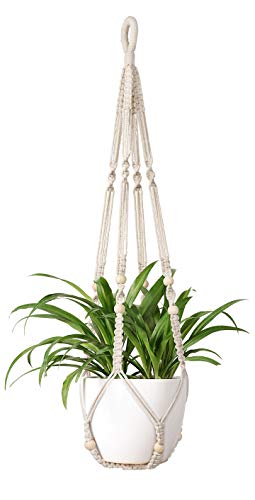
Macrame hangers are all the rage right now. And the best part is that you can make them yourself.
It’s both a mindful hobby and very useful. Because when you make your own plant hangers, you can save yourself some cash, too!
 Save
Creating a macrame hanger involves making several simple knots. You can follow along with this video tutorial to find out how to make your own:
Then, you can hang your macrame hanger off any available hook or handy place in your home.
Use Magnets to Hang Your Plants
 Save
You might never have considered using magnets to hang your plants. But if you live in a converted industrial building, this option is ideal. It’s simple, effective, and very low-cost.
Using magnets will work best if your apartment has metal beams running through it. Then, all you’ll need to add are some heavy-duty magnets.
You’d be surprised at how much weight these magnets can hold. But for safety reasons, you should test out how much weight each magnet can support.
Make sure you don’t hang anything too heavy. It’s better to be on the safe side and opt for smaller, lightweight plants.
This innovative way to hang plants invites nature into your modern, industrial flat. So, you’ll get a nice contrast between the organic and man-made elements.
Hang Plants from Your Curtain Rod
 Save
If you have curtains hanging around your home, you can put the curtain rod to double purpose.
All you need to do is hang your plants along the rod, and ta-da! You have a new place to display your beautiful plants.
But do beware! If you hang too many plants on your curtain rod, you may struggle to close your curtains. So, it all comes down to your priorities.
Make sure that you don’t overload the curtain rod, either. Lightweight plants like small trailing plants and miniature succulents work best.
Create a Hanging Plant Shelf
 Save
Another stylish yet practical way to hang your plants is by creating a hanging plant shelf.
It’s a perfect solution if you’ve run out of places for your plants. This way, you can create a new surface for them without taking up any more floor space.
If you hang your plant shelf in front of a window, they get all the sunlight. And it looks amazing, adding real style and flair to your home.
You could make your own shelf from any wood you can find or buy one ready-made.
As for how to hang it from the ceiling, you’ll need to attach eye bolts to the shelf. Then, you can use chains or cables to hang it from sturdy hooks in the ceiling.
You can find indoor plant hooks for varying weights. So, make sure you check how much weight the hooks can support before you buy them.
The benefit of a hanging plant shelf is that you can have several different plants together. That allows you to mix and match the plants and create a gorgeous look.
Hang Plants from Coat Stands or Hooks
 Save
If you don’t want to do any DIY, a shortcut for hanging plants is to use a coat stand. It’s a quick and easy way to add more greenery to your home.
As most coat stands have several hooks at varying heights, you can have a lot of fun with it. It’s a great way to hang lots of plants together. You can get creative and play around to see where the plants will look best.
 Save
Another idea is to use a ladder to hang plants from. That can look very rustic and on-trend. You’ll just want to make sure that it’s secured to the wall so it doesn’t all topple over.
Or, you could attach coat hooks to the wall (or maybe you already have some).
Put your jackets in the wardrobe, and use these hooks for plants instead. Then, you’ll see them as soon as you come in the door.
There’s no reason why you can’t have plants in every room of your home – even your entryway!
Hang Plants from Exposed Beams in the Roof
 Save
If you’re lucky enough to have a home with exposed beams or wood in the ceiling, you can hang plants from them.
All you need to do is add a sturdy hook or nail. You could even hang plants from each side of the beam, varying the height and type of plants.
It’s a smart way to use the built-in features of your home to bring in more greenery. It also adds a lot of texture and detail when you have plants at different levels around the room.
You could experiment with grouping plants together for an eclectic and luscious look!
Hang Plants from Wooden Slats in Your Balcony or Garden
 Save
Now, you’ve got loads of ideas for hanging plants indoors. But don’t neglect your outdoor spaces, either!
You could build a pergola to give you even more room to hang plants. That will provide you with limitless potential for hanging plants on your balcony.
So, you could create a real jungle! If you’re considering DIYing a pergola, check out this video on how to build a pergola from scratch:
 Save
The Wrap Up
Now, you should have loads of inspiration for how to hang plants in an apartment or small home.
Let me know which of these ideas for how to hang a plant without nails appeals most to you! And if you try it in your home, I’d love to hear how it goes.
Follow Quiet Minimal on Pinterest for more interior design and minimalist home tips!
From the guides
You've saved it, wanted it. Here's the how: codes, measurements, order. Your choices make it yours.
The Japandi Honest PlaybookThe honest version of the style: what to keep, what to skip, and the order to do it in.See inside →The Room Refresh PlaybookA repeatable four-step method, room by room, in ten minutes, thirty minutes, or one weekend.See inside →Make Any Room Feel Cozy on PurposeWhy some rooms hold people and others empty out, and the moves that change it.See inside → Save


